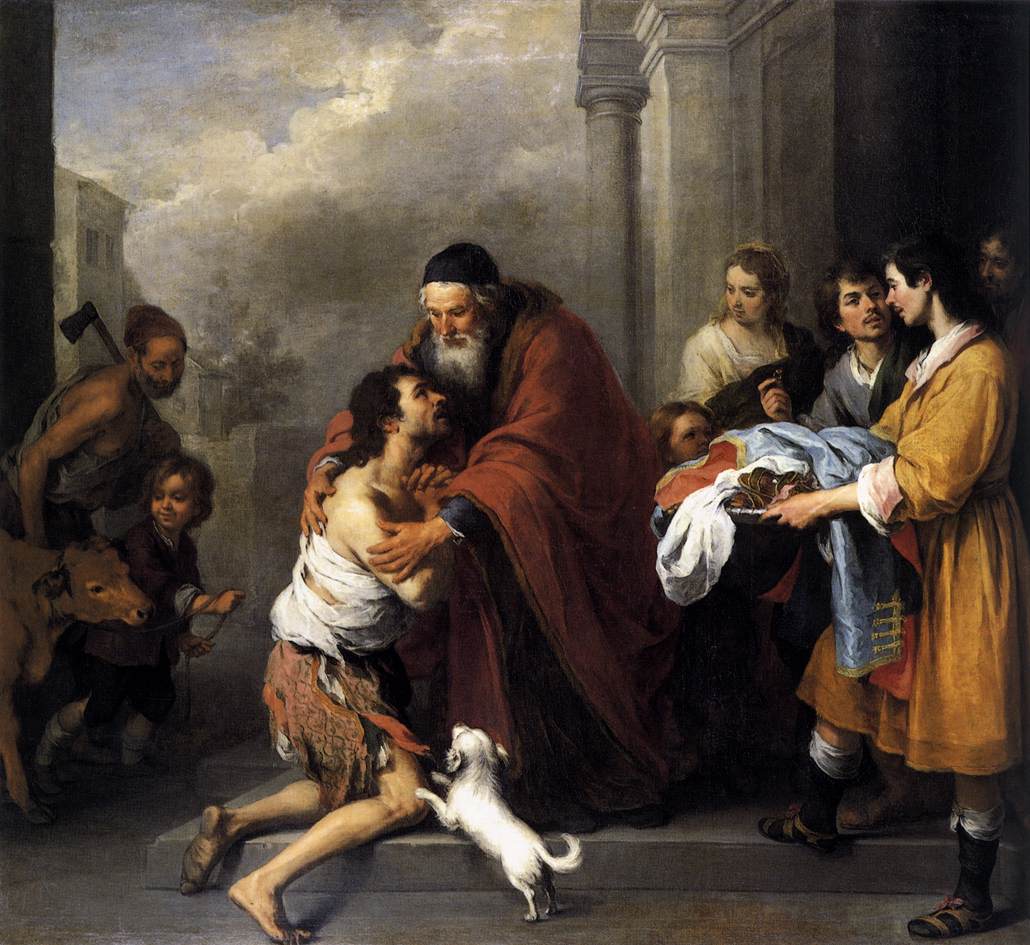
Image source: wikiart.org
Context and subject of “Return of the Prodigal Son”
“Return of the Prodigal Son” by Bartolome Esteban Murillo, painted around 1670, visualizes one of the most beloved parables from the Gospel of Luke. The story tells of a younger son who squanders his inheritance in a distant land, falls into misery, and finally decides to return home, ready to ask his father to take him back as a servant. Instead of punishment, he receives an embrace, new clothes, a ring, and a feast.
Murillo belonged to the Spanish Baroque, and he spent most of his working life in Seville. His art is deeply shaped by Counter-Reformation spirituality, which favored images that were emotionally direct, doctrinally clear, and full of compassionate feeling. This painting fits that ideal perfectly. It is not a distant religious allegory. It is a human drama, set in a world that feels tangible and close, full of familiar objects, animals, and people who react in individual ways to the prodigal son’s return.
The parable also had a special resonance in seventeenth century Spain, where charity, repentance, and forgiveness were central themes in sermons and religious confraternities. Murillo’s image becomes more than illustration. It is a visual meditation on mercy, a lesson in how divine forgiveness might look when translated into human gesture and daily life.
Composition and first impression
At first glance, the eye goes straight to the intimate moment at the center. The father, wrapped in a heavy red cloak, bends over his kneeling son in a sweeping embrace. The son, half clothed in a torn shirt and ragged skirt of fabric, collapses against him with folded hands and an uplifted face. Their interlocked forms create a strong vertical axis in the middle of the painting, stabilizing the otherwise busy scene.
Murillo arranges the figures in a broad triangle. The base of this triangle starts at the barefoot prodigal son on the left and extends to the servant carrying fine garments on the right. The apex of the triangle is the father’s head. This triangular structure gives the composition balance and directs attention toward the father’s gesture, which is the emotional core of the painting.
Around this central encounter, the painter builds a small stage of reactions. To the right, a young servant steps forward with a bundle of rich clothing, a cloak of deep blue and red embroidered garments. Behind him, other family members lean in, their faces lit with curiosity, surprise, and tenderness. On the left, a laborer leads a calf, ready for the celebratory feast. A child glances up at the animal while a tiny white dog jumps eagerly at the prodigal’s legs, visually echoing the joy of reunion.
Architecture frames the drama. A tall column and the façade of a stately building rise on the right, suggesting a substantial household with a sense of permanence and authority. On the left, distant buildings and a muted sky open the space, placing the event in a larger world. The setting is not a specific biblical landscape but a Spanish-inflected environment that Murillo’s viewers would recognize.
Light, color and atmosphere
Murillo’s use of light is central to the emotional impact of the painting. A soft, diffused radiance falls from the upper left, bathing the father and son in a warm glow. The light wraps around their faces and hands, and it spills onto the white shirt and pale skin of the prodigal, making their contact even more visible. Shadows are gentle rather than harsh, but they deepen toward the edges of the scene, guiding the eye back to the central embrace.
Color ties the narrative together. The father’s cloak is an intense, brick red that immediately marks him as the figure of authority and love. This red is echoed in smaller accents throughout the painting: in the clothing of the servant at the far right, in hints of fabric around other figures, and even in the repeating tones of the distant architecture. These subtle echoes kindle a visual rhythm across the canvas.
The prodigal son’s clothing, in contrast, is muted and dirty. His exposed skin is lit with a fragile paleness that reinforces his vulnerability. His nearly white cloth binds him visually to the small dog, to the light stone steps, and to the sky above, creating a chain of pale notes that keeps him from visually disappearing into the darker surroundings.
Murillo favors a gentle, earthy palette of browns, greys, soft blues, and gold-tinged clouds. The sky is dramatically cloudy but not stormy. Instead it feels like a moment of calm after a long journey, a visual metaphor for spiritual peace after turmoil. The overall atmosphere is tender and contemplative rather than theatrical, even though the story he paints is charged with narrative tension.
Gesture, expression and emotion
Murillo excels at storytelling through body language. Every figure in “Return of the Prodigal Son” participates in the emotional narrative with expressive gestures and poses.
The father’s posture is the key. He leans forward, arms open, enveloping his son. His hands rest gently but firmly on the young man’s shoulders and back, pulling him upward rather than pushing him away. His face bends close, not in stern judgment but in concern and relief. The rounded curve of his back and arms forms a protective shell around the prodigal, visually embodying the idea of shelter and acceptance.
The prodigal son is shown kneeling on the steps, barefoot and dirty. His torn clothing hangs loosely from his body, revealing thin legs and a bare, scarred back. One foot is extended behind him, toes curling on the stone, as if he has just collapsed in front of his father. His hands cross over his chest in a classic gesture of humility and supplication, yet his head is lifted toward his father’s face. This mixture of shame and hope makes his figure deeply sympathetic.
The surrounding figures provide a range of emotional responses. A young woman behind the father looks at the prodigal with a mixture of compassion and curiosity. A young man holds out the robe and ring that will restore the son’s honor, his body turned toward the father, his face intent on the unfolding scene. A small child peeks from behind, half hidden, wanting to see but unsure how to react. On the far left, the older servant leading the calf glances toward the main group, while the boy by his side looks excited.
Even the animals participate: the little dog jumping on the prodigal’s leg seems to recognize its master instantly, tail wagging in pure joy. This detail adds a touch of everyday reality and emphasizes the idea that the home he left has been waiting for him in many subtle ways.
Symbolism and theological meaning
The biblical parable is rich in symbolism, and Murillo weaves many of these symbolic elements into his composition.
The father represents God’s mercy, and Murillo emphasizes this through visual cues. His red cloak suggests both authority and love. His embrace is unconditional; the son has not yet had time to give a full confession or explanation. The painting captures the moment when forgiveness is granted before words, a powerful image for viewers steeped in Christian ideas of grace.
The prodigal’s bare feet and torn clothing signify his moral and material ruin. He is literally stripped of dignity. Yet the white cloth around his waist hints at cleansing and renewal. The object carried by the servant to the right, likely the “best robe” mentioned in the gospel, symbolizes restoration of status. The small chest or bundle may contain the ring and sandals that will mark him again as a son rather than a servant.
The fattened calf on the left, led by a servant and followed by a child, foreshadows the feast that will celebrate his return. It speaks to the community dimension of forgiveness: the father’s joy will overflow into a shared meal, turning private reconciliation into a public event.
Architecture also carries meaning. The sturdy columns and grand entrance evoke a stable, permanent household, an image of God’s enduring home. By placing the encounter on the threshold, Murillo underscores the idea of crossing from exile back into belonging. The steps where the prodigal kneels are a literal and symbolic meeting point between the outside world and the father’s house.
Even the sky contributes to the spiritual message. The clouds are open and high, suggesting the infinite space of divine mercy. While there are no overt heavenly apparitions here, the light itself feels sacred, as if heaven quietly endorses what is happening on earth.
Murillo’s style and the Spanish Baroque context
“Return of the Prodigal Son” shows many hallmarks of Murillo’s mature style. Compared with some of his earlier, more sharply defined works, this painting displays a softer, more atmospheric approach. Contours are slightly blurred, transitions are smooth, and surfaces have a luminous quality. This softness serves the emotional content: it makes the scene feel gentle and accessible.
Murillo was deeply influenced by Italian painters such as Correggio and by the warm chiaroscuro of the Venetian school, but he filtered these influences through his own Sevillian sensibility. His figures have a particular sweetness of expression, an understated grace that avoids the extremes of drama found in some other Baroque artists. In this work, the drama is contained in the inner emotional transformation rather than in violent movement or harsh contrasts.
Spanish Baroque art often emphasized realism and the presence of ordinary people. Murillo brings that realism into biblical stories by giving his characters faces and bodies that could belong to his own contemporaries. The prodigal son looks like a young Sevillian laborer, and the servants and children are drawn from everyday life. This approach made religious narratives feel close to Murillo’s audience, encouraging viewers to identify with the figures and to see themselves in the role of the prodigal, the father, or the onlookers.
At the same time, the painting retains a certain elegance. The draperies are finely handled, especially the father’s red cloak and the shimmering fabrics carried by the servant. Murillo had a keen eye for texture: the roughness of the prodigal’s tattered garment, the smooth fur of the dog, the worn stone steps, and the soft folds of the rich fabrics all contribute to the sensory richness of the scene.
Emotional and spiritual resonance today
Although “Return of the Prodigal Son” was created in seventeenth century Spain, its emotional power continues to resonate strongly with modern viewers. Themes of failure, regret, and longing for home are universal. Murillo’s interpretation invites the viewer to step into the story, not as a distant observer, but as someone who knows what it means to be lost and to hope for acceptance.
One of the striking aspects of the painting is how nonjudgmental it feels. The prodigal’s poverty and shame are clear, but Murillo does not dwell on his sins. Instead, he dwells on the father’s compassion. The old man’s arms are already wrapped around his son before the household has even had time to react. The crowd behind them is secondary. The painting quietly suggests that mercy can move faster than social opinions.
The work also explores reconciliation across generations. The father is old, the son still young. Their embrace bridges a gap that might otherwise remain unhealed. The presence of younger children, servants, and animals shows that this reconciliation will affect the entire household. Forgiveness is not just a private emotional experience; it reshapes relationships and community life.
For viewers who approach the painting from a nonreligious perspective, it still offers a powerful meditation on empathy. The gentle way Murillo paints the father’s hands, the tired but hopeful expression on the prodigal’s face, and the curious, sympathetic glances of the onlookers all model ways of responding to another person’s vulnerability.
In the context of Murillo’s wider work, “Return of the Prodigal Son” stands as a synthesis of his strengths: his ability to tell a biblical story with emotional clarity, his gift for painting tender human relationships, and his talent for creating light-filled atmospheres that feel both realistic and spiritual.
Conclusion
“Return of the Prodigal Son” by Bartolome Esteban Murillo is more than a simple religious illustration. It is a fully realized human drama rendered with warmth, subtlety, and technical mastery. Through composition, light, gesture, and symbolism, Murillo expresses the heart of the parable: unconditional love that meets repentance with open arms.
The painting’s carefully arranged figures lead the eye to the embrace between father and son, while the surrounding servants, children, and animals enrich the narrative with layers of everyday reality. Soft light and harmonious color create a mood of tenderness, reinforcing the message that mercy is gentle rather than harsh.
Seen today, the work continues to speak about forgiveness, homecoming, and the possibility of new beginnings. Whether approached as a devotional image or as a masterpiece of Baroque painting, Murillo’s “Return of the Prodigal Son” invites the viewer to consider how compassion might look in their own life and relationships.
