Image source: wikiart.org
Introduction to Isaac Blessing Jacob
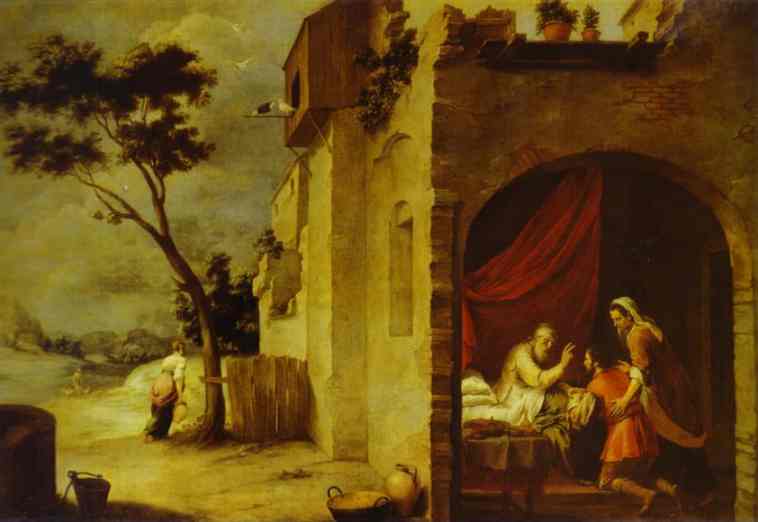
“Isaac Blessing Jacob,” painted by Bartolomé Esteban Murillo around 1670, brings one of the most dramatic scenes from the Book of Genesis into the intimate visual language of the Spanish Baroque. The painting shows the precise moment when the blind patriarch Isaac unknowingly bestows his paternal blessing on Jacob, who has disguised himself as his elder brother Esau with the help of his mother Rebekah.
Murillo is celebrated for his warm light, compassionate figure style, and narrative sensitivity. All of these qualities are present here. The scene becomes more than an illustration of a biblical trick: it is a meditation on family, destiny, and the mysterious ways in which divine plans unfold through human weakness.
The composition is unusual and clever. The drama of the blessing takes place in a darkened room on the right, framed by a stone archway and red curtain. On the left, in a contrasting outdoor landscape, Esau approaches the house, unaware that the blessing he expects has already been stolen. Murillo allows us to see both halves of the story at once, inviting reflection on truth, deception, and the irreversible passage of time.
The Biblical Story Behind the Painting
The subject comes from Genesis 27. Isaac, old and nearly blind, wishes to grant his solemn blessing to his eldest son Esau. He sends Esau to hunt and prepare a favorite dish, promising that after the meal he will pronounce the blessing. Rebekah overhears and quickly plots to secure this blessing for Jacob, the younger son, whom she prefers and whom God has already destined to continue the covenant.
Rebekah dresses Jacob in Esau’s garments and covers his smooth hands and neck with goat skins so that he will feel like his hairy brother. Jacob brings a meal prepared from a young goat to his father. Suspicious, Isaac tests him with questions and touch, then finally yields and blesses him, giving him inheritance and supremacy. Only afterward does Esau return, too late, and the full tragedy of the deception becomes clear.
Murillo chooses the climactic instant when Jacob kneels before the bed, Isaac extends his hand in blessing, and Rebekah looks on tensely. Outside, Esau approaches with his hunted game. The painting thus holds together two times, the moment of deception and the approaching moment of discovery.
Composition and Spatial Drama
The canvas is divided into two main zones: an interior on the right and an exterior on the left. This division is not rigid, however. The building forms a vertical band that anchors the center, acting as a hinge between the two spaces.
Inside the house, Murillo frames the bedroom with a dark arch. Within this arch a rich red curtain falls diagonally behind the bed, echoing the tension of the drama. Isaac lies propped up on pillows toward the edge of the bed, one arm extended in blessing. Jacob kneels before him, leaning forward with humility, his hands outstretched. Rebekah stands just behind Jacob, one hand on his shoulder, her body bent toward him as if urging him forward.
The outdoor section is quieter but heavy with foreboding. A path leads from the left foreground toward the house. Esau, dressed in pale clothing and carrying a game bird on his shoulder, walks toward us and toward the door. A tree leans slightly, echoing his movement. The sky is filled with shifting clouds, suggesting an unsettled atmosphere.
Murillo uses this two part structure to create narrative suspense. The viewer sees what Isaac cannot. We also know that Esau is coming. The static architecture between these two spaces suggests a barrier that cannot prevent the inevitable conflict.
Light and Color as Narrative Tools
Light plays a crucial role in guiding our understanding of the scene. The brightest area is the interior space around Isaac, Jacob, and Rebekah. A warm, golden light falls from above and slightly to the left, catching the folds of the red curtain, the pale linen sheets, and the figures’ clothing and skin. This illumination focuses attention on the act of blessing itself.
The outdoor area is lit more softly, with cooler tones. The sky is a muted mix of blues and grays, and the distant landscape dissolves into haze. Esau stands in a pool of gentle light that separates him from the dark foreground elements, but he is still noticeably less bright than the figures inside the house. This subtle contrast suggests that the decisive event is happening elsewhere, while Esau remains literally and symbolically in the dark.
Red is used strategically. The curtain behind Isaac is a deep crimson that visually amplifies the tension. Jacob wears a reddish garment, tying him chromatically to the curtain and to the idea of hot emotion, passion, and perhaps guilt. Rebekah’s clothing includes warm tones but is more subdued, implying calculation rather than impetuousness.
The overall palette of earth browns, golds, and muted greens gives the painting a grounded, domestic atmosphere. This is a family drama taking place in a believable, lived-in building, not an abstract stage.
Characterization of Isaac, Jacob, and Rebekah
Murillo excels at giving each figure a distinct psychological presence. Isaac, reclining on the bed, appears old and frail. His white beard and hair, along with the pale linens around him, emphasize his age and physical fragility. His eyes are half closed, hinting at his near blindness, yet his hand is raised with authority. The gesture of blessing is still strong, showing that his role as patriarch remains powerful even as his body weakens.
Jacob is shown as a relatively young man, kneeling with one leg extended behind him, his torso leaning forward. His face is partially hidden, but his posture reveals a mixture of eagerness and anxiety. One hand reaches toward Isaac, the other holds the dish of prepared food. He is the active agent of deception, yet Murillo does not portray him as villainous. Instead, his body suggests obedience and submission, underscoring the complexity of his moral position.
Rebekah has perhaps the most intriguing role. She stands behind Jacob, one hand resting on his shoulder and the other raised in a small gesture. Her face is turned toward Isaac, but her attention seems divided between husband and son. Murillo suggests that she is both director and anxious observer of the scene. Her stance shows determination, yet there is also a hint of concern in the tilt of her head. She understands the stakes of this deception better than anyone.
Together, these three figures form a tight triangular grouping that concentrates the emotional energy of the painting. The triangle points toward Isaac’s blessing hand, reinforcing the idea that everything hinges on the words he is about to pronounce.
Esau’s Approach and the Theme of Time
On the left side of the painting, Esau appears as a small but crucial figure. He carries the fruits of his hunting expedition, as his father instructed. Murillo catches him at a moment of casual return, unaware of the drama unfolding inside the house.
His placement within the composition is eloquent. Esau is physically far from the blessing scene, yet he moves along a path that leads directly toward it. The viewer immediately grasps that his arrival will cause a crisis. The painting freezes time just before the moment of revelation, when Esau will learn that the blessing has been given to another.
The sense of impending change is reinforced by the sky. The clouds appear in motion and the light suggests that a storm might be gathering. Even the angled tree seems to react to a gust of wind. Nature itself appears to echo the spiritual and emotional turbulence of the story.
By including Esau in this way, Murillo heightens the pathos. We feel sympathy for him because we know he is innocent of the plot and yet will suffer deeply. The painting thus avoids reducing the story to a simple tale of divine election. It acknowledges the human cost of the blessing.
Architecture, Domestic Detail, and Setting
The setting combines biblical narrative with seventeenth century sensibilities. The house is not a strictly historical reconstruction of a tent dwelling in ancient Canaan. Instead, it resembles a rustic Mediterranean building similar to those in Murillo’s own Seville.
The stone walls, small windows, and potted plants on the balcony give the scene a familiar domestic look. A wooden fence, clay jars, and a basket placed near the door add to the sense of everyday life. This approach allows viewers to imagine the story taking place in a world close to their own, making its moral and spiritual message more immediate.
Murillo uses the architecture to frame the main drama very effectively. The arch of the doorway creates a kind of proscenium, turning the bedroom into a stage. The red curtain behind the bed functions like theater drapery, focusing our attention and intensifying the scene. At the same time, the solidity of the stone walls around the arch gives a sense of confinement, reminding us that Isaac is trapped by his age and blindness, while Jacob and Rebekah are trapped by their decision.
Symbolic Elements and Theological Meaning
Beyond the narrative details, the painting invites symbolic reading. The act of blessing is central. In biblical tradition, the blessing is not a mere wish but an effective utterance. Once spoken, it cannot be revoked. Murillo’s focus on Isaac’s extended hand and earnest gesture underlines the irrevocable nature of what he is doing, even though he is being deceived.
The contrast between light and dark also carries meaning. The interior, though partially in shadow, is bathed in warm, directed light. This suggests that, despite human deceit, a higher providence is at work. It is inside this room that the divine promise given earlier to Rebekah, that the elder would serve the younger, is being fulfilled.
The presence of Esau in the dimmer, cooler light outside can be read as an image of someone standing at the threshold of the covenant but not entering in the same way. Yet Murillo does not cast him into deep darkness or depict him with negative attributes. This nuance reflects a compassionate view, acknowledging his loss without condemning him.
The rather modest objects scattered in the foreground, such as jars and baskets, emphasize the simplicity of the patriarchal household. They remind viewers that election and grace often operate in ordinary circumstances, among flawed people and plain surroundings.
Murillo’s Style and Humanized Spirituality
“Isaac Blessing Jacob” exemplifies Murillo’s signature ability to combine religious subjects with a strong sense of humanity. His brushwork is soft and atmospheric, especially in the sky and distant landscape, while the figures are modeled with delicate glazes that give the skin a warm, lifelike glow.
Murillo avoids harsh contours in favor of gentle transitions. This softness does not weaken the narrative clarity. On the contrary, it creates an enveloping atmosphere that draws viewers into the scene. The emotional tone is sympathetic rather than severe. Even in a story of deceit and rivalry, Murillo highlights tenderness in the family relationships. Isaac’s posture suggests trust and vulnerability. Jacob’s kneeling figure expresses dependence and fear. Rebekah’s touch on her son’s shoulder conveys maternal care as well as urgency.
This humanized spirituality was characteristic of Counter Reformation art in Spain. Painters were encouraged to present biblical episodes in ways that fostered empathy and meditation. Murillo answers this call by focusing on faces, gestures, and domestic details that viewers could recognize and feel close to. The painting becomes a tool for contemplation about moral choices, parental responsibility, and the mysterious interplay of human freedom and divine plan.
Emotional Resonance and Modern Relevance
For contemporary viewers, “Isaac Blessing Jacob” still resonates beyond its biblical context. The scene touches on themes of favoritism within families, competition between siblings, and the burden of expectations placed on children. Rebekah’s role raises questions about parental influence. Jacob’s participation in the deception invites reflection on ambition and fear of being overlooked. Esau’s impending disappointment evokes empathy for those who feel unfairly treated or displaced.
Murillo does not resolve these tensions neatly. There is no visual sign of condemnation or triumph. Instead, the painting presents a moment of fragile balance when choices have been made but consequences have not yet unfolded. This open quality makes the work emotionally compelling, inviting viewers to project their own experiences of ethical conflict and family complexity onto the scene.
The painting also prompts reflection on the nature of blessing in a broader sense. In many cultures, the approval of elders or authority figures can shape the course of a life. Murillo shows how powerful such approval can be and how much people are willing to risk to obtain it.
Conclusion
“Isaac Blessing Jacob” is a rich and carefully structured work that showcases Bartolomé Esteban Murillo’s narrative imagination and technical skill. By juxtaposing the intimate interior scene of the blessing with the outdoor approach of Esau, Murillo condenses an entire biblical chapter into a single, gripping image.
Light, color, architectural framing, and expressive gestures all work together to reveal the psychological and spiritual complexity of the episode. The painting captures the vulnerability of aging Isaac, the anxiety of Jacob, the calculating yet loving vigilance of Rebekah, and the unsuspecting approach of Esau.
More than a simple moral lesson, the painting suggests that divine purposes often unfold through messy human choices. Murillo invites viewers to contemplate how grace operates in families marked by rivalry and partiality. Through its warmth, emotional depth, and narrative clarity, “Isaac Blessing Jacob” remains a powerful example of how Baroque art can make ancient stories feel immediate and deeply human.
