Image source: wikiart.org
Introduction
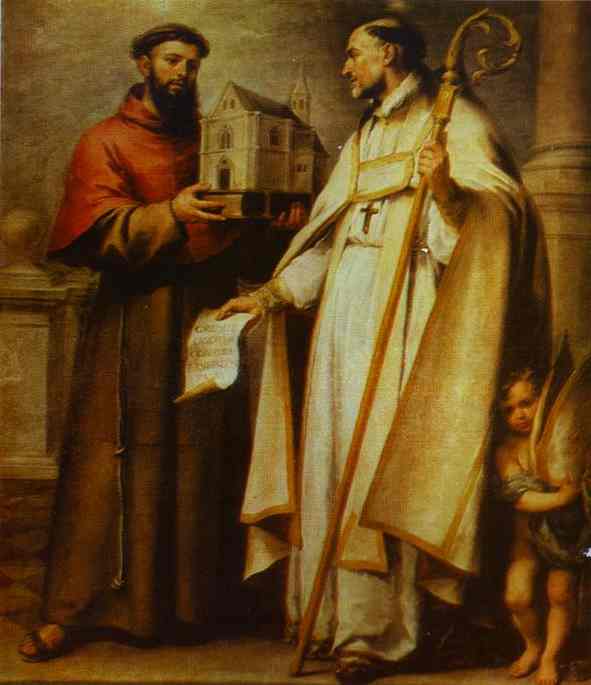
“St. Leander and St. Bonaventure,” painted by Bartolome Esteban Murillo in 1666, is a refined vision of ecclesiastical harmony and shared holiness. The canvas presents two towering saints standing in calm conversation, surrounded by the classical architecture of a church interior. On the left stands a Franciscan in a brown habit, holding a model of a church. On the right stands a bishop in white vestments, crozier in hand, offering a scroll. At their feet, a small angel peeks from behind the bishop’s cloak, adding a gentle, devotional note to the solemn meeting.
Murillo was one of the great masters of the Spanish Baroque. In this work he combines portraitlike realism with serene theology. The saints are at once historical personalities and symbols of the Church as a spiritual home. The painting reflects the devout atmosphere of seventeenth century Seville, a city proud of its bishops, monasteries and charitable institutions.
Historical and Religious Context
The two figures represent different eras of Christian history. St Leander of Seville was a sixth century bishop who helped consolidate Catholic belief on the Iberian Peninsula, combating Arianism and strengthening the church in the Visigothic kingdom. St Bonaventure, a thirteenth century Franciscan theologian and cardinal, became one of the great doctors of the Church and a key interpreter of St Francis’s spirituality.
By placing these figures together, Murillo bridges centuries of ecclesiastical tradition. The painting suggests that the Church is a continuous body in which early bishops and later theologians stand side by side in the communion of saints. In seventeenth century Spain, such images affirmed both the antiquity of local Christian roots and the ongoing vitality of religious orders like the Franciscans.
The church interior and architectural features hint at the Counter Reformation emphasis on the visible Church as a place of sacrament and teaching. The saints are not shown in visionary ecstasy but in calm, rational dialogue, embodying both pastoral authority and learned theology.
Composition and Spatial Balance
Murillo arranges the composition around a vertical axis that runs between the two saints. Their tall figures dominate the canvas, rising from the tiled floor to nearly touch the upper edge. The bishop’s crozier extends this vertical emphasis, while the model church in the Franciscan’s hands adds a smaller, echoing vertical structure.
The spatial balance is carefully calibrated. St Bonaventure in his brown habit occupies the left side, darker in tone and slightly recessed. St Leander, clad in white and gold, stands on the right, closer to the viewer and more illuminated. Between them flows a diagonal rhythm created by the scroll, the line of their arms, and the direction of their gazes.
The architecture behind them recedes gently into shadow, marked by a column and a balustrade. This architectural frame gives the figures a dignified setting without pulling attention away from them. The floor’s subtle pattern of tiles leads the eye inward, reinforcing the notion that the saints stand inside a consecrated space.
Murillo also plays with overlapping forms to create depth. The bishop’s cloak folds over the angel at his feet, while the Franciscan’s robe merges with the pedestal behind him. These overlaps avoid a stiff, frontal arrangement and make the encounter feel natural and lived.
St Bonaventure in the Franciscan Habit
On the left stands the figure traditionally identified as St Bonaventure. Murillo presents him in the humble brown habit associated with the Franciscan order, complete with cowl and simple cord. The saint’s face is serious yet gentle. He looks directly at his companion, creating a strong relational focus.
Bonaventure’s hands support the model of a church. The gesture is steady and respectful, as though he is presenting a precious gift or a theological thesis made visible. His stance is firm, feet planted solidly on the ground, suggesting the grounded realism of Franciscan spirituality.
The Franciscan habit is painted with broad, soft folds, which catch the warm light along their edges. Murillo uses subtle highlights to suggest the rough texture of the wool, reinforcing the idea of voluntary poverty. Yet the dignity of the figure prevents any sense of roughness or neglect. This poverty is chosen and ennobling.
In the context of Murillo’s Sevillian milieu, Bonaventure embodies the intellectual and contemplative side of the Franciscan tradition. He holds the church model as a theologian who has thought deeply about the nature of the Church and now offers his insights to the broader ecclesial body.
St Leander as Bishop and Shepherd
Opposite Bonaventure stands St Leander, depicted in full episcopal regalia. He wears a white alb, a richly worked cope, and a stole that marks his sacramental authority. A cross hangs at his chest, and he holds a crozier, the curved staff of a shepherd.
Leander’s face is lively and animated. He turns toward Bonaventure with a slight smile, his mouth open as if speaking. His right hand extends a scroll, while his left supports the crozier. The scroll is an important attribute, possibly evoking decrees or doctrinal formulations that helped shape the faith of his region.
Murillo paints Leander’s vestments with luminous whites and soft golds. Highlights fall on the folds, creating a sense of volume and weight. Yet the palette remains restrained, in keeping with the dignified mood. The bishop’s garments do not glitter with ostentation. They glow with the quiet authority of a pastor who carries the memory of the early Spanish Church.
The crozier introduces a dynamic diagonal line that counterbalances the vertical thrust of the figures. Its curve frames the bishop’s head, almost like a secondary halo, reminding viewers of his role as spiritual shepherd.
Symbolism of the Church Model and Scroll
The model church in Bonaventure’s hands is the most striking object in the painting. It resembles a miniature Gothic or Renaissance building with a pitched roof and small towers. This object can be read on several levels.
At a literal level, it may represent a specific church or monastery associated with the commissioning institution, perhaps a Franciscan foundation or a cathedral in Seville. On a symbolic level, the model stands for the Church itself, considered as a spiritual edifice of living stones. Bonaventure, as theologian and friar, holds this ecclesial structure, suggesting his role in articulating the Church’s doctrine and spirituality.
The scroll that Leander extends toward Bonaventure complements this symbolism. It likely represents written decrees, doctrinal formulations, or perhaps the rule or charter of a religious house. In the painting, the scroll appears to pass from bishop to friar, implying collaboration between hierarchical authority and religious orders.
Together, the church model and scroll embody the unity of different ministries within the Christian community. The bishop provides normative teaching and governance, while the religious order contributes contemplative insight and pastoral presence. Murillo, attentive to the realities of seventeenth century Seville, depicts this harmony as an ideal that should guide the relationship between bishops and monks in his own time.
Color, Light and Painterly Technique
Murillo’s handling of light in this painting is subtle yet expressive. The overall palette is warm, dominated by browns, creams and soft golds. A gentle light falls from the upper left, illuminating the faces and the upper bodies of the two saints. This light models their features without harsh contrasts, creating an atmosphere of calm clarity.
The Franciscan’s brown habit absorbs more light, giving him a slightly more shadowed presence that underscores humility. The bishop’s white garments reflect light strongly, positioning him visually as a focal point. Yet Murillo avoids making the bishop’s side of the painting overpowering. The two figures share the same pool of illumination, which unites them in a common spiritual space.
Murillo’s brushwork is fluid and economical. He suggests details of fabric and architecture without obsessively delineating every edge. The result is a softness that invites contemplation rather than analytical scrutiny. The faces are more carefully finished, with delicate transitions in skin tones that give the saints a lifelike presence.
The background remains understated. Columns, plinths and walls are indicated with broad strokes, creating a sense of solid structure but leaving the focus firmly on the human figures. The muted background hues also help the warm colors of the garments stand out.
The Presence of the Child Angel
At the lower right a small angel stands behind St Leander’s cloak, holding a palm branch or feather and gazing out toward the viewer. This figure plays several roles.
The angel provides a link between the spiritual and earthly dimensions of the scene. While the saints belong to heaven in their sanctity, they are depicted in fully human form. The angel, with its wings and youthful innocence, reminds us that this gathering takes place in a sacred, transfigured space.
Iconographically, a palm branch often symbolizes victory and martyrdom. Even if neither Leander nor Bonaventure was a martyr in the narrow sense, the palm can signify spiritual triumph and fidelity. The presence of the angel with palm suggests that both saints have overcome trials and now share in heavenly reward.
Compositionally, the angel balances the mass of the two tall figures. Placed low and to the side, it prevents the painting from feeling top heavy. The diagonal from Bonaventure’s feet through the angel to the bishop’s crozier creates a visual triangle that stabilizes the composition.
The childlike charm of the angel also softens the scene. Without it, the two standing men might appear austere or distant. The angel introduces a note of affection and playfulness, in keeping with Murillo’s fondness for cherubic figures in his religious works.
Murillo’s Vision of Ecclesial Harmony
Beyond its iconographic details, the painting communicates a broader message about the nature of the Church. Murillo portrays St Leander and St Bonaventure as collaborators rather than rivals. Their body language suggests mutual respect. Bonaventure presents the church model with both hands, while Leander offers the scroll with a gracious gesture. Their gazes meet at a comfortable angle, and neither dominates the scene.
This visual harmony reflects a theological ideal. The Church is not simply a hierarchy of power but a communion of different vocations. Bishops, theologians, friars and laypeople each contribute to the one body. Murillo’s image captures the cooperation between the early Spanish episcopate and later religious orders that renewed spiritual life.
The classical setting reinforces this vision. Solid columns and balanced architecture symbolize stability and continuity. The saints do not stand in a wild landscape or visionary cloud. They stand within the ordered space of the Church, whose beauty mirrors the order of doctrine and charity.
In seventeenth century Spain, where religious reforms and charitable initiatives were reshaping urban life, such an image would encourage viewers to see their own institutions as part of a long, holy tradition. Confraternities, hospitals and monasteries could recognize themselves in the model church held by Bonaventure, entrusted to the care of bishops like Leander.
Reception and Devotional Meaning
For devout viewers, “St. Leander and St. Bonaventure” offered more than a historical lesson. It functioned as an object of prayer and intercession. Believers could turn to Leander as a patron of the local church and to Bonaventure as a guide to contemplation and spiritual learning.
The calm dignity of the figures invites meditative attention. Their expressions are not ecstatic or tormented. Instead, they display a quiet joy and readiness to serve. This serenity would have encouraged viewers to seek similar interior peace in their own spiritual lives.
Murillo’s art often appealed to a broad audience because it combined doctrinal clarity with human tenderness. In this canvas, the human warmth appears in the gentle faces, the relaxed poses, and the presence of the child angel. Even viewers unfamiliar with specific hagiographic details could sense that these men are trustworthy, compassionate figures, close to both God and people.
In a wider cultural context, the painting would have affirmed Spanish Catholic identity. Leander connects viewers to the Visigothic past, while Bonaventure links them to the international Franciscan movement and the theological achievements of the medieval Church. Seeing these saints together would reinforce the idea that Spain stands within a universal yet locally rooted Christian tradition.
Conclusion
“St. Leander and St. Bonaventure” is a thoughtful and harmonious work that reveals Bartolome Esteban Murillo’s mature religious vision. Through a balanced composition, warm light and carefully chosen symbols, he presents two saints as partners in building up the Church. The model of the church, the scroll of teaching, the bishop’s crozier, the Franciscan habit and the watchful angel all contribute to a rich theological tapestry.
At the same time, the painting remains accessible and human. The saints are not remote icons but approachable figures with gentle expressions and natural poses. Murillo’s soft brushwork and warm palette create an atmosphere of calm contemplation that invites viewers to linger and reflect.
In this canvas, history, theology and devotion meet. St Leander and St Bonaventure stand together as guardians of faith and models of collaborative holiness, their conversation frozen in paint yet alive for anyone who pauses before the work and allows its quiet radiance to speak.
