Image source: wikiart.org
Introduction
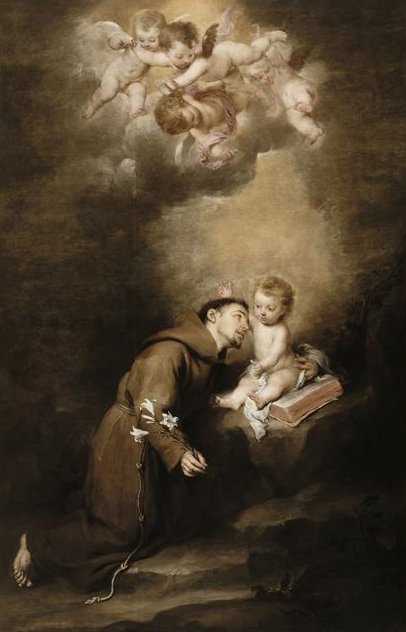
“Saint Anthony of Padua and the Infant Jesus,” painted by Bartolome Esteban Murillo around 1665, captures a moment of mystical intimacy between a beloved Franciscan saint and the Christ Child. The composition is vertical and contemplative. A kneeling friar in a brown habit turns tenderly toward a radiant Infant seated on a book, while a cluster of cherubs hovers in a luminous cloud above. The setting is dim and undefined, more like a spiritual grotto than a specific room, which allows the viewer to focus entirely on the encounter between saint and child.
Murillo’s painting belongs to a long tradition of images that celebrate the legendary vision of Saint Anthony. According to devotional accounts, Anthony spent the night in prayer when the Infant Jesus appeared to him, resting on a book or in his arms. Murillo translates this story into a gentle yet powerful meditation on humility, contemplation and divine love. It showcases the Sevillian painter’s gift for soft lighting, tender expressions and warm, humanized spirituality.
The Vision of Saint Anthony
At the heart of the painting is the meeting of two gazes. Saint Anthony kneels with one knee on the ground, leaning forward as if drawn irresistibly toward the child. His eyes are lifted slightly, his mouth parted in a look of wonder and affection. The Infant Jesus, seated on a thick book that rests on a rock, turns toward Anthony with equal attention. Their faces are close enough to suggest a quiet conversation or silent exchange of love.
Murillo selects this very intimate stage of the vision. There is no crowd, no elaborate architectural backdrop, no narrative sequence to distract from the encounter. The saint and the child inhabit a pool of light in the lower half of the painting, while everything else recedes into velvety brown shadow. Above them, angels observe from a distance, but they do not intervene. The viewer is invited to join the contemplative space, as if kneeling nearby and witnessing the same miracle.
Saint Anthony’s vision becomes a model for the viewer’s own inner life. The painting suggests that true devotion is not loud or spectacular. It happens in the quiet interior, where a believer comes face to face with the mystery of Christ.
Composition and Spatial Arrangement
Murillo structures the composition along a gentle diagonal that rises from the bottom left to the upper right. Saint Anthony occupies the lower left corner, tilted forward, his body forming a line that leads to the Infant Jesus on the book. From there, the eye naturally continues upward to the cluster of cherubs in the illuminated cloud at the top.
This diagonal movement gives the image a sense of ascent. The viewer’s attention climbs from earth to heaven, following the saint’s devotion as it rises toward God. At the same time, Christ and the angels appear to descend into Anthony’s world. The Infant sits quite low, almost at the saint’s level, while the cloud above opens downward, spilling soft light into the dark surroundings. The result is a visual meeting point in the center of the painting where divine condescension and human longing intersect.
The background is deliberately indistinct. Subtle hints of rock and ground suggest a cave or simple cell, a place of retreat from the world. This lack of clear setting removes the scene from everyday time and space, emphasizing its visionary character. The viewer cannot fully locate where this is happening, which strengthens the impression that it takes place in an interior realm of prayer.
Light, Color and Atmosphere
Murillo was a master of warm chiaroscuro, and in this work he uses light not only to shape forms but to express spiritual meaning. The overall palette is a range of browns, creams and soft golden tones. Darkness dominates the upper and lower edges, while a central shaft of light bathes the saint, the child and the hovering angels.
The source of this light seems ambiguous. It does not come from a candle or window. Rather, it appears to emanate from the Infant Jesus and from the small cloud that carries the cherubs. This gentle illumination softens edges and blurs transitions, creating an atmosphere of dreamlike tenderness. The saint’s habit, the child’s skin and the rounded bodies of the angels are all modeled by this luminous veil.
Murillo’s use of color is restrained but eloquent. The brown habit of Saint Anthony blends into the shadows, underscoring his humility and his closeness to the earth. In contrast, the Infant’s pale flesh and the white cloth beneath him capture the brightest highlights. This contrast reinforces the idea that the Christ Child is the center of grace and light. Touches of rosy pink in the cherubs and subtle greens in the background keep the palette lively without disturbing the overall harmony.
The atmosphere is calm and quiet, yet charged with emotion. The softness of the brushwork and the warm, diffused light give the impression that the scene is viewed through a spiritual haze, as if it is half seen and half remembered in prayer.
The Character of Saint Anthony
Saint Anthony of Padua is one of the most popular saints in Catholic tradition, often invoked as a helper in finding lost objects and as a model of preaching and learning. Murillo emphasizes both his Franciscan humility and his contemplative intensity.
The saint’s posture is low and submissive. He kneels barefoot, his toes gripping the ground, a detail that makes his body feel grounded and vulnerable. His habit is simple and unadorned, tied around the waist with a knotted cord characteristic of the Franciscan order. A string of white lilies is attached to this cord, symbolizing purity and his love for God.
Anthony’s expression reveals the interior dimension of his holiness. His eyes are wide and moist, full of reverence. His head tilts gently toward the child, as if listening closely or whispering a prayer. There is affection but also awe. Murillo resists the temptation to make him idealized or distant. Instead, Anthony’s face is that of a real man, with soft features, slightly parted lips and a trace of fatigue from long prayer.
In this way, Murillo presents the saint as a model of accessible sanctity. Viewers can identify with his human features and, through him, imagine themselves kneeling before Christ with similar devotion.
The Infant Jesus and the Symbolism of the Book
The Christ Child sits on a large book that acts as a makeshift throne. A white cloth softens the surface for him, and his small feet rest on its folds. He leans slightly forward, one hand gently touching Anthony’s face or shoulder, while his other hand holds the edge of the book or cloth. His expression is serene and affectionate, and his gaze meets the saint’s with confidence.
The book is a crucial symbol. It represents scripture and the wisdom of God. The fact that the Infant sits on it suggests that he is the living Word made flesh. Anthony was known for his learning and preaching, so the book also evokes his scholarly vocation. The vision reveals that beyond all texts and sermons, the ultimate truth of faith is a person, the child who now sits on his study book and communicates directly with his heart.
Murillo paints the Infant with rounded limbs and soft, luminous skin. Instead of the majestic Christ of Last Judgement scenes, we encounter a vulnerable child who is nonetheless the source of spiritual radiance. This duality of tenderness and divinity lies at the core of Murillo’s theological imagination. The painter invites viewers to see in this little child the infinite love that stoops to meet human beings at their own level.
The Angelic Host Above
In the upper half of the painting, a group of cherubs gathers in a glowing cloud. Their plump bodies twist in different directions, some looking down at the scene below, others interacting with one another. They appear playful yet reverent, a celestial audience to the saint’s vision.
These angels help to anchor the vision in the heavenly sphere. They signal that what Anthony experiences is not a private fantasy but a genuine encounter sanctioned by heaven. Their presence also lightens the mood of the painting, adding a sense of innocence and joy.
Murillo paints the cherubs in his characteristic style, with rosy cheeks, soft curls and delicate wings that blend into the surrounding clouds. The cloud itself forms an oval or halo-like shape, further focusing attention on the divine origin of the light. The angels are not sharply separated from the mist. Instead, they seem to emerge gradually from it, reinforcing the idea that the spiritual world is both present and veiled, partly visible to human eyes in moments of grace.
Murillo’s Devotional Baroque Style
This painting is a fine example of how Murillo adapted Baroque visual language to the needs of Counter Reformation devotion in Spain. Baroque art often favored dramatic gestures, strong contrasts and dynamic compositions. Murillo embraces these elements but tempers them with gentleness.
The diagonal composition and intense chiaroscuro clearly belong to the Baroque vocabulary. However, the gestures of the figures are restrained rather than theatrical. Anthony does not throw his arms wide in ecstatic rapture. He simply leans forward and clasps his hands in reverent attention. The Infant does not raise a commanding hand in judgement but reaches out with childlike affection.
Murillo’s brushwork is loose and atmospheric, especially in the background and clouds. Edges soften as they recede, giving the scene a sense of depth and mystery. At the same time, the key details such as faces, hands and lilies are more precisely defined, guiding the viewer’s focus.
This blend of clarity and softness mirrors the devotional function of the painting. It aims to guide believers into contemplation, not to overwhelm them with spectacle. The viewer is encouraged to linger on the tender gaze between saint and child, to meditate on the humility of Christ and the loving response of Anthony.
Emotional and Spiritual Resonances
One of the reasons Murillo’s religious works became so beloved is their emotional accessibility. In this painting, the spiritual message is expressed primarily through feelings rather than doctrinal symbols alone.
The relationship between Anthony and the Infant Jesus resembles that between a loving father or older brother and a child. The saint’s posture hints at adoration, but also at delight. The child, in turn, appears comfortable and trusting. This emotional language speaks to viewers who know what it is to care for a child or to be comforted by someone stronger and wiser.
At a deeper level, the painting expresses the Christian belief that God draws close to those who seek Him with simplicity and love. Anthony’s bare feet, worn habit and intense focus show that he has renounced worldly distractions. In response, Christ comes to him in the most approachable form, that of a tender child. The vision becomes an icon of spiritual friendship, where the infinite God meets the human soul at eye level.
This emotional dimension makes the painting suitable for personal devotion. Viewers can project their own hopes, fears and desires onto the saint and imagine themselves receiving consolation from the child. The soft light and hushed atmosphere reinforce this personal, interior experience.
Place of the Painting in Murillo’s Oeuvre
Murillo painted several works featuring Franciscan saints and visions, reflecting both his personal spirituality and the prominence of the Franciscan order in Seville. “Saint Anthony of Padua and the Infant Jesus” belongs to this group and shows the refined style of his mature period.
In earlier works, Murillo sometimes used stronger contrasts and more crowded compositions. By the mid 1660s his approach had become more atmospheric, his colors warmer and his figures more tender. This painting shares affinities with his images of the Immaculate Conception, the Christ Child, and other visionary scenes in which heavenly figures appear in a cloud of golden light.
Within the broader context of Spanish Baroque painting, Murillo’s vision of Saint Anthony stands out for its emphasis on gentle intimacy rather than severe austerity. While contemporaries such as Zurbaran often stressed monastic discipline and stark contemplation, Murillo highlights affectionate encounter and comforting grace. Both approaches belong to the Catholic spirituality of the period, but Murillo’s appealed especially to lay viewers seeking warmth and hope.
Conclusion
“Saint Anthony of Padua and the Infant Jesus” is a work of quiet power. Through a simple scene and limited palette, Bartolome Esteban Murillo conveys the depth of a saint’s love for Christ and Christ’s loving response. The kneeling friar, the book turned into a throne, the radiant child and the watchful angels all contribute to a poetic meditation on divine closeness.
The painting invites viewers to imagine themselves kneeling beside Saint Anthony, listening to the Infant’s silent message. It suggests that the heart of Christian life is a personal relationship with Christ, experienced in contemplation and expressed through humility and purity. Murillo’s soft light, gentle modeling and intimate composition continue to speak across centuries, making this canvas an enduring landmark of Spanish devotional art.
