Image source: wikiart.org
Introducing Santa Rufina
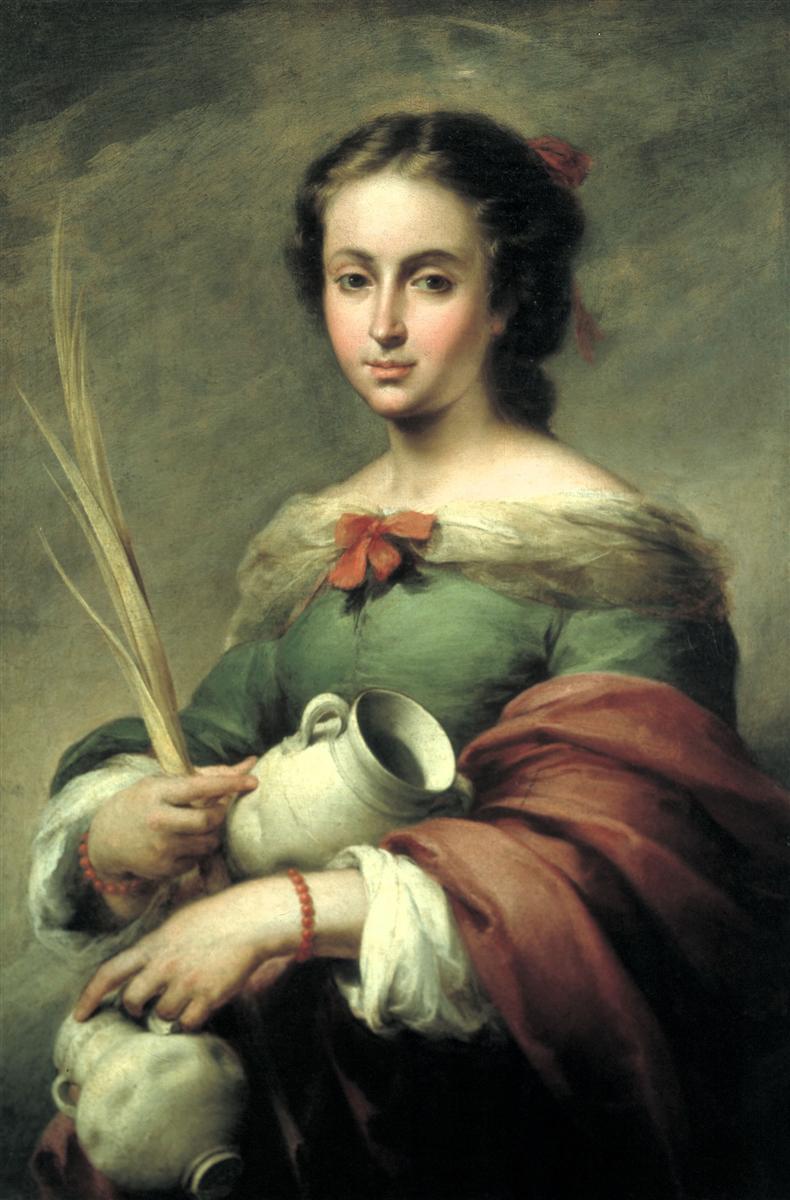
“Santa Rufina,” painted around 1665 by Bartolome Esteban Murillo, is one of the most intimate and compelling saint portraits of the Spanish Golden Age. Instead of presenting a distant, hieratic martyr, Murillo gives us a young girl with flushed cheeks, soft hair and a quiet, searching gaze. She holds the traditional attributes of Saint Rufina of Seville, yet she looks very much like a living Sevillian girl of Murillo’s time.
The painting stands at the crossroads between portrait and religious image. It reflects the Counter Reformation desire for saints who felt accessible and emotionally engaging, while also showcasing Murillo’s extraordinary gift for representing youth, innocence and luminous flesh. “Santa Rufina” reveals how the artist could turn a devotional image into something that feels almost like a psychological study.
The Legend of Saint Rufina
To understand the painting, it helps to recall the story of Saint Rufina. According to tradition, Rufina and her sister Justa were young Christian women from Seville who sold pottery and jugs in the local market. During a pagan festival in the third century, they refused to offer their wares for use in idol worship. For this act of defiance, they were persecuted and eventually martyred.
Saint Rufina is therefore usually shown with clay vessels and a palm frond, the symbol of martyrdom. She became one of the patron saints of Seville, especially associated with potters, merchants and those who worked with clay. For Murillo, a Sevillian painter, her story would have been particularly meaningful. By painting her as a beautiful, modest young woman holding simple jugs, he connects heavenly sanctity with the everyday life of his city.
Composition and Framing
Murillo chooses a half length format that fills the vertical canvas with the figure of the saint. She is turned slightly to the left, yet her head faces forward, engaging the viewer directly. This gentle twist of the torso gives the pose a natural grace, as if Rufina has just paused in her work and looks up from her thoughts.
The background is an indistinct, softly painted field of warm greys and muted browns. There is no detailed landscape, no architecture, no crowd of angels or narrative scene. By eliminating distractions, Murillo concentrates all our attention on the saint herself. The indistinct atmosphere around her suggests a spiritual space rather than a specific setting, allowing her to exist both in earthly time and in the timeless realm of devotion.
The composition is anchored diagonally by the arrangement of the jugs. One vessel rests against her chest, another is held lower in her left hand. A palm branch rises diagonally in the opposite direction. These elements balance the figure and guide the viewer’s eye from her hands to her face.
Light and Color
Light in “Santa Rufina” is both natural and symbolic. It falls from the left, illuminating her face, neck and hands, and catching the rounded surfaces of the clay jugs. The background remains subdued and shadowy. This gentle spotlight effect separates the saint from her surroundings and suggests an inner radiance.
Murillo’s color palette is restrained yet rich. Rufina wears a green bodice with a soft, warm tone that harmonizes with the earthy colors of the vessels. Over her shoulders drapes a red cloak, its folds rendered with deep, velvety shadows. The combination of green and red, softened by creamy whites, creates a harmonious contrast that feels festive but not ostentatious.
Her skin tones are executed with Murillo’s characteristic delicacy. The cheeks carry a rosy blush, the forehead is softly highlighted, and subtle transitions of color describe the roundness of her chin and the bridge of her nose. This mastery of flesh gives her an almost tangible presence and makes the spiritual subject feel intimately real.
The Face and Expression
The face of Santa Rufina is the emotional center of the painting. Murillo portrays her as a girl on the cusp of adulthood, with large, thoughtful eyes and a small, closed mouth. Her expression is calm, self possessed and slightly introspective. She does not look ecstatic or transported by visions. Instead, she seems quietly aware of her role and resigned to the fate that awaits her.
This restrained emotion is typical of Murillo’s religious portraits. He avoids extreme drama in favor of a gentle pathos that invites contemplation. Viewers may sense a mixture of innocence and resolve. Rufina looks delicate, yet her gaze has a steady firmness that suggests moral strength. It is easy to imagine her as the young woman who defied authorities rather than compromise her Christian faith.
Murillo also pays careful attention to details that humanize her. A small red ribbon ties back her hair. Soft strands escape around the temples. Her eyebrows are fine and slightly arched, giving subtle emphasis to her eyes. These touches make her feel like a real girl from seventeenth century Seville, not a remote icon.
Hands, Jugs and the Palm of Martyrdom
The lower half of the painting focuses on Rufina’s hands and the objects she carries. Her right hand gently grips the tall palm branch. Her left hand supports the upper jug while her fingers curl around the handle of the lower one. Murillo paints these hands with sensitivity, emphasizing both their youthful softness and their purposeful actions.
The jugs refer directly to her occupation in the legend. They are not elaborate silver vessels but modest, practical clay pots, slightly rough in surface. Murillo’s careful depiction gives them weight and volume, grounding the saint in the tangible world of work and commerce. At the same time, their rounded forms echo the roundness of her face and shoulders, visually uniting the figure with her attributes.
The palm branch, long and slender, cuts vertically across the left side of the canvas. It is a traditional sign of martyrdom, yet here it is integrated seamlessly into the composition. Instead of dominating the scene, it seems to be another element she carries calmly, like part of her daily burden. This understated symbolism suggests that martyrdom is not a sudden, isolated event but the flowering of a life already rooted in faith and responsibility.
Textiles and Drapery
Murillo’s love of textiles is evident in the handling of Rufina’s clothing. The green bodice has subtle highlights along the seams and edges, suggesting a sturdy yet refined material. Over it rests a translucent, creamy shawl around her shoulders, painted with feathery strokes that capture the softness of cloth. The red cloak falls over her arm in generous folds, its deeper hue providing a rich contrast.
These layers of fabric enhance the sense of volume and warmth. They also contribute to Murillo’s ideal of modesty. Although Rufina is young and beautiful, she is fully and richly clothed. The garments emphasize her dignity rather than sensuality, aligning with Counter Reformation ideals of virtuous femininity.
The red and green also carry symbolic undertones. Red can hint at love and sacrifice, while green often suggests hope and growth. Together they form an image of a saint whose young life, full of promise, becomes an offering of love to God.
Murillo’s Style and the Sevillian Context
“Santa Rufina” reflects Murillo’s mature style, shaped by years of work in Seville. The city was a thriving artistic center with strong ties to religious institutions. Murillo would have known the work of earlier masters like Zurbarán and Ribera, whose saints often appear severe and ascetic. In contrast, Murillo softened the emotional tone, creating images filled with tenderness and gentle light.
His experience painting children and youth in genre scenes also influenced “Santa Rufina.” The natural pose, the slightly parted lips and the delicate hands all recall the street boys and girls he painted in other works. That experience allowed him to bring authenticity to this saintly figure. She does not appear as an idealized princess but as a believable young woman who could have walked the streets of Seville.
At the same time, Murillo employs techniques associated with the broader Baroque movement. The soft yet directional light, the sense of quiet movement in the drapery, and the subtle modeling of forms all contribute to a feeling of immediacy. Viewers have the impression of encountering Rufina in a living moment rather than viewing a static icon.
Devotional Function and Emotional Resonance
For seventeenth century viewers, “Santa Rufina” would have served a devotional purpose. As one of Seville’s patron saints, she was venerated for her courage and her connection to ordinary tradespeople. A painting like this might have been commissioned for a private home, a chapel or a confraternity dedicated to her. It would invite contemplation of her virtues, particularly steadfastness in faith and humble service.
Murillo’s approach encourages a type of devotion based on empathy. By making Rufina appear approachable and human, he allows viewers to identify with her. Her quiet gaze meets the viewer’s, asking not for fear or distant admiration but for an intimate, sympathetic response. The jugs in her arms serve as reminders that holiness can flourish in the context of simple daily work.
The painting’s emotional resonance lies in its balance between fragility and strength. Rufina’s youth and softness elicit protective feelings, yet her calm expression signals inner resilience. The viewer senses that she is aware of the cost of faith yet embraces it willingly. This combination gives the painting a lingering, contemplative power.
Comparison with Other Female Saints by Murillo
Murillo painted numerous female saints, including Saint Agnes, Saint Catherine, the Immaculate Conception and several Marian images. Compared with these, “Santa Rufina” stands out for its simplicity and directness. There are no elaborate crowns, no swirling clouds of angels, no ornate architectural settings. Instead, the focus is on a single figure with a few clear symbols.
This simplicity aligns her with Murillo’s portraits of everyday girls, such as “The Girl with a Coin” or “A Girl with Fruits,” while the palm and jugs mark her as a saint. In this way, the painting blurs the boundary between sacred and secular. It suggests that sanctity is not separate from ordinary life but arises from it.
The work also reflects Murillo’s interest in portraying women as strong moral agents. While many Baroque images depict female saints as passive recipients of divine grace, Rufina is clearly an active figure. Her hands grip her attributes firmly, and her gaze is steady. She might be young, but she is not naive. This subtle empowerment makes the image particularly striking.
Legacy and Appeal for Modern Viewers
For modern viewers, “Santa Rufina” offers several points of fascination. First, it is a beautifully executed portrait that showcases Murillo’s technical skill in rendering flesh, fabric and subtle light. Second, it serves as a window into seventeenth century Spanish spirituality, showing how saints were imagined as approachable protectors rather than distant icons.
The painting also speaks to contemporary themes. Rufina’s story is one of conscience and courage in the face of social pressure. She chooses integrity over convenience, even at great personal cost. In a world where individuals still wrestle with maintaining values amid external demands, her image carries a timeless message.
Moreover, Murillo’s decision to present her as an ordinary working girl with clay jugs suggests a theology of everyday life. Holiness is not limited to monasteries or royal courts. It can emerge in markets, workshops and homes. This idea remains deeply appealing in a culture that often seeks spiritual meaning in daily routines.
Finally, “Santa Rufina” invites a quiet, personal response. There is nothing overtly spectacular in the painting. Its power lies in the gentle meeting of eyes between viewer and saint, in the soft light on her face, and in the humble objects she carries. Spending time with the image allows these subtleties to unfold and encourages the viewer to reflect on their own capacity for quiet courage and faithfulness.
Conclusion
“Santa Rufina” by Bartolome Esteban Murillo is far more than an illustration of a local saint’s legend. It is a nuanced exploration of youth, faith and moral strength. Through sensitive modeling, harmonious color and a restrained yet eloquent composition, Murillo transforms a devotional subject into a deeply human portrait.
The clay jugs, the palm branch and the layered garments root Rufina in her historical and symbolic context, while her thoughtful gaze and delicate features make her feel alive. She embodies both the vulnerability of a young girl and the resolve of a martyr. In doing so, she becomes an enduring image of integrity, inviting viewers across centuries to admire not only her beauty but her steadfast spirit.