Image source: wikiart.org
Introduction to Penitent Magdalene by Bartolomé Esteban Murillo
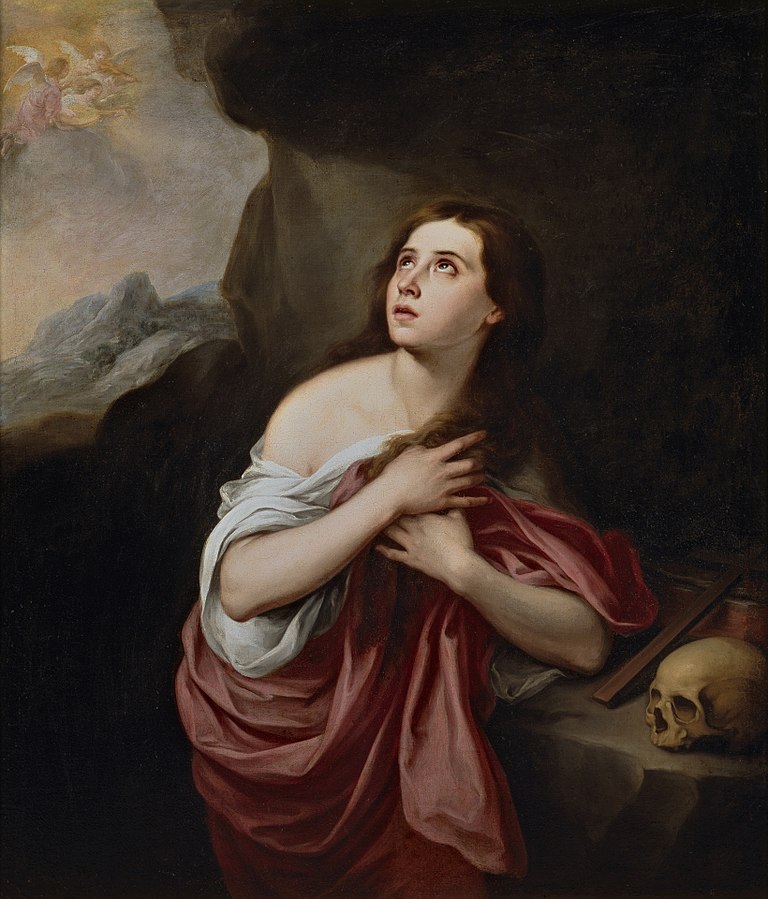
“Penitent Magdalene,” painted around 1665 by Bartolomé Esteban Murillo, is one of the most intimate spiritual portraits of the Spanish Baroque. In this canvas Mary Magdalene is shown not as a sinner surrounded by luxuries, but as a solitary woman in the wilderness, turned entirely toward God. With her hands crossed over her chest, her gaze lifted toward a heavenly light, and a skull and cross resting beside her, she becomes a powerful image of repentance and contemplative love.
Murillo was renowned for his ability to combine tenderness with deep emotion. In “Penitent Magdalene” he uses that gift to transform a popular Counter Reformation subject into a poetic and personal encounter between Magdalene and the divine. The painting invites viewers into the quiet drama of an inner conversion, rather than the spectacle of a public miracle.
The Story Behind Mary Magdalene’s Penitence
Mary Magdalene has long been one of the most compelling figures in Christian tradition. By the seventeenth century she was widely understood as a former sinner who became a model of repentance and passionate devotion to Christ. According to legend, after the events of the Gospel she withdrew into solitude, spending years in contemplation and penitence in a desert cave.
Murillo’s painting refers directly to this tradition. Magdalene appears alone in a rocky landscape, away from towns or crowds. Her worldly ornaments have disappeared. There are no jewels, no fine furniture, no lavish fabrics apart from the simple mantle enveloping her body. The viewer encounters her at a moment of intense prayer and longing, symbolizing the soul that turns from earthly vanity to seek God above all.
At the upper left of the composition, faint but luminous, a group of angels appears in the sky. They represent the heavenly realm toward which Magdalene directs her eyes and heart. Their presence confirms that her penitence is not despair but hopeful communion with God.
Composition and Spatial Structure
Murillo builds the image around a diagonal movement that runs from the lower right corner, where the skull and cross rest, up through Magdalene’s folded arms and upturned face, and finally into the clouded sky where the angels appear. This rising diagonal visually narrates her spiritual ascent from death and sin to grace and contemplation.
The setting is spare but carefully constructed. Dark rock walls form a sheltered alcove around Magdalene, creating a sense of seclusion. At the left edge, the rocky opening reveals distant mountains bathed in a soft, golden haze. This glimpse of landscape suggests the broader world she has left behind, while the cave interior represents the hidden chamber of her soul.
Magdalene is positioned slightly off center, closer to the right edge. This displacement gives space for the vertical column of light at the left, which carries the angels downward and leads the viewer’s eye upward along with her gaze. The figure and the light form a subtle cross shape, underscoring the connection between her penitence and Christ’s sacrifice.
Light and Color in Penitent Magdalene
Light is one of the most important expressive tools in this painting. A warm, almost honey colored glow enters from the upper left, enveloping Magdalene’s face, shoulders, and arms. This radiance has a supernatural quality. It does not come from a visible sun, but from the cloud where angels hover, suggesting a divine source.
Against this luminous area, the right half of the painting is much darker. The rocks behind Magdalene merge into deep shadow, and the skull and cross lie half obscured at the edge of the light. This contrast between light and darkness works on both literal and symbolic levels. It dramatizes the space and also represents the contrast between her past life of sin and the new illumination of grace.
Murillo’s color palette is dominated by warm reds, soft whites, and earthy browns. Magdalene’s mantle is a rich crimson that cascades in broad folds across her body and down to the bottom of the frame. Over one shoulder a pale white cloth slips softly, echoing the light that falls on her skin. Her fair complexion stands out against the dark stone, emphasizing her presence as the living focus of the scene.
The sky in the upper left transitions from golden light near the angels to cooler grays and blues, capturing the sense of a spiritual vision breaking through the clouds. These subtle modulations of color give the painting a gentle, atmospheric unity.
The Figure of Mary Magdalene
Murillo’s Magdalene is youthful, almost girlish, yet her expression carries the weight of spiritual maturity. Her long hair falls loosely over her shoulders, a reminder of the woman who once anointed Christ’s feet. Yet it is no longer styled as a seductress’s adornment. Instead it frames her face naturally, reinforcing her simplicity.
Her posture is crucial. Kneeling or seated low on the ground, she twists slightly toward the left, turning her whole body toward the heavenly light. Her arms cross over her chest, hands clutching the folds of her mantle near her heart. This gesture suggests both contrition and desire. She protects her heart as something precious, yet offers it upward at the same time.
Her face is tilted upward, eyes wide and moist, lips slightly parted. The expression is a mixture of awe, sorrow, and hope. It hints at unshed tears, but also a dawning sense of forgiveness. Murillo avoids any trace of theatrical exaggeration. Instead he captures an authentic, inward emotion that feels both personal and universally human.
The exposure of her right shoulder and upper chest has an ambiguous effect. On one hand it reminds us of her past as a woman associated with sensuality. On the other hand, bathed in gentle light and combined with her reverent posture, it becomes a sign of vulnerability and openness. She is stripped of worldly defenses, completely transparent before God.
Symbols of Penitence and Contemplation
Around Magdalene Murillo places a small number of symbolic objects that speak to her transformation. The most prominent is the skull resting on the ledge beside her. This memento mori reminds viewers of the inevitability of death and the fleeting nature of earthly pleasures. By placing the skull so close to Magdalene’s contemplative form, Murillo suggests that she has internalized this lesson and shaped her life around it.
Beside the skull we see a wooden cross. Its humble, unadorned form points to Christ’s sacrifice and the source of Magdalene’s conversion. It is partially hidden by the folds of her red mantle, implying that the cross is now wrapped into the fabric of her life. The connection between the red cloth and the cross also evokes the blood of Christ, underlining the idea of redemption.
Magdalene’s clothing itself functions as a symbol. The red mantle can represent both the passionate love that once led her astray and the transformed love she now directs toward God. The white cloth suggests purity, hinting at the cleansing power of repentance. Together they form a visual narrative of sin turned into sanctity.
In the upper left, the angels hover near a bank of light. Their presence suggests that Magdalene’s prayer is heard in heaven. Some versions of her legend describe angels bringing her communion or lifting her in ecstasy. Murillo alludes to these stories through their gentle approach, though he leaves the exact nature of their action undefined. This openness lets viewers project their own sense of divine consolation into the scene.
Emotion, Spirituality, and the Baroque Sensibility
“Penitent Magdalene” belongs to a broader Baroque tradition that sought to involve the viewer emotionally in religious scenes. Rather than presenting distant, idealized saints, Murillo offers a figure whose feelings are clearly visible and relatable. The viewer is invited to empathize with Magdalene, to feel the pull of regret and the yearning for forgiveness.
At the same time, the painting illustrates a key Counter Reformation theme: the power of personal conversion. Mary Magdalene represents the sinner who is not rejected but transformed by grace. Her upward gaze and the gentle radiance surrounding her convey a sense of intimate dialogue between the soul and God.
Murillo avoids violent gesture or extreme theatricality. The drama in this painting is interior. It lies in the tension between Magdalene’s past and present, between the darkness of the cave and the light opening in the sky. This subtle, inward drama is especially effective for devotional contemplation, since viewers can project their own spiritual struggles into her expression.
Murillo’s Style and Technique in Penitent Magdalene
From a technical standpoint, “Penitent Magdalene” shows Murillo at the height of his powers. His handling of oil paint is soft and fluid. Edges melt gently into one another, especially in the transitions between flesh and shadow. This softness creates a sense of warmth and intimacy that suits the subject.
The folds of the red mantle are rendered with broad, confident strokes. Highlights gather on the raised areas of fabric, while deeper crimson sinks into the folds, giving the cloth a tangible weight. The white drapery, by contrast, is painted with lighter, feathery touches that capture the delicate, almost translucent quality of the material.
Murillo’s modeling of Magdalene’s face is particularly refined. Subtle gradations of pink and beige create a lifelike skin tone. A slight blush colors her cheeks, suggesting emotion. The eyes are carefully detailed, with reflections of light that make them appear moist and alive.
The background rocks and distant mountains are painted more broadly, with less detail. This keeps them from competing with the figure and helps push Magdalene forward in space. The hazy handling of the clouds and angels further enhances the sense that the spiritual realm is luminous yet not fully graspable by the senses.
The Painting’s Place in Murillo’s Oeuvre and Its Ongoing Appeal
Murillo returned several times to the theme of Mary Magdalene in penitence, which was highly popular with Spanish patrons in the seventeenth century. This version from around 1665 is among the most lyrical. Compared with some harsher or more ascetic portrayals by other artists, Murillo’s Magdalene is notably gentle and hopeful. He also painted beggar children, the Holy Family, and scenes of Christ’s Passion, always with a characteristic mix of realism and tenderness.
“Penitent Magdalene” exemplifies this approach. While the skull and cross remind viewers of death and sacrifice, the overall mood is not one of despair but of longing and trust. Magdalene is not crushed by guilt. She is lifted toward the light, visibly sustained by an invisible presence.
Modern viewers often respond strongly to this combination of vulnerability and hope. Regardless of personal beliefs, the painting speaks to the human experience of regret, transformation, and the search for meaning beyond material success. The mixture of earthly realism in her body and face with the ethereal vision of angels gives the work a timeless, psychological depth.
In museums or reproductions, “Penitent Magdalene” continues to draw the eye because of its emotional clarity and its beautiful harmonies of color and light. It stands as one of Murillo’s most affecting images of individual spirituality.
Conclusion
“Penitent Magdalene” by Bartolomé Esteban Murillo is far more than a conventional religious picture. It is a carefully composed meditation on the themes of sin, repentance, and grace. Through the solitary figure of Mary Magdalene in her rocky retreat, Murillo explores what it means for a human heart to turn away from earthly illusions and toward the divine.
The diagonal composition, the contrast between light and darkness, and the meaningful symbols of skull, cross, and flowing garments all contribute to this spiritual narrative. Magdalene’s upturned face and clasped hands reveal inner turmoil transformed into trust. The soft glow from the heavenly cloud and the quiet presence of angels affirm that her penitence leads not to despair but to intimate communion with God.
With its blend of emotional immediacy and contemplative stillness, “Penitent Magdalene” remains one of the most moving works in Murillo’s career and a lasting testament to the expressive power of Baroque painting.