Image source: wikiart.org
Introduction to Christ on the Cross by Bartolomé Esteban Murillo
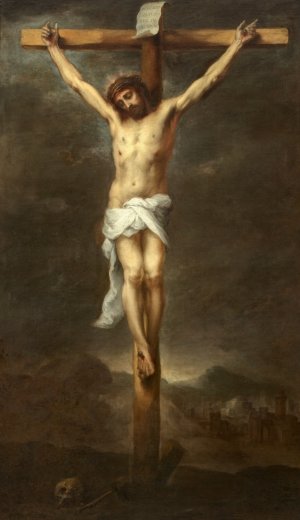
“Christ on the Cross,” painted around 1665 by Bartolomé Esteban Murillo, is a deeply moving vision of the Crucifixion. Rather than filling the canvas with soldiers, onlookers, or dramatic gestures, Murillo focuses almost entirely on the solitary body of Christ suspended against a somber sky. The cross stands upright in the center of the composition, forming a strong vertical axis, while the nearly nude figure of Jesus hangs with arms extended, head bowed gently to one side, and feet crossed and nailed together.
In this work Murillo distills the Passion story into a single, concentrated image of sacrifice and love. The quiet pathos of Christ’s pose, the subdued colors, and the subtle illumination invite contemplation rather than shock. The painting reflects both the intense spirituality of seventeenth century Spain and Murillo’s characteristic tenderness, transforming the scene of an execution into an icon of mercy and redemption.
The Spiritual and Historical Context
Seventeenth century Seville, where Murillo lived and worked, was a city shaped by Counter Reformation devotion. Religious art was expected to be clear, emotionally powerful, and doctrinally sound. Scenes of the Passion played a central role in this context, encouraging believers to meditate on Christ’s suffering and to respond with repentance and love.
Murillo was one of the most celebrated painters of his time, known for his gentle Madonnas, warm depictions of children, and luminous devotional works. His approach to the Crucifixion differs from the more brutal realism of some of his contemporaries. He does not focus on gory detail or violent action. Instead he emphasizes the interior dimension of Christ’s sacrifice, presenting him as both suffering man and serene redeemer.
The painting likely served as a focus for private or communal prayer, perhaps in a church chapel or within a monastic setting. Its vertical format and relatively simple composition make it ideal as an altarpiece, where viewers could stand or kneel before it and contemplate the meaning of the cross in silence.
Composition and Overall Structure
Murillo organizes “Christ on the Cross” around a powerful central axis. The wooden cross rises straight up through the middle of the canvas, dividing the dark background into two halves. Christ’s body follows this vertical line, yet his outstretched arms and bowed head create delicate diagonals that soften the severe geometry.
The composition is remarkably sparse. At the top of the cross, above Christ’s head, is the small plaque bearing the inscription “INRI,” abbreviating the Latin phrase meaning “Jesus of Nazareth, King of the Jews.” At the bottom, the ground slopes gently, and a small skull rests near the base of the cross, a traditional symbol associated with Golgotha and the triumph over death. In the distant background, barely visible beneath the heavy sky, lies the faint silhouette of a city, which evokes Jerusalem yet remains indistinct enough to suggest any human community.
By avoiding additional figures such as the Virgin, Saint John, or Roman soldiers, Murillo removes all distraction. The beholder is confronted with the solitary Christ, suspended between earth and sky, between mortality and eternity. This compositional simplicity heightens the emotional impact and underscores the universality of the sacrifice.
The Body of Christ An Image of Suffering and Peace
Murillo’s portrayal of Christ’s body reveals his deep understanding of anatomy and his desire to communicate both pain and serenity. The arms are stretched wide, muscles taut, showing the strain of supporting the body’s weight from the hands. The chest is slightly sunken, ribs subtly visible, suggesting labored breathing. Small traces of blood appear at the hands, feet, and wound in the side, but they are rendered with restraint. The emphasis is not on gore but on the physical reality of crucifixion.
Christ’s head tilts gently to his right shoulder, crowned with thorns that press into his hair. His eyes are closed, and his mouth is slightly parted, giving the impression that his last breath is near or has just been drawn. The expression is not one of contorted agony but of sorrowful resignation. Murillo invites the viewer to see in this face both the depth of pain and a profound acceptance of the Father’s will.
The white loincloth around Christ’s waist is painted with careful folds that twist and flutter slightly, creating a visual counterpoint to the stillness of the body. The bright cloth stands out against the muted skin tones and dark background, symbolizing purity and hinting at the resurrection yet to come.
Light and Shadow A Vision Emerging from Darkness
One of the most striking features of “Christ on the Cross” is its atmospheric use of light. The entire scene seems to take place in the dim light of late afternoon or early evening. The sky behind the cross is filled with heavy, brownish gray clouds that gradually darken toward the edges of the canvas. This gloom evokes the biblical description of darkness covering the land at the moment of Christ’s death.
Amid this somber environment, a subtle, warm light falls upon Christ’s body. This illumination seems to come from no natural source. It is not the harsh glare of the sun but a quiet, inner radiance. The light accentuates the curves of his torso, the contours of his arms and legs, and the gentle planes of his face.
The interplay of light and shadow creates depth, making the figure stand out almost sculpturally against the murky background. Symbolically, this contrast echoes the tension between sin and grace, death and life. The world around is dark, yet the crucified Christ glows with a light that suggests hope and salvation.
Symbolic Elements at the Foot of the Cross
Though Murillo keeps the composition simple, he includes a few key symbols that deepen the theological meaning of the painting. At the base of the cross sits a human skull, partially illuminated by the same light that falls on Christ. According to tradition, the hill of crucifixion, Golgotha, was also called the “place of the skull.” Some legends even associate it with the skull of Adam, the first man.
By placing the skull here, Murillo reminds viewers that Christ’s death is a response to human mortality and sin. The new Adam hangs above the bones of the old, conquering death through his own sacrifice. The skull also serves as a memento mori, a reminder to the viewer of his or her own mortality and need for repentance.
The distant city on the horizon, faint and almost swallowed by shadow, represents Jerusalem but can also stand for the human world as a whole. It lies far from the solitary cross, suggesting the spiritual distance between ordinary life and the mystery unfolding on this hill. At the same time, Christ’s outstretched arms encompass the entire scene, symbolically embracing that very world in an act of universal love.
Murillo’s Interpretation of the Crucifixion
In many earlier and contemporary depictions of the Crucifixion, artists emphasize the physical horrors of the event. They show distorted bodies, gushing wounds, and crowds of mocking soldiers or grieving followers. Murillo, while acknowledging the suffering, chooses a more meditative path.
His Christ is neither triumphant in a heroic sense nor utterly crushed. He hangs between those extremes. The wounds are real but not exaggerated. The body looks heavy and tired but remains harmonious and calm. This balance reflects Murillo’s desire to move viewers emotionally without overwhelming them. He seeks to awaken compassion and trust more than terror.
Murillo’s sensitivity is particularly visible in the way he paints Christ’s face. The closed eyes and relaxed features suggest that he is already turning toward the Father, that his death is not an end but a passage. For believers, this gaze invites imitation, encouraging them to entrust their own suffering and mortality to God with similar confidence.
The Theology of the Cross in Spanish Baroque Art
Spanish Baroque art was deeply influenced by mystical writers and reformers who stressed the centrality of the cross in the Christian life. Meditating on Christ crucified was seen as a path to humility, charity, and union with God. Paintings such as Murillo’s “Christ on the Cross” were visual counterparts to spiritual writings, translating theological ideas into images that could be grasped by anyone, regardless of literacy.
In this context, the bare cross and solitary figure convey several layers of meaning. The cross is a sign of obedience, as Christ accepts death out of love. It is also a sign of victory, since through the cross sin and death are overcome. Murillo hints at this victory through the quiet light that bathes the body and the subtle sense of peace in the composition.
The painting thus functions as both a reminder of the price of redemption and a reassurance of its fruit. It tells the viewer that out of this apparent defeat comes a new life, prefigured by the gentle radiance and the calm dignity of the crucified Christ.
Emotional Resonance and Devotional Use
Standing before this painting, a viewer is likely to experience a mixture of sorrow and gratitude. The sight of a young man nailed to a wooden beam, abandoned against a stormy sky, cannot leave the heart indifferent. Yet the softness of the light, the tenderness of the modeling, and the lack of brutal detail keep the experience contemplative rather than merely shocking.
For people in Murillo’s time, such an image would have been an aid to personal prayer. Devout viewers might linger on each aspect of the body and meditate on its meaning: the nailed hands as symbols of works of charity, the pierced side as a source of grace, the bowed head as a sign of obedience. The skull at the foot of the cross could lead to reflections on death and the fleeting nature of earthly life, prompting renewed commitment to faith.
Even today, the painting retains its power. The silence around Christ, the absence of a crowd, encourages viewers to imagine themselves alone with him on the hill of Calvary. In that solitude, the message of self giving love can be heard more clearly.
Murillo’s Artistic Techniques in Christ on the Cross
From a technical standpoint, “Christ on the Cross” shows Murillo at a mature stage of his career. His brushwork is fluid yet disciplined. The transitions between light and shadow are smooth, giving the flesh a velvety quality. This softness contrasts with the rougher texture of the wooden cross, which is rendered with more visible strokes and darker tones.
Murillo uses a limited color palette dominated by browns, grays, and warm flesh tones. The restraint of color focuses attention on form and light. Where he does introduce brighter tones, as in the white loincloth, they become focal points that lead the eye back to the central figure.
The proportions of Christ’s body are carefully calibrated to fit the vertical format of the canvas. His slightly elongated figure emphasizes his vulnerability and heightens the sense of being suspended between earth and heaven. At the same time, the naturalistic modeling keeps the figure believable and human.
This blend of realism and idealization is characteristic of Murillo. He avoids both cold abstraction and crude literalism, aiming instead for a middle path that stirs the heart through beauty.
The Enduring Legacy of Murillo’s Crucifixion Image
“Christ on the Cross” has enduring appeal because it distills complex theological and emotional themes into a clear and accessible image. Its simplicity of composition, combined with subtle richness of meaning, allows viewers from different cultures and eras to engage with it.
For art historians, the painting is a key example of how Spanish Baroque artists used light and atmosphere to convey spiritual ideas. For believers, it remains a visual entry point into the mystery of Christ’s sacrifice. For any viewer, religious or not, the image of a solitary figure enduring suffering with dignity and calm can be deeply affecting.
Murillo’s decision to present Christ alone, without dramatic crowds or elaborate architecture, keeps the focus on the fundamental human and spiritual drama. It is the encounter between suffering and love, between darkness and quiet light. This timeless tension ensures that the painting continues to speak powerfully to modern sensibilities.
Conclusion
Bartolomé Esteban Murillo’s “Christ on the Cross” from 1665 is a masterpiece of devotional painting. Through a restrained yet profoundly expressive composition, Murillo portrays the crucified Christ as both wounded and serene, alone yet bathed in a gentle glow that suggests divine presence. The central cross, the skull at its base, the shadowy city in the distance, and the heavy sky combine to create an atmosphere of solemnity and contemplation.
Rather than emphasizing sensational suffering, Murillo focuses on the interior meaning of the event. His Christ is a figure of compassionate love who willingly embraces death for the sake of humanity. The painting invites viewers to stand at the foot of the cross, to confront their own mortality, and to reflect on the possibility of redemption and hope that emerges from this darkest moment.
Through delicate handling of light, careful anatomy, and symbolic detail, Murillo offers an image that is both theologically rich and emotionally accessible. “Christ on the Cross” continues to draw viewers into quiet meditation, reminding them that in the very center of history’s greatest tragedy stands an act of boundless love.