Image source: wikiart.org
Introduction to “Christ after the Flagellation”
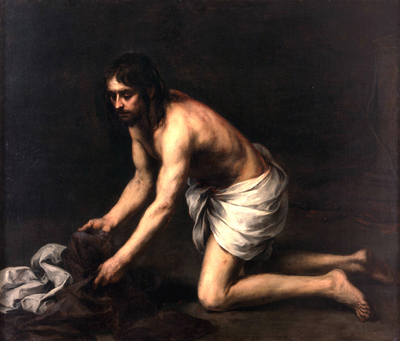
“Christ after the Flagellation,” painted by Bartolome Esteban Murillo around 1665, is a haunting meditation on suffering, humility and interior strength. Unlike more crowded scenes of the Passion that show Christ bound to the column or surrounded by executioners, this work isolates him in a moment of exhausted solitude once the torture has ended. Kneeling on the ground, wrapped only in a white cloth, he gathers discarded draperies with slow, weary hands. The darkness that surrounds him emphasizes the vulnerability of his half naked body, while a concentrated light reveals every tense muscle and sorrowful line of his face.
Murillo was renowned in seventeenth century Seville for his tender images of the Virgin and child and his compassionate depictions of the poor. In “Christ after the Flagellation” he brings the same empathy to the figure of Jesus, presenting him not as an invincible hero but as a man who has endured unimaginable pain. The painting invites believers and art lovers alike to contemplate a quiet, introspective side of the Passion that is often overshadowed by more dramatic episodes.
Historical and Religious Context
Seville in Murillo’s time was a deeply religious city shaped by Catholic reform and intense devotion to the humanity of Christ. Confraternities, monastic orders and wealthy patrons commissioned works that encouraged meditation on the mysteries of the faith. Images of the Passion were especially important during Holy Week processions and private contemplation. They were meant to move viewers to contrition and gratitude by making Christ’s suffering vivid and personal.
Murillo belonged to this spiritual culture but added to it his own gentle sensibility. Rather than depicting graphic violence, he often focused on quieter moments filled with psychological depth. In this painting he chooses the interval after the scourging, when Christ is no longer being struck yet still bears the fresh marks of abuse. This choice reflects a devotional interest in the interior response of Christ, his silent acceptance and enduring love for humanity.
The work also responds to broader artistic trends of the Baroque period. Caravaggesque lighting, dramatic contrasts and a focus on the solitary figure were all tools used by artists to heighten emotional impact. Murillo adapts these elements but softens them with his characteristic warmth, creating an atmosphere that is austere yet compassionate.
The Moment After the Flagellation
The title reveals the narrative point Murillo has selected. The Flagellation, one of the traditional Stations of the Cross, usually shows Christ tied to a column while soldiers beat him with whips. By contrast, “Christ after the Flagellation” shows what happens when the torturers have left. Christ is alone in a void like space, still kneeling, as if struggling to regain strength. The lack of architectural setting or identifiable instruments of torture focuses attention solely on his body and state of mind.
He gathers a dark cloak or cloth from the ground. This simple action suggests several layers of meaning. On a literal level, he is covering himself after being stripped of his garments. Symbolically, the act recalls the moment when he will soon be clothed again before appearing to the crowd or being led to the crucifixion. The gesture of picking up the cloth also conveys a sense of resignation. Christ accepts his fate and prepares himself for what comes next.
By choosing this quiet instant, Murillo draws viewers into an intimate space of reflection. The drama is not in external action but in the weight of fatigue and the silent determination visible in Christ’s posture.
Composition and Use of Space
The composition is remarkably simple yet carefully planned. Christ occupies almost the entire width of the canvas, positioned diagonally from the lower right corner to the upper left. He kneels with one leg forward and the other bent beneath him, leaning on one hand while the other reaches toward the cloth. This diagonal arrangement energizes the figure and prevents the scene from feeling static.
The surrounding space is almost entirely dark, with no architectural elements or landscape. This emptiness creates the impression of a spiritual stage where only Christ’s presence matters. It also heightens the sense of isolation. There are no onlookers, no tormentors, no signs of comfort. The viewer becomes the sole witness to his suffering.
Murillo anchors the composition with the bright white loincloth that wraps Christ’s hips. Its triangular form echoes the angle of his body and stands out dramatically against the darkness. The darker drapery he gathers lies in a triangular heap near his hands, creating a visual echo that further unifies the design. The eye moves naturally from Christ’s face down his torso to his hands and the cloth, then back up along the line of his bent leg.
This controlled composition keeps the viewer’s attention focused on the essential elements of the scene. There is nothing extraneous. Every curve and line serves the emotional narrative.
Light, Shadow and the Baroque Atmosphere
Chiaroscuro, the interplay of light and shadow, is one of the most striking features of this painting. Murillo bathes Christ in a concentrated beam of light that falls from the left, leaving the rest of the space in velvety darkness. This light reveals the modeling of muscles, the texture of skin and the folds of cloth. It is not a harsh glare but a warm, soft illumination that seems almost spiritual in nature.
The darkness is not empty. It functions as a kind of enveloping silence. It suggests the tomb, the night of Gethsemane and the interior darkness of abandonment that Christ experiences in his Passion. Yet within this gloom, the light on his body proclaims endurance and hope. The contrast between light and shadow thus becomes a visual metaphor for suffering and redemption.
Murillo’s mastery of mid tones is also evident. Between the brightest highlights and the deepest blacks, he paints subtle gradations that give the figure volume and realism. The transitions along the back, shoulders and thighs are especially delicate. This modeling allows the body to emerge convincingly from the gloom, making Christ appear palpably real and physically present.
The Body of Christ as Emotional Focus
Murillo’s attention to anatomical detail is not exhibitionist. Rather, it serves to communicate the reality of Christ’s suffering. Muscles in the arms and legs are tensed, knees and feet press into the hard ground, the spine curves under the weight of exhaustion. The body is lean and strong but marked by fatigue. Christ’s head droops forward, hair falling around his face, eyes cast downward in sorrow.
The wounds of the scourging are hinted at rather than shown as gory detail. Subtle reddish marks and bruises on the shoulders and back indicate the violence he has endured. This restraint actually intensifies the emotional impact. The viewer senses the pain without being distracted by graphic imagery. It is the inner experience of suffering, not the external spectacle, that matters.
The white cloth around his waist has both practical and symbolic roles. It preserves modesty yet also accentuates vulnerability, drawing attention to the exposed torso. In Christian iconography, this loincloth often prefigures the shroud of the burial and the purity of Christ as sacrificial lamb. Its brightness here further emphasizes his figure as the central source of light amid darkness.
Color, Fabric and Symbolic Details
Aside from the flesh tones, the color palette is limited. The background is a deep brown black, while the cloth on the floor is a muted dark reddish brown. The white loincloth introduces the only strong highlight. This restricted palette reinforces the somber mood and the focus on form rather than decorative detail.
The fabrics themselves carry symbolic weight. The dark garment Christ gathers may allude to his seamless robe, which will soon be taken and divided by the soldiers. Its color suggests the weight of sin he bears. By lifting it, Christ metaphorically assumes the burden of humanity’s wrongdoing. The white cloth at his waist, by contrast, speaks of innocence and sanctity. The interaction between these two fabrics hints at the theological mystery of the Passion, in which the sinless one carries the sins of the world.
Murillo paints the textiles with his usual sensitivity. The soft folds of the white cloth catch the light and reveal its texture, while the darker fabric lies in heavier masses. These visual contrasts provide variety within the subdued palette and highlight the tactile reality of the scene.
Psychological Depth and Human Vulnerability
One of the most compelling aspects of “Christ after the Flagellation” is its psychological insight. Christ’s face is not idealized into distant calm but shows genuine fatigue and sadness. His forehead is furrowed, his mouth slightly downturned, his eyes shadowed. This is a man who has been beaten, humiliated and abandoned. Yet there is no trace of hatred or despair. Instead there is a quiet acceptance, a melancholy serenity that suggests inner strength.
The kneeling posture reinforces this emotional reading. On one level it is a position of weakness, placed close to the ground. On another level it conveys prayer and submission. Christ is physically diminished yet spiritually active, still communicating with the Father, still willing to proceed toward the cross.
For viewers, this portrayal can be deeply moving. It emphasizes that Christ shares in human vulnerability. He knows exhaustion, pain and loneliness. Murillo invites devotees to recognize their own suffering mirrored in his, and to find comfort in the belief that he understands and accompanies them.
Devotional Function and Counter Reformation Spirituality
In the context of seventeenth century Spain, a painting like this would have had a clear devotional purpose. It was likely commissioned for a monastic setting or a private chapel where individuals would meditate on the Passion. The work encourages a form of prayerful contemplation known as affective devotion, in which the believer imaginatively enters the scene and responds with love and compassion.
By presenting Christ alone and close to the viewer, Murillo facilitates this interior encounter. There are no distracting narrative details. The viewer stands almost at the same level as the kneeling figure, invited to pause and share the moment. The quiet action of gathering the cloth can be seen as an invitation to help, at least in spirit, by offering sympathy and repentance.
This form of art also served Counter Reformation aims by reaffirming the central mysteries of Catholic belief. The suffering humanity of Christ, his willingness to bear sins and his obedience to the Father were themes that teachers and preachers emphasized. Murillo’s painting translates those doctrines into visual experience, accessible even to the illiterate.
Comparison with Other Depictions of the Passion
When compared with other Baroque treatments of the Flagellation or Ecce Homo, Murillo’s approach appears distinctly introspective. Many artists, especially in Italy, show Christ bound to the column while executioners raise whips, focusing on the moment of physical violence. Others present him crowned with thorns before a mocking crowd. In both cases the emphasis is on the cruelty of others.
Murillo removes the aggressors and the spectators, choosing instead a private pause between episodes. This choice aligns the work more closely with images of Christ in the Garden of Gethsemane, where he prays alone, or with depictions of the Man of Sorrows that show him displaying his wounds in silence. Yet even among those contemplative images, Murillo’s painting stands out for its lack of overt symbols such as the cross, nails or chalice. Everything is conveyed through pose, expression and subtle detail.
This restraint gives the picture a modern feeling of psychological realism. It does not rely heavily on allegorical devices, but on the viewer’s intuitive response to another human being in pain. At the same time, for those familiar with Christian iconography, it contains rich layers of meaning that connect it firmly to the tradition of Passion imagery.
Contemporary Resonance
For contemporary viewers, “Christ after the Flagellation” continues to speak powerfully about themes of endurance, loneliness and quiet strength. Even outside a religious context, the painting can be read as an image of a person who has encountered extreme hardship yet begins to gather themselves, literally and figuratively, to go on. The act of reaching for the clothing becomes a metaphor for reclaiming dignity after humiliation.
The stripped down setting and naturalistic figure make it accessible to modern sensibilities that may be less attuned to overt religious symbolism. The work can inspire empathy for all who suffer violence or injustice, inviting reflection on how dignity can be preserved in the midst of suffering.
At the same time, for believers, the painting retains its original devotional impact. It provides a visual focus for prayer during Lent or Holy Week, or at any moment when reflection on Christ’s Passion is desired. Murillo’s ability to balance realism with spiritual depth allows the painting to bridge centuries and speak to varied audiences.
Conclusion
“Christ after the Flagellation” is a masterpiece of concentrated emotion and spiritual reflection. In a single kneeling figure surrounded by darkness, Bartolome Esteban Murillo conveys the weight of the Passion and the quiet heroism of Christ’s acceptance. The careful composition, rich chiaroscuro, restricted palette and sensitive modeling of the body all serve the same purpose: to draw the viewer into an intimate encounter with the suffering Christ.
Rather than dramatizing the violence itself, Murillo shows the aftermath, when pain settles into tired limbs and the future ordeal of the cross looms. In this stillness, Christ exhibits both human vulnerability and divine resolve. The painting stands as a moving testimony to Murillo’s gift for translating theological mysteries into human terms and remains a poignant invitation to contemplate suffering, love and redemption.
