Image source: wikiart.org
Introduction to Christ after the Flagellation by Bartolomé Esteban Murillo
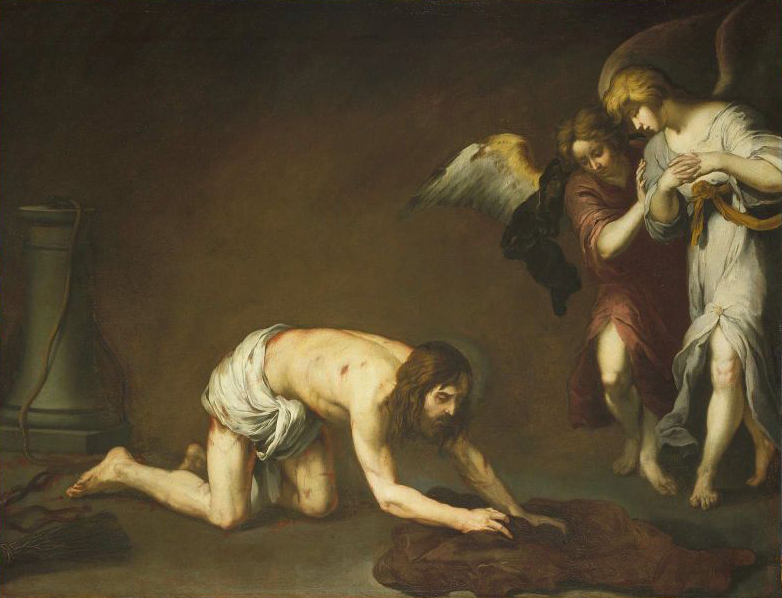
“Christ after the Flagellation,” painted around 1665 by Bartolomé Esteban Murillo, shows one of the most harrowing yet tender moments in the Passion story. The scene takes place after Christ has been scourged at the pillar. His back is marked with wounds, his body is exhausted, and he supports himself on hands and knees. To the right, two angels descend in quiet compassion, carrying a cloth with which to cover and comfort him. On the left, the towering column and scattered scourges remain as mute witnesses to the brutality he has just endured.
Murillo, a leading figure of the Spanish Baroque, was famous for combining intense religious emotion with gentle, approachable imagery. In this painting he departs from heroic poses and triumphant gestures. Instead he presents Christ almost at ground level, humbled and vulnerable, yet surrounded by a mysterious, soft light that hints at his divine dignity. The work invites contemplative prayer as much as visual admiration, and it reveals the spiritual climate of seventeenth century Seville, where devotion to the suffering Christ was central to religious life.
The Biblical Moment Depicted in the Painting
The Gospel accounts describe how Jesus was scourged by Roman soldiers before his crucifixion. The flagellation is often represented while it is taking place, with Christ tied to a column and soldiers striking him. Murillo chooses a more introspective and less narrative instant. The scourging is over. The instruments of torture lie on the floor. Christ has been untied and now collapses, too weak to stand.
This is a moment of silence between violence and the next stage of the Passion. The crowds are absent. The soldiers have left. Only Christ remains, accompanied by angels who appear as gentle attendants. Murillo thus transforms a space of cruelty into a space of consolation. The painting shows not just physical suffering but the tenderness of heaven toward the wounded Savior.
In Catholic spirituality of Murillo’s time, meditations on the Passion often encouraged believers to imagine themselves present with Christ in his humiliation. By showing him alone with angels, the artist suggests that the devout viewer may also spiritually approach and console Christ in his pain.
Composition and Spatial Drama
The composition of “Christ after the Flagellation” is striking in its simplicity. The entire scene takes place in a shallow, darkened space. There is no elaborate architectural background or detailed landscape. The focus is on the three figures and the few symbolic objects that surround them.
Christ occupies the lower center of the painting, his body stretched almost horizontally. One knee and one hand touch the ground, while the other arm reaches toward a dark cloth that lies before him. This low, diagonal posture gives a sense of collapse and exhaustion. His figure forms a strong contrast with the vertical column at the far left and the upright angels at the right.
The angels stand close together, their bodies forming a gentle arc that leans toward Christ. Their presence balances the heavy column on the opposite side, so that the composition is structured between two poles: the instrument of torture and the messengers of consolation. The empty space above Christ’s back intensifies the feeling of desolation while making his body the clear focal point.
Murillo uses the floor as a kind of stage. A broom, ropes, and the base of the column are placed near the left edge, leading the viewer’s eye toward the center. The dark background recedes behind the figures, without distracting details, so that attention remains on the emotional drama unfolding before us.
The Figure of Christ Vulnerability and Dignity
Murillo’s Christ is brutally wounded yet deeply dignified. His body is muscular but not idealized. The artist carefully paints the bluish marks, welts, and small streams of blood left by the scourging. These physical details are realistic enough to evoke empathy, but they are never grotesque. The warm, golden light that falls on his skin softens the brutality of the wounds, suggesting that even in suffering his body is glorified.
His loincloth is loosely tied, another sign of humiliation and exposure. Yet Murillo arranges it in careful folds that echo traditional depictions of Christ’s modesty, keeping the figure chaste and respectful. His long hair falls around his face, partially hiding his expression, but we can see enough to sense exhaustion and inward prayer. His eyes seem downcast, focused perhaps on the dark cloth beneath his hand, perhaps on an inner dialogue with the Father.
The decision to show Christ on all fours is unusual in art history. It brings him as low as possible, close to the ground where prisoners and slaves might crawl. This posture expresses both physical collapse and an astonishing humility. At the same time, the diagonal line of his body leads directly toward the angels, reminding us that this humiliation is part of a larger plan of redemption.
The Role of the Angels as Heavenly Consolers
The two angels at the right of the painting are essential to its emotional tone. Without them, the scene would be almost unbearable in its bleakness. Their presence transforms it into an image of compassion and care.
Both angels are depicted as youthful figures with soft features and flowing garments. One wears a rose colored tunic, the other a pale blue robe that catches the light. Their large wings overlap behind them, creating a feathery halo effect. They bend toward Christ in a posture of reverence and concern.
The angel in blue holds a cloth, likely the garment that will cover Christ’s torn body. The delicate way he or she folds it suggests a nurse preparing a bandage or a mother arranging a blanket. The other angel looks on with solemn attention, hands gently clasping the cloth as if assisting. Their bare feet on the ground emphasize their closeness to the human realm even as their wings mark them as heavenly beings.
Murillo avoids portraying the angels in ecstatic or triumphant attitudes. They do not gesture dramatically toward heaven. Instead they are wholly focused on Christ, as if their entire mission at this moment is to care for him. This quiet service is in itself a lesson in compassion for the viewer.
Light Color and Atmosphere in Murillo’s Late Style
Light in “Christ after the Flagellation” plays a crucial narrative role. The background is almost uniformly dark brown, fading into deep shadow. Against this backdrop, the pale flesh of Christ and the soft garments of the angels glow with a gentle radiance.
The main light source seems to come from the upper right, bathing the angels first and then falling across Christ’s back and shoulders. The column and scourging tools at the left remain in half shadow, as if the violence they represent belongs to darkness. By contrast, the wounded body of Christ and the ministering angels belong to the realm of light.
Murillo’s color palette is restricted yet rich. Warm ochres, soft whites, and muted reds dominate the scene. There are no sharp blues or greens that might distract from the narrative. The angels’ robes show delicate tints of rose and silver blue, which harmonize with the golden tones of Christ’s skin. This restrained harmony enhances the painting’s contemplative mood.
The atmosphere is hazy and almost smoky, as if the air still carries dust and sweat from the brutal scourging. Yet within this gloom a spiritual light emerges, enveloping the figures in an aura of holiness. This balance between physical atmosphere and spiritual radiance is a hallmark of Murillo’s mature style.
Symbols of the Passion in the Background
Though the composition seems bare, Murillo includes several objects that deepen the meaning of the scene. To the far left stands the tall column to which Christ had been tied. Its cold, smooth surface contrasts with the warmth of his flesh. Coiled around its base is a rope or chain, suggesting the bonds that held him prisoner.
Near the column lies a broom, a surprisingly humble object. It may allude to the brutal “cleaning up” of punishment spaces after executions or tortures. It also reinforces the sense that this is a work environment, a courtyard where soldiers carry out orders without pity. By including the broom, Murillo highlights the banality of the cruelty that has just occurred.
On the ground close to Christ is a dark cloth on which he reaches out his hand. It could be the garment stripped from him before the flagellation or the very cloth that the angels will now use to cover him. Either way it symbolizes both humiliation and impending consolation. His hand touching it suggests that he accepts this small comfort even as he prepares to face greater suffering.
These objects function as visual reminders of the Passion’s larger narrative. The viewer is invited to recall the entire sequence of events that will culminate in the crucifixion and resurrection.
Emotion Devotion and Spanish Seventeenth Century Spirituality
In seventeenth century Spain, devotional art aimed to engage the emotions and stir compassion for Christ and the saints. Murillo, working in Seville, was deeply influenced by this spiritual climate. Confraternities, processions, and sermons all encouraged believers to meditate on Christ’s wounds and to identify with his suffering.
“Christ after the Flagellation” fits perfectly within this context. The painting does not simply describe a biblical episode. It invites the viewer to kneel with Christ on the cold floor, to feel the weight of exhaustion in his limbs, and to share the silent sorrow of the angels.
Murillo’s approach is less focused on strict historical realism and more on emotional truth. The bare setting and minimal props allow the viewer’s imagination to project feelings and prayers into the empty space. This open, dark background becomes an interior landscape, perhaps echoing the believer’s own heart where encounters with Christ’s suffering take place.
For viewers of Murillo’s time, such images were not merely decorative. They were aids to contemplation, teaching tools for meditation, and expressions of faith that could be revisited again and again.
Murillo’s Humanized Vision of Christ
One of the most remarkable aspects of this painting is how human Christ appears. He is not shown with exaggerated ideal beauty or distant majesty. His body is robust yet exhausted, his hair tangled, his wounds visible. He looks like a real man who has just endured terrible physical abuse.
At the same time, the calmness of his posture suggests a deep inner acceptance. There is no theatrical gesture of protest or anger. Instead we sense a steady commitment to the path he has chosen. This combination of frailty and moral strength is central to Murillo’s Christology.
By humanizing Christ in this way, Murillo makes him a companion for suffering people. Anyone who has felt beaten down, humiliated, or overwhelmed can recognize something of their own experience in this image. The angels’ tender care further suggests that such suffering does not go unnoticed in heaven.
In this sense, “Christ after the Flagellation” offers not only a depiction of the past but also an invitation to trust that personal wounds can become places of divine presence and compassion.
Comparisons with Other Passion Scenes
When compared with other Baroque depictions of the flagellation or the Ecce Homo, Murillo’s painting stands out for its quietness. Many artists chose to show Christ surrounded by jeering soldiers, his body twisted in pain, or his hands bound to the column. Murillo, by contrast, removes the antagonists from the scene.
A similar contemplative focus can be seen in his images of the “Christ on the Cross” or “Christ the Good Shepherd,” where the emphasis lies on tenderness and inner peace rather than spectacle. This approach reflects Murillo’s particular talent for gentle religious imagery, which contrasted with the harsher realism of some of his Spanish contemporaries.
Compared with works by painters like Ribera or Zurbarán, whose Passion scenes sometimes stress the raw physicality of wounds and instruments, Murillo softens the horror without denying it. His aim is to invite loving contemplation rather than shock. “Christ after the Flagellation” is a perfect example of this balance.
Why Christ after the Flagellation Still Speaks to Modern Viewers
Today, viewers may not share the same devotional practices as Murillo’s original audience, yet “Christ after the Flagellation” continues to resonate. Its depiction of extreme vulnerability, combined with quiet support, speaks to universal human experiences.
The painting can be read as an image of someone who has been broken by violence or injustice and then gently helped by caring companions. The angels represent any form of compassionate presence: friends who sit by a hospital bed, volunteers who aid the homeless, family members who support a loved one after trauma.
In a world aware of suffering, torture, and the scars of conflict, Murillo’s vision offers a counterpoint of tenderness. It suggests that even in the darkest places, there can be moments of delicate care. For believers, the painting also affirms that Christ enters into human suffering and that heaven draws near to the wounded.
The restrained composition, subtle light, and dignified emotion give the work a timeless quality. It avoids sensationalism, inviting instead a prolonged, meditative gaze. This quiet power ensures that “Christ after the Flagellation” remains moving and meaningful centuries after it was painted.
Conclusion
“Christ after the Flagellation” by Bartolomé Esteban Murillo is a masterful synthesis of Baroque artistry and deep spiritual sensitivity. By choosing the moment after the scourging, Murillo focuses not on the spectacle of violence but on the exhausted silence that follows it. Christ is shown at his most human, crawling on the ground, yet bathed in a light that affirms his divine mission.
The tender angels, the dark column, and the humble objects on the floor all contribute to a narrative of suffering, compassion, and hope. The painting reflects seventeenth century Spanish devotion while speaking directly to contemporary concerns about pain, vulnerability, and the need for care.
Through careful composition, warm color, and expressive detail, Murillo creates an image that invites viewers to contemplate both the cost of redemption and the gentle mercy that accompanies it. “Christ after the Flagellation” remains a powerful meditation on love that endures even in the aftermath of cruelty.