Image source: wikiart.org
Introduction to Murillo’s “Baptism of Christ”
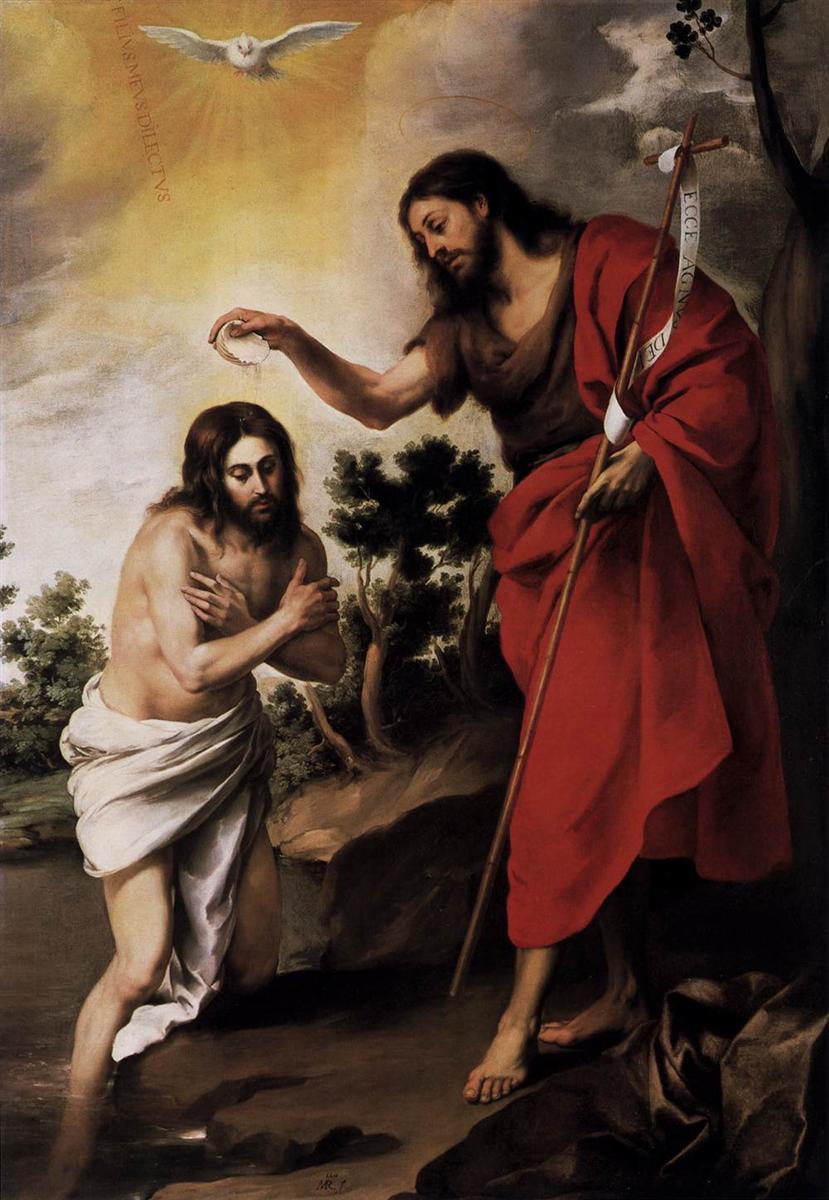
“Baptism of Christ,” painted by Bartolome Esteban Murillo in 1665, is a serene and majestic vision of one of the most important moments in the New Testament. The scene captures the baptism of Jesus by John the Baptist in the river Jordan, the moment when the heavens open and the Holy Spirit descends in the form of a dove. Murillo transforms this familiar subject into an intimate encounter between the humble Christ and the prophetic figure of John, framed by a soft Andalusian light and a tranquil landscape.
The painting reflects Murillo’s unique ability to balance doctrinal clarity with tender emotion. It is both a theological statement about the revelation of the Trinity and a deeply human scene that invites viewers to contemplate humility, obedience, and renewal. With its harmonious composition, gentle modeling of flesh, and luminous colors, “Baptism of Christ” stands among Murillo’s most refined religious works.
The Biblical Narrative Behind the Painting
The story of Christ’s baptism appears in all four Gospels. Jesus comes from Galilee to the Jordan to be baptized by John, who has been preaching repentance and preparing the people for the coming of the Messiah. At first John hesitates, saying that he is the one who should be baptized by Jesus, but Christ insists, declaring that this act is necessary to fulfill all righteousness. As Jesus emerges from the water, the heavens open, the Spirit of God descends like a dove, and a voice from heaven proclaims, “This is my beloved Son, in whom I am well pleased.”
Murillo chooses to depict the climactic instant of this narrative, when John pours water on Christ’s bowed head and the dove hovers in a radiant sky above them. By freezing this sacred moment, he allows viewers to contemplate both the humility of Jesus, who submits to a baptism meant for sinners, and the divine affirmation that reveals his true identity. The painter’s challenge is to show both the simple act of pouring water and the invisible mystery of God’s presence. He solves this through careful use of gesture, light, and symbolism.
Composition and Spatial Harmony
The composition is organized around the vertical dialogue between heaven and earth. Christ stands in the shallow water of the Jordan on the left, his body slightly bent in humility, while John the Baptist stands on the rocky bank to the right, elevated above him. Above them, at the top of the canvas, the dove of the Holy Spirit glows against a golden cloud. These three elements form a subtle triangle, directing the viewer’s gaze from Christ to John to the descending Spirit.
Murillo places the figures close to the foreground, so that the viewer seems to stand at the edge of the river, witnessing the event almost at eye level. The background landscape, with its clusters of trees and distant sky, is softly indicated rather than meticulously detailed. This keeps the focus on the interaction between Christ and John while providing a natural setting that enhances the realism of the scene.
The diagonal formed by John’s body and staff adds dynamism. He leans toward Christ, his right arm extended in a graceful arc as he pours the water. Christ’s body forms a counter diagonal as he bows forward slightly, arms crossed over his chest. This interplay of lines creates a sense of movement even within the overall stillness. The composition is both stable and alive, a visual reflection of the balance between solemn ritual and spiritual transformation.
The Figure of Christ: Humility and Quiet Majesty
Christ is shown as a young man with long brown hair and beard, his expression calm and contemplative. He wears only a white cloth wrapped around his waist, which emphasizes the vulnerability of his humanity. Standing in the river, he bows his head slightly and crosses his arms over his chest in a gesture of reverence and self offering. This posture expresses submission to the will of God and identifies him with the sinners whom John has been baptizing.
Murillo renders Christ’s body with soft, delicate modeling. Light touches the shoulders, chest, and forearms, highlighting the rounded muscles without ostentation. The skin glows with a warm tone that sets it apart from the cooler colors of the water and the darker greens of the surrounding landscape. The artist avoids the heroic exaggeration found in some earlier depictions. Instead he presents Jesus as both divine and approachable, a figure of gentle strength rather than overwhelming power.
Christ’s downward gaze contributes to the meditative mood of the painting. He does not look at John or at the viewer, but seems absorbed in prayer. This inward focus suggests his awareness of the significance of the moment: the beginning of his public ministry, the acceptance of his mission, and the symbolic anticipation of his death and resurrection. In Murillo’s hands, the baptism becomes not only a ceremonial gesture but a quiet, profound turning point.
John the Baptist: Prophet and Servant
On the right, John the Baptist appears as a tall, robust figure, dressed in the traditional garments associated with his desert life. A rough brown tunic of animal skin covers his body, but over it Murillo drapes a vibrant red cloak that cascades in ample folds down his side and across the foreground. The red not only provides a striking visual contrast to Christ’s white garment, it also hints at sacrifice and zeal.
John holds a long reed cross in his left hand. Wrapped around it is a banner that bears the Latin words “Ecce Agnus Dei,” “Behold the Lamb of God,” a phrase from the Gospel of John used by the Baptist to identify Jesus. This inscription clarifies John’s role as the herald who recognizes and announces the Messiah. Even as he performs the act of baptism, he points beyond himself to the one he serves.
The gesture of John’s right hand is gentle and controlled. He leans forward, extending his arm to pour water on Christ’s head from a small shell. The shell is a traditional baptismal symbol, and Murillo paints it with delicate precision, catching the glimmer of water droplets. John’s expression is serious but not severe. His eyes look down at Jesus with a mixture of reverence and responsibility, aware of the paradox of baptizing someone greater than himself.
Murillo balances John’s physical dominance in the composition with his spiritual humility. Elevated on the bank and clothed in rich red, he might easily overshadow Christ, yet his posture and gaze show that he understands his secondary role. He is the forerunner, fulfilling his task and then ready to decrease as Christ increases.
The Holy Spirit and the Trinitarian Vision
Above the two central figures, the Holy Spirit appears in the form of a white dove, emanating rays of golden light. The background sky glows around it, transitioning from deeper tones at the edges to a luminous center. The dove’s wings are outstretched in a posture of descent, emphasizing the connection between heaven and the scene below.
Murillo uses this radiant apparition to suggest the presence of the entire Trinity. Although the voice of the Father cannot be painted, the bright opening in the clouds and the text lightly inscribed near the rays evoke the proclamation “This is my beloved Son.” The placement of the dove directly above Christ’s head visually links the Spirit to the Son, completing the theological triangle that defines the event.
The light surrounding the dove spills softly onto Christ and John, unifying the upper and lower sections of the canvas. It is not a harsh spotlight but a warm, enveloping glow. This subtle handling of illumination allows Murillo to present the supernatural in a believable, almost natural way, consistent with his characteristic blend of realism and mysticism.
Landscape, Water, and the Natural Setting
Although the background is secondary, the landscape in “Baptism of Christ” contributes significantly to the painting’s atmosphere. Murillo suggests a river valley with rocky banks and clusters of trees. The foliage is dense in some places and more sparse in others, allowing glimpses of sky. The distant horizon is soft and slightly hazy, creating a sense of depth without distracting from the foreground.
The river Jordan is indicated by the shallow water in which Christ stands. Murillo paints the surface with gentle ripples and reflections, capturing the movement of water around Christ’s legs. The stones beneath the surface create a sense of physical reality. Yet the water also carries symbolic meaning. It represents purification, rebirth, and the passage from old life to new. By standing partially submerged, Christ visually enters into the realm of humanity’s need for cleansing, even though he himself is without sin.
The earthy tones of the rocks and trees anchor the scene in nature, grounding the spiritual drama in the tangible world. Murillo, who often painted landscapes as settings for his religious subjects, uses nature here to provide a calm, contemplative environment. There is no crowd of onlookers, no background narrative activity. The solitude of the landscape underscores the intimacy of the encounter between Christ and John and the profound interior significance of the baptism.
Color and Symbolism
Color plays a crucial role in the painting’s emotional and symbolic language. The dominant hues are the red of John’s cloak, the white of Christ’s garment, the warm golden light of the sky, and the deep greens and browns of the landscape.
Christ’s white loincloth symbolizes purity and innocence. Its brightness contrasts with the darker tones around it, emphasizing his sinless nature. The cloth also recalls the shroud that will wrap his body after the crucifixion, linking the beginning of his ministry with its sacrificial end.
John’s red mantle is rich and saturated, drawing the viewer’s eye. Red is associated with passion, blood, and prophetic zeal. It can also signify the love that motivates John’s mission and his readiness to suffer for the truth. In this context, the red cloak suggests the fiery urgency of his call to repentance and his role as a bridge between the Old Covenant and the New.
The golden light in the upper part of the canvas conveys the presence of the divine. Murillo’s warm yellows and soft oranges create an aura that is simultaneously natural, like a sunrise, and supernatural, like a heavenly radiance. The blending of these tones with the cooler grays at the edges of the sky gives depth and drama to the scene.
Greens and browns in the trees and rocks enhance the stability and earthiness of the composition. They remind the viewer that the sacred event occurs within the same natural world we inhabit. The harmony among all these colors reflects Murillo’s skill in constructing a palette that is both symbolic and visually satisfying.
Murillo’s Style and Devotional Intent
“Baptism of Christ” exemplifies many hallmarks of Murillo’s mature style. His figures are graceful and well proportioned, with soft modeling that avoids harsh contours. Faces are expressive yet idealized, conveying spiritual beauty rather than raw realism. The brushwork is refined and smooth, especially in the flesh tones and drapery folds, creating a polished surface that draws the eye into the pictorial space.
Murillo’s handling of light is particularly important. Rather than dramatic, sharp contrasts, he prefers a gentle diffusion that suggests divine presence without overwhelming the senses. The luminosity that bathes Christ and John from the upper left modulates gradually into the darker areas, so that the viewer experiences the light as enveloping rather than blinding. This approach gives his religious scenes a contemplative, almost tender character.
The painting was likely intended for a church or monastic setting where it would serve as an object of devotion. Its composition guides the viewer’s meditation. The humble posture of Christ invites reflection on the virtue of obedience and the acceptance of God’s will. John’s prophetic presence encourages readiness to witness to the truth. The descending dove and radiant sky evoke the action of the Holy Spirit, suggesting that baptism is not merely an external rite but an interior transformation.
In Murillo’s Seville, such an image would also have reminded congregations of the importance of the sacrament of baptism as the gateway into the Christian life. The painting thus operates on multiple levels: narrative, doctrinal, and personal.
Emotional Tone and Spiritual Message
Despite the theological depth of the subject, the overall tone of “Baptism of Christ” is gentle and peaceful. There is no sense of struggle or confrontation, only quiet reverence. The figures are absorbed in their roles. Christ prays, John serves, and the Spirit descends. The viewer is invited to share in this calm, contemplative atmosphere.
Murillo emphasizes the unity between heaven and earth. The same light that surrounds the dove touches the shoulders of Christ and the cloak of John. The natural landscape is suffused with a subtle glow, as if transformed by the sacred event. The painting communicates the idea that divine grace enters the ordinary world, sanctifying water, stone, and human bodies.
The spiritual message is one of renewal and beginning. Christ steps into the water at the start of his public mission, sanctifying the path that believers will later follow through baptism. The humility with which he accepts John’s ministry serves as an example of voluntary submission to God’s plan. Murillo’s image encourages viewers to consider their own readiness to be transformed, to leave behind old ways, and to receive a new identity as beloved children of God.
Conclusion
“Baptism of Christ” by Bartolome Esteban Murillo is a masterful blending of narrative clarity, theological symbolism, and emotional intimacy. Through careful composition, restrained yet expressive gestures, and a luminous palette, the artist presents the moment when Jesus is revealed as the beloved Son, the Spirit descends, and the prophetic mission of John reaches its fulfillment.
The painting draws viewers into a quiet encounter at the river Jordan, where the eternal mystery of the Trinity meets the flowing water of the earth. In Murillo’s hands, this scene becomes both a reflection on the life of Christ and an invitation to personal contemplation about humility, obedience, and spiritual rebirth. It remains a powerful example of Spanish Baroque devotion and of Murillo’s enduring ability to make sacred stories vibrantly present.
