Image source: wikiart.org
Introduction to The Prodigal Son Among the Swine
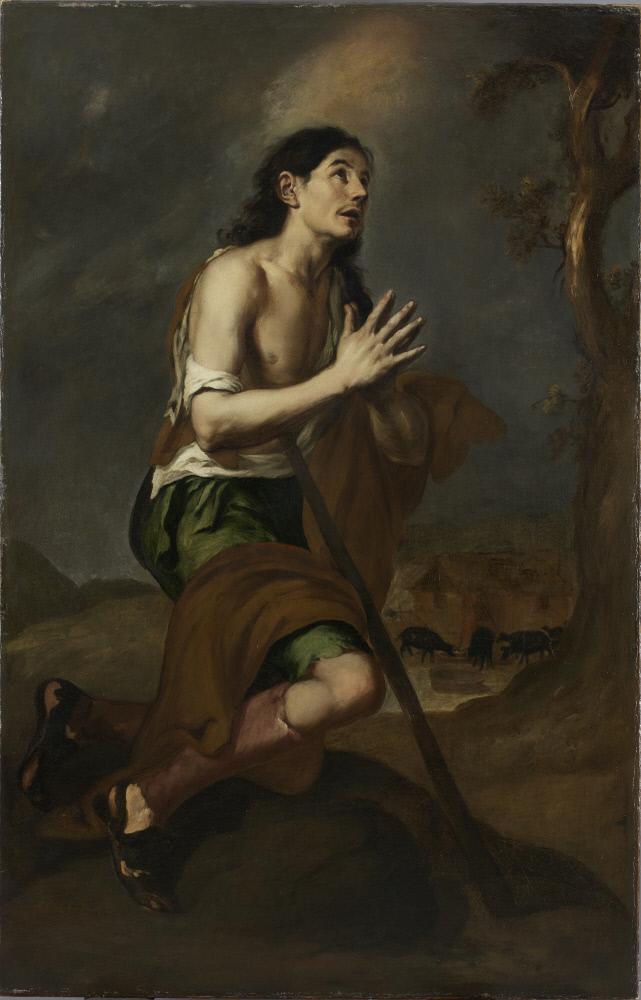
“The Prodigal Son Among the Swine,” painted around 1665 by Bartolome Esteban Murillo, captures the most desolate yet spiritually pivotal moment in the famous gospel parable. Unlike scenes that show the young man leaving home in pride or returning in triumph, this canvas fixes on the instant when he reaches absolute rock bottom. Hungry, ragged and humiliated, he kneels on the bare earth and finally understands what his choices have cost him.
Murillo was a master storyteller of the Spanish Baroque, and in this work he unites deep religious meaning with a realistic view of human misery. There is no bustling tavern or crowded street here, only a lonely field, a dark sky and distant swine feeding in the background. The emptiness around the figure echoes the emptiness of his soul. Yet a mysterious glow begins to gather above his head, suggesting that this is also the beginning of grace. The painting becomes a powerful meditation on repentance, self knowledge and the possibility of return.
Narrative Context in Murillo’s Prodigal Son Cycle
Murillo did not treat the Prodigal Son as a single isolated episode. He created an entire cycle of paintings that follow the young man from his departure, through his life of luxury, his ruin among the swine and finally his homecoming. “The Prodigal Son Among the Swine” stands at the emotional center of that sequence.
In the biblical parable from the Gospel of Luke, the son wastes his inheritance, then becomes so destitute that he hires himself out to feed pigs, a degrading job that would have shocked a devout Jewish audience. It is while watching the animals eat better than he does that he comes to his senses and decides to return to his father. Murillo condenses this crisis of conscience into a single, intense image.
By choosing this moment, the artist shifts the focus of the story from external action to inner conversion. There are no revelers, no angry tavern keepers, no welcoming father. There is only the sinner and his God. This makes the painting exceptionally suited for devotional contemplation, inviting viewers to examine their own turning points and awakenings.
Composition and Spatial Organization
Murillo builds the composition around the kneeling figure of the Prodigal Son. He occupies the left and central part of the canvas, oriented diagonally so that his body forms a rising line from his bare feet in the lower left corner up to his uplifted face near the top. This diagonal movement gives the entire image a sense of urgency, as if the young man has just dropped to his knees and is about to speak.
The right side of the painting is anchored by the trunk of a tree that stretches upward out of the frame. Its dark, twisted form balances the strong shape of the kneeling figure. Between them, in the middle distance, lies a low building and a small group of pigs, barely visible in the murky light. The sky above is heavy and turbulent, filling most of the upper half of the canvas with deep gray and brown tones.
There is very little decorative detail. The ground is rough and undefined, a simple patch of earth. The architecture in the distance is reduced to silhouettes. This spareness serves a purpose. By stripping away distractions, Murillo concentrates the viewer’s attention on the young man’s body and face, which tell the whole story through posture and expression.
The staff that the Prodigal holds creates another diagonal, crossing his body and linking earth to sky. It suggests both his status as a hired laborer and his spiritual journey. Visually, it acts as a stabilizing element that prevents the composition from feeling too weightless as the figure leans upward.
The Figure of the Prodigal Son
Murillo’s portrayal of the Prodigal Son is both physically convincing and laden with symbolism. The youth is half dressed, his green knee length trousers tied loosely at the waist, a torn white shirt slipping from his shoulders, and a brown cloak wrapped around him with little care. His sandals are worn and his bare legs show signs of strain and hardship.
The artist treats the body with a realism that reveals his knowledge of anatomy. Muscles are visible in the arms and legs, but there is also a sense of fatigue. This is not the robust body of his earlier days of feasting. His frame appears leaner, his skin slightly dull, as if malnutrition has already begun its work.
What truly carries the emotional weight, however, is the position of his hands and the expression on his face. His fingers are interlaced tightly, pressed together in an almost desperate clasp. The gesture combines prayer, pleading and self accusation. His head tilts upward, mouth slightly open, eyes wide with a mixture of fear, regret and hope. Murillo captures that fragile moment when the prodigal first dares to turn his thoughts back toward home and toward God.
His posture is unstable, one knee bent under him while the other leg extends behind. It looks as though he could collapse completely at any time. This physical imbalance mirrors his inner crisis. The boy who once strode away with confidence now clings to the staff and the earth, uncertain of his footing in every sense.
The Swine and the Distant Farm
Although the painting is titled “The Prodigal Son Among the Swine,” the animals themselves play a small but crucial role. They are relegated to the background, feeding calmly near a rough shelter. Their dark, compact shapes contrast with the elongated, agitated form of the young man.
In the gospel story, the swine represent the lowest point of the prodigal’s degradation. For a Jewish audience, tending unclean animals would have symbolized complete estrangement from religious and social norms. Murillo echoes this idea, yet he does not paint the pigs grotesquely. They are ordinary beasts going about their business. The real ugliness lies not in the animals but in the human heart that has sunk below them in dignity.
The distant farm structures hint at the world in which the Prodigal now lives. They are crude and temporary, a sharp contrast to the solid family home depicted in later scenes of his return. The fact that the young man prays away from these buildings, in a dark open field, underlines his isolation. He is neither fully part of this hired laborer’s world nor able yet to reclaim his place at home.
By minimizing detail in this part of the canvas, Murillo ensures that the swine and buildings function primarily as symbols. They whisper of hunger, humiliation and alienation, without distracting from the central drama of repentance.
Light, Color and Atmosphere
Murillo’s handling of light is particularly striking in “The Prodigal Son Among the Swine.” Most of the painting is shrouded in a murky twilight. The sky is filled with heavy clouds that threaten rain or storm. Browns, dark greens and grays dominate the palette, creating a somber mood that reflects the young man’s spiritual darkness.
Yet a subtle illumination breaks through this gloom. A soft, warm light touches the Prodigal’s face, chest and clasped hands, as well as a small patch above his head where the clouds seem to part. This glow is not as bright as the divine light in some of Murillo’s other religious works, but it is distinct enough to suggest a higher presence. It is as if grace has begun to search out the sinner even in the far country.
The contrast between this gentle light and the dark environment heightens the emotional tension. The Prodigal’s body emerges from the shadow, not fully but enough to signal a turning. His bare skin becomes a reflective surface for the spiritual awakening taking place within.
Color plays a role in this transformation as well. The green of his trousers hints at life and renewal, while the brown cloak connects him to the earth, to humility and poverty. The faded white of his shirt reminds viewers of purity lost but perhaps recoverable. Murillo’s muted colors resonate with the Spanish Baroque taste for earthy tones, yet he uses them with great subtlety to express inner states of soul.
Spiritual and Theological Meaning
Theologically, this painting captures what many commentators call the moment of conversion. The prodigal has not yet returned home. He has not yet received forgiveness or festive robes. What he has done is remember his father and recognize his own sin.
Murillo communicates this inner movement through visual cues. The upward gaze suggests that the young man is no longer absorbed in earthly pleasures or animal cares. His clasped hands show that he acknowledges a power higher than himself. The opening in the clouds can be read as a symbol of divine response, a hint that heaven is listening to his first halting prayer.
For believers, this stage of the story is essential, because it affirms that God’s grace begins to work not only in moments of joy but also in the depths of misery. The swine, the tattered clothes and the dark landscape are not the end of the story. They are the setting for the first spark of repentance.
Murillo thus offers viewers a powerful image of hope. No matter how far one has wandered, the path back begins with an honest acknowledgement of failure and a turning of the heart toward home. The painting does not lecture or sermonize. It simply shows a human being on his knees, caught between despair and trust.
Murillo’s Humanitarian Vision
One of the strengths of Murillo’s religious art is his deep compassion for the human condition. In “The Prodigal Son Among the Swine,” he avoids caricature. The young man is not painted as a villain or buffoon. Even in his degradation, he retains a certain dignity. His face is expressive, his body still graceful, his clothing rough but not repulsive.
This humane approach reflects Murillo’s broader interest in poor and marginalized figures. In other works he portrays beggar children, street boys and humble workers with tenderness and respect. The Prodigal Son, stripped of privilege and wealth, becomes one of these poor. He is no longer the arrogant youth of the early scenes, but a man who has learned through suffering.
Murillo’s empathy invites viewers to look at sinners and failures with similar understanding. Rather than gloating over the consequences of the prodigal’s choices, the painting encourages sorrow and solidarity. It asks the viewer to share in the young man’s anxiety and to hope for his redemption.
This gentle moralism was particularly effective in seventeenth century Seville, where many people struggled with poverty and instability. The canvas would have reminded them that even in hard times, the door to mercy remained open.
Relationship to the Rest of the Cycle
When seen alongside Murillo’s other Prodigal Son paintings, this work gains additional layers of meaning. In earlier scenes, the youth appears confident and stylish, dressed in fine clothes, surrounded by companions. In later scenes, he kneels before his father and receives a loving embrace.
“The Prodigal Son Among the Swine” sits precisely between these extremes. It marks the turning point from self indulgence to grace. The visual contrast between this bare, stormy landscape and the warm courtyard of the homecoming painting is striking. In the later work, light pours over richly clothed figures and solid architecture. Here, the world is unstable and bleak.
By placing this canvas in the middle of the narrative sequence, Murillo helps viewers see repentance not as an abstract idea but as part of a human journey. The young man who now looks upward from the mud is the same person who will soon wear a ring and feast with his family. The transformation has already begun in his heart, and the painting offers a snapshot of that interior change.
Contemporary Relevance and Emotional Impact
Although created more than three centuries ago, “The Prodigal Son Among the Swine” continues to speak powerfully to modern viewers. Many people today know what it feels like to hit bottom, whether through addiction, financial collapse, broken relationships or moral mistakes. Murillo’s painting gives a face to that experience.
The image of a young person in worn clothes, kneeling in a desolate landscape, is surprisingly contemporary. It can evoke the plight of refugees, the homelessness of urban youth, or any situation in which someone realizes that earlier choices have led to painful consequences. At the same time, the faint light and upward gaze keep the painting from sinking into despair. It tells viewers that even in the darkest moments, the first step toward healing is possible.
For those who appreciate art for its emotional resonance, the work offers a moving study of vulnerability. The exposed chest, the tense hands and the wide eyes communicate fear and hope in equal measure. The viewer may feel an urge to comfort the young man, to assure him that his prayer will not be ignored. This empathetic response is part of Murillo’s achievement as a painter of the heart.
Conclusion
“The Prodigal Son Among the Swine” by Bartolome Esteban Murillo is a masterpiece of spiritual psychology and Baroque narrative painting. Through a restrained composition, a somber palette and a deeply expressive figure, Murillo captures the moment when a wayward youth realizes the depth of his fall and begins to turn back toward his father.
The distant swine, the rough ground and the turbulent sky provide a stark backdrop to this inner awakening. Light that barely pierces the clouds hints at divine presence, while the young man’s clasped hands and pleading gaze reveal the first stirrings of repentance.
Seen within the larger Prodigal Son cycle, the painting marks the crucial hinge between sin and forgiveness. Standing alone, it offers a timeless image of human brokenness touched by hope. Whether viewed in a museum, a book or on a screen, “The Prodigal Son Among the Swine” continues to invite reflection on the ways we lose ourselves, the painful clarity of hitting bottom, and the surprising mercy that can begin in the very darkest place.
