Image source: wikiart.org
Introduction to Madonna in the Clouds
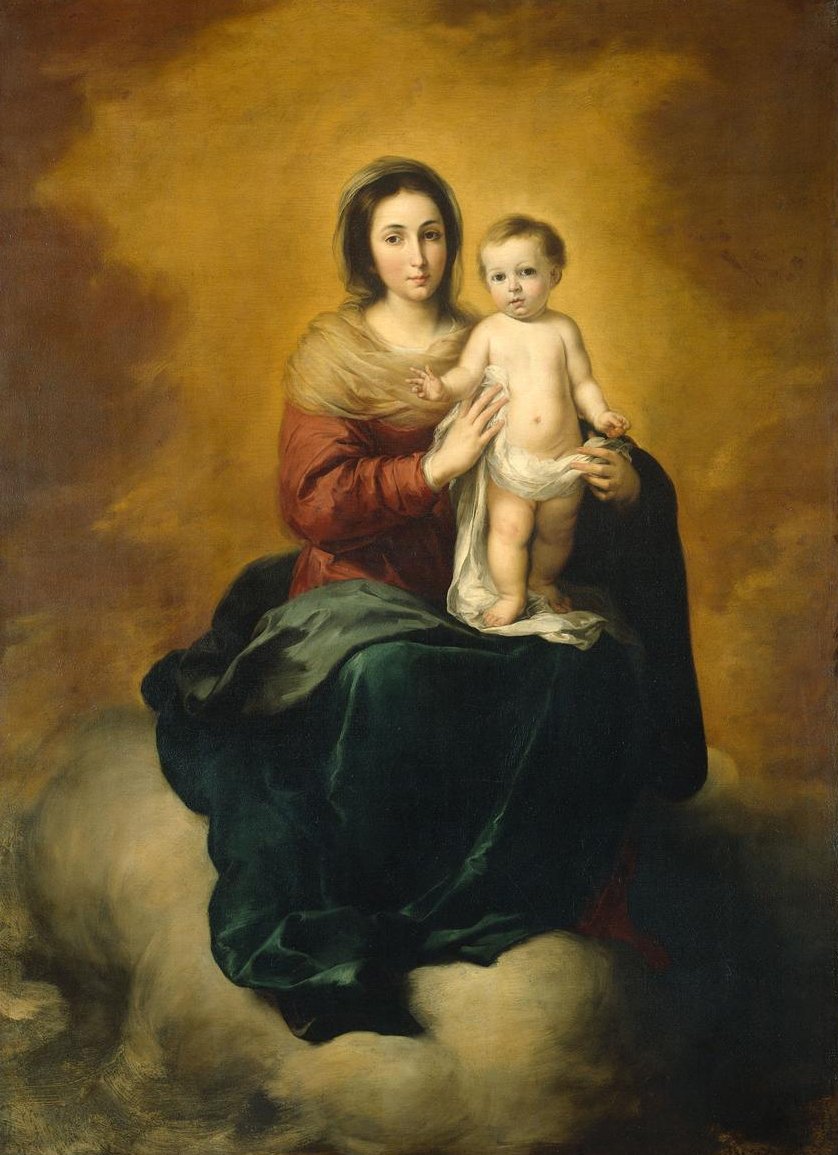
“Madonna in the Clouds,” painted around 1660 by Bartolome Esteban Murillo, is a serene and luminous vision of the Virgin Mary with the Christ Child. Suspended on a billowing bank of clouds and set against a glowing golden sky, the figures appear at once heavenly and disarmingly human. Murillo was one of the great interpreters of Marian devotion in seventeenth century Spain, and this painting captures the balance that made him so beloved: grandeur without coldness, and tenderness without sentimentality.
The image belongs to the broader tradition of Marian iconography in which the Virgin is presented as Queen of Heaven, yet Murillo strips away elaborate symbols and attendants. There is no crown, no scepter, no multitude of angels. Instead, Mary sits quietly, holding the standing Child as if in a family portrait. The simplicity of this arrangement invites an intimate, contemplative encounter in which theological ideas are carried primarily through gesture, gaze and light.
Composition and Spatial Structure
The composition is deliberately simple and vertical. Mary is seated at the center of the canvas, her large mantle creating a dark triangular base that anchors the entire image. The Christ Child stands on her lap, elevated slightly so that his small body occupies the upper right quadrant. Together they form a pyramidal structure that is both stable and gently dynamic.
Murillo places the figures on a dense bank of clouds that fills the bottom of the painting. These clouds act almost like a pedestal, lifting the Holy Mother and Child out of earthly space and asserting their heavenly status. Yet their forms are soft and rounded, not harsh or dramatic. This softness reflects Murillo’s preference for a contemplative rather than theatrical Baroque style.
The background is a nearly continuous field of golden ocher that becomes lighter around the heads of Mary and Jesus. This creates a natural halo effect without the need for sharply defined halos. The lack of detailed architecture or landscape further emphasizes the spiritual, timeless quality of the scene. The viewer’s attention is directed entirely to the relationship between Mother and Child.
The subtle asymmetry of the composition keeps it from feeling rigid. Mary is oriented slightly to the right, while her gaze and the Child’s body gently counter this movement. The drapery of the green mantle flows down toward the left, balancing the Child’s forward step on the right. In this way Murillo creates a quiet rhythm that guides the eye across the entire surface.
The Virgin’s Presence and Humanity
Murillo’s Virgin Mary is notable for her accessible humanity. She appears as a young woman with a calm, thoughtful expression. Her features are soft but not overly idealized: a straight nose, full lips, clear eyes and slightly flushed cheeks. The artist seems to have studied real women from Seville, then elevated their beauty into a sacred key.
Mary’s clothing combines traditional colors with Murillo’s own sense of harmony. She wears a deep red dress, symbolizing love and sacrifice, covered by a bluish green mantle associated with her heavenly role. A light beige veil or shawl wraps around her shoulders and frames her face. The layering of these garments creates a rich interplay of textures and tones: the heavy folds of the mantle, the softer, almost transparent quality of the veil, and the smoother surface of the dress beneath.
Her pose is modest and maternal. She sits with her body facing forward, yet her shoulders and arms gently wrap around the Child. One hand supports his torso, while the other holds the draped cloth that partially covers his body. Her touch is firm but tender, suggesting both care and reverence. Unlike some earlier representations in which the Virgin looks away in abstract contemplation, here she addresses the viewer directly. Her steady gaze draws the viewer into the scene and invites a personal response.
This blend of humility and dignity is characteristic of Murillo’s Marian imagery. Mary is not distant or unreachable. She is a mother who holds her child with evident affection, yet her calm bearing and luminous surroundings mark her as the spiritual mother of all believers.
The Christ Child as Blessing and Promise
The Christ Child stands on Mary’s knee, supported by her hands and by the white cloth that wraps his waist. His small body is painted with delicate, pearly flesh tones that contrast with the darker fabrics around him. Murillo’s rendering of infant anatomy is carefully observed: rounded belly, dimpled knees, tiny toes gripping the cloth. The realism of these details reinforces the doctrine of the Incarnation, which affirms that Christ truly took on human flesh.
At the same time, the Child’s pose conveys more than ordinary childhood. One hand reaches outward in a gesture that suggests blessing or greeting, while the other lightly touches the cloth his mother holds. His head tilts slightly, and his large eyes look toward the viewer with a mix of innocence and quiet awareness. He is both a baby and a divine person who recognizes the one who approaches.
The white cloth around his waist serves multiple symbolic functions. It recalls the swaddling clothes of Bethlehem and anticipates the loincloth of the Crucifixion, subtly linking birth and sacrifice. Its bright tone also draws attention to the Child’s body as the focal point of the composition. Surrounded by the darker red and green of Mary’s garments, the Child shines like a source of light at the center of the painting.
Murillo’s depiction avoids excessive sentimentality. The Christ Child is sweet but not overly playful. There is a hint of seriousness in his expression, which suggests that even in infancy he bears the weight of his mission. This nuance gives the painting an emotional depth that continues to speak across centuries.
Light, Color and Murillo’s Luminous Style
One of the most striking features of “Madonna in the Clouds” is the warm, enveloping light that fills the scene. The golden background functions almost as an atmosphere rather than a flat plane. Light seems to emanate from behind the figures and to wrap around them, creating soft highlights on faces, hands and drapery.
Murillo uses a palette dominated by ochers, reds, greens and creamy whites. The transitions between these tones are smooth, with very few hard edges. This soft modeling creates a sense of volume without harsh contrast. The technique shows Murillo’s familiarity with both Italian and Flemish painting, yet he adapts these influences into his own uniquely Sevillian language of light.
The interplay of dark and light is especially effective in the Virgin’s mantle. Its deep, almost bluish green folds fall heavily across her lap and down into the clouds, anchoring the lower half of the canvas. Highlights along the creases of the cloth give it a velvety texture and suggest thickness and weight. Against this dark base, the Child’s pale skin and the lighter tones of Mary’s veil stand out with gentle radiance.
The clouds themselves are rendered with broad, swirling strokes, using grays and soft creams that blend into the background. They have a tangible, almost sculptural presence, yet they remain ethereal enough to support the idea that Mary and Jesus are hovering above earthly ground. The effect is one of peaceful suspension, as if time itself were momentarily stilled.
Iconography and Spiritual Meaning
Although visually simple, “Madonna in the Clouds” carries rich iconographic significance. The Virgin seated on clouds refers to her role as Queen of Heaven and her close union with God. In a Spanish context, it also resonates with devotion to the Immaculate Conception, which presented Mary as preserved from sin and exalted above earthly corruption. Even though this painting does not include the conventional crescent moon or crown associated with the Immaculate Conception, the iconography of clouds and radiant background aligns with that theological emphasis.
The absence of other saints, angels or elaborate symbols is equally meaningful. Murillo chooses to focus entirely on the relationship between Mary and Jesus. This concentration encourages a personal, affective meditation rather than a purely doctrinal one. The viewer is invited to contemplate the mystery of God made man within a tender family bond.
Mary’s direct gaze and the Child’s half raised hand create a kind of dialogue with the viewer. The scene is not something witnessed from afar but experienced as a personal encounter. It suggests the idea that in prayer, the believer is not just remembering past events, but standing in the presence of the living Mother and Child.
The calm composition and gentle light also support the image of Mary as intercessor and comforter. There is no trace of drama, suffering or threat in this scene. Instead, it offers reassurance and peace. The viewer may feel drawn to entrust worries and hopes to the maternal figures who rest upon the clouds, yet are presented in such familiar, approachable form.
Murillo’s Marian Imagery and Seventeenth Century Devotion
In seventeenth century Seville, Marian devotion was central to religious life. Confraternities, churches and private homes all sought images of the Virgin for veneration. Murillo emerged as one of the most beloved painters of such images, producing numerous versions of the Immaculate Conception, the Virgin and Child, and related themes.
“Madonna in the Clouds” belongs to this wider body of work but stands out for its particular combination of simplicity and intimacy. Many of Murillo’s Marian canvases include swarms of cherubs, elaborate symbols and dynamic compositions. Here, by contrast, he chooses restraint. The two figures occupy a quiet, unadorned space, allowing their humanity to become the primary vehicle of meaning.
This approach matched the devotional needs of many of his patrons, who sought artworks that could foster personal prayer. Instead of overwhelming the viewer with complex allegory, Murillo offers an image that can be approached daily, yielding new layers of comfort and insight over time.
The painting also reflects the Counter Reformation emphasis on clear, emotionally engaging religious art. After the Council of Trent, the Catholic Church encouraged artists to develop images that were doctrinally correct, visually accessible and spiritually stirring. Murillo’s “Madonna in the Clouds” meets all these criteria with quiet brilliance.
Technique and Painterly Details
A close look at the painting reveals Murillo’s technical skill. The skin tones of both Mary and the Child are built from thin layers of paint, which allow a gentle luminosity to emerge. Subtle variations in color around the cheeks, nose and chin create a sense of living flesh.
The fabric of the mantle and veil shows Murillo’s sensitivity to different textures. Broader, more opaque strokes define the heavy folds of the green mantle, while lighter, more translucent strokes suggest the airy quality of the beige veil. The red dress below is partially visible at the edges, adding depth and complexity to the color structure.
Murillo’s brushwork in the clouds and background is more relaxed and atmospheric. Here he uses soft blending and irregular patterns to suggest movement and light without sharp detail. This difference in handling between figures and background enhances the sense that Mary and Jesus are clearly present and tangible within a more diffuse, spiritual environment.
The overall surface has a smooth, unified finish that invites lingering attention. Nothing is rushed or sketchy, yet the painting does not feel overworked. Murillo achieves a rare balance between finish and freshness, which contributes to the enduring appeal of his religious scenes.
Emotional Resonance for Contemporary Viewers
Although created in a specific historical and theological context, “Madonna in the Clouds” continues to speak to modern viewers. Its emotional core is the bond between a young mother and her child. Anyone who has witnessed or experienced such a bond can recognize the tenderness expressed in the way Mary supports her son and in the way the Child leans lightly into her hands.
At the same time, the painting offers a vision of calm amidst uncertainty. The surrounding clouds and golden sky might be read metaphorically as the shifting conditions of life. In the midst of this, the Madonna and Child remain centered, peaceful and luminous. Their stillness suggests an inner stability that transcends external change.
For viewers who share the Christian faith, the painting also serves as a reminder of the doctrines it quietly embodies: the Incarnation, the maternal care of Mary and the promise of divine closeness. For those outside that tradition, it remains a compelling work of art that invites reflection on themes of love, protection and the intersection of the ordinary with the transcendent.
Murillo’s great achievement in this canvas is to make profound religious ideas immediately approachable. Through gentle light, harmonious color and subtle gesture, he shows that the heavenly can be encountered in the language of human affection.