Image source: wikiart.org
Introduction to “Flight into Egypt” by Bartolomé Esteban Murillo
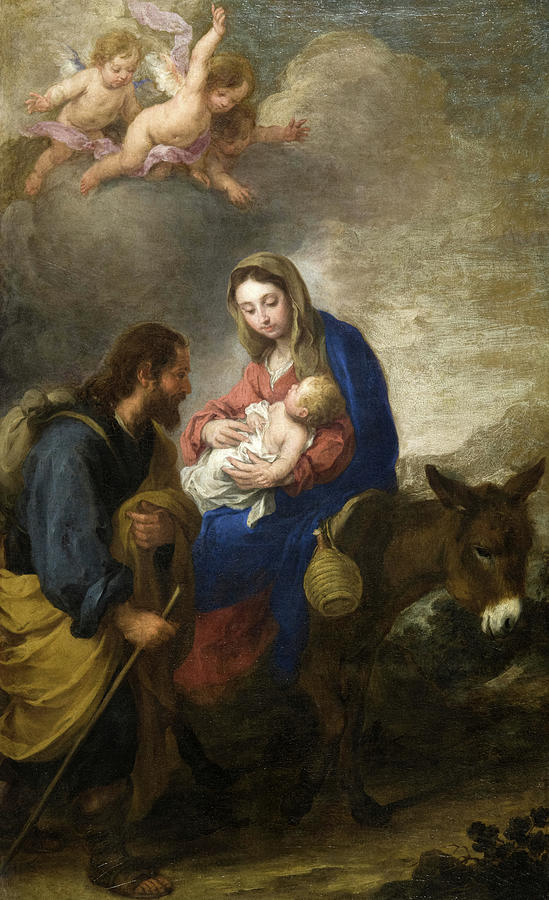
“Flight into Egypt,” painted around 1660 by Bartolomé Esteban Murillo, is a lyrical meditation on one of the most tender episodes in the life of the Holy Family. Rather than focusing on danger and haste, Murillo presents a quiet pause during the journey. Mary sits with the Christ Child in her arms, Joseph stands close in conversation, and the patient donkey waits beside them. Above, a cluster of cherubs glides through the clouds, linking the humble travelers to the heavenly realm that guides and protects them.
This painting reveals Murillo at the height of his powers as a storyteller and observer of human emotion. The scene is intimate and domestic yet also filled with theological meaning. The artist uses soft light, a restrained but glowing palette, and gentle gestures to show the vulnerability of the family, the loving bond between its members, and the quiet certainty that their path is watched over from above.
The Biblical Story Behind the Painting
The subject comes from the Gospel of Matthew, which recounts how Joseph was warned in a dream that King Herod planned to kill the newborn Jesus. In obedience to the angelic message, Joseph took Mary and the Child and fled into Egypt, where they remained until it was safe to return.
Artists have interpreted the Flight into Egypt in many ways. Some show the family in motion, crossing rugged landscapes. Others focus on miracles that happened along the way. Murillo chooses a moment of rest. His Holy Family is temporarily halted on the road, caught in a quiet interval between danger and safety. This choice allows him to explore the emotional depths of the story. Instead of dramatic movement, the painting offers contemplative stillness.
By doing so, Murillo emphasizes the human experience of the journey. The Holy Family is traveling as refugees, carrying little more than their faith and their love. Their brief pause becomes an image of trust in divine providence even when the future is uncertain.
Composition and Spatial Arrangement
The composition is vertically oriented, with the figures of Joseph, Mary, and the donkey forming a diagonal line that rises from the lower left to the upper right. This diagonal movement evokes the notion of a road stretching ahead and behind them. Mary sits near the center, slightly elevated, so her blue cloak and red dress become the main focus of color. The infant Christ, cradled in her arms, occupies the luminous focal point at the heart of the painting.
Joseph kneels or bends toward Mary and the Child from the left. His body creates a counter diagonal, stabilizing the composition and drawing the viewer back toward the central group. The donkey stands on the right, its head bowed in a gentle arc that echoes the curvature of Mary’s posture as she looks down at the Child.
Above, the composition opens into a cloud filled sky where three cherubs hover. Their forms break the upper edge of the cloud, guiding the viewer’s gaze upward. This vertical extension suggests that the earthly travelers are accompanied by invisible hosts. The lower half of the painting remains grounded, with rocks, soil, and vegetation, while the upper half dissolves into airy light, representing the spiritual dimension.
Murillo’s arrangement of figures creates a sense of intimacy that draws the viewer close. The Holy Family forms a tight triangle, a classic composition that expresses unity and stability. The donkey and the distant landscape are secondary but important, offering context and reinforcing the sense of journey.
The Holy Family as Human and Sacred
Murillo excels at portraying sacred figures with human warmth. In “Flight into Egypt,” Mary appears as a young mother wrapped in her familiar red dress and blue mantle. Her head is slightly inclined as she looks at her sleeping Child with a mixture of tenderness and quiet concern. Her face is serene, yet there is a hint of fatigue in her posture, as one would expect from a mother who has been traveling long hours.
The Christ Child lies comfortably in Mary’s arms, wrapped in light garments. His body is relaxed, his face peaceful. Murillo’s depiction of the infant emphasizes vulnerability. This is no distant, abstract symbol of divinity, but a real baby who must be carried, protected, and comforted. At the same time, the Child’s pale body catches the brightest light in the painting, visually signaling his divine identity.
Joseph is portrayed as a sturdy, humble man, dressed in practical travel clothing with a cloak and a staff. He leans forward toward Mary and the Child, his face softened with concern and admiration. The angle of his body shows both respect and affection. He is the protector, but also a loving father figure who cherishes the tiny life entrusted to his care.
By giving Joseph such a prominent place and a tender expression, Murillo underscores the importance of his obedience and guardianship. The dialogue of glances between Joseph and Mary unites them around the Child, turning the group into a circle of love and responsibility.
The Role of the Donkey and Everyday Objects
The donkey to the right is more than an incidental animal. In the story of the Flight into Egypt, the donkey traditionally carries Mary and the Child, symbolizing humble service and patience. In Murillo’s painting, the animal seems to have paused along with the family. Its head is lowered in a calm, almost contemplative manner.
Hanging from the donkey’s saddle is a small water gourd, a practical travel item that reminds the viewer of the physical realities of the journey. The presence of this simple object introduces an earthy note into the otherwise ethereal composition. It suggests the daily needs of the travelers, their dependence on basic provisions, and the hardships they face on the road.
Murillo often includes such details in his religious paintings to make the sacred story relatable. The donkey and the gourd ground the scene in the material world and highlight the simplicity of the Holy Family’s circumstances. They are not wealthy pilgrims surrounded by luxury but refugees relying on modest means.
Cherubs and the Heavenly Dimension
Above the Holy Family, three cherubs emerge from a billowing cloud. Their chubby bodies and playful gestures are typical of Murillo’s angelic figures. One cherub waves upward, another leans forward with an outstretched arm, and a third gazes down toward the scene below. Their bright flesh tones and flowing ribbons add a lively note of color against the gray and golden clouds.
These cherubs serve several purposes. Symbolically, they represent God’s protection over the family. Their presence implies that the journey is guided, that the dangers from which the family flees are known and countered by heaven. They also connect the painting to Murillo’s broader imagery of the Immaculate Conception and Marian devotion, where groups of cherubs frequently surround the Virgin.
Visually, the cherubs help balance the composition. Without them, the upper part of the canvas might appear empty or weightless. Their forms, echoing the curves of the clouds, create a rhythmic pattern that leads the eye back down toward Mary and the Child. Through them, the viewer senses that the terrestrial path of the Holy Family is wrapped in a larger, invisible drama of salvation.
Landscape and Setting
Murillo’s landscape is understated but carefully chosen. The ground beneath the figures is rocky, with patches of vegetation that appear sparse, indicating a rugged, perhaps unfamiliar terrain. This aligns with the notion that the family is traveling through foreign lands on their way to Egypt.
The horizon is low, allowing the sky to dominate the background. The clouds are thick and voluminous, painted in layers of gray, beige, and soft blue. They create an enveloping atmosphere, almost like a veil that separates the earthly plane from the heavenly. The play of light within the clouds gives them depth and life.
The path the family follows is not clearly defined, symbolizing the uncertainty of their exact route. Nevertheless, the composition suggests forward movement. Joseph’s stance, the orientation of the donkey, and the opening of the landscape imply that they will soon resume their journey. This combination of pause and implied motion captures the essence of a pilgrimage that continues beyond the frame.
Light, Color, and Murillo’s Signature Atmosphere
Murillo is renowned for his warm, diffused light and tender color harmonies. In “Flight into Egypt,” light falls gently from the upper left, illuminating the Holy Family and creating soft highlights on their faces and garments. The brightest point is the body of the Christ Child, whose pale skin glows against Mary’s red and blue clothing.
Mary’s mantle is a deep, saturated blue, contrasted with the warm red of her dress. This classic color pairing underscores her role as Mother of Christ while also tying the painting to long traditions of Marian iconography. Joseph wears earthier tones of brown, yellow, and muted blue, which align him with human labor and the everyday world.
The cherubs above are painted in delicate pinks and creams, which harmonize with the warm tones of the clouds. The palette overall is restrained, with a focus on naturalistic hues rather than high contrast. This subtlety contributes to the painting’s meditative character. There are no harsh transitions or stark shadow patterns. Instead, light seems to bathe the figures, unifying them and suggesting the presence of divine grace.
Emotional Tone and Spiritual Message
Although the underlying story involves danger and flight, the emotional tone of the painting is one of calm trust. Murillo avoids dramatic gestures or expressions of fear. Instead, the figures radiate quiet resilience. Mary’s gentle gaze, Joseph’s attentive posture, and the sleeping Child create a sense of intimate security amidst uncertainty.
This peaceful atmosphere invites the viewer to contemplate the virtues of faith, humility, and obedience. The Holy Family has responded to God’s warning by setting out on an arduous journey, yet they do so with an attitude of acceptance. The pause depicted here may be a moment of rest, prayer, or simple reflection.
The cherubs watching from above strengthen the message that those who follow God’s guidance are never truly alone. Even in exile or hardship, they are accompanied by unseen protectors. This consoling theme would have resonated strongly with seventeenth century viewers facing their own struggles, and it remains powerful for modern audiences.
Murillo’s ability to combine theological depth with human tenderness makes the painting especially moving. The Holy Family is not remote or idealized to the point of coldness. They appear approachable, sharing in the experiences of ordinary families who travel, work, and care for their children. Yet at the same time, the luminous atmosphere reminds us that this family’s journey carries the weight of salvation history.
Murillo’s Sevillian Context and Artistic Legacy
“Flight into Egypt” belongs to Murillo’s mature period in Seville, a city marked by intense religious devotion, charitable institutions, and a rich artistic culture. Murillo created numerous works for churches, convents, and private patrons who valued images that combined doctrinal clarity with emotional appeal.
In this context, the subject of the Flight into Egypt would have held particular significance. Seville was a port city involved in trade and exploration, where journeys and migrations were part of daily life. Many viewers would have understood the vulnerability of travel and the need for divine protection on dangerous routes.
Murillo’s gentle style, with its soft edges and affectionate figures, distinguished him from some of his more austere or dramatic contemporaries. In “Flight into Egypt,” his characteristic warmth is on full display. The painting stands as an example of how he could turn a biblical episode into a relatable and uplifting vision that encouraged trust in Mary, Joseph, and the Christ Child.
The legacy of this work extends beyond its time and place. It has often been reproduced and admired for its serenity and pictorial beauty. It exemplifies the fusion of Baroque devotion with a more intimate, almost domestic sensibility that made Murillo so beloved.
Symbolic Layers and Interpretive Possibilities
On a symbolic level, “Flight into Egypt” invites multiple readings. The journey can represent the spiritual pilgrimage of every believer, leaving behind the realm of sin or oppression and moving toward a place of deeper freedom under God’s guidance. The temporary pause suggests moments of reflection along this path, when one must rest, regroup, and reaffirm trust in divine providence.
The Christ Child’s peaceful sleep while being carried through danger symbolizes confidence in the Father’s plan. Mary’s protective embrace echoes the Church’s role in safeguarding faith. Joseph’s sturdy presence speaks of responsible leadership grounded in obedience.
The donkey, often associated with humility, reminds viewers that God chooses simple means to accomplish great purposes. The water gourd highlights dependence on daily sustenance that God provides. The cherubs in the sky signal that even when dangers are real, the final word belongs to mercy and care from above.
Murillo’s soft, embracing light brings these layers together. The painting becomes a visual prayer, inviting those who look at it to place their own journeys under the protection of the Holy Family and the angels who accompany them.
Conclusion
“Flight into Egypt” by Bartolomé Esteban Murillo is a masterful fusion of narrative, emotion, and devotion. Through a simple pause on a rocky road, the artist reveals the courage and tenderness of the Holy Family, their dependence on God, and the constant presence of heavenly guardians.
The gentle interaction between Mary, Joseph, and the Christ Child, the humble donkey, the practical traveling gear, and the hovering cherubs all contribute to a rich scene that feels both earthly and otherworldly. Murillo’s warm palette, soft light, and delicate modeling create an atmosphere of quiet trust, transforming a story of flight and danger into an image of consolation and hope.
For viewers today, “Flight into Egypt” continues to speak of faith in uncertain times, the strength of family bonds, and the belief that every difficult journey is accompanied by unseen grace.