Image source: wikiart.org
Introduction to “Angel holding the tunic and dice”
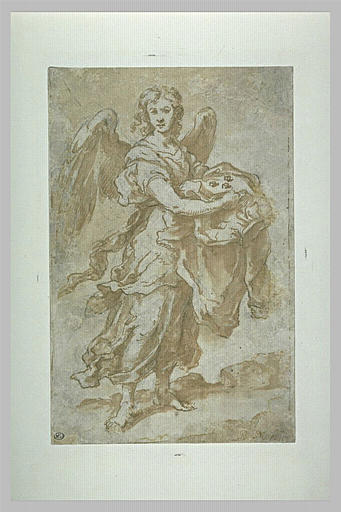
“Angel holding the tunic and dice,” created by Bartolome Esteban Murillo around 1660, is a small yet powerful devotional drawing that condenses the drama of the Passion into a single figure. Executed in brown ink and wash on paper, the work shows an angel stepping lightly across a suggestion of ground while presenting Christ’s seamless tunic and the dice used by Roman soldiers to gamble for it at the foot of the cross.
Although the image is monochrome and modest in size, Murillo manages to express deep theological meaning and emotional resonance. The drawing reveals his mastery as a draughtsman and his ability to translate complex spiritual ideas into clear, accessible visual form. It also offers a rare look into his creative process, where angels and Passion symbols were carefully studied before being incorporated into larger altarpieces and narrative canvases.
Murillo’s devotional context and the iconography of the Passion
Seventeenth century Seville was one of the most intensely Catholic cities in Europe. Confraternities, monasteries, and churches commissioned artworks that encouraged meditation on the life, death, and resurrection of Christ. The Passion in particular held a central place in Spanish spirituality. Believers were urged to contemplate each episode of Christ’s suffering, not only as a historical narrative but as an invitation to personal conversion.
Within this context, artists like Murillo often represented the instruments of the Passion: the cross, nails, crown of thorns, ladder, sponge, tunic, and dice. These objects, sometimes called the Arma Christi, served as visual reminders of Christ’s humiliation and the human cruelty that he willingly endured. Murillo’s drawing focuses on two of these instruments, the tunic and the dice, and entrusts them to an angelic figure.
By placing such ordinary objects in the hands of a heavenly messenger, Murillo elevates their significance. The tunic is no longer just a piece of cloth seized by soldiers. It becomes a sacred relic, symbol of Christ’s unity and purity. The dice cease to be mere tools of gambling and become emblems of human indifference and chance confronted by divine purpose. The angel’s role is to present these symbols to the viewer, guiding contemplation and memory.
Composition and the dynamic pose of the angel
Murillo composes the drawing within a tall rectangular field that echoes the vertical stance of the angel. The figure occupies most of the central space, yet there is still room around it for breath and movement. The angel stands with one foot forward and the other slightly back, knees bent as if in mid step. This contrapposto creates a sense of motion and keeps the figure from appearing static.
The tunic is held in both hands, spread outward like an offering. The folds of the cloth sweep across the angel’s torso, forming a horizontal band that balances the vertical thrust of the body. Nestled within the cloth are the dice, small yet clearly indicated. Their presence demands close viewing, rewarding those who attend carefully to the details.
The angel’s wings rise behind the figure in two broad shapes. They are slightly asymmetrical, with one wing more extended than the other, which reinforces the sense of motion. Murillo uses the wings not only to identify the figure as celestial but also to frame the head and shoulders, directing attention to the angel’s face and to the objects it carries.
The ground is indicated with a few suggestive strokes and patches of wash. There is no elaborate landscape. Instead, the minimal setting suggests that the angel stands on the threshold between earth and heaven, perhaps stepping out of a cloud bank or a rocky Golgotha-like terrain. This ambiguity allows the viewer to imagine the scene unfolding either within the narrative of the Passion or in a timeless spiritual space.
The angel’s expression and gesture
The emotional core of the drawing lies in the angel’s face and gesture. Murillo gives the figure youthful features, with large eyes, softly rounded cheeks, and slightly parted lips. The angel looks outward, not down at the tunic or dice but toward the viewer or toward some unseen divine presence. The gaze is serious yet gentle, conveying both compassion and quiet urgency.
The arms extend forward, elbows bent, holding the tunic as if presenting it for careful inspection. This gesture is both offering and appeal. The angel does not clutch the cloth protectively, nor does it cast it aside. Instead, it invites the viewer to consider these objects, to remember the event they recall, and to respond inwardly. The effect is that of a silent preacher, speaking through posture and attribute rather than through words.
Murillo’s handling of the hands enhances this impression. The fingers curve naturally around the fabric, gripping it securely yet delicately. One can almost feel the weight and softness of the cloth. The care with which the angel holds the tunic suggests reverence. It is as if the garment is fragile, not materially but spiritually, requiring respectful handling because of what it represents.
Tunic and dice as symbols of the Passion
The tunic and dice carry rich layers of meaning that seventeenth century viewers would have recognized instantly. According to the Gospel of John, Christ’s tunic was seamless, woven from top to bottom. Rather than tear it into pieces, the Roman soldiers cast lots to decide who would receive it. This detail resonated with theologians, who saw the seamless garment as an image of the unity of Christ’s person, the wholeness of his mission, and even the undivided nature of the Church.
Murillo emphasizes the tunic’s softness and volume. It billows in generous folds, hinting at a garment that once clothed a living body. Its very emptiness is poignant. The absent wearer reminds the viewer of Christ now stripped and crucified. At the same time, the tunic’s wholeness and intactness suggest that death could not divide or destroy what Christ truly is.
The dice introduce a contrasting note. They are small, hard, and associated with games of chance. In the Passion story they expose the soldiers’ indifference: while Christ suffers on the cross, they are busy gambling for his clothing. For a devout viewer, the dice might symbolize humanity’s tendency to treat sacred things casually, to risk eternal goods for fleeting pleasures.
By bringing tunic and dice together in the angel’s arms, Murillo juxtaposes divine unity and human frivolity, love and indifference. The angel appears as a mediator who holds these opposites before our eyes and asks what we will choose. Will we side with the soldiers, treating Christ’s gift as an opportunity for entertainment, or will we share the angel’s reverent grief?
Line, wash, and the beauty of Murillo’s draftsmanship
Even in a limited medium, Murillo demonstrates remarkable skill. The drawing is made with pen and brown ink, enriched with brown wash to create areas of shadow and depth. He uses line to define contours and essential folds, while the wash provides volume and atmospheric softness.
The lines of the angel’s face and hands are delicate and precise. Murillo uses finer strokes here to preserve the figure’s humanity and tenderness. In the wings and robe, he allows his pen to move more freely, sketching broad feather shapes and flowing drapery with confident energy. This variation in line weight keeps the drawing lively and prevents it from becoming stiff.
The wash is applied in transparent layers. Darker tones appear under the arms, along the inner folds of the robe, and in the deeper parts of the wings. Lighter wash touches suggest the cast shadow on the ground and the subtle transitions in the cloth. Areas left nearly untouched by wash, such as parts of the face and tunic, stand out as highlights. The result is a convincing play of light that models the forms without overwhelming the paper’s surface.
Because the drawing is monochrome, the viewer’s eye is especially attuned to these tonal relationships. The image has a quiet harmony that color might disrupt. The brown ink evokes the warm hues of sepia, giving the scene an antique, contemplative atmosphere that suits its subject.
Movement, drapery, and spiritual energy
Murillo’s angels rarely stand completely still. In this drawing, motion is expressed through the interplay of drapery and limbs. The robe swirls around the angel’s legs, suggesting a breeze or the momentum of walking. The hem lifts slightly, and the fabric wraps around the knees, implying that the figure is in transition rather than fixed.
This sense of movement has spiritual significance. Angels in Christian art often symbolize the active presence of God in the world. They move between heaven and earth, carrying messages, offering protection, or presenting sacred objects. Murillo’s angel seems to have just stepped into our space, bringing the tunic and dice from the scene of the Crucifixion or from a heavenly treasury of memory.
The drapery also helps express the angel’s inner energy. The flowing lines and shifting folds suggest that the figure is animated by something more than physical inertia. There is a sense of readiness, as if the angel might at any moment adjust its grip, bow its head, or turn to lead the viewer toward deeper contemplation. Murillo uses the robe as a visual echo of the unseen spiritual forces at work.
The drawing as a devotional tool and preparatory study
Drawings like “Angel holding the tunic and dice” likely had a double function. On one hand, they were working tools in the artist’s studio. Murillo would experiment with poses, gestures, and symbolic attributes on paper before transferring selected figures into larger oil paintings. An angel of this sort could appear in a composition of the Crucifixion, an altarpiece showing the instruments of the Passion, or a vision of a saint.
On the other hand, such drawings were also appreciated as finished works. Wealthy patrons, monasteries, or clergy might keep them as objects for private devotion, treasuring the immediacy of the artist’s hand and the intimacy of the small format. The simple, direct style of the medium makes the drawing particularly suited to quiet prayer, inviting the viewer to draw close and reflect rather than to stand at a distance and admire grand spectacle.
In either case, the drawing reveals Murillo’s capacity to think visually about theology. Rather than merely illustrating a biblical episode, he isolates a crucial detail and meditates on it through line and form. The result is not just a study of anatomy or costume but an exercise in spiritual imagination.
Emotional resonance and contemporary relevance
Although rooted in Counter Reformation Spain, “Angel holding the tunic and dice” still speaks powerfully to modern audiences. The basic human themes it touches remain relevant: the contrast between sacred meaning and casual indifference, the invitation to take responsibility for the suffering of others, and the call to hold memory with reverence.
The image can be seen as a visual metaphor for how we handle the pain and vulnerability present in our own time. The tunic may stand for the dignity of those who suffer, while the dice represent the forces of chance, exploitation, or apathy that toy with human lives. The angel’s careful presentation of both invites us to look honestly at these realities rather than turning away.
For viewers who share the Christian faith, the drawing offers a rich focus for meditation on the Passion. It encourages a personal response: not just to sympathize with Christ’s suffering but to recognize the ways in which everyday choices resemble the soldiers’ game of dice or the angel’s attitude of reverent care. The small scale and monochrome palette make the encounter feel intimate, as if the angel has approached a single soul rather than addressing a crowd.
Conclusion
“Angel holding the tunic and dice” is a quiet masterpiece of Baroque draftsmanship and spiritual insight. With a few strokes of brown ink and gentle washes, Bartolome Esteban Murillo creates a figure that carries profound theological symbolism and emotional depth. The angel’s poised step, attentive gaze, and careful presentation of Christ’s tunic and the soldiers’ dice synthesize the drama of the Passion into a single contemplative image.
The drawing reveals how Murillo combined technical skill with devotional sensitivity. His subtle handling of line, light, and movement animates the angel and invites viewers into an encounter with sacred memory. More than three centuries after its creation, the image continues to whisper its message: remember the suffering that love endured, and choose whether to treat it as a game of chance or as a gift held with reverence.
