Image source: wikiart.org
Introduction to “Angel holding registration” by Bartolomé Esteban Murillo
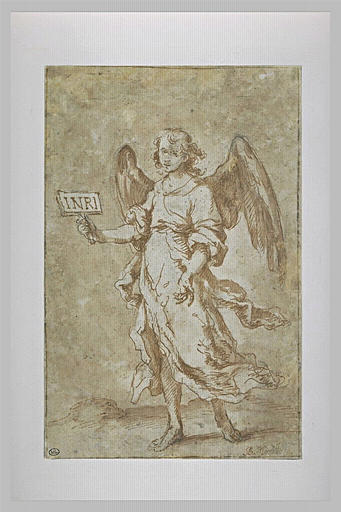
“Angel holding registration,” created around 1660 by Bartolomé Esteban Murillo, belongs to the intimate world of his devotional drawings that explore angels and the instruments of Christ’s Passion. Executed in a restrained monochrome palette, likely pen with brown ink and wash, the work forgoes color in favor of line, gesture, and atmosphere.
At the center stands a youthful angel who steps lightly across the ground while holding up a small plaque bearing the inscription “INRI.” This inscription, the titulus once fixed above Christ on the cross, transforms the simple board into a powerful symbol of the Crucifixion. By placing it in the hands of an angel, Murillo turns a historical object into a timeless emblem carried and contemplated in heaven.
Although small in scale, the drawing carries a surprising emotional weight. It reveals Murillo’s sensitivity to the expressive potential of the human figure and his understanding of how a few carefully chosen details can evoke entire chapters of Christian theology.
Composition and Structure
The composition is straightforward yet carefully balanced. The angel occupies almost the entire height of the sheet, slightly left of center, with one foot placed firmly on the ground and the other stepping forward. This stance creates a sense of movement, as if the figure is in the act of presenting the inscription to the viewer.
Murillo arranges the angel’s body along a subtle S curve. The head tilts gently downward, the shoulders angle softly, the hips counterbalance, and the legs shift in opposite directions. This sinuous arrangement gives the figure grace and prevents stiffness. It also recalls the classical contrapposto pose, adapted here to a heavenly messenger.
The inscription “INRI” is held in the angel’s right hand, slightly projecting outward from the body into the empty space of the paper. This creates a focal point that immediately captures the viewer’s attention. The plaque is small yet visually prominent because it breaks the vertical rhythm of the figure with its firm horizontal line. The object reads like a visual statement, a silent proclamation contained in four letters.
Behind the angel, Murillo suggests space with minimal means. A few faint strokes indicate the ground. The rest of the background is an airy field of lightly modulated tone. By avoiding architectural framing or detailed scenery, he allows the figure and inscription to stand out clearly, as if suspended between earth and heaven.
The Angel’s Pose and Gesture
The character of the angel emerges primarily through pose and gesture. The figure walks with a measured, almost ceremonial step. One foot is placed forward, heel slightly raised, toes pointing outward. The trailing leg stays behind, lending the body a sense of forward momentum. This movement is gentle rather than dramatic, evoking the quiet purpose of a messenger who carries a precious sign.
The left arm hangs downward, holding a slender attribute that may represent a reed or a staff, another instrument associated with Christ’s Passion. Its vertical line echoes, in softer form, the upright bearing of the angel. The right arm extends outward to present the “INRI” inscription. The elbow is bent, and the hand delicately grips the edge of the tablet. This presentation is neither aggressive nor casual. It is respectful, as though the angel were offering the viewer an object of contemplation.
The head is turned slightly to the left, away from the plaque. The angel does not look at the viewer directly but gazes downward, perhaps in modesty or sorrowful reflection. This indirect gaze prompts the viewer to focus not on the angel’s face, but on the sign that the angel carries. The figure thus becomes a mediator, directing attention to the meaning rather than to itself.
Facial Expression and Emotional Tone
Murillo renders the face with delicate, economical strokes. Soft waves of hair fall around the forehead and cheeks, partly obscuring one eye and giving the figure a gentle, introspective quality. The features are youthful and somewhat androgynous, in keeping with traditional depictions of angels as beings beyond simple gender classification.
The expression is calm, tinged with seriousness. There is no overt anguish, yet the lowered eyes and slight downturn of the mouth suggest awareness of the suffering that the inscription represents. This subtle emotion communicates a contemplative sorrow rather than a dramatic grief. It is as if the angel carries not only a sign but also the memory of the Passion.
Murillo’s choice to avoid strong emotional extremes allows the drawing to function as a quiet aid to meditation. Viewers are not overwhelmed by theatrical pathos. Instead, they are invited into a more reflective mood, one that mirrors the angel’s own inward disposition.
Drapery and the Sense of Movement
The angel’s robe, tied at the waist with a simple sash, is one of the most striking visual features of the drawing. Murillo uses energetic yet controlled lines and washes to convey flowing cloth. The fabric streams around the legs, flares slightly behind, and bunches in folds at the knees and elbows.
These folds serve multiple purposes. They emphasize the movement of the figure, as though the robe responds to the step forward and to a subtle breeze. They also give weight and volume to the otherwise slender body, making the angel appear both ethereal and substantial. The interplay of light and shadow in the drapery suggests the presence of a real body underneath, not a ghostly apparition.
The hems of the garment show ragged, fluttering edges. These irregular contours break up otherwise smooth lines and encourage the eye to wander across the figure, following the rhythms of cloth. With sparing touches of darker wash, Murillo models the recesses of folds, leaving other areas nearly white. This contrast adds depth and makes the garment appear to shimmer slightly, appropriate to a heavenly being.
Wings and the Angelic Identity
The wings emerging from the angel’s back confirm its identity as a celestial messenger. Murillo depicts them with long feathers, extending vertically before curving slightly outward. They are not spread in flight but remain at rest, following the downward orientation of the figure’s overall posture.
The wings are shaded more heavily than other parts of the figure, creating a visual anchor that balances the lighter robe. Their darker tone ensures that the angel stands out clearly against the pale background. Murillo hints at overlapping feathers with a few quick strokes rather than painstaking detail, trusting the viewer’s eye to complete the impression.
Symbolically, the relaxed wings communicate that the angel is not in swift motion but in a moment of gentle procession. The focus is on the message being carried, not on the spectacle of flight.
The “INRI” Inscription and Passion Symbolism
The small plaque labeled “INRI” is the key to understanding the drawing’s spiritual content. These four letters stand for the Latin inscription “Iesus Nazarenus Rex Iudaeorum” (Jesus of Nazareth, King of the Jews) that, according to the Gospel narratives, Pontius Pilate ordered to be placed on Christ’s cross. Over time, the titulus became one of the standard instruments of the Passion, depicted along with the cross, crown of thorns, nails, spear, and sponge.
By isolating this particular element and placing it in the hands of an angel, Murillo emphasizes the power of words and their role in salvation history. The inscription that once mocked or labeled Christ becomes, in the context of faith, an affirmation of his kingship and sacrificial love. The angel acts as guardian and herald of this transformed meaning.
Visually, the plaque is very simple: a rectangular board with the letters clearly inscribed in dark strokes. Its stark design contrasts with the flowing drapery and organic forms of the angel, enhancing its function as a clear, legible sign. The careful legibility indicates that Murillo expects the viewer to read the letters and recall the narrative. Thus the drawing engages both sight and memory.
Technique and Drawing Style
“Angel holding registration” offers an intimate look at Murillo’s drawing technique. The artist uses pen lines to establish the contours of the figure and to describe key details such as facial features, fingers, and folds of cloth. These lines are fluid rather than rigid, sometimes tapering or breaking, which lends a lively, spontaneous quality to the image.
Over this linear framework he applies washes of brown ink to suggest shadow and modulation. He keeps the tonal range relatively narrow, with only a few spots of stronger darkness in the wings, under the robe, and around parts of the inscription. Large areas of the paper remain exposed, serving as highlights and giving the drawing an airy luminosity.
The background seems loosely brushed with a light wash that varies in density, suggesting an undefined space rather than a flat blank. This wash prevents the figure from floating in emptiness while still keeping the environment open and spiritual. Tiny specks and accidental marks in the wash contribute to a sense of age and texture, reminding the viewer that this is a handcrafted object.
Overall, the technique strikes a balance between control and freedom. Murillo’s secure sense of anatomy and drapery allows him to draw with confidence, while the loose wash introduces softness and mystery.
Comparison with “Angel Carrying the Cross” and Related Works
This drawing forms a natural companion to Murillo’s “Angel Carrying the Cross,” created around the same time. In both images, angels bear instruments of the Passion, linking heavenly beings with the central events of Christ’s suffering. However, each drawing emphasizes a slightly different aspect of devotion.
“Angel Carrying the Cross” focuses on the physical weight and volume of the cross, suggesting the labor of bearing suffering and the embrace of sacrifice. “Angel holding registration” shifts attention toward the verbal and declarative dimension of the Passion, highlighting the meaning inscribed above the crucified Christ.
Stylistically, the two drawings share similar techniques: monochrome wash, flowing drapery, and youthful angelic figures. Yet the pose here is more frontal and open, inviting the viewer to face the inscription directly. Together, the two works may have been intended as part of a series of angels bearing different Passion instruments, perhaps as studies for a larger ensemble in a church or for prints used in private devotion.
Spiritual and Devotional Significance
For seventeenth century viewers steeped in Catholic spirituality, “Angel holding registration” would have carried layered devotional meanings. It would call to mind the events of Good Friday, the proclamation of Christ’s kingship, and the paradox that an instrument of ridicule became a title of glory.
The angel’s calm demeanor and simple act of presentation encourage meditative prayer rather than emotional agitation. A viewer might imagine the angel approaching quietly, extending the plaque, and inviting reflection on what those letters mean personally. The message is not shouted but offered.
Because the artwork is small and intimate, it could easily accompany private contemplation, perhaps alongside a rosary or a book of meditations. The monochrome technique aligns with the quiet mood, allowing the mind to focus on the spiritual message rather than on decorative color.
Even for contemporary viewers outside the original devotional context, the drawing conveys a sense of gentle solemnity. The combination of youthful grace and symbolic burden speaks about the carrying of meaning across time, and about the way history’s wounds are remembered and interpreted in light of faith.
Place in Murillo’s Artistic Legacy
Bartolomé Esteban Murillo is often celebrated for his luminous oil paintings of the Virgin, Christ, and street children of Seville. Works like “Angel holding registration” remind us that behind those large canvases lies a disciplined and imaginative draftsman. His drawings reveal the underlying grammar of his art: clear composition, expressive line, and sensitivity to human and angelic form.
This particular drawing shows how Murillo could distill complex theological ideas into a single figure and a single object. It reveals his capacity to work economically, using minimal means to evoke maximum significance. For art historians and admirers, these sheets offer invaluable insight into his working methods and his devotional imagination.
At the same time, “Angel holding registration” has an independent beauty. It stands as a finished work of art in its own right, not merely as a preparatory sketch. Its balanced composition, restrained elegance, and spiritual focus encapsulate many of the qualities that make Murillo one of the central figures of the Spanish Baroque.
Conclusion
“Angel holding registration” by Bartolomé Esteban Murillo is a finely crafted meditation on the Passion of Christ and the power of sacred words. Through a youthful angel stepping forward with a small plaque bearing the inscription “INRI,” Murillo transforms a historical detail into a timeless symbol carried lovingly by heaven.
The drawing’s graceful composition, flowing drapery, and subtle facial expression create a mood of quiet reverence. The monochrome technique emphasizes form and meaning, while the open background situates the figure in a spiritual, undefined space. As part of Murillo’s broader exploration of angels and Passion instruments, this work reveals his deep sensitivity to devotion and his mastery of line and wash.
For modern viewers, the image continues to inspire reflection. It invites us to consider how signs and words can bear profound significance, how suffering can be remembered as love, and how art can translate theology into a language of gesture and grace.