Image source: wikiart.org
Introduction to Rebecca and Eliezer
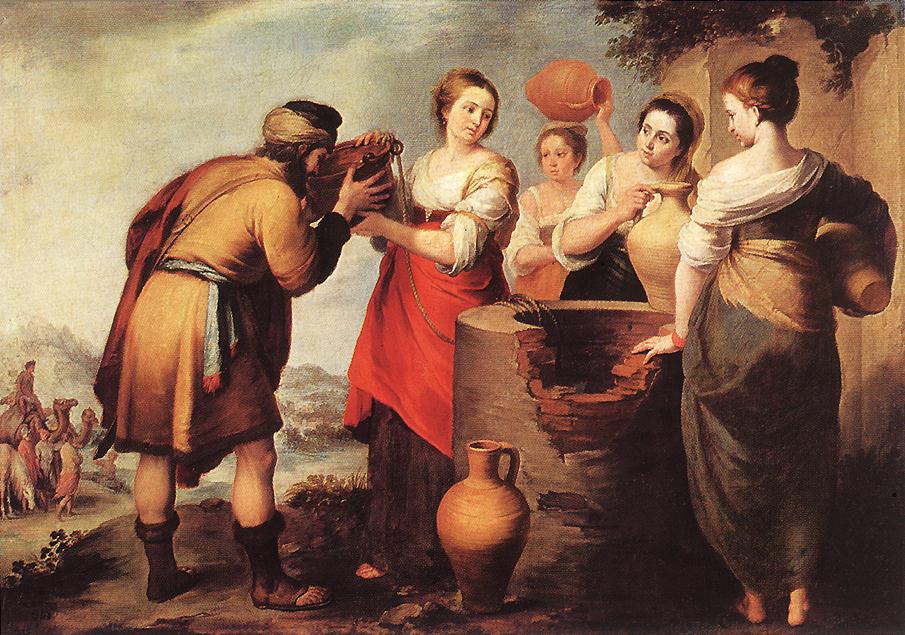
“Rebecca and Eliezer,” painted by Bartolome Esteban Murillo around 1660, presents a gentle and humanized interpretation of a well known Old Testament scene. At a sunlit well, a weary traveler drinks from a vessel offered by a young woman dressed in striking red, while other women fill their jars and watch the encounter with curiosity. In the distant background, a caravan of camels waits, almost dissolving into the hazy landscape.
Murillo’s painting captures the moment when Abraham’s servant Eliezer recognizes Rebecca as the divinely chosen bride for Isaac. Instead of emphasizing miraculous spectacle, the artist focuses on the warmth of hospitality, everyday gesture and subtle psychological interaction. It is a biblical narrative brought down to earth, transformed into something that feels as immediate and natural as a scene from daily life in seventeenth century Spain.
The Biblical Story Behind the Scene
The story of Rebecca and Eliezer comes from the Book of Genesis. Abraham, advanced in years, sends his trusted servant to his ancestral homeland to find a suitable wife for his son Isaac. The servant prays for a sign at the well: the woman who willingly gives water to him and to his camels will be the one chosen by God.
Rebecca arrives with her jar. She not only offers the servant water but eagerly draws water for all his animals. Her generosity, energy and kindness reveal her character, and Eliezer recognizes in her the answer to his prayer. He then bestows gifts upon her and eventually arranges her marriage with Isaac.
Murillo concentrates on the first part of this story, the initial encounter at the well. The painting shows the moment when Rebecca holds a vessel from which Eliezer drinks, while other women and the distant caravan provide narrative context. By focusing on this exchange, the artist underlines the virtues of hospitality, charity and trust in divine providence.
Composition and the Rhythm Around the Well
The well at the center of the painting organizes the entire composition. It acts as both literal water source and symbolic meeting point. Murillo places it slightly off center, allowing for a dynamic yet balanced arrangement of figures around it.
On the left side, Eliezer bends forward in a deep bow, holding the drinking vessel with both hands. His posture expresses physical thirst and spiritual gratitude. He leans into the painting, drawing the viewer into the story. Directly opposite him stands Rebecca, slightly turned toward us. Her red dress and white blouse catch the eye, making it clear that she is the protagonist. Her extended arm bridges the gap between them, forming a diagonal that guides the viewer’s gaze from servant to maiden.
To the right of Rebecca, three other young women cluster around the well. One holds a large jar, another rests a hand on the well’s edge, and the third, in profile at the far right, carries her vessel on her hip. Their bodies create a gentle curve that echoes the shape of the well and leads the eye back toward Rebecca.
The background is kept relatively open. A low horizon line allows for a broad expanse of sky, while at the far left a train of camels and figures moves toward the well. This caravan reminds viewers that the servant has traveled a long distance and that more action will follow. Yet Murillo keeps these elements small and subdued so that they support rather than compete with the foreground group.
Characterization of Rebecca
Murillo’s Rebecca is not a stylized biblical heroine. She looks like a young Sevillian woman with rosy cheeks, clear eyes and a calm, confident demeanor. Her facial expression is a mixture of modesty and curiosity. She seems aware that something important is happening, even if she does not yet fully understand it.
Her posture conveys both grace and strength. She stands firmly, weight settled on one leg, while her arms move freely to hold the vessel. The vivid red of her skirt and the soft ocher of her blouse contrast with the neutral tones around her, ensuring that she remains the visual and narrative center. A simple chain at her waist and a delicate necklace around her neck suggest modest adornment rather than extravagant wealth.
By giving Rebecca such a natural, approachable appearance, Murillo invites viewers to see in her an ideal of everyday virtue. Her kindness to the stranger and readiness to serve become qualities that the viewer can admire and imitate. The biblical heroine becomes, in his hands, a model of practical charity and feminine strength.
Eliezer as Humble Servant and Grateful Pilgrim
On the left, Eliezer’s figure completes the moral and emotional dynamic of the scene. He is depicted as an older man with a beard, dressed in travel worn garments tied with a simple belt. His knees are slightly bent, his back bowed. Holding the vessel with both hands, he drinks with eagerness, yet his posture expresses deep respect.
Murillo surrounds Eliezer with earth tones and muted colors. His tunic is a dusty yellow, his mantle a warm but subdued red. These tones harmonize with the rocky path at his feet and the distant landscape. The effect is to portray him as a man of the road, someone who has traveled far and bears the marks of fatigue.
At the same time, there is dignity in his humility. The bowed head and clasped vessel convey gratitude not only to Rebecca but to the God who has answered his prayer. Murillo thus balances the servant’s social role with his spiritual nobility. The viewer sees a man who is faithful to his mission and receptive to divine guidance.
The Women at the Well and Everyday Life
The three additional women around the well play an important role in the painting. They provide narrative realism, indicating that the well is a communal place where many come to draw water. Their presence also allows Murillo to explore variations in posture, dress and expression.
The woman immediately behind Rebecca holds a large terracotta jar on her shoulder and looks at the servant with intent curiosity. Her slightly tilted head and raised eyebrows suggest that she is trying to assess the unusual traveler and his request. Next to her, a younger girl carries a smaller jar and gazes toward the interaction with quieter interest.
At the far right, another woman stands with her back partially to us, her face in profile. She also carries a jar and seems about to move away, perhaps returning home. Her placement at the edge of the canvas and her poised step add a sense of movement and daily routine. The world of the painting does not stop for the biblical drama. Everyday life continues around the moment of divine selection.
Through these figures Murillo gently fuses sacred history with seventeenth century reality. Their hairstyles, clothing and gestures resemble those of women in contemporary Spain. This blending helps viewers feel that the biblical story is not remote, but touches ordinary social situations.
Color Harmony and the Warmth of Murillo’s Palette
The color scheme of “Rebecca and Eliezer” is dominated by warm earth tones, soft blues and muted greens. The sky is a pale, hazy blue that fades into warm clouds, suggesting either early morning or late afternoon light. The landscape in the background uses subdued greens and browns, echoing the garments of the figures and the clay of the well.
Rebecca’s vivid red dress forms the strongest color accent. Murillo places it at the center of the composition so that it acts as a visual magnet. The deep warmth of the red is balanced by the golden ocher of her blouse and the soft white of the sleeves. The servant’s clothing mirrors this range with red and yellow tones, creating a color dialogue that highlights their connection.
The terracotta jars and the stone of the well are painted in rich oranges and browns that catch the sunlight, adding depth to the foreground. These hues harmonize with the warm skin tones of the figures, giving the entire scene a sense of cohesion. Murillo’s palette creates an atmosphere of mild Mediterranean heat and gentle radiance that suits the theme of hospitality and blessing.
Handling of Light and Spatial Depth
Light in this painting is gentle rather than dramatic. Unlike some Baroque artists who favor strong contrasts, Murillo uses soft transitions between light and shadow. A diffuse, natural light source seems to come from the left, illuminating the figures and casting mild shadows to the right.
Rebecca’s face and upper body are bathed in this light, emphasizing her role as chosen bride. The servant’s head and back receive slightly less light, which nonetheless is enough to reveal the textures of his clothing and the weariness of his posture. The women at the right are painted in half tones, with subtle highlights on their shoulders and jars.
The landscape recedes into atmospheric haze, creating a sense of depth. The caravan of camels in the distance appears lighter and less detailed, consistent with the effect of distance in natural light. Murillo’s use of atmospheric perspective enhances the realism of the scene and helps maintain focus on the foreground action.
Symbolism of the Well, the Jars and the Caravan
Several elements in the painting carry symbolic resonance beyond their practical function. The well is the most obvious. In many biblical narratives, wells are places of encounter and covenant. They are sources of life, essential for survival in arid regions, and thus natural settings for meetings that shape family and tribal history. In this scene, the well becomes the place where divine providence reveals itself through daily necessity.
The jars, carried by the women, are symbols of service and domestic labor. Rebecca’s willingness to draw water for the stranger and his camels reflects generosity that goes beyond what is strictly required. Her jar, therefore, becomes a sign of her capacity for self giving.
The caravan in the background, with its camels and attendants, reminds viewers of Abraham’s distant household and of the long journey that will take Rebecca to her new life. It points forward to the future marriage and the continuation of the covenant line through Isaac. At the same time, its placement on the far left suggests that the decisive moment is happening now, at the well.
Murillo’s Humanizing Approach to Sacred History
Murillo had a distinctive ability to infuse sacred themes with warmth and accessibility. In “Rebecca and Eliezer” he does not rely on dramatic miracles or overt signs of divine intervention. Instead, he shows how God’s guidance works through ordinary actions: offering a drink, drawing water, conversing with a stranger.
The figures’ faces are expressive yet restrained. There are no theatrical gestures or exaggerated emotions. The atmosphere is one of calm, curiosity and simple kindness. This humanizing approach reflects a theological emphasis of Murillo’s time, which encouraged believers to find traces of the divine in everyday life and to see biblical figures as companions and models rather than distant legends.
Murillo also subtly incorporates elements of Spanish rural life, such as the clothing and pottery, thereby connecting the ancient Middle Eastern story with the daily experience of his Sevillian viewers. This fusion invites contemplation of how the promises of God unfold in every generation and culture.
Narrative Flow and Implied Future
Although the painting captures a single moment, its composition and details imply a larger narrative arc. On the left, the approaching caravan hints at the past journey and the future departure. In the center, the exchange of water and gaze between servant and maiden signals recognition and choice. On the right, the women’s preparations to leave or continue drawing water show that life moves forward.
The viewer, familiar with the biblical story, knows that Eliezer will soon present Rebecca with gifts, and that negotiations with her family will follow. Murillo does not depict these later events. Instead he chooses the first spark, the initial gesture of hospitality that sets everything in motion. This focus on the beginning invites reflection on how significant life changes often grow from small acts of kindness.
Emotional Resonance and Moral Themes
At its heart, “Rebecca and Eliezer” conveys themes of trust, generosity and vocation. Eliezer has trusted in God’s guidance and finds his prayer answered in the simple act of a young woman offering him water. Rebecca, without knowing the full consequences, is willing to serve the stranger and his camels. Her selfless act reveals the character that prepares her for her future role.
For viewers, the painting suggests that everyday encounters may carry unseen significance. The stranger who appears by the well may be part of a larger plan. Murillo thus encourages hospitality and attentiveness to others, presenting these virtues as paths by which divine providence enters human life.
The painting also quietly honors the labor of women. The repeated actions of drawing water, carrying jars and tending to the household are shown not as drudgery but as dignified work where important spiritual moments can occur.
Conclusion
“Rebecca and Eliezer” is a masterful example of Bartolome Esteban Murillo’s ability to transform biblical history into a scene that feels close, warm and deeply human. Through careful composition around the central well, expressive yet natural characterization and a harmonious palette of earth tones and radiant reds, Murillo presents the meeting of Abraham’s servant and Rebecca as a moment of quiet destiny.
The humble act of giving a drink becomes a sign of divine election, while the presence of other women and the distant caravan weave the event into the fabric of daily life and ongoing story. In this canvas, sacred providence and ordinary kindness intertwine, inviting viewers to consider how their own acts of service may participate in a larger plan.
More than three centuries after its creation, the painting continues to speak to themes of hospitality, faithfulness and the discovery of vocation. Murillo’s gentle realism and luminous warmth ensure that Rebecca and Eliezer remain a living pair of figures, meeting at the well in every generation of viewers who pause to contemplate their story.