Image source: wikiart.org
Introduction to “Saint John the Baptist Pointing to Christ”
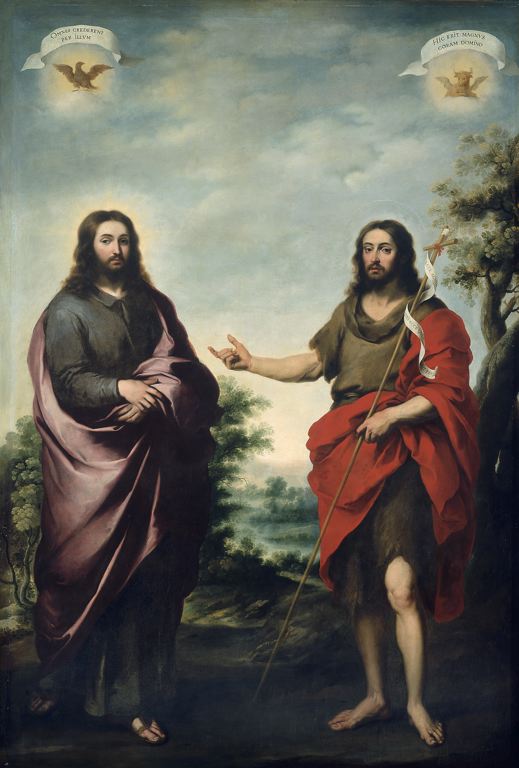
“Saint John the Baptist Pointing to Christ,” painted around 1655 by Bartolomé Esteban Murillo, is a serene yet powerful vision of the meeting between the herald and the Messiah. Two full length figures dominate the canvas. On the left stands Christ, calm and self contained, wrapped in a majestic violet cloak. On the right is John the Baptist, barefoot and dressed in his rough camel skin tunic, a vivid red drapery swirling around him as he gestures openly toward Jesus and holds his tall reed cross.
The scene unfolds in a quiet landscape beneath a pale sky. At the top of the composition two floating cartouches contain Latin inscriptions and small images of the eagle and the lamb, visual echoes that clarify who these figures are and what their relationship means. Murillo creates a painting that is at the same time doctrinally precise and deeply human. It invites viewers to meditate on the identity of Christ and the mission of John the Baptist while also offering an accessible, almost conversational encounter between two men who share a sacred purpose.
The Biblical Theme and Iconography
The subject of the painting comes from the Gospel scene in which John points to Jesus and proclaims, “Behold the Lamb of God who takes away the sin of the world.” In Christian art John is often shown baptizing Christ in the Jordan, yet here Murillo chooses the moment of recognition and testimony rather than the act of baptism itself.
Iconographic details help the viewer read the scene. John wears his traditional rough garment, indicating his life in the wilderness and his austerity. He holds a tall staff that takes the form of a reed cross, from which a white banner unfurls. This banner usually carries the words “Ecce Agnus Dei,” the Latin version of his proclamation. Even if the letters are not legible from a distance, the form of the banner instantly identifies him.
Christ, by contrast, wears more refined clothing. His inner garment is dark and simple, but a broad violet cloak wraps around him and falls in dignified folds. The cloak suggests both royal dignity and sacrificial destiny. He stands with his hands relaxed and his expression gentle, as if accepting the role that John publicly acknowledges.
Above the figures Murillo adds symbolic devices. On the left a small eagle accompanies the inscription that refers to John the Evangelist, whose Gospel most clearly states the words about the Lamb of God. On the right another cartouche includes the lamb, reinforcing the message that Jesus is the sacrificial lamb announced by the Baptist. These hovering motifs create a bridge between the visual scene and the scriptural text that lies behind it.
Composition and Spatial Balance
Murillo’s composition is elegantly balanced. Christ and John occupy the foreground, each claiming roughly half of the canvas. Yet the painting does not feel static, because their gestures and gazes create a dynamic dialogue.
Christ stands slightly turned toward the viewer, his body weight resting on one leg, his cloak forming soft diagonal lines across his torso. John faces more directly toward Christ, his torso angled, one arm extended in a pointing gesture. The gap between their bodies opens onto a gently receding landscape, a path that leads the eye into the distance. This empty space functions like a visual pause in their conversation and suggests that the message John proclaims is destined to travel out into the world.
The vertical staffs of the cross and the upright figures are countered by the horizontal lines of the landscape and clouds. The result is a harmonious structure in which calm stability and subtle movement coexist. Murillo avoids crowded details or dramatic diagonals, preferring a measured rhythm that suits the contemplative nature of the subject.
The Gesture of Pointing and the Dialogue of Gazes
The most striking element in the painting is John’s extended hand. His right arm lifts away from his body, palm open and fingers slightly curved toward Christ. This gesture is both literal and symbolic. Literally, he is pointing to Jesus as the one who is to come, fulfilling his role as the forerunner. Symbolically, the open hand expresses surrender and testimony. John directs attention away from himself and toward the one greater than he.
Christ’s response is quieter but no less eloquent. His left hand rests against his chest, near the heart, in a gesture that can be read as acceptance of his mission and as a sign of interior calm. His gaze is directed outward, slightly beyond the viewer, as if he sees not only those in front of him but also the future path that lies ahead.
The interplay of gazes reinforces the relationship. John looks directly at Christ, emphasizing his recognition. Christ does not look back; instead he looks past, suggesting a wider horizon that includes all humanity. The viewer stands in the space between them, invited to receive the message that passes from one to the other.
Color, Fabric, and Symbolic Contrast
Murillo’s choice of color contributes significantly to the meaning of the painting. Christ is clothed in a deep violet mantle laid over a dark, almost charcoal tunic. Violet can suggest both royalty and penitence. It links Christ to kingship as well as to the passion he will undergo. The dark inner garment grounds him in humility, while the mantle adds a sense of serene majesty.
John’s attire offers a complementary contrast. His camel skin tunic is rendered in earthy browns, emphasizing his connection to the wilderness and to poverty. Over this he wears a vivid red drapery that catches the light and draws the viewer’s eye. Red has several resonances. It can symbolize fervor, prophetic zeal, and the martyrdom that John himself will suffer. It also echoes the blood that Christ, the Lamb of God, will shed.
Together, the colors of the two figures create a visual dialogue. The deep violet and bright red, set against the soft greens and browns of the landscape, mark Christ and John as central, yet they do so without overwhelming the scene. Murillo’s handling of fabric is particularly notable. The draperies fall in broad, sculptural folds, giving the figures solidity and presence, but also a certain nobility.
Landscape Setting and Atmospheric Depth
Behind the figures stretches a gentle landscape of trees, distant hills, and a pale sky. Murillo does not give a specific topographical location; rather, he creates an idealized countryside that suggests openness and calm. The path that winds through the middle distance hints at a journey, perhaps evoking Christ’s coming public ministry.
The atmosphere is rendered with subtle gradations of light. The sky is brightest near the horizon, where it meets the land, and gradually becomes cooler and more muted as it rises. This vertical modulation of light mirrors the spiritual descent of the divine into the human world. The soft greens of the trees and shrubs frame the figures and prevent them from appearing isolated on a blank stage. Instead, they inhabit a plausible environment that supports the narrative without distracting from it.
The cartouches with the eagle and the lamb float in the upper sky. Their presence slightly breaks the naturalism of the landscape, reminding viewers that the scene is not merely historical but also theological. The earthly horizon and the heavenly emblems together create a connection between the visible world and the realm of divine meaning.
Theological Meaning and Spiritual Message
“Saint John the Baptist Pointing to Christ” is more than a portrait of two biblical figures. It is a visual summary of a central Christian belief: that John’s mission was to prepare the way for Christ and to direct people’s hearts toward him. Murillo expresses this doctrine through composition, gesture, and symbolism.
John stands in a dynamic pose, his body full of movement. He represents the prophetic voice of the Old Testament, calling people to repentance. His bare feet and rough clothing testify to his ascetic life. By pointing to Christ, he acknowledges that his message finds its fulfillment in this person.
Christ’s stillness contrasts with John’s motion. He is the answer to the prophetic question, the fulfillment of the promise. His calm posture and steady gaze embody the peace that he brings and the authority with which he will carry out his mission.
The lamb symbol above and the banner on John’s staff connect the scene to the sacrificial language that runs through Christian theology. Christ is identified as the Lamb of God, the one whose life will be offered for the salvation of others. John’s gesture announces not only who Jesus is but also what he will do.
For devout viewers in seventeenth century Spain, this painting would serve as a reminder to listen to the voice of John and to follow the path he indicates. It calls believers to shift their focus from themselves to Christ, just as John does. The open landscape suggests that this call extends to the whole world, not only to a chosen few.
Murillo’s Style and the Spanish Baroque Context
Murillo painted this work during a period when Spanish Baroque art was flourishing, characterized by dramatic lighting, strong emotional content, and religious intensity. While some artists favored highly theatrical compositions, Murillo often chose a softer approach. His figures exude gentle humanity and approachable warmth rather than overwhelming grandeur.
In this painting his characteristic style is evident. The faces of Christ and John are idealized yet naturalistic. Their features are calm, their eyes expressive without exaggeration. Murillo avoids harsh tenebrism. The light is even and diffuse, allowing details of clothing and landscape to be seen clearly. This clarity suits the topic; the painting is about revelation and recognition, not about mystery and obscurity.
Murillo’s ability to blend doctrinal precision with emotional accessibility helped make his works popular among both clergy and lay patrons. “Saint John the Baptist Pointing to Christ” would have functioned well in a church or monastery setting, where it could visually reinforce sermons and meditations on the role of John the Baptist. At the same time, its quiet beauty and harmonious composition appeal to viewers simply as a work of art.
Emotional Tone and Human Presence
Although the painting deals with elevated theological themes, its emotional tone is remarkably gentle. There is no overt drama or violent action. Instead, viewers encounter two men standing together in conversation. Their bare feet, visible beneath their robes, anchor them in human reality. Christ and John share features that almost suggest kinship, which is fitting given their familial relationship in the Gospel narrative.
The softness of their hair, the calmness of their faces, and the relaxed positioning of their hands all contribute to an atmosphere of trust. John does not seem fearful or overwhelmed by Christ’s presence; rather, he appears confident and at peace as he fulfills his task. Christ, for his part, does not loom over John but stands beside him in a posture of receptive humility.
This human dimension allows viewers to feel close to the figures. The painting becomes not only a theological statement but also a scene of friendship and mutual understanding. It shows how the divine mission unfolds through human relationships and cooperation.
Conclusion
“Saint John the Baptist Pointing to Christ” by Bartolomé Esteban Murillo is a masterful union of theology, composition, and quiet emotion. Through the balanced arrangement of two full length figures in a tranquil landscape, Murillo presents the moment when the last prophet directs all attention to the one he has awaited.
John’s open hand, rugged attire, and vivid red drapery convey his role as ascetic herald and future martyr, while Christ’s calm stance, deep violet mantle, and steady gaze reveal him as the serene fulfillment of prophecy. The floating symbols of the lamb and the eagle, along with the softly illuminated countryside, frame the encounter in a broader spiritual context that stretches from Scripture to the viewer’s own time.
In this painting Murillo demonstrates his unique ability to make doctrinal truths visually accessible and emotionally compelling. The scene invites contemplation not through spectacle but through gentle persuasion, drawing viewers into the quiet dialogue between the Baptist and the Christ. It remains a powerful image of witness, humility, and the turning of hearts toward a promised savior.
