Image source: wikiart.org
Introduction to Saint Adelelmus of Burgos
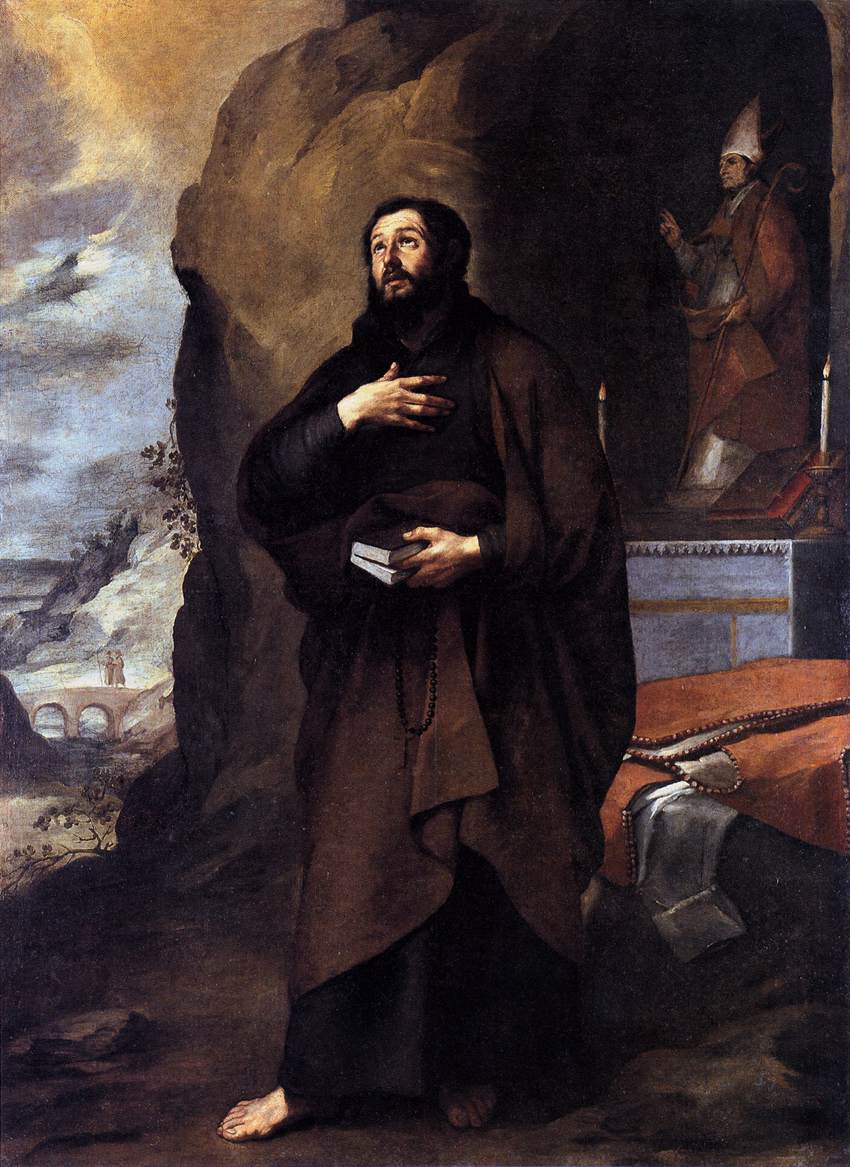
Bartolome Esteban Murillo’s “Saint Adelelmus of Burgos,” painted around 1655, is a powerful meditation on conversion, humility and the tension between worldly honor and spiritual calling. The canvas shows a solitary monk standing barefoot in a rocky grotto. One hand presses to his chest while the other cradles a small book and rosary. His eyes are lifted toward a luminous sky that opens above the cliff face. Behind him, an altar and a vision of a bishop figure emerge from the shadows, while discarded armor lies near a red cloth in the lower right corner.
Murillo brings together portraiture, landscape and symbolic still life to narrate the story of Adelelmus, a noble soldier who renounced his former life and became a monk, eventually recognized as a saintly figure of Burgos. The painting speaks not through dramatic miracles but through the quiet eloquence of posture, gesture and carefully chosen objects. It is a work that asks viewers to consider what it means to leave behind worldly ambitions and offer the heart to God.
The Life of Saint Adelelmus and Its Visual Translation
Adelelmus of Burgos, also known as Lesmes, was traditionally believed to have been a nobleman and warrior from France who later became a Benedictine monk. According to legend, he traveled to Spain, settled in Burgos and dedicated himself to the care of the poor and the sick. Over time he was honored as a patron of the city. The story of a knight who abandons arms for the monastic habit made him an ideal subject for Counter Reformation Spain, which valued examples of radical conversion.
Murillo translates this biography into visual terms with remarkable economy. The bare feet of the saint, firmly planted on the rocky ground, speak of poverty and humility. The coarse brown habit wrapped around his body marks him as a monk. The discarded armor and sword in the foreground allude to his former life as a soldier. The book and rosary indicate a new commitment to prayer and study.
By gathering these elements into a single moment of prayerful stillness, Murillo suggests that Adelelmus stands at the meeting point of two worlds. The rugged landscape to the left hints at his travels and struggles. The altar and bishop figure to the right evoke his integration into the institutional Church. Between them, the saint offers his heart upward, embodying both personal devotion and public example.
Composition and Spatial Drama
The composition is organized around the tall, vertical figure of Adelelmus. He stands just off center, slightly toward the right, framed by the curving wall of the cave behind him. His body forms a gentle diagonal, with his bare feet at the lower right and his upward gaze directed toward the upper left, where the sky opens. This diagonal line leads the viewer’s eye through the painting, emphasizing the saint’s spiritual ascent.
On the left side of the canvas, Murillo paints a deep valley landscape with a stone bridge and two small figures in the distance. The valley recedes into a misty horizon, giving a sense of depth and suggesting the broader world that Adelelmus has left behind. On the right, the rock wall darkens and gives way to the shadowy interior of a chapel. There we see an altar draped with cloth, candles, books and the figure of a bishop standing in blessing.
The effect is to divide the painting into three zones: the world of nature and journey, the interior sanctuary of the Church, and the central grotto where Adelelmus stands. This middle ground, where rock and light meet, becomes a symbolic space of transition. The saint is no longer fully in the world but not yet fully absorbed into the heavenly vision. Murillo allows viewers to feel the weight of that in between position.
Chiaroscuro and the Path of Light
Light is one of Murillo’s most expressive tools in this painting. The strongest illumination comes from the upper left, where the sky breaks through swirling clouds. This light falls diagonally onto the face and upper body of the saint, leaving his lower garments and the rocky floor in deeper shadow. The head and hands of Adelelmus therefore stand out dramatically against the darker background.
The light also touches the surface of the altar and the bishop figure in the background, though more softly. It grazes the red cloth covering the table and picks out the metal gleam of the abandoned armor. In the distant landscape, gentler light plays over the stone bridge and the slopes of the valley.
This careful distribution of light creates a hierarchy of meaning. The brightest focus is the saint’s face and gesture of the hand on the chest, which symbolizes interior conversion. Secondary highlights connect that interior event to the Church and to the memory of his past life. The contrast between the illuminated sky and the shadowed cave reinforces the sense that the saint is turning away from darkness toward a new light that calls him from above.
Gesture and Emotion in the Figure of Adelelmus
Murillo’s portrayal of Adelelmus is both realistic and deeply expressive. The saint is depicted as a middle aged man with a dark beard, slightly disheveled hair and a weathered face. His expression is sober and earnest. The eyes look upward with a mixture of longing and quiet trust, as though he is listening to a voice that only he can hear.
The hand pressed against his chest is the key to his emotional state. It is a gesture of self offering and contrition, associated with the prayer “Mea culpa” in Catholic tradition. At the same time, it is also a gesture of astonishment, as if he is moved by the grace that has been given to him. The other hand, holding a book and rosary against his side, suggests stability in the new life of prayer and discipline.
His posture is slightly forward, almost as though he is about to take a step toward the light. Yet his feet remain grounded in the rocky floor of the cave. The tension between movement and stillness captures the dynamic nature of conversion. Adelelmus has renounced his former path, but the ongoing journey of sanctity continues.
Symbolism of the Armor and Monastic Habit
One of the most evocative passages in the painting is the area near the lower right corner, where pieces of armor lie crumpled beside a red cloth. We see a shield and fragments of metal plates, perhaps part of a breastplate. They are painted with subtle reflections of light and shadow, which give them a heavy, cold presence.
These abandoned weapons represent the life of chivalry and warfare that Adelelmus has set aside. Their placement near the edge of the canvas suggests that they no longer dominate his identity. The red cloth beneath them may refer to earthly honor, courtly prestige or worldly passions. Together they form a kind of still life of renounced glory.
In contrast, the monk’s habit that Adelelmus wears is simple and unadorned. The rough brown fabric falls in heavy folds, enveloping his body and hiding any sign of physical prowess. The habit speaks of humility, obedience and stability. The contrast between shimmering metal and coarse wool visually articulates the difference between worldly and spiritual armor. Adelelmus has exchanged the steel of the soldier for the habit of the monk, trusting now in a different kind of protection.
The Altar and the Bishop Vision
Behind Adelelmus, within the shadowy recess of the cave, Murillo paints an altar with two lighted candles and a richly draped cloth. On or near the altar rest several books, symbols of Scripture and the teachings of the Church. Rising above the altar is the figure of a bishop in mitre and vestments, hand raised in a gesture of blessing.
This bishop may represent the official recognition of Adelelmus’s holiness or the ecclesial authority that guides his vocation. Some viewers interpret the figure as Saint Adelelmus in glory or as another saint who appears to him in vision. Regardless of the precise identity, the presence of this figure links the solitary prayer of the monk to the wider body of the Church.
The fact that the bishop is painted in softer focus and partially in shadow suggests that he belongs to a more spiritual plane. He is physically behind Adelelmus yet conceptually ahead of him, as if representing the sanctity to which the monk aspires. The altar, with its candles and books, forms a bridge between earth and heaven, liturgy and personal devotion.
Landscape as Inner Journey
The landscape on the left side of the painting is not simply a backdrop. It plays a significant role in conveying the idea of pilgrimage and inner journey. A narrow valley, perhaps a river gorge, stretches into the distance. At its center stands a stone bridge with two small figures walking across. Above, the sky is filled with soft, turbulent clouds through which light breaks.
This distant bridge can be read as a symbol of passage from one state of life to another. The small figures may recall Adelelmus’s own travels or stand for souls on the path to God. The rocky slopes and sparse vegetation suggest the hardships of the spiritual journey. Yet the presence of light and the openness of the horizon also imply hope and the possibility of arrival.
By including this landscape, Murillo situates the saint’s conversion not only inside the cave of prayer but also within the broader geography of the world. Adelelmus is a man rooted in real places and histories, yet his true homeland lies beyond the visible horizon.
Murillo’s Style and the Spirit of Seventeenth Century Seville
“Saint Adelelmus of Burgos” reflects Murillo’s mature style in the 1650s. While he is best known for his tender images of the Virgin and Child and his genre scenes of poor children, he also produced significant works of monastic and hermit saints. In these, he combines a warm realism with Baroque drama and spiritual introspection.
The color palette in this painting is predominantly earthy. Browns, ochers and muted grays dominate the saint’s habit, the rocks and the landscape. These subdued tones create a sense of sobriety and seriousness that suits the subject. Against this background, touches of red on the altar cloth and the bishop’s vestments offer small bursts of intensity that draw the eye without overwhelming the scene.
Murillo’s brushwork is smooth and controlled, with soft edges that fuse figures and environment. This subtle handling of paint contributes to the contemplative atmosphere. The viewer is not confronted with harsh outlines or aggressive contrasts, but rather with a gently modulated space that invites quiet reflection.
In seventeenth century Seville, such images were vital tools for spiritual formation. Monasteries, confraternities and private patrons commissioned paintings that modeled virtues such as humility, obedience and detachment from worldly honors. Adelelmus, as a noble warrior turned monk, provided a perfect example. Murillo’s sensitive treatment of his inner life would have resonated deeply with viewers seeking to deepen their own spiritual commitments.
Devotional Function and Viewer Participation
The painting is clearly designed to serve as an aid to contemplation. Its vertical format, life sized figure and limited narrative details encourage viewers to stand before it and identify with the saint. The hand on the chest and the upward gaze function as an invitation. They suggest a posture of prayer that viewers can imitate physically and spiritually.
The objects around Adelelmus guide meditation. One might contemplate the armor and ask what needs to be set aside in one’s own life. One might look at the book and rosary and reflect on the practices that sustain faith. The distant bridge may inspire thoughts about the journey of life and the decisions that shape its course.
Murillo’s art does not impose a single reading. Instead it offers a rich cluster of visual cues that each viewer can integrate into personal reflection. The painting becomes a silent companion in prayer, presenting a saint whose struggle and surrender mirror the desires of anyone who seeks deeper meaning beyond worldly success.
Emotional and Spiritual Resonance Today
For contemporary viewers, “Saint Adelelmus of Burgos” continues to speak with surprising clarity. In a culture often focused on achievement, power and public recognition, the image of a man who has laid down his armor and chosen a life of humility feels both challenging and refreshing. The painting asks what treasures we might be called to relinquish in order to discover a more authentic identity.
The solitude of the cave and the openness of the sky also resonate with modern experiences of searching and longing. Many people today feel torn between the noise of the world and the desire for quiet reflection. Adelelmus, standing barefoot on the rock with one hand on his heart, embodies that desire for interior freedom.
Murillo’s gentle realism helps keep the saint close to us. Adelelmus is not portrayed as superhuman. His slightly tired face, simple robe and ordinary hands make him relatable. This human accessibility allows the spiritual message of the painting to reach across centuries and cultures.
Conclusion
Bartolome Esteban Murillo’s “Saint Adelelmus of Burgos” is a richly layered portrayal of conversion and contemplative life. Through a carefully constructed composition, expressive chiaroscuro and a network of symbolic objects, Murillo tells the story of a soldier who abandons his armor for the habit of a monk and offers his heart fully to God.
The painting balances landscape, still life and devotional figure in a way that draws viewers into the saint’s inner drama. The abandoned armor, the altar and bishop, the distant bridge and the open sky all converge around the solitary figure of Adelelmus, who stands as a witness to the possibility of radical change.
More than three centuries after its creation, this work continues to move viewers with its quiet intensity. It invites each person who looks at it to consider where light is breaking through the rock face of their own life, and what acts of surrender or trust might be needed in order to step toward that light.