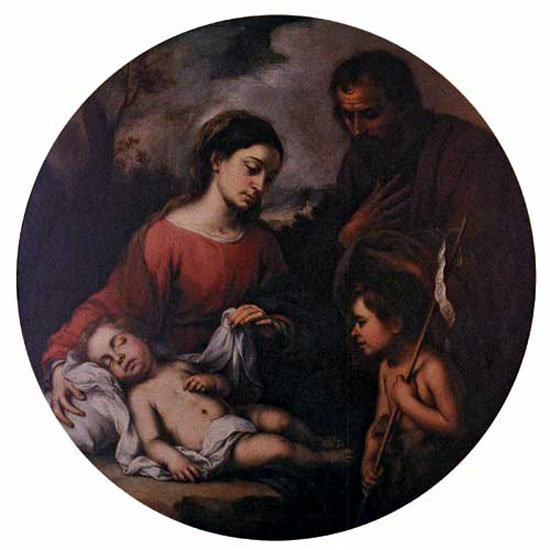
Image source: wikiart.org
Introduction to “Holy Family with the Infant Saint John”
“Holy Family with the Infant Saint John,” painted by Bartolome Esteban Murillo around 1655, is a tender and meditative vision of the most familiar of Christian subjects. Within a circular format, Murillo gathers the Virgin Mary, Saint Joseph, the sleeping Christ Child, and the young John the Baptist into a quiet clearing that feels at once earthly and sacred. The painting belongs to Murillo’s mature Sevillian period, when he developed a distinctive way of combining spiritual doctrine with intimate human feeling.
The work captures a moment of stillness in which the Holy Family pauses, perhaps during their daily life in Nazareth, while Saint John approaches in childhood to pay homage to his cousin. Murillo transforms this traditional religious theme into a scene of domestic affection and contemplation, inviting the viewer to meditate not only on theology but on the beauty of family bonds.
The Tondo Format and Intimate Composition
One of the first things that sets this painting apart is its tondo, or circular, format. Rather than the usual rectangular canvas, Murillo composes the scene inside a round frame. This choice greatly affects how the viewer experiences the image. The circle has long been associated with perfection, eternity, and unity. It has no beginning or end. By placing the Holy Family within this shape, Murillo subtly underscores their role in the eternal plan of salvation.
The circular boundary also tightens the composition. Figures must be gathered in close, with no sprawling landscape or distant architecture. Mary occupies the central left portion, her body forming a gentle arc that echoes the curve of the tondo. To her right stands Joseph, slightly in shadow, his head bent in reverent attention. At the lower left, the Christ Child lies asleep, diagonally across the foreground, while on the right the young Saint John kneels or stands with a reed cross and banner, leaning toward the sleeping infant.
This arrangement creates a closed, harmonious circle of gazes and gestures. Mary looks tenderly at her son. Joseph watches the scene with hand pressed to his chest. John directs his earnest gaze toward the Christ Child. Even the line of the infant’s body curves gently back into the group. The viewer feels as if looking into a small, private world, enclosed by the round frame and sustained by the shared devotion of the figures.
Characters and Narrative in the Holy Family Group
Murillo’s narrative approach is subtle. He does not depict a miraculous event or dramatic movement. Instead he shows a moment of everyday tenderness that carries deep spiritual meaning.
The Virgin Mary is the compositional anchor. She sits with calm dignity, wearing a red gown and a muted mantle. Her head is slightly bowed, her eyes resting on the sleeping child. One hand supports the Christ Child’s head while the other delicately arranges the white cloth around him. Her posture conveys both maternal care and quiet contemplation, as though she is pondering in her heart the destiny of this infant.
The Christ Child lies across a support that could be a rock or low bench. He is wrapped in light fabric that reveals the softness of his body. His head falls back in deep sleep, one arm resting loosely on his chest, the other extended. The pose evokes complete trust and vulnerability. Even in repose, he becomes a focus of veneration for those around him.
Saint Joseph stands behind Mary. Murillo often treats Joseph with simplicity and humility, and this painting is no exception. Joseph’s clothing is plain, his figure partially lost in shadow. He does not dominate the scene but supports it, hand at his chest and head bent. He appears as a contemplative guardian, a silent witness who realizes the significance of what unfolds before him.
On the right, the infant Saint John the Baptist provides a counterpoint to the sleeping Christ. While Jesus rests, John is alert and active. He holds his traditional attributes, a simple reed cross and a banner that alludes to his future role as herald of Christ. His childlike body is full of energy. He looks intently at the sleeping infant with an expression that blends curiosity, respect, and early recognition. This contrast between the peaceful Christ and watchful John helps to tell the story of how John will one day announce the coming of the Lamb of God.
Light, Color, and the Baroque Atmosphere
Murillo’s use of light in “Holy Family with the Infant Saint John” creates a warm, enveloping atmosphere. The main illumination seems to fall from an undefined source in the upper left, perhaps filtered through clouds or foliage. It bathes Mary’s face, the body of the Christ Child, and the small figure of John, while leaving Joseph and parts of the background in a gentle penumbra.
This gradation of light guides the viewer’s attention. The brightest area is the sleeping child, whose pale body and white cloth catch the light. From there the eye moves to Mary’s softly illuminated face, then across to John’s head and shoulders. Joseph, in deeper shadow, serves as a quiet backdrop rather than a competing focal point. The effect is almost like a spotlight on a theater stage, except that Murillo’s light is softer, with no hard edges, conveying an atmosphere of spiritual rather than theatrical drama.
Color plays an important complementary role. Mary’s red garment stands out strongly, symbolizing love and sacrifice. The red is balanced by darker, earthy tones in Joseph’s clothing and by the subdued greens and browns of the landscape. The flesh tones of the children are delicate and luminous, giving a sense of health and innocence. Murillo’s palette is warm but not overly saturated. It is designed to evoke serenity and reverence rather than excitement.
The background landscape is intentionally vague. Faint trees, a bit of sky, and distant forms suggest an outdoor setting, yet these elements are kept soft and low in contrast. They serve to situate the scene in the natural world while ensuring that the viewer’s attention remains on the figures. The overall atmosphere is one of late afternoon or early evening, a time associated with rest and reflection.
Symbolism and Foreshadowing of the Passion
Although the scene appears gentle and domestic, it carries numerous hints of future events, especially the Passion of Christ. Baroque viewers, familiar with devotional literature and iconography, would have recognized these details.
The sleeping Christ Child, for example, is often interpreted as a symbol of his future death. His pose resembles that of a recumbent figure on a tomb, with head thrown back and limbs relaxed. Sleep becomes a metaphor for death that is temporary and will lead to resurrection. The white cloth that Mary arranges around him can be read as a prefiguration of the shroud in which his body will be wrapped after the crucifixion.
John’s presence similarly anticipates his adult mission. The reed cross and banner are standard symbols of his role as forerunner of Christ. The banner typically carries the phrase “Ecce Agnus Dei,” meaning “Behold the Lamb of God.” Even as a child, he approaches Jesus with gestures of homage. Murillo thus compresses time, presenting in one scene both the infancy of Christ and the future proclamation of his sacrifice.
Mary’s contemplative expression signals her awareness of these mysteries. In Christian tradition she is the one who understands in advance the suffering that awaits her son. Her red garment, associated with love and martyrdom, reinforces this reading. Joseph’s hand at his chest likewise suggests a heart affected by knowledge and devotion.
The circular format itself can be seen as symbolic. The circle, associated with eternity, reminds viewers that the events depicted are part of an eternal plan that transcends historical time. The Holy Family and Saint John are caught in a moment that is both domestic and salvific, part of an unending cycle of contemplation for the faithful.
Murillo’s Devotional Style and Sevillian Context
By the mid 1650s, Murillo had established himself as one of Seville’s leading painters. The city was a major center of religious life, home to numerous monasteries, confraternities, and charitable institutions. These groups commissioned artworks that would encourage meditation and reinforce Catholic doctrine in the wake of the Counter Reformation.
Murillo’s style was perfectly suited to this environment. Unlike some of his contemporaries who favored harsh tenebrism or heroic exaggeration, he preferred a gentle naturalism that made sacred figures approachable. His Virgins often look like young Sevillian women, his children like local boys and girls. Yet his paintings retain a sense of spiritual grace. In “Holy Family with the Infant Saint John” he applies this approach with particular delicacy.
The painting likely served as a domestic devotional image for a private patron or as part of a series for a religious house. The tondo format and modest scale suggest an intimate setting rather than a grand altarpiece. Viewers might have approached it at close range for prayer, allowing the soft expressions and tender gestures to support their contemplation of the mysteries of Christ’s childhood.
Murillo’s technique enhances this devotional function. His brushwork is smooth in the faces and more fluid in the draperies and landscape. Forms are clearly defined but never hard edged. The softness of transitions mirrors the softness of emotions he wishes to evoke, such as tenderness, trust, and quiet reverence.
Emotional Tone and Psychological Depth
What gives this painting enduring appeal is not only its iconography but its emotional truth. Murillo conveys complex psychological relationships without grand gestures.
Mary’s face expresses a mix of love, seriousness, and inwardness. She is clearly attached to her child, yet her gaze is contemplative rather than merely affectionate. It is as if she knows that the peace of this moment will not last, and she treasures it while accepting the future sacrifice.
Joseph’s posture suggests humility and gratitude. Standing slightly apart, he does not intrude on the closeness between Mary and Jesus. Instead he protects and venerates from a distance. His hand on his chest signals not only piety but emotional involvement. He is touched by what he sees.
The interaction between the two children adds another layer. Christ sleeps, totally defenseless, while John watches with a seriousness unusual in one so young. The contrast evokes the relationship between divine mission and human weakness. John seems almost like a small sentinel, keeping vigil over the Savior. Their closeness foreshadows the close connection between their later ministries and their shared destiny as cousins and martyrs.
Murillo’s handling of facial expressions is subtle. No one in the painting smiles broadly, yet there is no sense of gloom. The feeling is one of calm gravity. This restraint avoids sentimentality and allows viewers to project their own devotional feelings into the scene.
Legacy and Contemporary Resonance
“Holy Family with the Infant Saint John” exemplifies why Murillo became one of the most beloved painters of sacred subjects in Spain and beyond. His ability to blend naturalistic detail with spiritual symbolism created images that were both emotionally accessible and theologically rich.
For modern viewers, the painting continues to resonate on several levels. On a religious level it offers a meditative entry point into the mysteries of the Incarnation and the Passion. On a human level it presents a family gathered around a sleeping child, a scene that many can relate to regardless of faith background. The combination of protective adults and vulnerable children evokes universal emotions of care, responsibility, and hope.
The image also invites reflection on themes such as migration, poverty, and resilience. The Holy Family and Saint John appear in simple clothing, in a landscape that could belong to rural Andalusia. They are not surrounded by luxury. Yet the serenity on their faces suggests that holiness and dignity can flourish in humble circumstances.
In art historical terms, the painting helps bridge the gap between earlier Italian Renaissance ideals and later, more intimate approaches to religious imagery. Murillo took the balanced compositions and clear narratives of the Renaissance and infused them with a softness and warmth that anticipate later developments in European painting.
Conclusion
Bartolome Esteban Murillo’s “Holy Family with the Infant Saint John” is a deeply moving example of Spanish Baroque devotional art. Within the circular frame, the painter brings together Mary, Joseph, the Christ Child, and the young John in a moment of quiet reverence. Through carefully orchestrated composition, gentle light, and nuanced expressions, he creates a scene that is at once domestic and divine.
The tondo format emphasizes unity and eternity, while the contrast between sleeping Christ and vigilant John foreshadows the drama of salvation that lies ahead. Murillo’s warm palette and soft chiaroscuro envelop the figures in an atmosphere of peace. The painting invites viewers into an intimate encounter with the Holy Family, encouraging them to share in the contemplation that Mary and Joseph model.
More than three centuries after its creation, this work continues to speak to those who stand before it. It reminds us that spiritual truths can be expressed through the simplest of human gestures: a mother cradling her child, a father watching with reverent care, and a small cousin approaching with devotion. In this gentle circle of love and faith, Murillo offers a vision of hope that transcends time.
