Image source: wikiart.org
Introduction to Murillo’s Virgin and Child
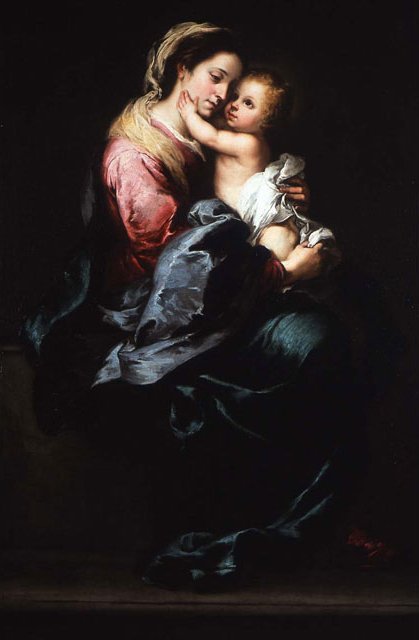
Bartolome Esteban Murillo’s “Virgin and Child,” painted around 1650, is a deeply intimate interpretation of one of Christianity’s most familiar subjects. The canvas is small and simple, yet it holds enormous emotional power. Against a dark background that almost dissolves into pure shadow, the Virgin Mary sits quietly with the Christ Child in her arms. Their faces are pressed close together, cheek to cheek, in a gesture that blends maternal tenderness with reverent adoration.
Murillo, one of the leading painters of the Spanish Baroque, became especially famous for works like this. His images of the Virgin are not distant or stern. Instead they are warm, youthful and full of human feeling. In this painting, he offers not a royal Madonna on a throne but a mother absorbed in the loving embrace of her child. The result is a devotional image that feels at once sacred and very close to ordinary experience.
Composition and the Embrace at the Center
The composition is dominated by a single compact group: Mary and the Child wrapped together in a swirl of fabric and light. Murillo places them slightly off center, leaning gently to the left, yet they are fully balanced within the vertical format. The lines of the composition form a soft spiral that begins at the lower folds of Mary’s blue cloak, rises along her arm, circles around the Child’s body, and ends in the delicate contact of their faces.
The Christ Child sits on Mary’s lap, turned toward the viewer but clinging to his mother. One small hand holds a portion of her garment, while the other reaches up to touch her face. Mary responds with an arm that supports his back and a slight tilt of her head that presses her cheek against his. This closeness eliminates any sense of separation between them. They become, visually and emotionally, a single unit.
Everything else in the painting is subordinated to this embrace. There is no detailed background, no architectural setting, no angels or symbols filling the space. A simple bench or ledge is faintly visible, but otherwise the figures emerge from deep darkness. Murillo’s decisions focus the viewer’s attention entirely on the relationship between mother and child.
Chiaroscuro and the Language of Light
Light plays a central role in “Virgin and Child.” Murillo uses a powerful chiaroscuro that recalls the influence of Caravaggio and Spanish masters like Zurbaran. A strong yet gentle light falls from the upper left, bathing the faces and upper bodies of Mary and Jesus. Their skin glows softly, while the folds of their garments catch luminous highlights.
The surrounding darkness is dense, almost velvety. It swallows up any potential distractions and creates a sense that the figures exist in a timeless, spiritual space rather than a specific room or landscape. At the same time, the darkness makes the illuminated areas seem even more tender and precious. The viewer’s eye is drawn again and again to the glowing oval of their joined faces, which become the true light source of the painting.
This use of light has clear symbolic meaning. In Christian tradition, Christ is often described as light in the darkness. Here, that theological idea is translated into visual terms. The child’s body is the brightest point on the canvas. His pale skin contrasts with the deeper tones of Mary’s garments, as if radiating an inner illumination. Yet the light does not appear harsh or supernatural. It is the warm, natural glow that one might see in a quiet interior. In this way, Murillo suggests that divine light is fully present within the human experience of mother and child.
Color, Fabric and Symbolic Clothing
Murillo’s handling of color contributes greatly to the painting’s emotional impact. Mary wears a soft rose colored tunic with a blue green mantle draped over her lap and shoulder. These colors echo traditional Marian iconography, where red is associated with love and sacrifice and blue with purity and heavenly grace. In Murillo’s hands the colors are rich but subdued. They have the slightly muted quality of well worn fabric in low light, which makes the Virgin feel accessible and human rather than dazzling or regal.
The Child is wrapped only in a white cloth that covers part of his lower body. The whiteness symbolizes innocence and purity, but it also emphasizes his vulnerability. The tender folds of the fabric, painted with delicate highlights, create a visual rhyme with the soft flesh tones of the child himself.
Murillo is a master of fabric. The sweeping folds of Mary’s cloak form broad, rhythmic shapes that give weight and volume to her seated figure. The blue mantle cascades downward in a triangular mass, anchoring the composition and creating a stable base for the embrace above. At the same time, the soft shimmer of the cloth adds a touch of elegance and beauty.
The contrast between the luxurious appearance of the folds and the simplicity of the overall scene mirrors the dual nature of Mary in Catholic theology. She is both humble handmaid and Queen of Heaven. Murillo manages to suggest both aspects with a limited palette and a few carefully painted surfaces.
The Faces of Mother and Child
Perhaps the greatest strength of “Virgin and Child” lies in the expressions of the two figures. Murillo’s Mary is young, with smooth features and a slightly elongated oval face typical of his idealized feminine type. Her eyes are half closed, not in sleep but in quiet contemplation. The corners of her mouth lift almost imperceptibly, giving her a gentle, inward smile. She appears completely absorbed in the moment, aware of her child and of something beyond the visible world.
The Christ Child looks outward and slightly upward. His eyes meet an unseen point in space, but they can also be read as glancing toward the viewer. His expression is serious yet trusting, as if he is both a child seeking comfort and a divine figure already aware of his mission. The way his cheek presses into Mary’s suggests absolute reliance, while his open gaze suggests a consciousness that extends beyond his age.
What makes these faces so compelling is their naturalness. Murillo avoids exaggerated sentimentality or theatrical emotion. The interaction feels like a real scene one might observe between a young mother and her toddler. At the same time, the quiet intensity in their eyes and the perfect harmony of their features give the scene a timeless, sacred quality.
Emotional Intimacy and Spiritual Tenderness
Murillo was particularly admired for his ability to combine emotional immediacy with spiritual depth. In “Virgin and Child,” the viewer witnesses an intimate moment that could take place in any family: a child clinging to his mother, a mother leaning in to cherish the closeness. There is no obvious sign of fear, drama or suffering. The mood is one of calm affection.
Yet for devotees, this ordinary embrace carries profound meaning. Mary holds not just any child but the Son of God. Her tender gesture is simultaneously an act of maternal love and a form of worship. The Child, in turn, accepts her touch while also embodying divine love for humanity. The painting invites viewers to consider that the mystery of the Incarnation involves precisely this kind of human closeness. God becomes present in the softness of a child’s cheek and the warmth of a mother’s arms.
Murillo’s success lies in not forcing these meanings. He does not insert complex symbols or overt gestures. Instead, he trusts the simple language of touch and gaze. This approach reflects the spirituality of Counter Reformation Spain, where believers were encouraged to meditate on the human life of Christ and Mary in order to feel God’s presence in their own lives.
Comparison with Earlier Marian Images
To appreciate Murillo’s originality, it helps to compare this painting with earlier depictions of the Virgin and Child. In medieval and early Renaissance art, Madonnas were often shown frontally, enthroned, with formal poses and stylized features. The child might appear more like a miniature adult, sitting stiffly on Mary’s lap. The emphasis was on majesty and doctrinal clarity rather than on emotional realism.
By contrast, Murillo presents a much more naturalistic scene. The Virgin is seated in an undefined space, not on a decorated throne. She holds the child in a relaxed, almost informal way. The child’s body is that of a real infant with soft limbs and slight roundness in the belly and arms. The emphasis is on lived experience rather than formal symbolism.
Moreover, many earlier images included elaborate gold backgrounds, halos and ornate costumes. Murillo reduces such elements to their minimum. The background is plain darkness, the halos are suggested only by subtle glows rather than explicit circles, and the clothing, while beautiful, is not heavily decorated. This simplicity allows viewers to engage emotionally with the figures rather than being distracted by external splendor.
Murillo’s Marian Style in Seville
In seventeenth century Seville, devotion to the Virgin Mary was intense. Confraternities, churches and private patrons commissioned numerous images of her in different roles: Immaculate Conception, Mater Dolorosa, Queen of Heaven and tender mother. Murillo quickly became the most sought after Marian painter in the city.
“Virgin and Child” represents one of the models that made him so popular. His Mary is youthful and approachable, with a beauty that feels gentle rather than intimidating. The softness of his forms, the warmth of his color palette and the intimacy of his compositions all contribute to a sense of comfort and reassurance. These qualities aligned perfectly with the spiritual needs of his time, when people sought visual reminders of divine mercy and maternal protection.
This painting also reveals Murillo’s technical skill. The smooth blending of tones, the careful modulation of light on skin and fabric, and the subtle transitions between color fields show an artist working at the height of his powers. He combines the drama of Baroque chiaroscuro with a lyricism that is uniquely his own.
Devotional Function and Viewer Experience
Originally, a painting like “Virgin and Child” would likely have hung in a chapel, a convent cell or a private oratory. Its modest size and intimate subject make it suitable for close viewing rather than public spectacle. Worshippers could approach the canvas, perhaps kneeling before it in prayer, and feel as though they were entering the quiet space of the mother and child.
The composition aids this sense of personal encounter. The dark background eliminates distractions, creating a visual silence that mirrors the silence of prayer. The gentle glow on the figures provides a focal point for meditative contemplation. The Child’s sideways glance and Mary’s slight turn toward the viewer further involve the spectator in the exchange of love.
For modern viewers, even outside a strictly devotional context, the painting offers a powerful experience of tenderness and calm. Its beauty lies not only in its religious significance but also in its universal evocation of maternal love and childlike trust. The artwork can speak to anyone who has known the comfort of a loving embrace or the innocence of early childhood.
Symbolic Hints of Future Suffering
Though the overall tone of the painting is serene, subtle details hint at the future story of Christ’s passion. The red and blue in Mary’s garments echo traditional colors that associate her both with earthly love and with heavenly grace, but red in Christian symbolism can also point toward sacrifice and martyrdom.
The deep shadows that envelop the lower part of the scene may likewise suggest that this moment of tenderness takes place against the looming darkness of human sin and future suffering. The child’s partially naked body, so vulnerable and exposed, can remind viewers that he will one day suffer physically for humankind.
Murillo does not emphasize these tragic elements, choosing instead to keep them as quiet undertones. The painting captures an early moment in the narrative, when mother and child are still wrapped in the simplicity of affection. This focus allows viewers to dwell on the positive mystery of God’s closeness before contemplating the later events of the Gospel.
Conclusion
Bartolome Esteban Murillo’s “Virgin and Child” from around 1650 is a jewel of Spanish Baroque painting. Through a restrained composition, masterful use of light and color, and exquisitely rendered expressions, Murillo creates an image that is at once deeply human and profoundly spiritual.
The painting invites viewers into a quiet, almost private moment of embrace between Mary and the Christ Child. Their closeness, expressed through the press of their cheeks and the gentle clasp of hands, captures universal themes of love, protection and trust. At the same time, subtle symbolism and the luminous handling of light remind us that this is no ordinary mother and child, but the central figures of the Christian story.
Over three centuries later, “Virgin and Child” still moves viewers with its warmth and serenity. It stands as a testament to Murillo’s unique gift for uniting theological depth with everyday emotion, and for presenting divine love in the familiar language of human tenderness.