Image source: wikiart.org
Introduction to “The Flight into Egypt”
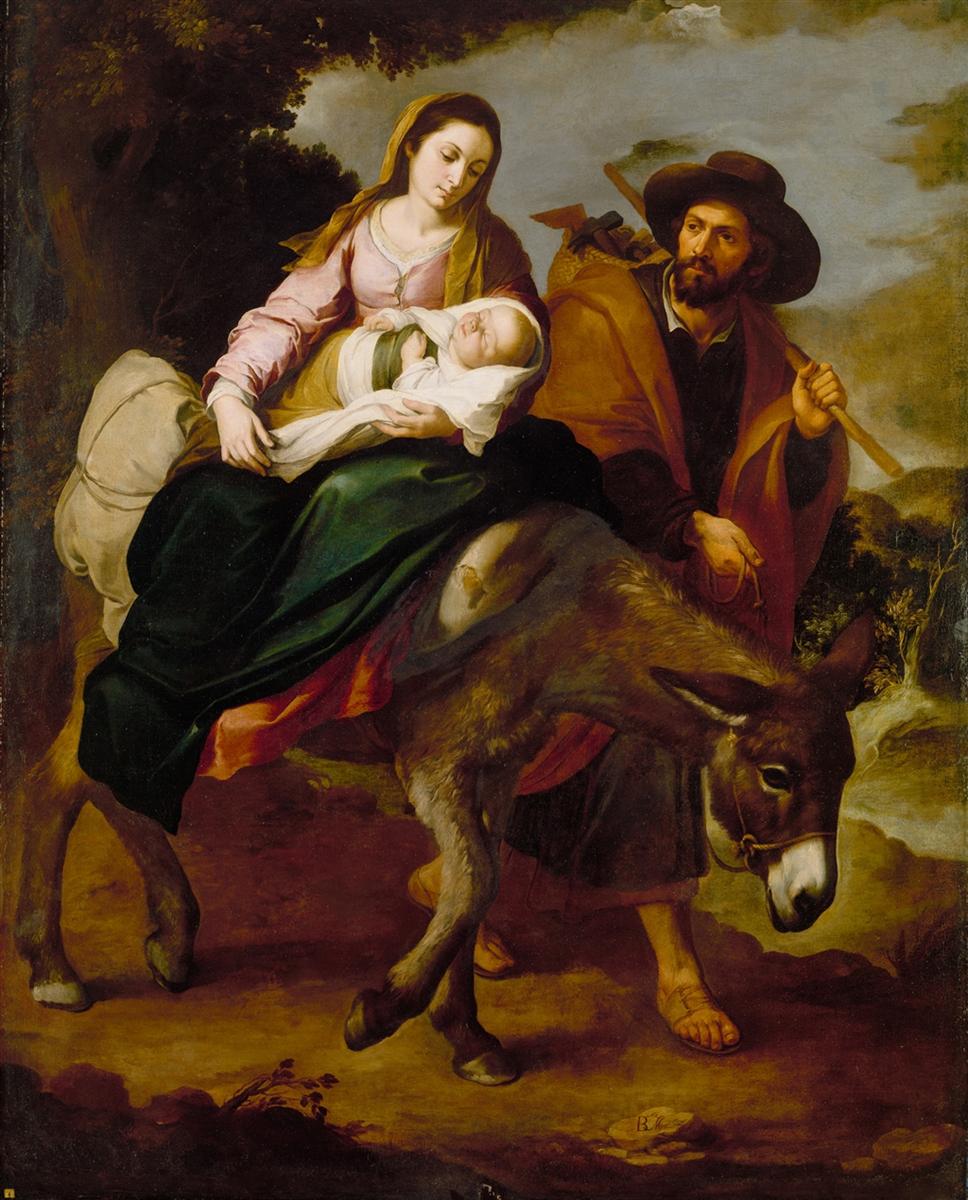
“The Flight into Egypt,” painted by Bartolome Esteban Murillo around 1650, is a tender and deeply human interpretation of the Gospel story in which the Holy Family flees from Herod’s persecution. Rather than filling the scene with miracles or dramatic angels, Murillo focuses on a quiet moment along the road. Mary rides a small donkey, cradling the sleeping Christ Child in her arms, while Joseph walks beside them, guiding the animal with staff in hand. A dusky landscape unfolds around them, suggesting both the hardship of travel and the protective embrace of nature.
This painting epitomizes Murillo’s ability to combine devotional content with warm naturalism. The Holy Family appears as real peasants on a hard journey, yet the sense of peace that surrounds them reveals their sacred identity. Viewers are invited to contemplate the vulnerability of God made flesh and the courage of two parents who protect their child through simple perseverance.
The Biblical Story Behind the Image
The subject comes from the Gospel of Matthew. After the visit of the Magi, Joseph receives a dream in which an angel warns him that King Herod intends to kill the newborn Messiah. Joseph is told to take Mary and the child and flee into Egypt, remaining there until it is safe to return. The story speaks of obedience, trust, and the experience of exile.
Murillo does not depict the angelic apparition or the frantic departure from Bethlehem. Instead he chooses a quieter episode on the road, when the initial shock has passed and the journey stretches ahead. This choice allows him to explore the ongoing reality of the Holy Family as refugees, traveling through strange lands with only their faith and each other for support.
Composition and Arrangement of the Holy Family
The composition centers on the three figures and the donkey, arranged diagonally from lower left to upper right. The donkey’s head lowers toward the ground, stepping carefully across the rocky path. Mary sits side saddle on its back, placed slightly above the center of the canvas. In her lap lies the sleeping Christ Child, swaddled in soft white cloth. Joseph walks on the right, slightly behind the animal, his body angled inward as he looks toward Mary and the baby.
This diagonal movement suggests progress. The eye follows the line of the donkey’s body from front legs to hindquarters, up to Mary and the child, and finally to Joseph’s face. Although the figures occupy most of the foreground, they are integrated into a broader landscape that opens toward the right, where distant trees and sky create a sense of depth.
Murillo balances the composition through contrasts. Mary’s gentle downward gaze and the closed eyes of the child create a vertical axis of stillness, while Joseph’s more alert expression and the donkey’s forward motion add dynamic tension. The arrangement makes the viewer feel both the calm of the sleeping child and the ongoing concern of the parents who must protect him.
Light, Color, and Atmosphere
Light plays a crucial role in shaping the mood of the painting. A warm illumination falls primarily on Mary and the child, bathing their faces and garments in a golden glow. The folds of Mary’s pink tunic and dark green cloak catch this light, creating rich highlights and deep shadows. The child’s face and swaddling cloth shine softly, becoming the luminous center of the composition.
Joseph, by contrast, stands partly in shadow. His brown cloak and dark hat blend more into the surrounding tones, yet his face is still clearly modeled by light. This subtle variation hints at his role as guardian and traveler, more exposed to the hardships of the road while Mary and the child remain in a protective pool of light.
The background sky is filled with clouds and muted colors that suggest early morning or late afternoon. The atmosphere feels calm but not entirely serene, as if the family travels under a sky that could change quickly. The earthy browns of the path, the soft greens of foliage, and the warm tans of the donkey’s fur all harmonize with the tones of the figures, binding them to their environment.
The overall effect is one of soft chiaroscuro rather than harsh contrast. Murillo uses light not primarily for theatrical drama but to create an enveloping warmth that underlines the spiritual protection surrounding the Holy Family.
The Humanity of Mary, Joseph, and the Child
One of the most remarkable aspects of Murillo’s “The Flight into Egypt” is the humanity of its figures. Mary is not idealized as an untouchable queen. She appears as a young, tired mother, her head slightly bowed, eyelids heavy, yet her arms firm around the sleeping baby. There is a quiet tenderness in the way her hand supports the child’s back and another hand cradles his small body.
The Christ Child is shown as a completely relaxed infant. His face is turned upward, lips parted in sleep, one arm resting loosely over his chest. This depiction emphasizes his vulnerability. He is not yet the teacher or healer of later years, but a baby entirely dependent on his parents. The idea of the Savior of the world sleeping in his mother’s arms on the back of a humble donkey underscores the paradox of the Incarnation.
Joseph is portrayed as a sturdy, thoughtful man. His beard, broad hat, and staff give him the appearance of a working peasant or pilgrim. His gaze is directed outward and slightly backward, as though he is watching the path behind them or scanning the surroundings for danger. The pack slung over his shoulder suggests he carries provisions and tools, reinforcing his role as diligent provider.
Murillo’s humanized portrayal allows viewers to identify with the Holy Family. They are not removed from daily experience but share the fatigue, concern, and simple gestures of any family fleeing hardship.
Symbolism of the Journey
Although the painting is naturalistic, it also carries symbolic meaning. The donkey, a traditional emblem of humility and service, reinforces the modest status of the travelers. Its lowered head and careful steps mirror the submission of Joseph and Mary to God’s will. The journey itself symbolizes the path of faith, full of uncertainty yet guided by divine providence.
Mary’s pink and green garments have theological associations. Pink or rose often suggests love and joy, while green symbolizes hope and renewal. Wrapped around her and the child, these colors hint at the virtues that sustain them. The white swaddling cloth around Jesus points to purity and foreshadows the burial shroud, linking infancy to the future Passion.
Joseph’s brown cloak speaks of the earth and of humility. His feet are bare or in simple sandals, emphasizing poverty and pilgrimage. The staff he carries is both a practical walking aid and a symbol of his role as protector and guide. In Christian art, Joseph’s staff sometimes recalls the shepherd’s staff, connecting him to the image of Christ as future Good Shepherd.
The landscape also carries symbolic overtones. Trees arch overhead on the left, forming a kind of protective canopy around Mary and the child. On the right, the terrain opens into a more uncertain distance, representing the unknown future. Yet the light that falls on the path assures the viewer that God’s providence accompanies them.
Landscape and the Sense of Time and Place
Murillo sets the scene in a landscape that feels both specific and generalized. The rocky ground, scattered vegetation, and distant trees recall the countryside around Seville more than the deserts of Judea or the Nile. Like many Baroque painters, he transposes biblical stories into familiar local scenery, making them more relatable to his audience.
The sky, filled with clouds and warm light, suggests a particular time of day, perhaps late afternoon when shadows lengthen. This choice enhances the impression of an extended journey. The family is not just starting out nor have they yet reached safety; they are somewhere in the middle, trudging onward as evening approaches.
The natural environment functions almost as another character. The path curves gently and seems to sink slightly, making the donkey’s steps appear heavy. The trees and rocks provide a sense of shelter while also reminding us of the roughness of the road. Murillo’s careful balance of comfort and difficulty reflects the mixed reality of their flight: protected by God, yet still subject to fatigue and uncertainty.
Murillo’s Style and Sevillian Context
“The Flight into Egypt” illustrates several hallmarks of Murillo’s style. His brushwork is supple and fluid, especially in the draperies. The folds of Mary’s cloak and Joseph’s mantle are modeled with a combination of soft blending and decisive highlights that suggests both weight and movement. The animal’s fur is rendered with lively strokes that capture texture without pedantic detail.
In seventeenth century Seville, religious art served both devotional and didactic purposes. Confraternities, monasteries, and churches commissioned works that would inspire contemplation among the faithful. Murillo, with his warm naturalism and empathetic approach to biblical characters, became one of the most beloved painters of the city. “The Flight into Egypt” would have spoken directly to an audience familiar with hardship, plague, and economic strain. Many believers in Seville knew what it meant to travel, to lose home or stability, and to trust in divine help.
Murillo’s choice to emphasize domestic intimacy rather than spectacular miracles also aligns with the spiritual ideals of his era. Counter Reformation spirituality encouraged meditation on the life of Christ through identification with the Holy Family. By presenting Mary and Joseph as approachable figures, Murillo provides a visual aid for such prayer.
Emotional and Devotional Impact
On an emotional level, the painting evokes compassion and quiet admiration. Viewers may feel moved by Mary’s serene concentration on her child, by Joseph’s steadfast vigilance, and by the donkey’s resigned labor. There is no panic or complaint, only a calm acceptance that resonates deeply.
Devotionally, the work invites prayerful reflection on several themes. It speaks of trust in God during times of danger. Joseph obeys the divine command and leads his family into unfamiliar territory. Mary surrenders herself and her child to this journey, embodying faith without dramatic words. The sleeping Christ Child symbolizes divine peace within human vulnerability. For believers, the image reassures that God remains present even when the future is uncertain.
The painting also holds contemporary relevance. In a world where many people still experience forced migration and exile, Murillo’s depiction of the Holy Family as refugees traveling by foot and donkey can foster empathy. Their quiet dignity and mutual support model how love can sustain people through displacement.
Conclusion
Bartolome Esteban Murillo’s “The Flight into Egypt” is a masterful blend of narrative, symbolism, and human feeling. By focusing on a simple moment along the road rather than a spectacular miracle, Murillo highlights the everyday courage of the Holy Family. Warm light, harmonious color, and sensitive characterization create a scene that is both historically grounded and spiritually timeless.
Mary’s tender embrace of the sleeping child, Joseph’s watchful stride, and the humble donkey’s steady steps combine to express a deep theology of trust, humility, and divine protection. The landscape around them echoes their inner journey, balancing shelter with uncertainty. More than three centuries after its creation, this painting continues to invite viewers to accompany the Holy Family on their path and to find in their quiet perseverance a source of comfort and inspiration.
