Image source: wikiart.org
Introduction to Murillo’s “The Immaculate Conception”
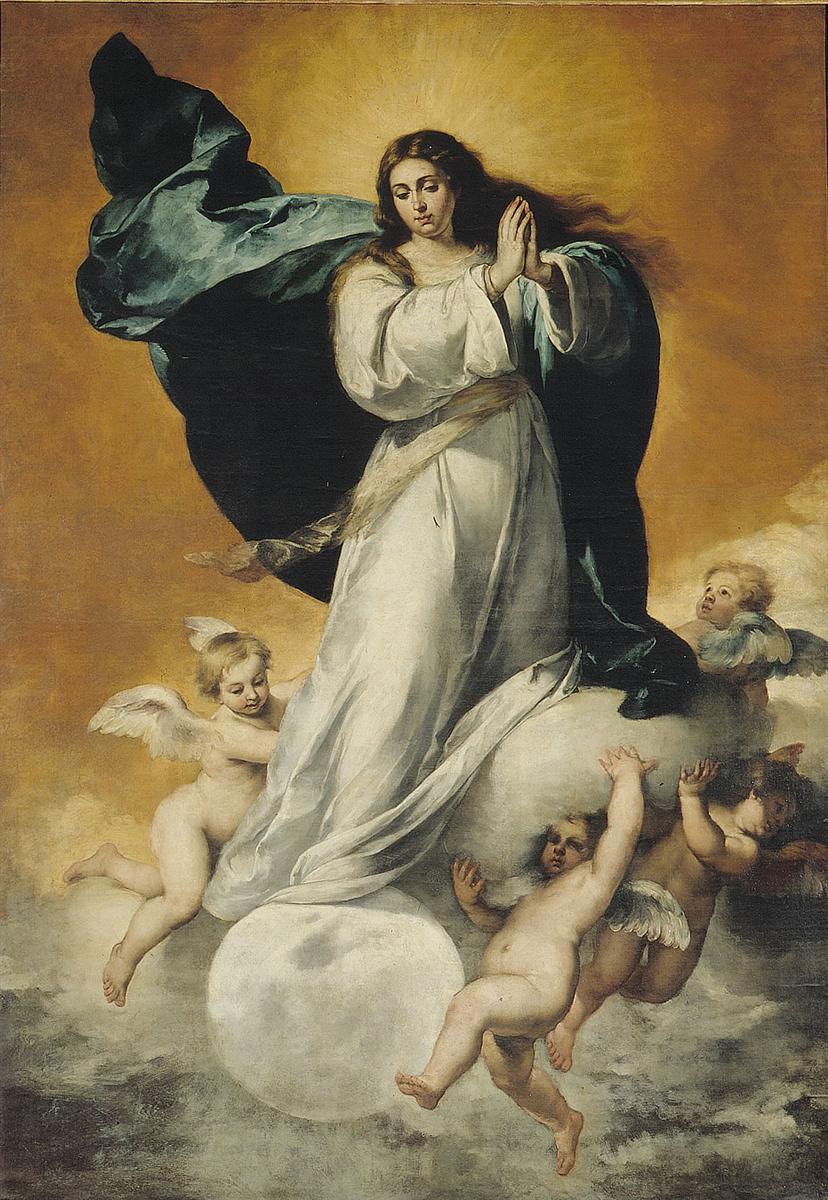
Bartolome Esteban Murillo’s “The Immaculate Conception,” painted around 1650, is one of the most iconic images of the Virgin Mary in Spanish Baroque art. In this luminous vision, Mary rises above a sea of clouds, carried upward by playful cherubs. She wears a flowing white robe and a deep blue mantle that billows behind her like a sail, while a golden light radiates from her head. Under her feet a bright white orb, evoking the moon, symbolizes her purity and victory over sin.
This painting belongs to a series of works in which Murillo explored the theme of the Immaculate Conception, a doctrine that held special meaning in seventeenth century Spain. In this version, he finds a perfect balance between doctrinal clarity and poetic, almost dreamlike beauty. The composition is simple but powerful, the colors are restrained yet glowing, and the figure of Mary is at once exalted and tender.
Historical and Devotional Context
During Murillo’s lifetime, devotion to the Immaculate Conception reached a high point in Spain. The belief that Mary had been preserved from original sin from the first moment of her existence inspired confraternities, sermons, processions and artistic commissions. Seville, Murillo’s home city, saw itself as a champion of this doctrine. Local churches and religious communities competed to obtain the most moving and beautiful images of the Immaculate Virgin.
Artists developed a distinctive iconography based on the Woman of the Apocalypse described in the Book of Revelation. She is clothed with the sun, crowned with stars, standing on the moon and crushing the serpent. In Spanish painting, these symbols were translated into a youthful Virgin in white and blue, often surrounded by cherubs and supported on a crescent moon.
Murillo became the leading interpreter of this theme. His versions of the Immaculate Conception shaped Catholic visual culture for centuries, influencing not only Spanish artists but also painters in Latin America and beyond. The 1650 “Immaculate Conception” shows him in the process of refining his own iconographic formula, emphasizing both the purity and the approachable humanity of Mary.
Composition and Dynamic Movement
The composition of the painting is dominated by the ascending figure of Mary. She is placed slightly to the right of center, her body forming a gentle S curve as she glides upward. Her hands are joined in prayer close to her chest, and her head tilts slightly, with her gaze directed downward. This posture suggests humility even as she is elevated above the clouds.
Around her swirl a group of cherubs, some fully visible as winged children, others represented mainly by heads emerging from the clouds. They cling to the edges of her robe, push the billowing fabric upward or float nearby with arms outstretched. Their playful poses and rounded forms create a lively rhythm in contrast to Mary’s serene stillness.
The lower part of the painting is filled with clouds painted in cool grays and whites. Out of this mist rises the bright orb at Mary’s feet, signifying the moon. It serves as a visual anchor, echoing the round faces of the cherubs and grounding the otherwise weightless scene.
Murillo arranges these elements to create a strong sense of vertical movement. The viewer’s eye travels from the orb and cherubs at the bottom up through the folds of the robe to the calm face of Mary and finally to the golden sky above. The sweeping curve of her blue mantle enhances this movement, acting almost like a windblown banner that carries the composition upward.
Color and Light in a Golden Heaven
Color plays a crucial role in the emotional power of this painting. Murillo uses a limited palette dominated by white, blue and warm golden tones. Mary’s tunic is a luminous white with subtle gray shadows and soft reflections of golden light. The mantle is a deep, cool blue with touches of green, standing out dramatically against the warm background.
The sky behind Mary is not blue but a glowing ocher that deepens toward orange near the top. This golden field suggests a radiant, supernatural atmosphere. Rather than depicting a literal sky, Murillo creates an abstract space filled with divine light. The color recalls the gilded backgrounds of medieval icons while still remaining fully Baroque in its painterly handling.
Light appears to emanate from behind Mary’s head and from the upper center of the painting. It radiates outward, illuminating the folds of her garments and the bodies of the cherubs. The contrast between the bright figure and the slightly darker clouds below enhances the sense that Mary is moving into an ever more luminous realm.
Despite the dramatic lighting, there are no harsh contrasts. Murillo softens transitions between light and shadow, giving the scene a gentle, almost velvety quality. This softness underscores the painting’s message of grace and purity rather than judgment or terror.
The Figure of Mary as Immaculate Virgin
Murillo’s portrayal of Mary is central to the painting’s appeal. She appears as a young woman, perhaps in her mid teens, with delicate features and long brown hair that falls freely over her shoulders. Her face is serene and modest, with downcast eyes and slightly parted lips. There is a quiet introspection in her expression, as though she is contemplating the mystery of God’s action in her life.
The joined hands near her chest are a traditional sign of prayer and submission to God’s will. At the same time, they add elegance to her silhouette, emphasizing the slenderness of her arms and the graceful flow of her sleeves. The voluminous white garment envelops her but does not overwhelm her figure. Murillo paints the fabric with a sense of lightness, suggesting that it is almost weightless in the heavenly air.
The blue mantle, symbolic of divine grace, wraps around her body and extends outward in a dramatic sweep. Its movement gives visual form to the idea that she is being carried by the wind of the Spirit. The cloth acts as both a protective cloak and a dynamic element that propels her upward.
Mary’s bare feet rest lightly on the orb that represents the moon. She does not press down with force, but merely touches it, as if effortlessly borne above the world of change and darkness. This gentle contact communicates both her freedom from sin and her connection to the created order. She is part of humanity, yet unsullied by its original fault.
Cherubs and the Joy of Heaven
The cherubs around Mary are more than decorative. They express the joy of heaven at the Immaculate Conception and serve as intermediaries between the divine and human realms. Each cherub has a distinct posture and personality. Some cling to Mary’s robe as if accompanying her ascent, while others frolic among the clouds.
Their small, plump bodies and soft wings create a sense of playful innocence. Murillo paints their skin with warm, rosy tones that echo the warmth of the background. The way light touches their faces and limbs gives them a tangible presence, yet their buoyant movement marks them as inhabitants of the spiritual world.
The cherubs also help to shape the visual rhythm of the painting. Their positions form a circular movement around Mary, guiding the viewer’s eye in a gentle spiral. This circular flow counters the vertical thrust, giving the composition both stability and dynamism.
Symbolically, the presence of these childlike angels hints at Mary’s role as spiritual mother and protector. They appear devoted to her, just as Christians are invited to turn to her as a nurturing figure. At the same time, their joy communicates that her Immaculate state is good news for all creation.
The Moon and the Victory over Sin
At the bottom of the painting, Mary’s feet rest on a bright, solid sphere that reads as the full moon. In traditional imagery of the Immaculate Conception, the crescent moon is often shown under her feet, accompanied by a serpent that she crushes. Here Murillo simplifies the symbol. The serpent is absent and the moon appears full rather than crescent, a shining disk that emerges from clouds.
This orb stands for the changeable world, the realm of night and time. By standing upon it, Mary is shown as triumphant over instability and darkness. Her Immaculate Conception means that she is free from the shadow that falls over the rest of humanity. She is, in the language of devotion, “fair as the moon, bright as the sun.”
The decision to depict the moon as a glowing sphere also serves a compositional purpose. It introduces a strong circular form that contrasts with the soft, irregular shapes of the clouds and the flowing garments. This geometric clarity anchors the lower part of the painting and balances the more open space above.
Theology Expressed Through Visual Poetry
Murillo’s “Immaculate Conception” is not a theological treatise, yet it expresses complex ideas through visual means. The upward movement of Mary’s body evokes her being drawn into the life of God. Her white garment and the surrounding light proclaim her purity. The blue mantle, the cherubs and the golden sky all communicate grace, joy and heavenly favor.
The absence of explicit narrative details allows the painting to function as a timeless icon. There is no specific moment in Mary’s life depicted here. Instead, the image represents her permanent state of being conceived without sin and filled with divine grace. Viewers are invited to contemplate not an event in history but an ongoing spiritual reality.
At the same time, Murillo’s humanized portrayal of Mary keeps this lofty doctrine connected to everyday experience. She looks like a young woman one might meet on the streets of Seville, yet transfigured by grace. This fusion of realism and idealization makes the doctrine of the Immaculate Conception feel close and accessible.
Murillo’s Mature Marian Style
By 1650 Murillo was already recognized in Seville for his religious works, and especially for his images of the Virgin. This “Immaculate Conception” reveals many of the characteristics that would define his mature Marian style.
He favors a youthful, almost girlish Mary rather than a distant queen. His color palette leans toward warm golds, soft whites and cool blues, creating a harmonious and soothing effect. His brushwork is fluid but controlled, with careful transitions that lend a sense of softness to faces and fabrics.
Compared with some of his later Immaculate Conception paintings, this version still retains a certain structural clarity and firmness in the drawing. Later works would become even more vaporous and ethereal. Yet already here we see the blend of tenderness, luminosity and gentle idealization that made Murillo so influential.
Emotional Impact on the Viewer
Standing before this painting, viewers often feel a sense of calm uplift. The composition leads the gaze upward, but the downward tilt of Mary’s head makes the encounter reciprocal. She looks toward us with gentle seriousness, as if listening as much as being adored.
The golden background generates warmth, while the cool whites and blues provide a soothing counterpoint. The cherubs’ playful presence may elicit a smile, yet the overall tone remains contemplative rather than exuberant. Murillo invites us to rest our eyes on the peaceful figure of Mary and to experience something of the serenity that her Immaculate state represents.
For seventeenth century worshippers, this image would have reinforced trust in Mary’s intercession and in God’s grace. For modern viewers, regardless of belief, the painting still offers a powerful experience of balance, beauty and spiritual aspiration. It captures a human body made radiant by light, rising without effort into a realm of golden peace.
Conclusion
“The Immaculate Conception” of 1650 stands as one of Bartolome Esteban Murillo’s defining achievements. In this work he transforms a complex theological doctrine into a vision of luminous simplicity. Mary, clothed in white and blue, floats above clouds and cherubs, her hands joined in prayer, her bare feet resting on a radiant moon.
Through subtle composition, harmonious color and delicate handling of light, Murillo creates an image that is at once doctrinally clear and emotionally compelling. The painting affirms Mary’s unique purity while presenting her as a gentle and approachable figure. It reflects the fervent Marian devotion of seventeenth century Spain and continues to resonate as a symbol of grace, innocence and hope.