Image source: wikiart.org
Introduction to “Baking of Flat Cakes” by Bartolomé Esteban Murillo
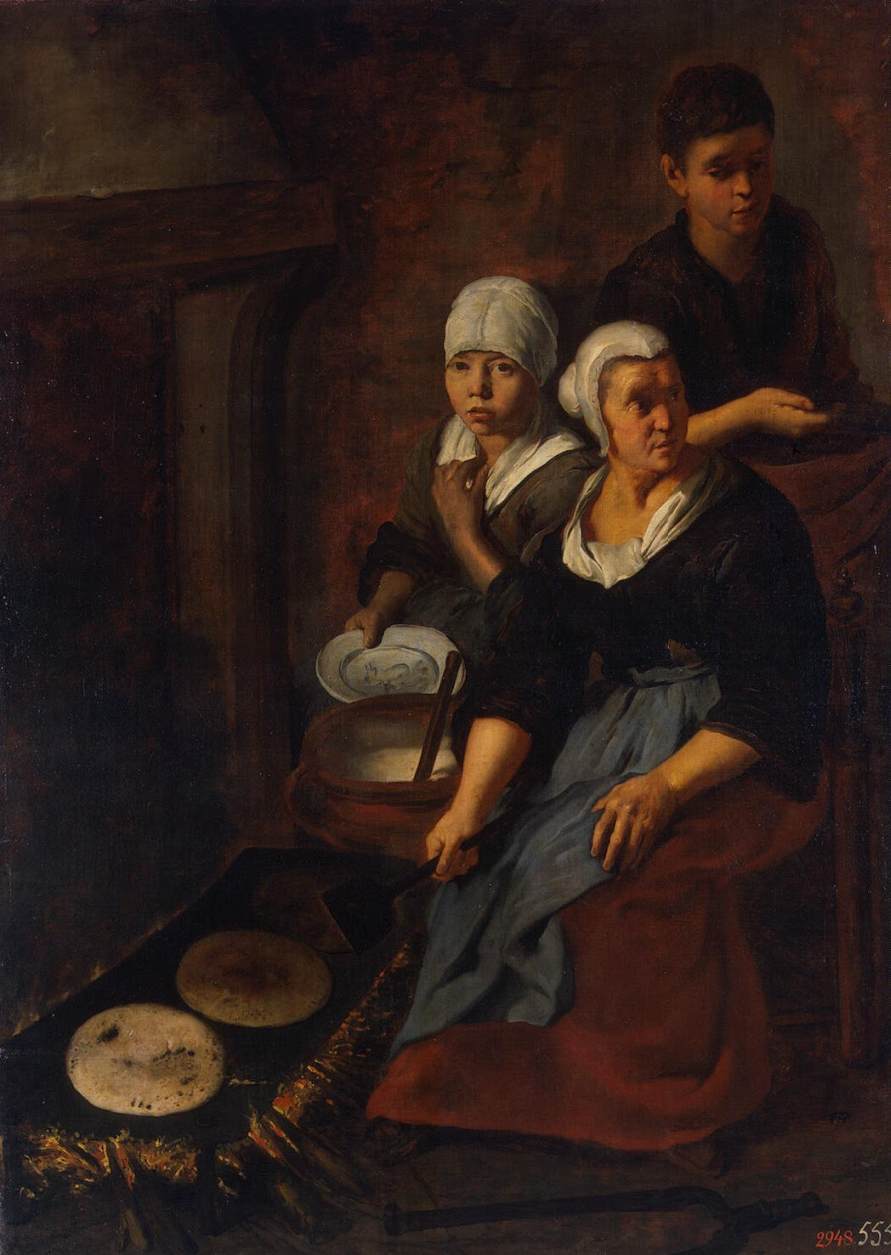
“Baking of Flat Cakes,” painted around 1650 by Bartolomé Esteban Murillo, offers an intimate view of everyday life in seventeenth century Spain. The canvas shows three figures gathered around a hearth. A woman sits closest to the fire, tending flat cakes that bubble and brown on an iron griddle. Beside and slightly behind her, a young girl with a white head covering holds a bowl and plate, ready to serve. At the back, a boy looks out of the shadows, his hands suggesting conversation or waiting.
Murillo is often remembered for religious visions and tender images of the Virgin and Child. In this domestic scene he turns his attention to working people and their daily labor. Yet the painting is anything but trivial. Through careful composition, expressive faces, and a rich handling of light, Murillo transforms a kitchen into a stage where human relationships, social realities, and quiet dignity are revealed.
Composition and the Intimate Hearth
The composition is built around the triangle formed by the three figures. The seated woman anchors the lower right side of the canvas. The girl sits slightly behind her, while the boy stands further back. Their heads form a gentle diagonal that leads the eye from the woman’s focused gaze to the girl’s direct look and then to the boy in half shadow.
On the left, the dark interior of the hearth and wall occupies nearly half the painting. A massive chimney and sooty brickwork frame the open fire, where two flat cakes are baking on a hot plate. This large area of darkness makes the figures on the right appear more concentrated and luminous. The viewer’s attention is naturally drawn to the group, yet the fire remains a powerful visual presence, hinting at heat, smell, and sound.
The low vantage point places us almost at the level of the seated woman. We seem to be in the room with them, perhaps just inside the doorway. There is no idealized distance. Instead, composition and perspective pull the viewer into the intimate world of the kitchen. Murillo invites us to observe, but he also makes us feel like participants in the scene.
The Central Woman and the Labor of Cooking
The woman who tends the cakes is the emotional center of the painting. She wears a dark bodice, white chemise, blue apron, and a red skirt that pools around her on the stool. Her sleeves are rolled up, revealing solid, capable arms. One hand rests on her lap, the other grips a spatula or long handled tool that she uses to manage the cakes over the fire.
Her head is turned toward the right, slightly away from the fire and toward the unseen space outside the picture. Her expression is alert and somewhat wary, as if she has heard something or is answering a comment from someone not visible to us. This sideways glance gives the painting a sense of narrative. We feel that something has just happened or is about to happen, even though Murillo offers no explicit story.
The woman’s body language suggests long familiarity with hard work. She sits firmly, knees apart, leaning slightly forward from the waist. Her hands are large and strong, with visible knuckles and veins. Yet there is no caricature. Murillo paints her with respect and individuality. She is a person with a history, not a generic servant. The way she grips the cooking tool and the care with which she positions herself by the fire underscore the skill involved in her work.
The Girl and the Young Boy
The girl seated just behind the woman provides a second focal point. Her white cap and kerchief catch the light and stand out against the dark wall. Murillo gives her a serious, almost solemn expression. She looks directly at the viewer, holding a plate and bowl that contain batter or dough. Her hand rests near her throat, a gesture that can be read as modesty or quiet self consciousness.
The girl’s presence adds a generational dimension to the scene. She is clearly learning the routines of the kitchen, watching the older woman, ready to pass utensils or carry finished cakes to the table. Her calm seriousness hints at the responsibilities placed on young people in working households. At the same time, her smooth skin and wide eyes convey youth and potential. She stands at the threshold between childhood and adult labor.
Behind her rises the figure of a boy, partially veiled by shadow. His face turns toward the unseen space to the right, following the direction of the older woman’s gaze. One arm stretches forward, palm up, as if he is explaining something or asking for food. The vagueness of his gesture invites interpretation. He could be a son, a helper, or simply a companion waiting for his share of the meal. His presence stresses that this is a family or communal scene, not isolated labor.
Light, Shadow, and the Atmosphere of the Kitchen
Murillo’s mastery of light gives this painting its particular mood. The primary light source seems to come from above and slightly to the right, perhaps from a small window or doorway outside the frame. This light falls across the faces and hands of the figures, leaving the background and the upper portion of the room in rich shadow.
The girl’s white head covering acts as a reflector, bouncing soft light onto her face and onto the shoulder of the woman beside her. The boy remains more in obscurity, his features partially obscured, which adds depth and an almost theatrical layering to the composition.
The fireplace itself provides an additional, warmer glow. Although the flames are not fully visible, the orange and yellow tones on the underside of the griddle and on the cakes suggest their presence. This firelight mixes with the cooler, more diffuse daylight in subtle ways. The result is a complex interplay of warm and cool tones, echoing the mix of heat and draft in an old kitchen.
Shadow plays a vital role. The left half of the painting is dominated by dark walls and the cavernous mouth of the hearth. These deep tones contrast sharply with the lighter skin and fabrics of the figures, drawing attention to them and giving an almost sculptural quality to their forms. The darkness also enhances the sense of enclosure, making the kitchen feel like a protected interior space where daily life and small dramas unfold.
Texture, Objects, and the Senses
Murillo enriches the painting through careful depiction of textures and objects. The flat cakes on the griddle show tiny bubbles and browned patches, suggesting an almost tangible smell of cooking dough. The iron plate itself is soot blackened, and the logs beneath it are charred at the ends, with glowing embers hinted at in red. The viewer can almost hear the hiss of batter and crackle of firewood.
The ceramic bowl near the girl has a subtle shine, indicating a glazed surface. Inside, a wooden spoon or ladle rests in thick batter. The girl’s plate, held at an angle, bears faint decoration. These domestic objects are not luxurious, yet they are rendered with care. They speak of a household that, while modest, possesses the tools necessary for daily sustenance.
The fabrics add another layer of tactile experience. The woman’s blue apron folds across her lap with heavy, slightly stiff creases, while her red skirt seems softer and more voluminous. The linen caps and kerchiefs have a crisp, slightly rough appearance. The interplay of surfaces wool, linen, ceramic, iron, dough serves to place the viewer in a fully embodied space rather than an abstract scene.
Everyday Life and Social Context
“Baking of Flat Cakes” belongs to the tradition of genre painting that flourished in seventeenth century Europe, particularly in the Low Countries and Spain. These works focused on ordinary people engaged in work or leisure, often in taverns, kitchens, or marketplaces. In Spain they are related to the bodegón, a type of painting that combines still life and figures in humble settings.
Murillo’s choice of subject reflects both artistic trends and social realities. Seville in the mid seventeenth century was a bustling yet economically troubled city. Many families struggled with poverty, food shortages, and disease. The act of baking simple flat cakes speaks to a world where basic nourishment was precious.
The painting does not romanticize poverty, but neither does it dwell on misery. Instead, it presents working people with dignity. The woman and children are not begging; they are engaged in productive labor. Their clothing is plain but not in rags. Murillo’s sympathetic realism acknowledges hardship while emphasizing resilience and competence.
At the same time, the large area of empty darkness surrounding the hearth can be read as a metaphor for the uncertainties and difficulties that hem in everyday life. Within that darkness, the warm circle of the fire and family stands out as a small refuge.
Possible Symbolic Meanings
Although “Baking of Flat Cakes” is primarily a scene of daily life, viewers in Murillo’s time may have detected subtle symbolic resonances. Bread and baking are common metaphors in Christian tradition, associated with nourishment, hospitality, and the Eucharist. Flat cakes cooking over the fire can hint at the transformation of basic ingredients into sustaining food, paralleling spiritual transformation.
The motherly figure tending the cakes recalls the idea of care and provision. She may echo the image of the Church as mother, feeding her children with both physical and spiritual bread. The presence of the children, one learning and one waiting, reinforces themes of teaching and receiving.
Murillo was deeply immersed in religious imagery, and even in his secular subjects he often infused a sense of quiet spirituality. The seriousness and almost contemplative expressions of the figures suggest that they carry inner lives as significant as those in explicitly sacred paintings. The kitchen becomes a place where virtues like diligence, patience, and care are practiced.
Murillo’s Style and the Broader Artistic Tradition
Stylistically, “Baking of Flat Cakes” shows Murillo absorbing influences from Caravaggio and from Spanish painters like Velázquez and Zurbarán. The strong contrasts of light and dark, the naturalistic depiction of humble figures, and the focus on a single moment in time all reflect this lineage.
Yet Murillo brings his own sensibility. Where Caravaggio often used sharp contrasts and dramatic gestures, Murillo prefers softer transitions and gentler moods. The figures here are solid and real, but they are also suffused with a human warmth that would become a hallmark of his later religious work.
Compared to Velázquez’s early kitchen scenes, Murillo’s painting feels more sentimental, in the best sense of the word. He is clearly interested in the emotional bonds between the figures, not only in the play of light or the realism of objects. This concern with human relationships anticipates the tenderness of his famous depictions of children, beggars, and saints.
Emotional Tone and Viewer Experience
The emotional tone of the painting is quiet and contemplative. There is no overt humor, but neither is there tragedy. Instead, a sense of subdued seriousness pervades the scene. The girl’s direct gaze, in particular, invites viewers to reflect on what they are seeing. It is as if she is silently asking us to recognize the value of their labor and their existence.
For modern viewers, this work can evoke empathy and respect for domestic work that often goes unnoticed. The long hours at the hearth, the constant preparation of food, and the training of the next generation are presented as worthy subjects of art. The painting also reminds us that history is not only made by kings and saints, but also by anonymous women and children who kept households running.
Place within Murillo’s Oeuvre
“Baking of Flat Cakes” occupies an interesting place in Murillo’s career. Painted around 1650, it comes as he was transitioning from early bodegón subjects toward the more lyrical religious works that would make him famous. The careful observation of light and texture seen here would later enrich his altarpieces and devotional images.
The emphasis on children and the poor anticipates his numerous paintings of street kids, urchins, and everyday figures in Seville. In those later works, as in this one, Murillo presents the marginalized not as curiosities but as full human beings with dignity and emotional depth.
This painting also demonstrates his versatility. He could handle religious ecstasies, noble portraits, and humble kitchens with equal skill. Throughout these varied subjects, his underlying interest in humanity and grace remains consistent.
Contemporary Resonance
Today “Baking of Flat Cakes” speaks to viewers across cultures. The act of cooking together, of sharing a warm space around a fire or stove, is a nearly universal experience. Many people see in this painting echoes of their own families, grandparents, or community kitchens.
The painting can also spark conversations about gender roles, labor, and food culture. It invites us to appreciate the knowledge and physical effort behind simple meals. In a time when fast food and convenience often obscure the origins of what we eat, Murillo’s canvas returns us to the elemental combination of fire, flour, and human hands.
Conclusion
“Baking of Flat Cakes” by Bartolomé Esteban Murillo is more than a depiction of three people preparing food. It is a carefully crafted exploration of domestic labor, family relationships, and the quiet dignity of ordinary life. Through a balanced composition, subtle use of light, and sensitive portrayal of faces and gestures, Murillo turns a kitchen corner into a work of enduring significance.
The painting shows how art can honor the everyday, revealing beauty in tasks that are repeated countless times and often taken for granted. It reminds viewers that within the glow of a hearth and the soft talk of a family, there is a depth of human experience as worthy of contemplation as the grandest historical or religious scene.
