Image source: wikiart.org
Introduction to Murillo’s “Immaculate of St. Vincent”
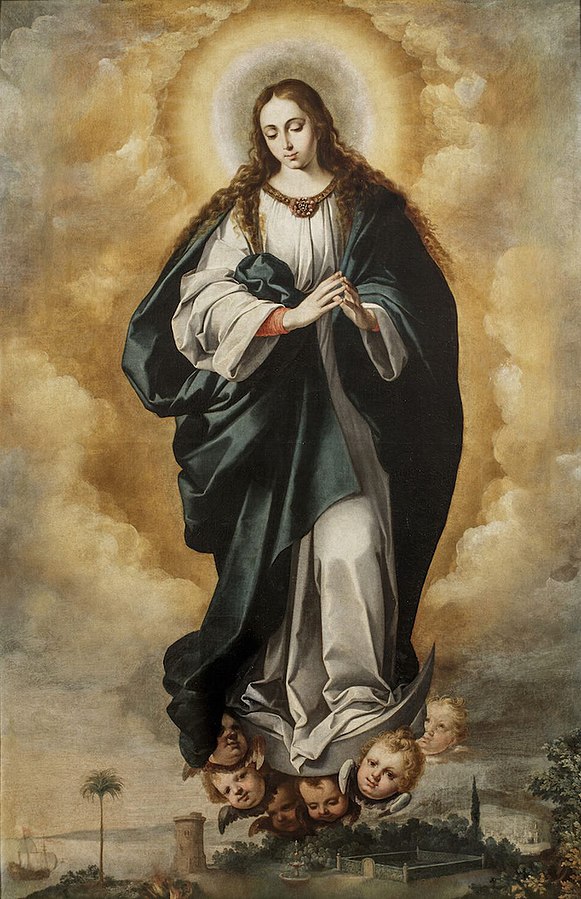
“Immaculate of St. Vincent,” painted by Bartolome Esteban Murillo around 1645, is one of the earliest and most refined examples of his lifelong devotion to the theme of the Immaculate Conception. The painting shows the Virgin Mary floating in a golden heaven, wrapped in voluminous robes of white and deep blue, surrounded by clouds and crowned with a radiant halo. She gazes downward with gentle modesty, hands clasped in prayer at her breast. Beneath her feet a group of cherub heads and soft clouds support her, while a small earthly landscape stretches across the bottom edge of the canvas.
This work was created for the Sevillian monastery of San Vicente, which gives the picture its name. From the outset it reveals many of the qualities that would make Murillo the great Marian painter of seventeenth century Spain. The composition is simple yet majestic, the atmosphere suffused with warm light, and the figure of Mary combines spiritual elevation with very human tenderness.
Historical and Devotional Context
The doctrine of the Immaculate Conception affirms that Mary, the mother of Christ, was preserved from original sin from the first moment of her existence. In seventeenth century Spain this belief was a passionate focus of devotion, even before it was officially defined as dogma. Cities, confraternities and religious orders competed in honoring the Immaculate Virgin with processions, sermons and works of art. Seville, Murillo’s home, was one of the leading centers of this Marian fervor.
Painters were asked to translate complex theological ideas into images that ordinary believers could love and understand. Spanish artists adopted a standardized iconography for the Immaculate Conception, derived from the Woman of the Apocalypse described in the Book of Revelation. This woman is clothed with the sun, crowned with stars, standing on the moon and crushing the serpent of evil. Over time these symbols were simplified into a figure of the young Virgin, in white tunic and blue mantle, hands joined, often standing on a crescent moon and surrounded by cherubs.
Murillo would become the supreme master of this iconography. In “Immaculate of St. Vincent” he is still shaping his personal approach. Compared with some later canvases, this image is austere and classical, yet the essential elements are already present. Mary appears as a youthful, pure and slightly withdrawn figure, lifted above the world but still reachable through her gentle expression.
Overall Composition and Vertical Movement
The composition is strongly vertical. Mary’s figure occupies almost the entire height of the canvas, rising from the cherubs at her feet to the halo that frames her head. She stands at the very center, so that the whole painting seems to revolve around her presence. The space around her is filled with rolling clouds tinted in warm golden and grayish tones, which reinforce the sensation that she is suspended in a luminous, heavenly atmosphere.
The viewer’s eye naturally begins at the bottom, where the tiny landscape and cherubs form a horizontal base. From there it moves upward along the flowing lines of her garments, then rests on her face and halo before disappearing into the surrounding clouds. This upward movement mirrors the spiritual ascent that the doctrine of the Immaculate Conception suggests. Mary is the bridge between earth and heaven, and the composition guides the viewer to contemplate that elevation.
Despite the strong central axis, Murillo avoids rigidity. The folds of the cloak and tunic swirl around her legs and gently sway to the left, introducing a sense of softness and movement. The slightly tilted position of her head and the crossing of her hands add to this subtle dynamism. The painting thus combines a stable, iconic structure with a living, almost breathing figure.
The Figure of the Virgin Mary
Murillo’s Mary is youthful and serene. Her oval face with delicate features, downcast eyes and pale complexion communicates innocence and modesty. She does not look directly at the viewer, but her soft gaze falls somewhere below, as if she were contemplating the world she protects. This downward look is essential to the painting’s emotional tone. It suggests compassion rather than distance, humility rather than triumph.
Her long brown hair falls in gentle waves over her shoulders, partly veiled by the white tunic. The hair is not adorned with a crown of twelve stars, a common attribute in other Immaculate Conception images. Instead Murillo concentrates on the luminous halo that surrounds her head. This halo, rendered as a glowing ring of light merging with the clouds, emphasizes that her holiness is interior and radiant rather than merely decorative.
Mary’s hands, placed together near her chest, express prayer and self offering. The gesture is simple but eloquent. It embodies the attitude of Fiat, the yes to God that Christian tradition sees as central to Mary’s role in salvation history. In this painting, that consent is not dramatized but quietly present in her posture and gaze.
Her body is enveloped in ample drapery. The white tunic represents purity, while the deep blue mantle stands for heavenly grace. The cool tone of the blue contrasts beautifully with the warm gold of the clouds, making the figure stand out while still harmonizing with her surroundings. The drapery is handled with a mixture of realism and stylization. Some folds are carefully described, while others dissolve into soft, sweeping masses that enhance the sense of weightlessness.
Color, Light and Atmosphere
Light in “Immaculate of St. Vincent” is both natural and symbolic. It seems to emanate from behind Mary, creating a glowing aura that spreads into the surrounding clouds. This backlighting effect outlines the silhouette of her figure and gives her an almost translucent presence. At the same time, softer frontal light illuminates her face and robes, revealing gentle modelling and subtle variations in tone.
The colors are relatively restrained compared to some of Murillo’s later works, yet they are rich and harmonious. The palette centers on whites, cool blues and warm earths, unified by a golden atmosphere. The clouds range from creamy highlights to deeper ochers and grays, suggesting both the solidity and the ethereal nature of this heavenly environment.
The landscape at the bottom introduces touches of green and brown, but these remain minor accents. The overwhelming impression is one of luminous clarity and warmth. This atmosphere contributes significantly to the devotional power of the painting. It evokes a world suffused with grace, where light gently bathes every form, abolishing harsh shadows and creating a sense of peace.
Cherubs and the Symbolism at Mary’s Feet
At the base of the Virgin’s figure, a cluster of cherub heads emerges from the clouds. These angelic children support her as she floats above the miniature landscape. Their faces are round, tender and varied, each with its own expression. Some look upward at Mary, others glance outward toward the viewer. Their presence adds warmth and playful innocence to the composition.
The cherubs also have a symbolic function. In images of the Immaculate Conception, Mary often stands on the crescent moon and crushes the serpent that represents sin. Murillo sometimes includes these elements in other versions, yet in “Immaculate of St. Vincent” he chooses to soften the iconography. The cherubs and clouds become her pedestal, indicating that she is borne up by heavenly beings and freed from the weight of the earth.
Among the cherubs we can glimpse a suggestion of celestial energy. The swirling clouds around them create a sense of movement, as if they were rising with Mary. This upward motion contrasts with the small, stable landscape below, reinforcing the idea that Mary transcends the limitations of the world while still caring for it.
The Earthly Landscape and its Meanings
Beneath the clouds and cherubs, at the very bottom of the painting, Murillo includes a thin strip of landscape. It is easy to overlook on a first viewing, yet it plays a significant role. We see a calm body of water, perhaps a river or bay, with a ship under sail at the left. A tower rises near the shore, and palm trees and gardens indicate a fertile region. These motifs almost certainly allude to Seville and its surroundings, the city where the painting was created.
By incorporating this miniature landscape, Murillo anchors the heavenly vision in a specific earthly place. The Immaculate Virgin is not an abstract symbol; she is the patroness of Seville, watching over its harbor, towers and fields. For the monks and visitors of the monastery of San Vicente, this would have carried strong emotional resonance. Many would have recognized familiar landmarks and felt that Mary’s protective gaze fell directly on their city.
The scale difference between the monumental figure of Mary and the tiny buildings and trees also conveys a theological message. It emphasizes her exaltation above the world and her role as Queen of Heaven. Yet the inclusion of the landscape at all suggests that this exaltation is not separation. She stands above the earth, but the earth remains within the orbit of her care.
Theology of the Immaculate Conception in Visual Form
Murillo’s painting encapsulates key aspects of the theology of the Immaculate Conception in a visual language that is both clear and poetic. Mary’s immaculate state means that she is completely free from the stain of original sin, untouched by darkness. This is expressed through the overwhelming luminosity of the scene, the whiteness of her garments, and the absence of any threatening or chaotic elements.
The fact that she stands in mid air, supported by clouds and angels, indicates that she participates in heavenly reality even while remaining a human creature. She is elevated and preserved by divine grace, not by her own power. The downward direction of her gaze and the humility of her posture underline this dependence. She does not claim glory, but receives it as a gift.
The presence of cherubs and the calm sea below echo scriptural and liturgical texts that speak of Mary as a new creation and a vessel of peace. In a time when Spain saw itself as a Catholic bastion amid religious and political turmoil, such images of serene, immaculate protection had strong consoling power.
Murillo’s Marian Style Emerging
“Immaculate of St. Vincent” belongs to Murillo’s early maturity, yet it already points toward the style that would define his later decades. In his subsequent Immaculate Conception paintings he would soften contours even further, use lighter blues and more vaporous clouds, and give Mary an even younger, more delicate appearance. Nevertheless, the essential formula is present here: a graceful, modest Virgin enveloped in light, surrounded by angels, standing between earth and heaven.
Compared with works by other Spanish painters of the same subject, such as Zurbaran or Ribera, Murillo’s approach is less austere or dramatic and more tender and lyrical. There is no harsh contrast of light and shadow, no intense physicality or anxiety. Instead, the emphasis falls on sweetness, peace and quiet joy. This Marian style made Murillo immensely popular both in Spain and abroad, shaping the visual imagination of Catholic devotion for generations.
Emotional Impact and the Viewer’s Experience
Standing before “Immaculate of St. Vincent,” the viewer is drawn into a contemplative experience. The luminous figure of Mary, centrally placed and gently illuminated, becomes a visual focus that calms the eye and invites prayer. Her downward gaze creates an intimate connection. It gives the impression that she sees and understands the person who is looking at her, yet without overwhelming or intimidating.
The warm, golden clouds behind her generate an atmosphere that is both majestic and comforting. This is not a stormy or frightening heaven, but a realm of gentle light. The cherubs at her feet introduce a touch of childlike joy, reminding the viewer that sanctity is also associated with innocence and tenderness.
The small landscape at the bottom can trigger a sense of belonging. Viewers in Seville would have perceived their own city under Mary’s protection. Today’s beholders, even if they do not recognize the specific location, can still read the motif as a sign that the Immaculate Virgin watches over the world.
Murillo’s carefully balanced composition and warm color harmonies work together to create a feeling of repose. The painting does not push the viewer into emotional extremes. It invites a quieter, interior movement, a desire to share in the serenity and purity that the Virgin embodies.
Conclusion
“Immaculate of St. Vincent” is a pivotal work in Bartolome Esteban Murillo’s career and in the history of Spanish Marian art. Created in 1645 for a Sevillian monastery, it fuses theological ideas, local devotion and artistic innovation into one coherent image. The central figure of Mary, youthful and modest, stands bathed in light above a cluster of cherubs and a tiny earthly landscape. Through thoughtful composition, subtle color and delicate expression, Murillo translates the complex doctrine of the Immaculate Conception into a vision that is accessible, moving and visually memorable.
In this painting we already see the qualities that would make Murillo the great painter of gentle spirituality. His Mary is both exalted and approachable, both queen and humble daughter. She embodies purity without coldness, and celestial glory without distance. For the monks of San Vicente and for viewers today, the painting offers a visual invitation to contemplate the beauty of grace and the hope of a world bathed in divine light.
