Image source: wikiart.org
Introduction to “The Angels’ Kitchen”
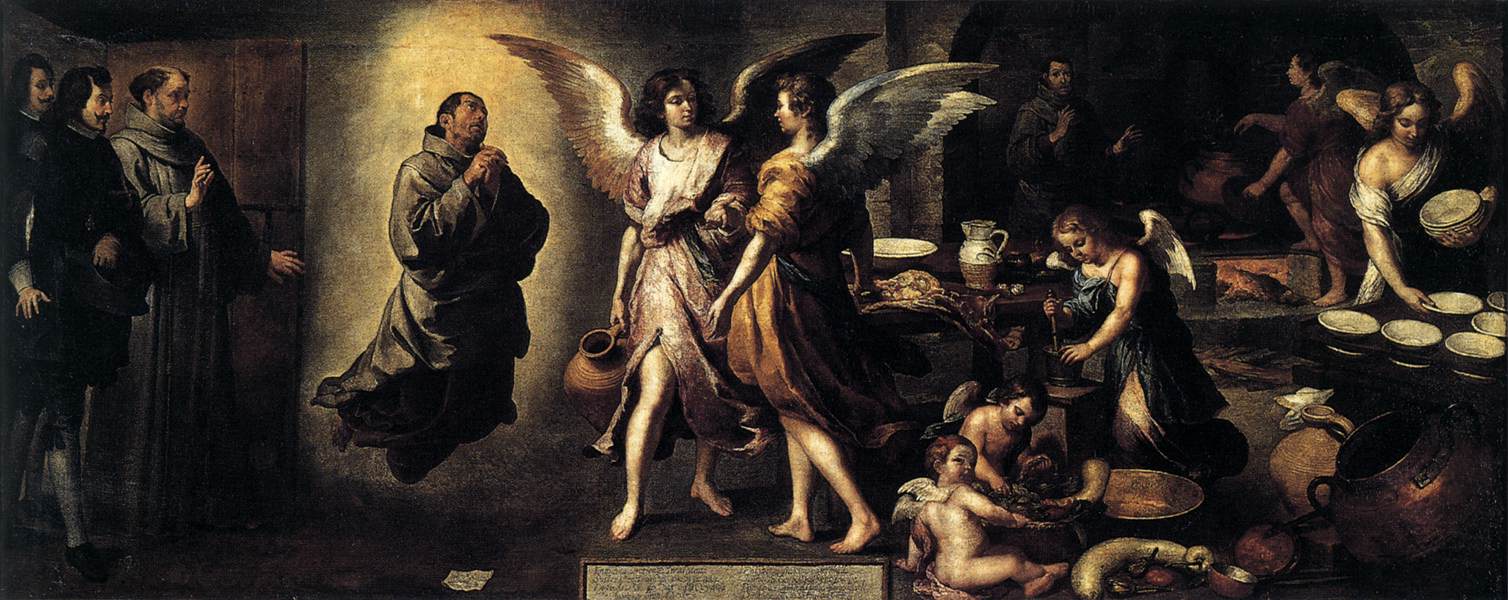
“The Angels’ Kitchen,” painted by Bartolome Esteban Murillo in 1646, is one of the most fascinating and original religious images of the Spanish Baroque. At first glance it appears to be a bustling monastic kitchen, filled with pots, pans, bowls, and food. Only after looking more closely does the viewer realize that many of the workers are angels, their wings glowing softly in the dim interior as they cook, wash dishes, and tend a fire. At the center, a friar floats in mid air, absorbed in prayer, while three majestic angels guide him forward in a blaze of supernatural light.
Based on a miracle from Franciscan tradition, the painting combines humble daily labor with celestial intervention. Murillo uses this subject to explore themes of work, holiness, and divine assistance in ordinary life. The result is a rich visual narrative in which the sacred and the domestic meet in a remarkably natural way.
The Miracle Behind the Painting
The story that inspired “The Angels’ Kitchen” comes from the life of a Franciscan lay brother, often identified as Saint Didacus of Alcalá or a similar humble friar. According to the legend, the monk was responsible for the kitchen in his monastery. One day, while he was supposed to be preparing the meal, he became so absorbed in prayer and meditation that he lost all sense of time. When the hour came to eat, the other friars feared the kitchen would be in chaos.
Instead, they discovered that angels had taken over the work. Heavenly helpers had cooked the food, washed the dishes, and arranged everything in perfect order while the friar levitated in spiritual ecstasy. The story served as an example of the value of contemplative prayer and the readiness of heaven to reward sincere devotion.
Murillo’s painting is a visual retelling of this miracle. It was commissioned for a Franciscan convent in Seville, where such stories reinforced the ideals of humility and divine grace central to the Franciscan spirit.
Overall Composition and Spatial Organization
“The Angels’ Kitchen” is a horizontally oriented canvas with a clear division between left and right. On the left side stand two human observers and two friars, dressed in brown habits. One of the friars is the miraculously levitating brother, whose body hovers above the ground in front of a plain wall. The other friar looks on with amazement, his hands raised in astonishment.
In the middle ground, three large angels lead the floating friar toward the right, where the kitchen scene unfolds. These angels, with their powerful wings and flowing garments, form a bridge between the human world and the supernatural activity taking place among the pots and pans.
The right half of the painting is a crowded, warmly lit kitchen. Angels of various sizes and ages perform different tasks. Some stir food in pots, others carry plates, and smaller winged children clean or arrange utensils. The setting is filled with everyday objects: earthenware jars, copper pots, baskets, and bowls. The floor is strewn with foodstuffs, including bread, vegetables, and perhaps fish. The far background opens toward a fireplace, where pots hang above the flames.
Murillo organizes this complex scene so that the eye moves naturally from the surprised observers on the far left, through the luminous central group of angels and levitating friar, to the busy kitchen on the right. The composition thus leads the viewer from human curiosity to divine action.
The Levitating Friar and His Ecstasy
At the heart of the narrative is the praying friar whose mystical experience has triggered the miracle. Murillo shows him slightly off center to the left, body angled toward the right. His brown habit billows as if caught in an invisible breeze, emphasizing his suspension in mid air. His feet do not touch the ground, and his hands are clasped or held in prayer near his chest.
A halo of light surrounds him, blending with the glow from the angels at his side. His face is turned upward, eyes half closed, lips parted in silent devotion. Murillo conveys both intensity and peace. The friar is unaware of the commotion around him; he is entirely absorbed in his union with God.
This depiction reflects a key theme of Counter Reformation spirituality: the value of contemplative prayer and the possibility of mystical experiences for humble believers. The levitation is a visible sign of interior elevation. By placing the friar in mid air yet close to the kitchen, Murillo suggests that holiness can arise within everyday environments, not only in remote deserts or grand churches.
The Three Guiding Angels
Flanking the friar are three tall angels who act as intermediaries between heaven and earth. They are larger and more statuesque than the kitchen angels to the right, emphasizing their special role. Each has a distinctive posture and garment, but together they form a harmonious group that moves in unison.
The central angel wears a rose colored tunic and carries a jug, echoing the domestic theme yet with a monumental grace. The angel to the right, clad in a golden orange garment, turns slightly toward the kitchen, gesturing as if inviting the friar to see the work that has been done for him. The angel on the left looks toward the friar with calm reassurance.
Their large wings are painted with delicate feather textures, catching the light in shades of white, cream, and soft gray. These wings fill much of the upper portion of the composition, creating a visual canopy that separates the miraculous central action from the darker corners. The angels’ presence signals that the miracle is not merely symbolic; it is a real intervention of heaven into the life of the monastery.
Angels at Work in the Kitchen
The right half of “The Angels’ Kitchen” is a delightful parade of domestic activities performed by celestial beings. Murillo shows that no task is too humble for angels when it serves the needs of God’s servants.
In the foreground, two small winged children, or putti, handle kitchenware near the ground. One seems to clean a vessel while another holds a utensil. To the right, a kneeling angel stirs a large pot with focused concentration. Her blue and pink garment stands out against the warm tones of the copper and clay pots around her.
Further back, a larger angel carries stacked plates toward a table where rows of white bowls are neatly arranged. Another figure tends the fire near the back wall, while yet another angel in white steps forward gracefully with a bowl in hand. The variety of poses and tasks creates a sense of bustling movement, similar to any busy kitchen at meal time, yet suffused with heavenly calm.
Murillo lavishes attention on the still life elements: the sheen of ceramic surfaces, the gleam of metal, the texture of bread and vegetables. These details ground the miracle in tangible reality. The angels, though radiant, interact with real objects, turning cooking and cleaning into acts of service and love.
Light, Color, and Atmosphere
Murillo’s handling of light is essential to the painting’s meaning. The left side of the scene is relatively dark, with subdued browns and grays surrounding the human observers. The background wall and floor are plain, emphasizing the earthly realm. As the eye moves toward the center, a golden light breaks forth around the levitating friar and the three angels. This luminosity appears supernatural, not coming from any identifiable source, symbolizing divine presence.
The right side of the painting, though still shadowy, is warmer and more varied. Firelight from the back of the kitchen glows on pots and angels alike, mingling with the softer heavenly light. The colors here are rich and earthy: terracotta, copper, deep blues, and creamy whites. Murillo uses these tones to create a harmonious balance between the spiritual and the material.
The contrast between light and dark also guides interpretation. The friar’s ecstasy and the angels’ work are bathed in light, while the human observers on the far left stand in shadow. It is as if the painting urges viewers to move from mere spectatorship into participation in the life of grace. The path from darkness into light runs through devout prayer and humble service.
Everyday Labor as a Path to Holiness
One of the most striking aspects of “The Angels’ Kitchen” is its positive portrayal of manual labor. In many religious paintings of the time, holiness is associated with preaching, martyrdom, or grand visions. Murillo, however, focuses on the tasks of a cook and the cleaning of dishes. By showing angels engaged in these activities, he affirms the spiritual value of work that often goes unnoticed.
The miracle does not suggest that the friar should neglect his duties permanently. Instead it implies that his moment of intense prayer is rewarded by divine assistance, so that the needs of the community are still met. The kitchen is not rejected as unspiritual. It is elevated and honored by the presence of angels.
For the Franciscan audience who originally viewed this painting, the message would have been clear. Every chore in the convent, from preparing food to washing pots, could become a prayer if done with love and humility. The members of the community might not see angels in their kitchen, but the painting reassured them that heaven smiled on their labor.
Murillo’s Style and the Sevillian Context
Painted in 1646, “The Angels’ Kitchen” belongs to Murillo’s relatively early period, when he was developing his distinctive blend of naturalism and softness. Seville at this time was a major religious and artistic center. Monasteries and confraternities commissioned works that combined doctrinal clarity with emotional resonance. Murillo’s ability to create tender, accessible images made him particularly well suited to this environment.
In this painting, his style shows clear influences from Spanish tenebrism and from Italian Baroque art. The dramatic contrasts of light and dark recall works by Ribera and Zurbaran, while the graceful angels and dynamic composition reveal admiration for artists such as Guido Reni or Pietro da Cortona. Yet Murillo’s treatment is more intimate and warm than many Italian examples. His angels feel close, almost familiar, and his domestic details anchor the scene in Sevillian reality.
The elongated horizontal format may have been chosen to fit a specific architectural space, perhaps above a refectory doorway or along a refectory wall. Its narrative sweep makes it ideal for contemplation during meals, reminding the friars of the miracle as they gathered in their own dining area.
Spiritual Significance and Counter Reformation Ideals
From a theological perspective, “The Angels’ Kitchen” reflects several key values of Counter Reformation Catholicism. First, it highlights the intercession of saints and angels. The friar’s holiness draws heavenly beings into his daily life, reinforcing the belief that prayer connects the faithful with a living spiritual world.
Second, the painting emphasizes obedience and humility. The protagonist is not a famous preacher or scholar but a kitchen worker. His sanctity lies in his faithful performance of a humble role and his heartfelt devotion. This aligns with Franciscan teaching that the smallest tasks can be done for the glory of God.
Third, the miracle underscores the idea that grace perfects nature rather than destroying it. The angels do not replace the ordinary kitchen with a vision of paradise. Instead they work within it, using its pots and ingredients. Divine grace enters human circumstances, transforming them from within.
Murillo’s visual storytelling communicates these theological ideas without resorting to complex symbols that might confuse viewers. The clarity of the scene, combined with its charm, made it an ideal didactic image for a religious community.
Viewer Experience and Emotional Impact
For contemporary and modern viewers alike, “The Angels’ Kitchen” has a unique charm that sets it apart from more solemn religious scenes. There is delight in seeing angels stirring pots and carrying plates, performing tasks we know well from our own daily lives. This element of gentle humor does not undermine the painting’s seriousness; instead it makes the spiritual lesson accessible and memorable.
The viewer may feel initial curiosity when noticing the levitating friar, then surprise and wonder at the angelic helpers. As the eye lingers, the richness of the kitchen still life invites slower appreciation. The painting rewards contemplation, revealing layers of detail that speak of care and craftsmanship.
Emotionally, the work generates a sense of reassurance. It suggests that no one who seeks God with sincerity is ever truly alone in their work. Even in hidden, repetitive tasks there can be unseen assistance and spiritual meaning. For many viewers, this message remains as relevant today as it was in seventeenth century Seville.
Conclusion
“The Angels’ Kitchen” is a remarkable example of how Bartolome Esteban Murillo united everyday realism with deep spiritual insight. By dramatizing a Franciscan miracle in which angels take over the chores of a kitchen, he created a painting that speaks both to the imagination and to the heart. Its composition leads the viewer from darkness to light, from curiosity to reverence. Its detailed portrayal of domestic objects grounds the supernatural in tangible reality, while its radiant angels affirm the closeness of the divine.
In this single canvas Murillo celebrates the value of humble work, the power of prayer, and the compassionate presence of heaven in ordinary life. “The Angels’ Kitchen” remains a vivid visual sermon on the dignity of service and the grace that can transform even the most commonplace tasks into acts of love.
