Image source: wikiart.org
Introduction to “Old Woman with Distaff”
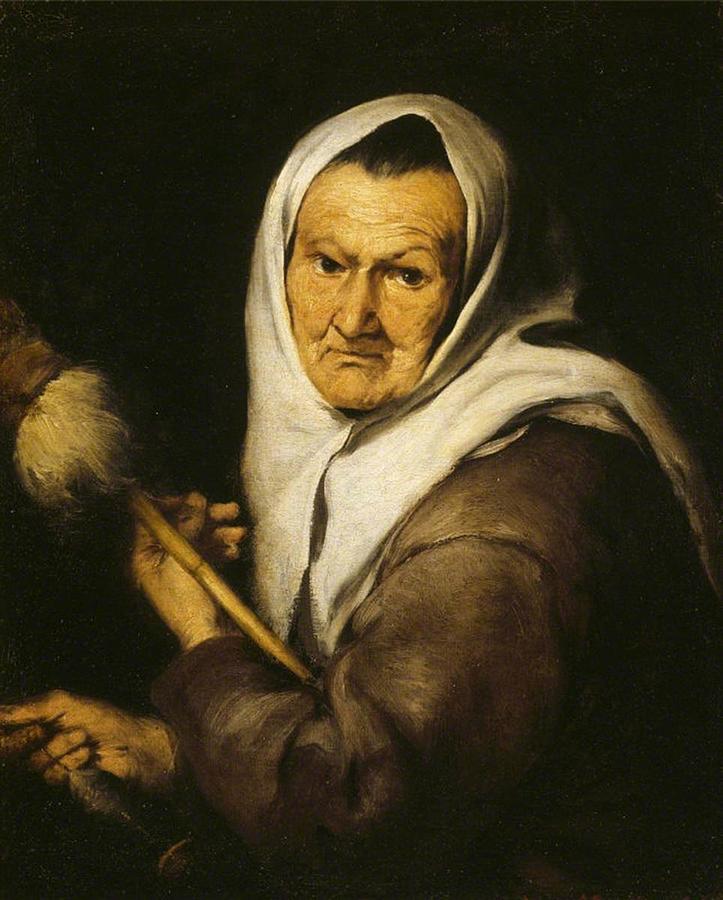
“Old Woman with Distaff,” painted by Bartolome Esteban Murillo in 1642, is one of the most poignant images of everyday life in seventeenth century Spain. Instead of saints, angels, or aristocrats, Murillo turns his attention to an elderly woman, wrapped in a simple white headscarf, holding the tools of her work. The painting shows her turning toward the viewer with a grave, questioning gaze. The dark background isolates her figure, while a warm light falls across her wrinkled face and weathered hands.
This work belongs to Murillo’s early career, when he was experimenting with scenes of ordinary people in Seville. It stands out for its psychological depth and its respectful treatment of age and poverty. Rather than caricature or sentimentalize his subject, Murillo presents her with a quiet dignity that invites contemplation. The distaff and spindle identify her as a spinner, a symbol of humble labor but also of the passage of time. Through this single figure, the artist reflects on work, endurance, and the human condition.
Composition and Pose
The composition is simple yet carefully arranged. The woman sits half turned to the left, but her head swivels back toward the viewer, creating a subtle twist through her shoulders and torso. This turning movement brings life into the image and prevents the figure from feeling static. The diagonal of the distaff and spindle reinforces this sense of motion, directing our eye from the lower left corner up toward the woman’s face.
Murillo places the figure close to the picture plane. There is almost no visible setting behind her, only a velvety darkness. This lack of background draws full attention to the woman and makes us feel physically near. The canvas becomes a kind of window through which we meet her.
Her head is wrapped in a white scarf that falls around her neck and shoulders. The cloth frames her face and becomes a large, bright shape against the dark backdrop. This contrast gives the painting a strong visual focus. Her torso is enveloped in a brownish garment with ample folds, modeled with broad strokes that suggest wool or heavy cloth. The simplicity of her clothing underscores her modest status.
The placement of her hands is also important. One hand holds the distaff close to her chest, as if she has just paused in her work. The other, partly visible at the bottom of the canvas, likely holds the spindle. The tools are not mere props but extensions of her body, evidence of a lifetime of labor. Together, the pose and composition create an image that is direct, intimate, and charged with character.
Light and Shadow
Murillo’s use of light is essential to the emotional power of “Old Woman with Distaff.” A warm light source from the left illuminates the woman’s face, headscarf, and hands, while leaving the background and much of her clothing in deep shadow. This contrast shapes her features in sculptural relief and lends the painting a dramatic clarity reminiscent of Caravaggio and Spanish tenebrism.
The light is not harsh. It slides softly across her forehead and cheeks, emphasizing wrinkles and furrows without exaggeration. The shadowed areas around her eyes enhance their intensity, making her gaze more probing. The white headscarf catches the strongest highlights, creating a luminous halo that defines the silhouette of her head. This luminous white gives the painting a central glow, suggesting inner resilience despite external hardship.
The darkness around her has several functions. It sets a humble, almost timeless stage, free from specific details of environment. It also symbolizes uncertainty and hardship, against which the figure stands out like a small but determined flame. The combination of warm light and deep shadow creates both realism and a sense of quiet drama that keeps the viewer engaged.
The Face and Psychological Depth
The woman’s face is the true center of the painting. Murillo renders it with extraordinary sensitivity. Her skin is lined, her cheeks hollowed, and her mouth drawn tight. Yet these marks of age are never treated as grotesque. Instead, they become signs of experience. Her eyes, slightly narrowed, appear to study us with a mixture of curiosity, caution, and weary intelligence.
The tilt of her head intensifies this psychological impression. She does not sit stiffly; she turns as if someone has called her name or entered the room unexpectedly. This simple gesture establishes a narrative moment and strengthens the sense that we are encountering a real person rather than a type. Her gaze is neither submissive nor confrontational. It is level and assessing, as if she has seen much in life and is not easily impressed.
Murillo avoids theatrical expressions. There is no exaggerated sadness or joy, only a quiet, enduring presence. This restraint allows viewers to project their own interpretations. Some may see loneliness or resignation, others resilience and dignity. The ambiguity makes the painting richer and more lifelike.
The Symbolism of the Distaff and Spindle
The distaff and spindle that the woman holds are practical tools used for spinning wool or flax into thread. In seventeenth century Spain, spinning was a common occupation for women, especially the elderly and poor who could work from home. By including these objects so prominently, Murillo anchors the painting in everyday reality.
Beyond their practical function, the distaff and spindle carry deeper associations. In many cultures, spinning is a metaphor for the passage of time and the unfolding of human life. The ancient Fates of Greek mythology spin and cut the thread of each person’s destiny. In Christian Europe, images of women spinning could evoke patience, industry, and acceptance of one’s lot. For a viewer in Murillo’s Seville, the old woman’s occupation would have suggested the virtues of perseverance and humble labor.
In this painting, the tools appear worn and familiar, almost extensions of her own hands. They indicate that she continues to work despite her age, perhaps to support herself or her family. The distaff held close to her chest may suggest that work is not just necessity but identity, something that has shaped her entire life. Murillo uses these simple objects to turn a portrait into a meditation on work, time, and human endurance.
Realism and Social Context
“Old Woman with Distaff” belongs to a broader tradition of Spanish painting that focused on ordinary people, often those on the margins of society. In Seville during Murillo’s lifetime, poverty was widespread. The city was a major port connected to the Americas, but it also suffered from economic decline, plague, and social inequality. Many artists responded by depicting beggars, street children, and elderly workers.
Murillo’s approach is distinct from that of some contemporaries. Instead of highlighting misery, he emphasizes dignity. The woman in this painting is clearly poor, judging by her simple clothing and the domestic nature of her work, yet she is not reduced to a stereotype of poverty. Her face carries individual personality, and the careful rendering of her features affirms her worth.
The painting retains a sense of realism that would have resonated strongly with viewers in seventeenth century Spain. It echoes the powerful naturalism of artists like Velazquez and Ribera, who portrayed ordinary people with unflinching honesty. At the same time, Murillo’s softer light and sympathetic expression differentiate his vision. He shows hardship but tempers it with compassion.
This mixture of realism and empathy aligns with Counter Reformation ideals. Religious writers of the period encouraged charity toward the poor and emphasized the spiritual value of humility and suffering. Even though this painting is not explicitly religious, it shares that moral sensibility. The old woman becomes a quiet reminder of those who labor in obscurity and of the Christian duty to see Christ in the least of one’s neighbors.
Technique and Brushwork
Murillo’s technique in “Old Woman with Distaff” reveals his skill as a painter and his evolving style. The face and hands are treated with relatively fine brushwork, carefully blended to create smooth transitions of tone. This meticulous modeling conveys the textures of skin and conveys the subtleties of facial expression.
In contrast, the clothing and background are handled more loosely. The folds of the garment are suggested with broad, confident strokes, letting the viewer’s eye fill in details. The headscarf, though bright, is not overworked; Murillo uses sweeping strokes to indicate its folds and edges. This contrast between precise and free brushwork creates depth and directs attention toward the most important areas.
The color palette is limited and earthy. Browns, ochres, grays, and creamy whites dominate. This restraint contributes to the painting’s unity and focuses attention on the interplay of light and shadow rather than on bright hues. The muted tones reflect the sober atmosphere of everyday life and keep the image grounded.
Murillo’s early works often show a stronger influence from tenebrist Spanish painters and from Caravaggio’s followers. In this painting, we see that influence in the dramatic dark background and the concentrated light on the figure. Over time, Murillo’s style would become lighter and more luminous, especially in his religious works. “Old Woman with Distaff” offers a valuable glimpse of his earlier, more austere manner.
Comparison with Murillo’s Other Genre Paintings
Murillo is best known for religious paintings, but he also produced a significant group of genre scenes depicting children, beggars, and humble workers. These works were popular with foreign visitors and collectors who appreciated their vivid realism and human warmth. “Old Woman with Distaff” shares many qualities with paintings such as “Two Women at a Window” or “The Young Beggar,” though its mood is more introspective.
In his images of children, Murillo often blends humor and sentiment, showing them playing, eating, or interacting with each other. In contrast, the old woman is alone, absorbed in her work and thoughts. Where the children’s world is lively and social, hers is quiet and solitary. This contrast underscores the different stages of life and invites reflection on aging.
Yet there are continuities as well. In both types of genre scenes, Murillo focuses on the humanity of his subjects. He gives each figure a distinct expression and posture, emphasizing individuality rather than generic types. His ability to capture subtle moods makes even minor characters memorable.
“Old Woman with Distaff” can also be compared with his portrayals of saints, particularly those that emphasize humility and poverty, such as Saint Elizabeth of Hungary caring for the sick or Saint Thomas of Villanueva giving alms. The old woman may not be a canonized saint, but she embodies similar virtues of patience and labor, and Murillo treats her with comparable reverence.
Emotional Resonance and Viewer Response
One of the lasting strengths of this painting is its emotional resonance. Viewers often report feeling a sense of recognition when they encounter the old woman. She may remind them of a grandmother, neighbor, or someone seen in daily life. Her gaze meets ours directly, and in that meeting there is a subtle exchange.
The painting does not tell us exactly what she feels or thinks. Instead it invites us to imagine her story. Perhaps she has spent decades spinning wool to support a family. Perhaps she has suffered losses and disappointments yet continues her work. The slight tightening of her mouth, the crease between her brows, and the firm grip on the distaff all hint at endurance. By keeping the narrative open, Murillo allows each viewer to project personal associations, making the painting deeply relatable.
This emotional engagement is reinforced by the intimate scale of the work and the close framing of the figure. We are drawn into her presence as if we share the same small room. The lack of overt sentimentality helps the image avoid cliché. Instead of telling us how to feel, Murillo simply presents her and lets the power of her presence speak.
Legacy and Significance
“Old Woman with Distaff” may not be as famous as Murillo’s grand altarpieces or his serene Immaculate Conceptions, but it holds an important place in his oeuvre and in the broader history of Spanish art. It demonstrates how seventeenth century painters could find profound meaning in the lives of ordinary people and how they used the tools of portraiture to explore social reality.
The painting anticipates later traditions of realist art that focused on workers, peasants, and the elderly, from the nineteenth century Realists to twentieth century social painters. Murillo’s respectful portrayal of age contrasts with many stereotypes of old women in art, who are often cast as witches, misers, or comic figures. Instead, he offers a serious, dignified image that acknowledges both hardship and strength.
For modern viewers, the painting continues to resonate in a world where many elderly people still labor quietly, often overlooked. Murillo’s work becomes an invitation to recognize and value them. It also serves as a reminder of the timeless connection between art and empathy, showing how a single, modest image can open a window onto another person’s life.
Conclusion
“Old Woman with Distaff” is a remarkable combination of realism, psychological depth, and human compassion. Through restrained composition, powerful use of light, and subtle characterization, Bartolome Esteban Murillo transforms an anonymous elderly spinner into a figure of enduring presence. Her lined face, wrapped headscarf, and humble tools tell a story of work and resilience that transcends its seventeenth century context.
The painting invites us to look closely at those who might otherwise pass unnoticed. It shows that dignity can reside in the most modest circumstances and that the artist’s eye, guided by empathy, can reveal the inner life of every human being. In this quiet image of an old woman at her work, Murillo offers not only a study of age and labor but also a moving meditation on the value of each individual soul.
