Image source: wikiart.org
Introduction to “A Young Man with a Basket of Fruit”
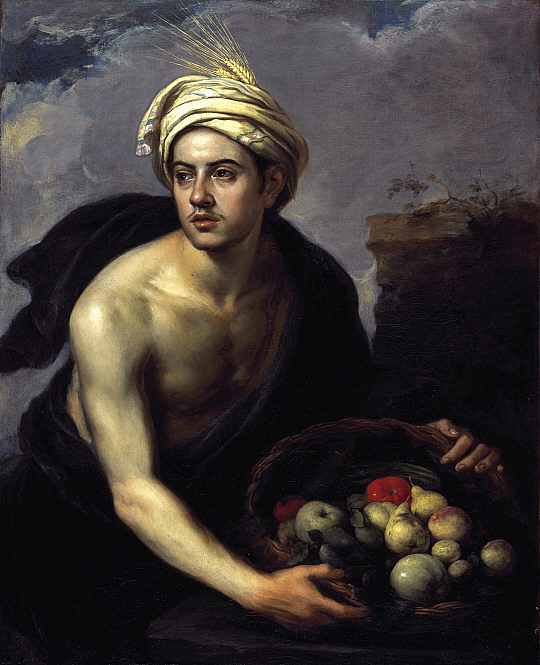
“A Young Man with a Basket of Fruit,” painted by Bartolome Esteban Murillo around 1640, captures a moment that is both everyday and quietly theatrical. A bare chested youth leans forward with a heavy basket of fruit, his body emerging from deep shadow while his gaze drifts away from the viewer toward some unseen point. The painting balances sensual physical presence with hints of narrative and symbolism, revealing Murillo’s skill at combining genre scene, portrait and still life in a single work.
This canvas belongs to Murillo’s early period, when he was experimenting with dramatic lighting and naturalistic detail under the influence of Spanish Tenebrism and Italian art. Even at this stage, however, his characteristic warmth and empathy already shine through. The young man is not a generic model but a vivid individual whose expression invites curiosity and sympathy.
The young fruit seller as subject
At first glance the painting seems to depict a simple figure from the streets of Seville. The young man is half naked, with a dark drapery slung loosely around his shoulders and torso. His head is wrapped in a turban like cloth crowned with stalks of grain, a detail that suggests both exoticism and a connection to harvest. He holds a woven basket brimming with fruit: apples, pears, figs, plums and perhaps a tomato or pomegranate glowing red among more muted tones.
Such figures were common in seventeenth century Seville, a busy port city where vendors of all kinds filled the markets and plazas. Murillo often painted street children and humble workers, bringing a compassionate eye to their lives. Here the young man stands at the threshold between work and art. He might be a vendor pausing between customers, a model posing in a studio or a symbolic figure personifying abundance.
Murillo leaves his social status ambiguous. The bare torso suggests poverty, yet his features are dignified and idealized. The turban and strong profile give him a touch of classical heroism. This mixture of realism and idealization is typical of Murillo, who often sought the beauty of divine creation within ordinary people.
Composition based on diagonal energy
The composition is built around a powerful diagonal. The youth’s extended arm and the basket of fruit stretch from the lower left corner toward the right, while his torso twists in the opposite direction, leading the eye back up to his face. This arrangement creates a sense of movement, as if he has just turned or is about to move forward.
The background is simple but carefully structured. A dark mass of drapery and shadow fills much of the left side, while a stone ledge and sparse plants occupy the right. Above, a slice of sky with clouds opens a cooler zone of color. These elements frame the figure and prevent the eye from wandering off the canvas.
Murillo positions the young man slightly off center. His head sits near the upper left quadrant, not in the strict middle. This asymmetry gives the painting a dynamic rather than static quality. Yet the overall structure remains balanced. The weight of the basket and arm on the right is countered by the broad dark cloak on the left, and the openness of the sky balances the solid forms below.
Light and shadow in the spirit of Tenebrism
One of the most striking features of the painting is its dramatic use of light and shadow. Murillo adopts the strong chiaroscuro associated with Caravaggio and his followers, a style already influential in Spain through painters such as Ribera and Zurbaran.
A focused light source illuminates the young man’s upper body and face, carving his anatomy out of deep darkness. The light grazes his shoulder, chest and forearm, revealing the tension of muscles as he supports the heavy basket. It also picks out the contours of the fruit, making their round forms gleam against shadow.
The rest of the scene dissolves into rich browns and blacks. The cloak, the background architecture and much of the lower canvas fall into obscurity. This contrast not only creates depth but also guides attention directly to the human figure and the still life. The darkness gives the painting an almost theatrical feeling, as if the young man were on a stage spotlighted against a dark backdrop.
Murillo softens the starkness of Tenebrism with a gentle handling of light. Shadows are deep but not harsh. Edges are softened and transitions between light and dark are subtly blended. This approach foreshadows the warmer, more atmospheric style that would characterize his mature religious works.
The basket of fruit as still life and symbol
The basket overflowing with fruit is not a mere accessory. It plays a central role in the painting’s visual and symbolic structure. Murillo meticulously renders the various fruits, giving each its own texture and color. The cool green of unripe apples, the yellow of pears, the deep purples of plums and the bright red accent all contribute to a rich yet harmonized palette.
In seventeenth century art, fruit often carried layered meanings. It could represent abundance and the generosity of nature, but also the fleeting nature of earthly pleasures. Overripe fruit suggested decay and the passage of time. In Christian symbolism, specific fruits carried particular associations: apples with original sin, grapes with the Eucharist, figs and pomegranates with fertility and resurrection.
Murillo does not insist on a single symbolic reading, but the painting invites reflection on the tension between youthful vitality and the transience of material goods. The young man is in the prime of life, his body strong and smooth, yet the basket he offers will soon spoil. His turned gaze and thoughtful expression hint that he may be aware of this underlying fragility.
The still life also allowed Murillo to display his technical skill. The play of light on smooth skins, rough stems and woven basket shows his keen observation of natural surfaces. By placing the fruit so close to the picture plane, he makes it almost tactile, as if within the viewer’s reach.
The psychology of the young man
Perhaps the most captivating aspect of the painting is the young man’s expression. He does not look at the viewer or directly at the fruit. Instead his gaze is directed outward and upward, slightly to the left. His brows are relaxed yet serious, his lips closed in a faintly pensive line.
This sideways gaze introduces a sense of narrative. He might be watching a person approaching to buy his wares, listening to a distant sound or lost in private thoughts. The uncertainty invites viewers to imagine their own stories.
Murillo shapes the features with sensitivity. The eyes are dark and reflective, the nose straight and well defined, the lips full but not exaggerated. A soft mustache and delicate shadow along the jaw give him a slightly aristocratic air. Combined with the turban and bare torso, these features create a blend of everyday youth, classical beauty and vaguely exotic character.
The posture reinforces this psychological nuance. While his arm extends energetically, his torso bends and twists with a gentle curve. The tension between action and contemplation suggests an inner complexity, as if physical labor and interior reflection coexist within him.
Costume and the hint of exoticism
The turban that wraps around the youth’s head is an unusual element in a Spanish painting of the time. It may refer to the presence of Moorish culture in the Iberian Peninsula, or it may simply be a studio prop used to create a sense of exotic allure. The stalks of grain tucked into the cloth heighten this effect, turning the headdress into a symbol of harvest and fertility.
The dark cloak that surrounds his shoulders and waist provides dramatic contrast to his bare skin. Murillo paints it with broad, sweeping strokes, creating heavy folds that recede into shadow. This garment might be interpreted as a simple wrap used by a worker, or it might allude to classical drapery, linking the figure to ancient ideals of masculine beauty.
By combining the bare torso, the dark drapery and the turban, Murillo positions his subject somewhere between a real street vendor, a biblical or mythological figure and an allegorical personification. This ambiguity allows the painting to function on multiple levels: as genre scene, portrait and symbol of agricultural abundance.
Murillo’s early style and artistic influences
Painted around 1640, “A Young Man with a Basket of Fruit” belongs to Murillo’s formative period, before the softer devotional style of his later Immaculate Conceptions and tender Madonnas made him famous. At this time he was absorbing influences from several sources.
The strong chiaroscuro and everyday subject matter show the impact of Spanish naturalist painters such as Velazquez and Zurbaran, as well as the broader influence of Caravaggio. Murillo’s depiction of a youthful model with fruit also recalls Caravaggio’s early works like “Boy with a Basket of Fruit,” although Murillo’s interpretation is gentler and less confrontational.
Murillo likely saw works by Italian and Flemish masters through prints and collections in Seville. The combination of robust naturalism with a certain elegance of pose reflects this cosmopolitan exposure. At the same time, his distinctive sensitivity and compassion already mark the painting as his own. The young man is not simply a dramatic vehicle for light and shadow but a person with interior life.
Tension between sensuality and spirituality
While the painting is not explicitly religious, it carries echoes of spiritual themes. The youthful, semi nude body bathed in light suggests innocence and beauty of creation. The fruit basket evokes both nourishment and the potential for excess. Murillo’s later religious works often used similar contrasts between earthly materiality and spiritual meaning.
The young man’s upward gaze, combined with the opening patch of sky, can be read as a subtle reference to transcendence. He is grounded in physical labor but appears open to something beyond. This quiet spirituality differs from the explicit symbolism of altarpieces yet resonates with the era’s devotional sensibilities.
At the same time, the painting undeniably contains sensual appeal. The smooth modeling of the torso, the warm flesh tones and the lush fruit invite a sensuous response. Murillo negotiates this tension delicately, allowing beauty to be both physical and potentially symbolic of higher goods.
The viewer’s position and engagement
Murillo positions the viewer close to the action. The basket of fruit sits near the bottom edge, almost at the level of our hands. The extended arm draws us into the scene as if the young man were offering the fruit directly. His averted gaze, however, prevents a full sense of exchange. We are invited to look, but we are not the focus of his attention.
This combination of closeness and distance engages the viewer in a subtle way. We feel present in the scene, yet we are also observers of a world that continues independent of us. The painting becomes a window into Seville’s social and symbolic life, as well as a mirror for our own reflections on youth, labor and material abundance.
Legacy and continuing appeal
“A Young Man with a Basket of Fruit” may not be as widely known as Murillo’s religious masterpieces, but it offers a concentrated glimpse of his talents. It unites strong composition, luminous flesh tones, evocative still life and psychological depth. It also captures the vibrancy of seventeenth century Seville, where art, commerce and spirituality intertwined.
For contemporary audiences, the painting remains compelling because it feels both historical and fresh. The young man’s face could belong to someone today, while the basket of fruit and turban connect him to a distant past. The play of light across his body and the shadows surrounding him create a timeless sense of drama.
Viewed in the context of Murillo’s career, the work stands as an early declaration of his interest in the dignity of ordinary people and the beauty of everyday objects. It foreshadows the compassionate realism and warm spiritual tone that would make him one of Spain’s most beloved painters.
Conclusion
“A Young Man with a Basket of Fruit” is far more than a simple study of a market vendor. Murillo transforms a humble subject into an image of striking beauty and layered meaning. Through dramatic lighting, careful composition and sensitive characterization, he invites viewers to engage with themes of youth, labor, abundance and the fleeting nature of earthly goods.
The painting’s combination of realism and idealization, of sensual appeal and potential symbolism, reflects the richness of seventeenth century Spanish art and Murillo’s own unique voice. In the poised figure of the young man, we see both a real individual and a timeless embodiment of human vitality on the edge of change.
