Image source: wikiart.org
Introduction to Murillo’s “Madonna and Child”
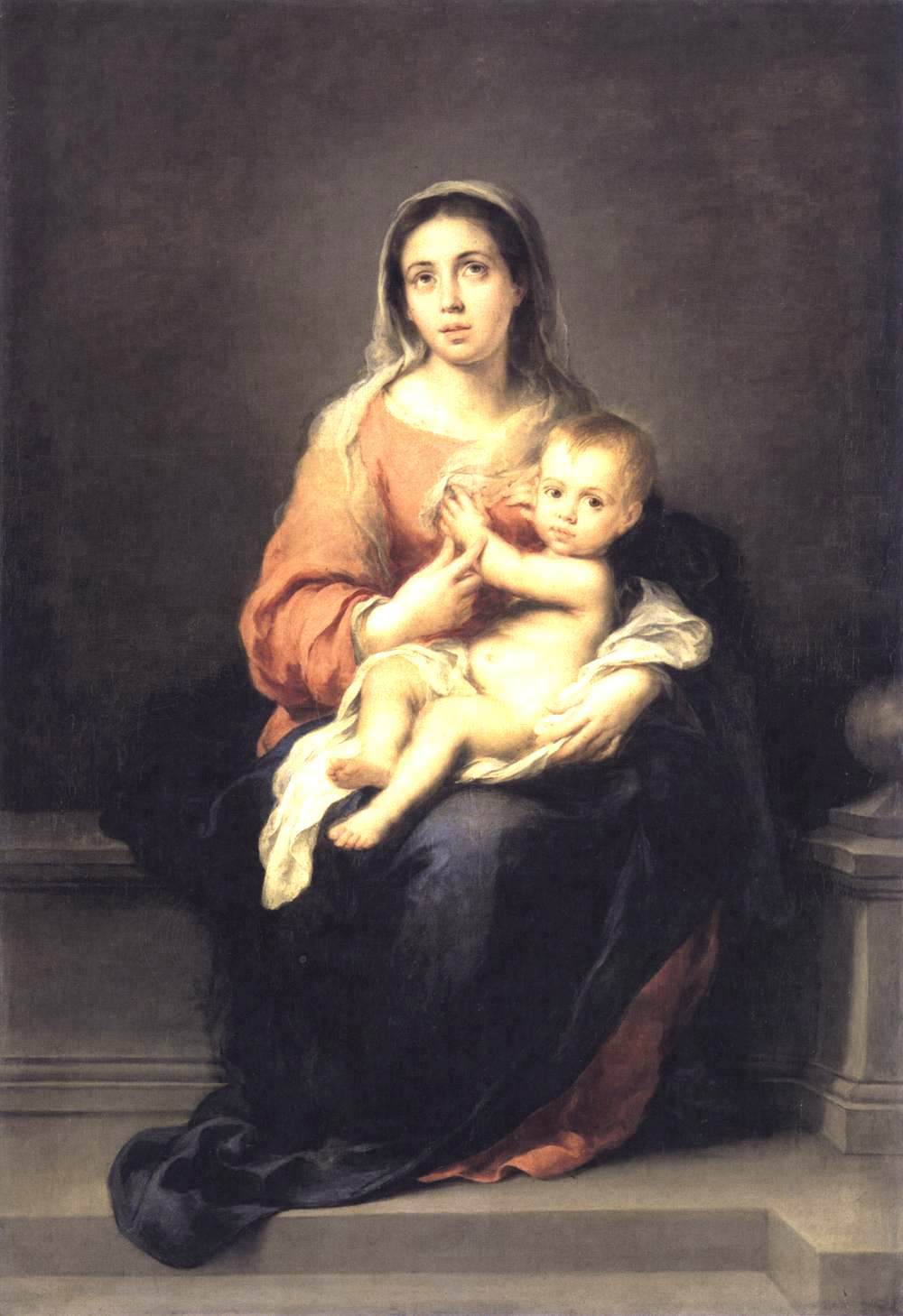
“Madonna and Child,” painted in 1638 by Bartolome Esteban Murillo, is an intimate and deeply human interpretation of one of the most beloved subjects in Christian art. The work shows the Virgin Mary seated in a simple architectural setting, cradling the Christ Child on her lap. There are no angels, no elaborate landscape, no gilded halo. Instead, Murillo offers a quiet encounter between mother and child, illuminated by a gentle light that seems to emerge from within them.
Created in seventeenth century Seville, this painting reflects both the devotional climate of the Counter Reformation and Murillo’s distinctive style, which combined Baroque softness and emotional warmth. It is the kind of image that would have been used not only as a church decoration but also for personal contemplation, intended to foster empathy and love rather than awe in the viewer. Through restrained composition, subtle color, and tender gesture, Murillo transforms a theological mystery into an accessible, living presence.
Composition and the Centrality of the Mother Child Bond
The composition of “Madonna and Child” is remarkably simple. Mary sits at the center of the canvas on a stone bench, slightly turned toward us. The Christ Child reclines diagonally across her lap, one arm wrapped around her neck, the other hand resting near her breast. Their bodies form a unified triangular shape that anchors the entire painting.
Murillo eliminates distractions. The background is a soft, undefined darkness that gradually lightens around the figures, creating a halo like glow without depicting an actual halo. Architectural elements appear only at the margins a stone step below and a fragment of pedestal or column to the right. These stabilize the composition and hint at a sacred setting, but they never compete with the figures.
The triangular configuration of Mary and Jesus is traditional in Renaissance and Baroque depictions of the Holy Family, yet Murillo softens it. The triangle is not rigidly geometric; it is formed by the curve of Mary’s mantle, the slope of her arm, and the line of the Child’s body stretching across her lap. This geometry gives structural balance while also suggesting the enveloping protection of a mother’s embrace.
The absence of additional characters means that the viewer’s attention is focused exclusively on the interaction between Mary and Jesus. The painting functions almost like a portrait, inviting a one to one relationship between viewer and sacred figures. Murillo draws us close, as if we are standing just a few steps away.
Light, Color, and Atmosphere
Murillo’s handling of light in this painting is one of its most striking features. A soft, warm illumination falls from the left, caressing Mary’s face and the Child’s body. The light is not harsh or dramatic; there are no deep Baroque shadows that slice across the forms. Instead, the transitions between light and dark are gradual, creating a sense of calm and serenity.
The color palette reinforces this mood. Mary wears a muted rose colored dress and a deep blue mantle, traditional Marian colors that symbolize love and heaven. Over her hair and shoulders drapes a pale veil that catches the light, forming a luminous frame around her face. The Child’s skin is rendered with creamy tones that glow against the darker cloth beneath him. Murillo uses limited, harmonized colors, avoiding strong contrasts that would disrupt the gentle atmosphere.
The background is a warm gray that tends almost toward brown, echoing the stone bench and pedestal. This neutral field allows the figures to stand out without appearing isolated. The soft fusion of tones creates an enveloping ambience reminiscent of candle lit chapels in seventeenth century Spain. The effect is of a quiet, contemplative light that encourages prayer.
The Humanity of the Virgin Mary
Murillo’s Virgin is not an unreachable queen but a young, tender mother. Her face is oval, her features soft and naturalistic. There is no elaborate crown or heavy ornamentation. She wears modest clothing appropriate to a humble woman. Her expression is calm, almost introspective. She looks out toward the viewer with wide, slightly mournful eyes, inviting contemplation.
This emotional nuance is crucial. Mary does not smile, yet she does not appear distressed. Instead she seems thoughtful, aware of the mystery and future suffering that surround her child. Her gaze bridges the gap between the earthly and the divine: she is a real woman, yet she also knows she participates in a cosmic drama. Murillo captures this complexity with remarkable restraint.
Her hands also express her inner state. One hand supports the Child under his back and shoulders, secure and firm. The other touches her chest near the neckline of her dress, guiding the Child’s hand which reaches for her veil. This gesture is both maternal and devotional. It suggests tenderness, modesty, and perhaps a quiet acceptance of her role as Mother of God. Through this simple action Murillo conveys Mary’s affection, her humility, and her readiness to offer Christ to the world.
The Christ Child as Infant and Savior
The Christ Child in Murillo’s painting is unmistakably a baby. His limbs are chubby, his posture relaxed, and his head slightly oversized, as is typical in infants. He reclines comfortably on Mary’s lap, one leg extended, the other bent, toes curling. Murillo’s careful modeling of the soft flesh and tiny fingers emphasizes his true humanity.
Yet the Child is not merely a generic baby. His gaze is alert and direct; he looks out toward the viewer with a calm, slightly solemn expression. In many earlier depictions of Madonna and Child, Jesus raises his hand in blessing or holds a symbolic object such as a globe. Here those overt symbols are absent, yet his identity is still evident. The combination of infant vulnerability and focused gaze hints at hidden wisdom and future mission.
The Child’s interaction with Mary reinforces both his dependency and his significance. By reaching toward her breast and veil, he evokes the traditional iconography of the nursing Madonna. Even though Murillo does not depict nursing explicitly, the gesture suggests nourishment, both physical and spiritual. In Christian theology, Mary nourishes Christ, and Christ in turn becomes spiritual food for believers. This layered symbolism is encoded in a perfectly natural maternal moment.
Devotional Function and Counter Reformation Spirituality
When Murillo painted “Madonna and Child” in 1638, Spain was deeply marked by Counter Reformation ideals. The Catholic Church encouraged art that was clear, emotionally engaging, and doctrinally sound. Paintings of the Virgin and Child were intended to inspire devotion, to draw believers into a more personal relationship with Christ, and to affirm the role of Mary as compassionate intercessor.
Murillo’s painting fits this program perfectly. It is easy to understand, accessible to all viewers regardless of education. At the same time it avoids sensationalism. There are no exaggerated miracles or violent scenes. The focus is on contemplation of the Incarnation: God made flesh in the arms of his mother. The viewer, standing before the painting, is encouraged to meditate on this mystery through the quiet, luminous presence of the figures.
The emotional tone of the painting is gentle and trusting. There is a sense of domestic peace, yet also a slight undercurrent of melancholy in Mary’s eyes. This combination allows worshipers to identify with her both as ideal mother and as woman familiar with suffering. In a period marked by plague, wars, and social inequality in Seville, such images offered comfort and hope.
Murillo’s Style and the Sevillian Context
Bartolome Esteban Murillo became the leading painter of Seville in the mid seventeenth century, known especially for his religious works and his tender depictions of children. “Madonna and Child” already shows many features that would define his mature style: soft contours, glowing light, idealized yet approachable figures, and an emphasis on emotional warmth.
Seville was a major artistic and economic center, enriched by trade with the Americas. The city’s churches and convents commissioned numerous altarpieces and devotional paintings. Murillo was shaped by both Spanish and Italian influences. He admired the warm color and atmospheric effects of Venetian painting, as well as the realistic detail of Spanish masters like Zurbaran and Velazquez. In “Madonna and Child” he synthesizes these influences into a cohesive vision that feels distinctly his own.
The painting’s restrained drama contrasts with the more intense tenebrism of earlier Baroque artists. Murillo prefers a middle path between harsh chiaroscuro and flat illumination. This moderation contributes to the work’s universal appeal. It is grand enough for a church, yet intimate enough for private devotion. His popularity in later centuries, particularly in the nineteenth century, owes much to this combination of sentiment and classical balance.
Symbolic Details and Subtle Iconography
At first glance, “Madonna and Child” appears free of complicated symbols. There are no lilies, rosaries, or elaborate attributes often found in Marian imagery. Yet Murillo still weaves meaning into the details.
The colors of Mary’s garments red and blue carry long standing symbolism. Red signifies love, charity, and the humanity of Christ; blue represents heavenly grace and her role as Queen of Heaven. Together they show her as the bridge between earth and sky.
The setting, although minimal, features solid stone architecture. This may allude to Mary as “House of God” or “Spiritual Temple,” titles used in litanies. The stable seat and steps suggest firmness and endurance, contrasting with the softness of mother and child. The world outside the frame may be unstable, but the foundation represented by Mary and Christ remains secure.
The Child’s partial wrap in a white cloth can be read as a hint of his future burial shroud. Many artists used such foreshadowing motifs to connect the joyous scene of infancy with the sorrow of the Passion. In Murillo’s painting, the cloth rests lightly, not yet a burden, but the idea is present for meditative viewers.
Emotional Communication with the Viewer
One of the reasons images like Murillo’s “Madonna and Child” remain powerful is their direct emotional communication. The Virgin’s eyes meet ours, inviting a personal encounter. The Child, although relaxed in her arms, also looks outward rather than at his mother. This shared gaze establishes a triangle among Mary, Jesus, and the viewer.
The viewer is thus not a distant observer. We are drawn into a relationship. Mary seems to offer her child to us, yet she also holds him protectively. Her hand near her heart suggests that she shares our concerns, that she feels with us. For believers, this is a visual affirmation of her role as compassionate intercessor, someone who understands human suffering and carries our prayers to her Son.
Even for viewers approaching the painting from a purely artistic perspective, the emotional sincerity of the faces and gestures is compelling. There is nothing theatrical or forced. Murillo’s mastery lies in making the sacred feel naturally human without losing its dignity.
Legacy and Continuing Appeal
Over the centuries, Murillo’s images of the Madonna and Child became some of the most reproduced religious artworks in Europe and the Americas. Their gentle sweetness appealed to both devout Catholics and to collectors who valued sentimental domestic scenes. “Madonna and Child” from 1638 captures early on the qualities that would make Murillo so influential.
Today the painting still speaks to modern audiences in search of quiet beauty and spiritual depth. Its limited palette and simple composition feel almost contemporary in their restraint. The theme of motherhood is universal, cutting across cultural and religious boundaries. Viewers may see in Mary’s pose the timeless tenderness of any parent holding a child, while those familiar with Christian symbolism recognize layers of doctrinal meaning.
The work reminds us that great religious art is not only about doctrine or historical style. It is also about the ability to touch the heart through empathy, light, and form. Murillo achieves this with remarkable subtlety, and “Madonna and Child” remains a moving testament to his capacity to make divinity visible in human terms.