Image source: wikiart.org
Introduction to “Landscape with a Watering Place”
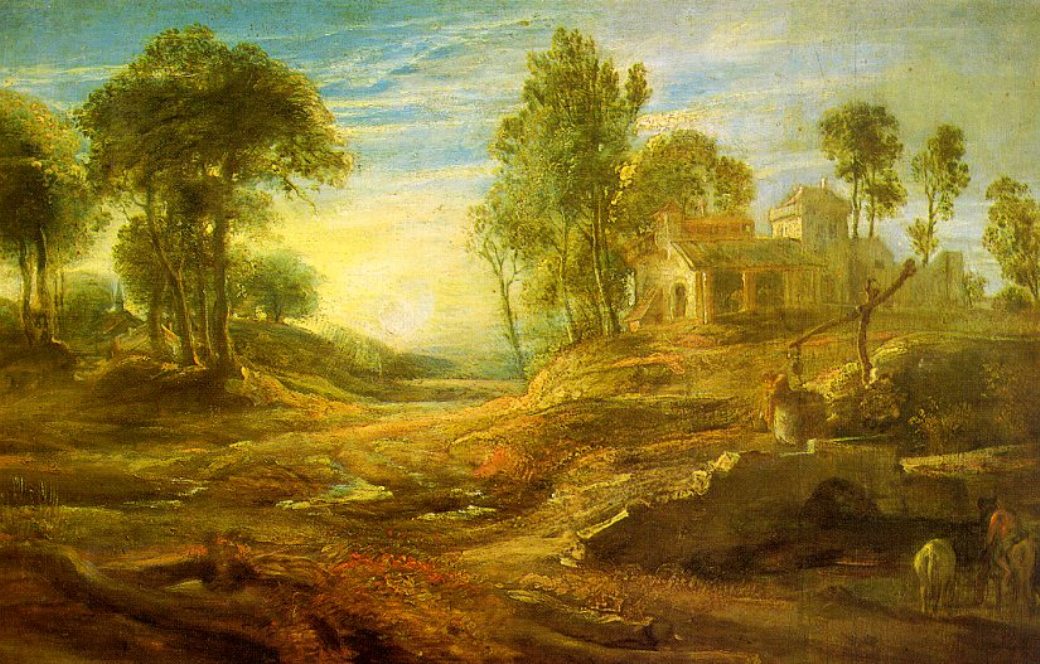
“Landscape with a Watering Place” by Peter Paul Rubens is a luminous and contemplative vision of the countryside, painted by an artist better known for his dramatic altarpieces and mythological epics. Here Rubens steps away from crowded religious scenes and heroic nudes to focus on the quiet poetry of nature. At first glance, the painting seems simple: trees, hills, a distant valley, a farmhouse on a ridge, and a small watering place where people and animals gather. Yet the more you look, the more complex and carefully orchestrated this landscape becomes.
The canvas glows with golden light. A pale sun hangs low near the center horizon, dissolving forms in a hazy radiance that feels like early morning or late afternoon. The eye is drawn into the space along a meandering path and stream that cut through the terrain, inviting the viewer to wander slowly toward that distant light. Rubens blends observation, memory, and imagination to create a landscape that is at once real and ideal, rooted in the Flemish countryside yet shaped by his experience of Italian art and classical poetry.
The Overall Composition and Sense of Space
One of the most striking aspects of “Landscape with a Watering Place” is the way Rubens organizes space. The composition is horizontal, stretching wide like a panoramic view. The foreground is darker and more detailed, filled with earthy browns and greens. From there, the land rises gently on both sides, forming a shallow bowl that frames the luminous valley in the center. This structure creates a natural visual journey from near to far.
On the right side of the painting, a group of buildings sits atop a hill, partially hidden by trees. On the left, another clump of trees balances the mass of architecture. The central valley opens between these two flanking elements, leading the eye toward the distant horizon where the sun glows. This arrangement recalls the “classical” formula of landscape composition, with framing trees and a recessive center, but Rubens handles it with great spontaneity. Nothing feels rigid or schematic. The slopes and paths curve organically, as if shaped by water and time.
Atmospheric perspective plays a crucial role in conveying depth. Forms in the foreground are strongly modeled, while those in the distance soften into hazy silhouettes. Colors shift from warm browns and greens to cooler blues and pale yellows, mimicking the way the eye perceives space in nature. The result is a convincing sense of vastness even though the scene is actually quite intimate.
Light as the Emotional Core of the Landscape
Light is the true protagonist of this painting. The low sun at the center horizon casts a diffuse radiance that seemed very modern for Rubens’s time. Instead of a sharp spotlight, the light spreads gently across the land, touching treetops, house walls, and patches of ground with delicate highlights. Shadows are soft and interwoven with the glow, creating a shimmering, almost dreamlike atmosphere.
This golden light is not merely descriptive. It sets the emotional tone of the work. The scene feels calm, meditative, and slightly nostalgic, as if it captures a fleeting moment at the beginning or end of the day when the world pauses. The warm illumination suggests benevolence and abundance rather than harshness. Field, forest, and human life all seem to bask in the same gentle blessing.
Rubens uses light to guide the viewer’s attention. The brightest area is the open valley, which serves as a visual destination. Yet small localized highlights—on the walls of the farmhouse, on tree trunks, on the stones around the watering place—keep the eye moving around the painting. Light ties together dispersed motifs, unifying the composition and reinforcing the sense that everything belongs to the same natural order.
The Watering Place and Everyday Rural Life
In the lower right corner, partly shaded, lies the watering place that gives the painting its title. A well or stone basin sits near a small bridge or embankment. Figures gather here: a person draws water with a long pole or well sweep, another leads an animal, perhaps a donkey or cow, toward the trough. These figures are tiny compared to the towering trees and wide landscape, yet they provide a vital human scale.
Rubens does not turn the watering place into a grand narrative scene. There is no dramatic incident, no overt religious or mythological reference. Instead, the artist celebrates the quiet routine of rural life. People fetch water, animals drink, and life goes on at a measured pace. The presence of the watering place suggests that this landscape is not wilderness but a lived environment shaped by human use and care.
The humble work performed here anchors the painting in reality. At the same time, the watering place functions compositionally as a visual counterweight to the luminous valley. The dark stone and shadowy recess at the very bottom right help to “lock” the composition, preventing the viewer’s gaze from slipping out of the picture. From this anchored corner, the eye moves diagonally upward toward the sunlit fields and distant view, reenacting the journey from earthbound tasks to contemplation of the broader world.
Architecture in the Landscape: The Distant Farmstead
Perched on the right hillside, partially screened by trees, is a small complex of buildings. A church-like structure with arches and a pitched roof stands in the foreground, while more houses rise behind it. Their pale walls catch the warm light, making them glow against the darker foliage.
These structures add narrative and symbolic layers to the landscape. On the most straightforward level, they represent a farmstead or rural estate, indicating human settlement and cultivation. The proximity of the watering place suggests a self-sufficient community: fields for crops, buildings for shelter, water for people and animals. The scene thus evokes a harmonious relationship between humanity and nature.
On a more poetic level, the architecture introduces a sense of history and culture. The buildings, with their arches and classical hints, recall Italian villas and ancient temples. Rubens had spent years in Italy and absorbed its landscape imagery. By incorporating such forms into a Flemish-like setting, he creates an idealized countryside that is both local and universal, rooted in his own estate life yet enriched by classical memory. The house on the hill becomes a symbol of cultivated civilization nestled within the larger natural world.
Trees as Living Columns
The trees in “Landscape with a Watering Place” are not mere background decoration. They act like living columns that structure the space and rhythm of the painting. On the left, a cluster of tall trunks rises almost vertically, their canopies merging into dense foliage. On the right, trees of varying heights step back in depth, weaving in and out among the buildings.
Rubens renders the trees with lively, loose brushwork. Trunks twist and lean, branches spread irregularly, leaves form restless masses rather than meticulously outlined shapes. This painterly handling conveys a sense of growth and movement. The trees seem to respond to the air and light, not fixed but in perpetual subtle motion.
Compositionally, the trees frame the central opening toward the valley and sun. They function almost like the side wings of a stage, directing the viewer’s attention to the illuminated “scene” beyond. Their dark masses also provide strong tonal contrasts that make the lighter areas glow more intensely. At the same time, the trees help integrate foreground and background by extending diagonals and repeated shapes across the width of the canvas. They are both structural elements and expressions of nature’s vitality.
The Meandering Path and Stream
A key feature of the painting is the winding path or stream that snakes through the landscape from foreground to distance. Its irregular course follows the natural contours of the land, dipping into hollows and climbing gentle rises. In some places it appears as a shallow watercourse, in others as a muddy track, but it always retains a sinuous, inviting form.
This meandering line gives the landscape narrative movement. It offers a virtual route for the viewer to follow, beginning near the watering place, looping through the middle ground, and finally vanishing into the glowing horizon. The path suggests travel, work, and the passage of time. Perhaps it is used by shepherds, farmers, or travelers moving between the farmstead and distant villages.
Symbolically, the winding way can evoke life’s journey, with its twists, obstacles, and moments of revelation. The fact that it leads toward the light reinforces the sense that nature itself is a pathway toward contemplation and perhaps spiritual insight. Rubens does not overstate this symbolism; it arises quietly from the geometry of the scene, allowing viewers to feel it rather than be told explicitly.
Color Harmony and Painterly Surface
The color scheme of “Landscape with a Watering Place” is dominated by rich earth tones and golden yellows, balanced by cooler greens and blues. Rubens employs a warm underpainting that seems to glow through the layers, giving the entire surface a unified, sunlit sheen. Even the shadows contain hints of warmth, preventing the scene from feeling dull or heavy.
Greens appear in many nuanced variations, from dark olive in the shaded trees to fresh, luminous green in the sunlit foliage. The sky transitions from pale yellow near the horizon to deeper blue higher up, with wisps of cloud that catch touches of gold. In the foreground, reddish browns and russets suggest exposed soil, fallen branches, and small flowers.
The brushwork is loose and energetic, especially in the vegetation and earth. Rubens does not dwell on tiny details; instead, he builds forms with broad strokes and layered glazes that allow light to bounce through the paint. This technique enhances the sense of atmosphere and gives the painting a vibrant, living surface. From a distance, the landscape appears richly detailed and coherent. Up close, it dissolves into expressive marks, revealing the artist’s hand at work.
Rubens the Landscape Painter
Although Peter Paul Rubens is most celebrated for his altarpieces, mythological scenes, and portraits, he devoted considerable attention to landscape painting, especially later in his career. Works like “Landscape with a Watering Place” reveal his deep love for the countryside around his own estate, as well as his interest in the expressive possibilities of nature.
Rubens’s landscapes are not strict topographical records. They blend observation with invention, often combining motifs from different locations and times of day. In this painting, the Italianate architecture and golden light may derive from memories of southern Europe, while the rolling fields and scattered trees echo the Flemish environment. The result is a kind of “ideal landscape” that embodies the essence of rural beauty rather than a specific site.
Through such works, Rubens helped pave the way for later landscape traditions. His treatment of light anticipates the atmospheric effects of painters like Claude Lorrain and, much later, the Impressionists. His interest in everyday rural activities, such as watering animals or walking along paths, anticipates the more humble landscapes of the Dutch Golden Age. “Landscape with a Watering Place” thus stands at an important crossroads in the history of European painting.
Nature, Harmony, and Quiet Spirituality
While this painting contains no overt religious iconography, it carries a subtle spiritual resonance. The harmonious arrangement of earth, water, vegetation, architecture, humans, and animals suggests a world ordered and sustained by a benevolent force. The golden light that bathes everything can be interpreted as a visual metaphor for grace or providence.
The smallness of the human figures compared to the vast landscape reminds viewers of their modest place within creation. Yet the figures are not overwhelmed or threatened. They belong here, performing necessary tasks and benefiting from the land’s resources. This balance between human activity and natural grandeur creates a mood of humble gratitude rather than domination or fear.
In this sense, “Landscape with a Watering Place” expresses a quiet spirituality grounded in the rhythms of rural life. It encourages contemplation not through dramatic miracles or visionary apparitions, but through attentive observation of the world’s beauty. Rubens invites us to imagine ourselves walking along the path, pausing at the watering place, feeling the warmth of the sun and the coolness of the shade, and recognizing in these sensations a glimpse of deeper harmony.
Conclusion
“Landscape with a Watering Place” is a remarkable example of Peter Paul Rubens’s ability to translate his Baroque sensibility into the genre of landscape. Through careful composition, luminous light, and expressive brushwork, he creates a scene that feels both real and ideal, grounded in rural labor yet open to poetic reflection. The watering place, the farmstead, the winding path, and the glowing valley together form a visual meditation on nature’s generosity and the peaceful coexistence of humans and their environment.
Far from being a minor diversion in Rubens’s oeuvre, this painting reveals a different facet of his genius. It shows him not as the painter of tumultuous dramas, but as a keen observer of light, atmosphere, and the subtle drama of everyday life. For viewers today, “Landscape with a Watering Place” offers a moment of quiet immersion in a world where work, rest, and contemplation unfold under the same golden sky.
