Image source: wikiart.org
Introduction to “The Departure of Lot and His Family from Sodom”
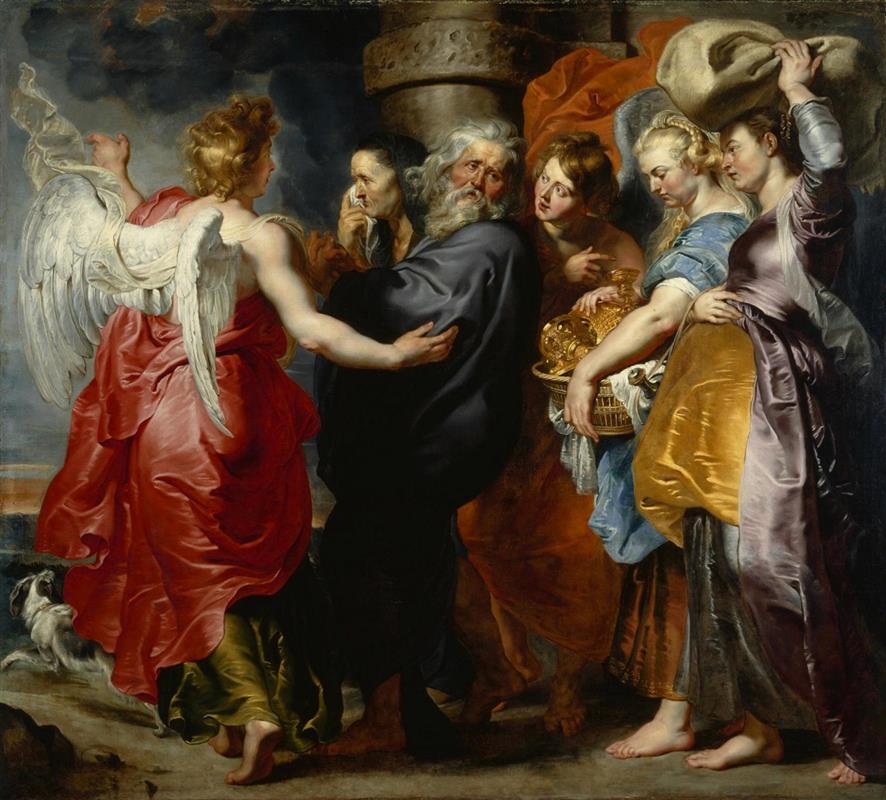
“The Departure of Lot and His Family from Sodom” by Peter Paul Rubens is a vivid Baroque retelling of one of the most dramatic episodes in the Book of Genesis. Instead of portraying the burning city in the distance, Rubens brings the story right up to the viewer, concentrating on the tense procession of figures as the angel leads Lot and his household away from destruction. Swirling fabrics, urgent gestures, and intense facial expressions transform the biblical narrative into a living scene of movement and emotion.
At first glance the painting appears as a tightly packed group moving toward the left. A powerful angel dressed in red and green guides the aged Lot, who turns back anxiously. Behind them follow Lot’s wife and daughters, burdened with baskets, textiles, and precious goods. The sky is darkening with ominous clouds, and a faithful dog trots at their feet. In this concentrated space Rubens explores themes of obedience and hesitation, faith and attachment to worldly possessions, family loyalty and divine judgment.
Biblical Story and Rubens’s Interpretation
The story of Lot and Sodom appears in Genesis chapters 18 and 19. Because of the wickedness of Sodom and Gomorrah, God decides to destroy the cities, yet grants mercy to Lot and his family. Angels visit Lot, warn him to flee, and lead him out of the city. They command him not to look back. Lot’s wife disobeys and turns toward the burning city; she is transformed into a pillar of salt.
Rubens chooses to depict the crucial moment of departure just before the catastrophe becomes visible. The tension in the scene arises from the awareness that an unseen disaster is unfolding behind the figures. The viewer knows that the city is about to be destroyed and that Lot’s wife will pay a terrible price for her lingering attachment. By focusing on the group in motion rather than on the distant flames, Rubens makes the psychological drama the center of attention.
The painting reflects Baroque religious culture, in which artists often emphasized the emotional and moral implications of biblical stories. Lot’s hesitation and his wife’s backward glance serve as warnings against clinging to sin or earthly wealth when God calls for conversion. At the same time, Rubens humanizes the characters, presenting them as a real family torn between fear, grief, and hope.
Composition and the Choreography of Figures
The composition of the painting is carefully orchestrated to convey both forward movement and internal conflict. The group forms a kind of spiral around the central axis of Lot and the angel. The angel strides toward the left, his back turned to the viewer, arm extended as if pointing the way. Lot, slightly behind, turns his head in the opposite direction, creating a strong counter movement. This twist of the torso effectively captures his struggle between obedience and the impulse to look back.
Behind Lot, his wife covers her face with one hand while his daughters cluster in a diagonal line that recedes toward the right edge. One daughter carries a basket filled with golden vessels, another balances a bundle of textiles on her head, and a third supports her from behind. These women form a cascade of color and movement, their robes in blue, gold, and lavender reflecting the wealth they are trying to preserve even as they flee.
The angel’s wings create a sweeping curve that echoes the folds of his red garment and visually unites the group. At the lower left, the dog reinforces the direction of travel, nose pointed forward, while the uneven ground suggests that the family is already leaving the paved streets of Sodom for the rocky countryside.
By crowding the figures so closely together, Rubens intensifies the sense of urgency. There is no spare space around them; the world seems to press in, mirroring the pressure of imminent judgment. Yet within this compressed arrangement each person retains a distinct posture and role, making the scene feel lively and complex rather than chaotic.
The Angel as Guide and Enforcer
The angel is the most dynamic and commanding figure in the painting. Seen from behind, with his curly hair lit by a warm glow, he is dressed in a flowing red robe over a green tunic. His large wings, painted in soft whites and grays, are spread slightly as if he has just descended or is ready to lift off again. The slight turn of his head suggests that he is speaking to Lot or issuing further instructions.
Rubens gives the angel a strong, youthful body that conveys both gentleness and authority. One arm wraps around the elderly Lot in a guiding embrace, while the other gestures outward, signaling urgency. This dual action expresses the angel’s dual function. He is at once a protector leading Lot to safety and a representative of divine judgment who cannot be disobeyed.
The red of the angel’s garment is highly significant. Red evokes both love and power. Here it suggests the burning energy of divine intervention, as well as the passion with which heaven seeks to rescue the righteous. In contrast to the dark sky and muted tones of the background, the angel’s glowing form becomes a visual embodiment of supernatural presence, a living flame leading the way through coming darkness.
Lot and His Inner Conflict
Lot stands at the emotional center of the painting. Rubens portrays him as an aged man with flowing white hair and beard, dressed in a deep blue cloak that contrasts with the angel’s red. His body moves forward, propelled by the angel’s arm, yet his head cranes backward, eyes wide and brows furrowed. His hand clutches the angel’s shoulder almost as if seeking reassurance.
This twisting pose captures Lot’s internal conflict. He has accepted the angel’s command and is in the act of leaving, yet his heart remains attached to the life he is abandoning. Perhaps he thinks of friends left behind, or of the property he must destroy. The viewer can almost hear him asking silent questions: Will the city truly be destroyed? Have I done enough to warn others?
The blue of his garment can be read as a color of melancholy and contemplation. Lot is not merely frightened; he is grieving. Rubens allows this grief to be visible without undermining the necessity of leaving. The tension in Lot’s body expresses the human difficulty of turning away from the familiar even when it is corrupt.
Lot’s Wife and the Seeds of Disobedience
Behind Lot stands his wife, already displaying the gestures that will lead to her downfall. She covers her face with one hand, as if crying or shielding her eyes, and she turns her head back toward the direction they are leaving. Her body leans slightly backward, in contrast to the forward motion of the angel and Lot. The seeds of disobedience are visible in this posture. She is not ready to let go.
Rubens does not caricature her as wicked. Her expression appears anguished rather than defiant. The viewer may sense empathy for her sorrow over the home being lost. Yet the painting also makes clear that her reluctance will have fatal consequences. By placing her so close to Lot, Rubens highlights the painful division within the couple. One struggles to obey, the other cannot tear herself away.
Her dark clothing and weathered face contrast with the youthful beauty of the daughters. She represents an older generation formed by long years in Sodom, more deeply rooted in its habits. The daughters, while reluctant to abandon their belongings, appear more adaptable. This difference points to the theme of generational change in the biblical narrative.
The Daughters and the Weight of Possessions
Lot’s daughters form a vivid trio on the right side of the painting. They are dressed in richly colored garments with abundant fabric that swirls around their bodies. One wears blue with a golden apron, another lavender and silver, while the third is wrapped in warm orange. Their costumes are elegant, reflecting the prosperity they enjoyed in Sodom.
Each daughter carries a burden. The central figure balances a basket overflowing with gold objects, perhaps cups and plates taken from their household. Another heaves a large bundle of cloth on her head, and the third supports her with a hand at her back. These loads symbolize the family’s attachment to material goods. Even as they flee destruction, they try to salvage treasures, thinking more of belongings than of their spiritual situation.
Rubens portrays them not as villains but as realistically human. Their faces show concern and curiosity. The central daughter looks toward the angel with a questioning gaze, as if seeking assurance that leaving is truly necessary. The youngest glances sideways at the viewer, drawing us into the scene and inviting us to judge our own priorities. The shimmering fabrics and gleaming gold also serve a visual purpose, adding richness and color that contrast with the dark sky and rough stone column.
Color, Light, and the Baroque Atmosphere
Color and light are central to the emotional impact of “The Departure of Lot and His Family from Sodom.” Rubens uses a palette of deep reds, blues, oranges, and golds set against a cool, threatening sky. The angel’s red robe dominates the left side, balanced on the right by the warm gold of the daughters’ garments. Between them Lot’s dark cloak acts as a visual hinge.
Light falls from the upper left, illuminating the figures in a soft yet intense glow. It highlights the angel’s wings, Lot’s silver hair, and the gleaming objects in the daughters’ basket. The background remains in relative shadow, with a glimpse of sea or landscape at the far left and a massive stone column rising behind the group. This contrast between illuminated figures and darker surroundings creates a theatrical effect typical of Baroque art, focusing our attention on the drama of the moment.
The swirling folds of fabric catch light in complex ways, creating rhythmic patterns that guide the eye across the canvas. The red of the angel’s garment flows into the orange of a daughter’s robe, the lavender of another, and the shimmering gold of the textile bundle. These color transitions reinforce the sense that the family is still entangled in worldly splendor even as they are being drawn toward salvation.
Gesture, Expression, and Emotional Narrative
Rubens is a master of expressive gesture, and this painting is filled with eloquent hands and faces. The angel’s extended arm and supportive embrace communicate urgency and care. Lot’s raised hand, gripping the angel’s shoulder, expresses both trust and anxiety. Lot’s wife’s hand at her face signals sorrow and hesitation, while the daughters’ hands clutch baskets, textiles, and one another in a chain of dependence.
Facial expressions deepen this narrative. The angel’s face, seen in profile, is calm yet firm. Lot’s eyes are wide, his brows knit, his mouth slightly open as if about to speak. His wife’s lips are compressed, her gaze turned backward. The daughters display a range of emotions from curiosity to concern. None of the figures are flat symbols; they are complex individuals experiencing a crisis together.
By coordinating these gestures and expressions, Rubens tells the story visually even for viewers who might not know the biblical text. The painting communicates the human drama of leaving behind a doomed world and stepping into an uncertain future, guided only by faith and divine command.
Moral and Spiritual Themes
“The Departure of Lot and His Family from Sodom” carries strong moral and spiritual messages that would have resonated with Rubens’s contemporaries. The painting warns against attachment to sinful surroundings and to earthly wealth. Lot’s family is saved not because they deserve it intrinsically but because God chooses to show mercy. Their role is to respond promptly and fully.
The angel’s leadership represents divine grace that comes to pull people away from danger. Yet grace does not abolish human freedom. Lot and his family must decide whether to follow. Lot’s wife’s backward glance foreshadows the consequences of divided hearts. She will become a symbol of those who long for the past instead of trusting God’s future.
At the same time, the painting affirms the value of family solidarity. Lot is not rescued alone. His daughters and even the reluctant wife are given a chance to leave. The group’s close physical arrangement, hands touching and garments overlapping, emphasizes this unity. Rubens suggests that spiritual decisions are rarely individual; they affect and involve entire households and communities.
Rubens’s Artistic Achievement and Lasting Appeal
From an art historical perspective, this painting showcases Rubens at the height of his powers. The rich color, powerful anatomy, expressive brushwork, and complex yet coherent composition exemplify Baroque ideals. The fabric textures, from the heavy silk of the robes to the soft feathers of the angel’s wings, demonstrate the artist’s remarkable technical skill.
The painting also reveals Rubens’s ability to translate scriptural episodes into emotionally compelling images that speak across centuries. Modern viewers may not share the exact theological concerns of seventeenth century audiences, yet the painting’s exploration of choice, loss, and moral courage remains deeply relatable. Anyone who has had to leave behind a familiar but destructive situation can identify with Lot’s struggle and his family’s reluctance.
Moreover, the painting invites reflection on the relationship between spiritual and material values. The glistening gold and sumptuous textiles that make the scene visually sumptuous also function as subtle critiques of attachment to luxury. Rubens uses beauty to question the hold that beauty and abundance can have over human hearts.
Conclusion
“The Departure of Lot and His Family from Sodom” is a rich and multifaceted work that combines biblical narrative, psychological insight, and Baroque splendor. Through tightly choreographed figures, radiant color, and expressive gestures, Peter Paul Rubens turns the moment of escape from Sodom into a powerful meditation on obedience, attachment, and divine mercy. The angel’s red robe, Lot’s twisted posture, the weeping wife, and the burdened daughters together create a visual sermon on the difficulty of leaving the past behind when God calls.
Even today the painting continues to speak to viewers who wrestle with their own departures, whether from harmful habits, unjust structures, or personal histories that must be relinquished. Rubens reminds us that such departures are rarely graceful or easy, yet they are guided by a grace that both commands and supports. In this way, “The Departure of Lot and His Family from Sodom” remains not only a masterpiece of Baroque art but also a timeless reflection on the human journey from destruction toward hope.
