Image source: wikiart.org
Introduction to “Saint James the Greater”
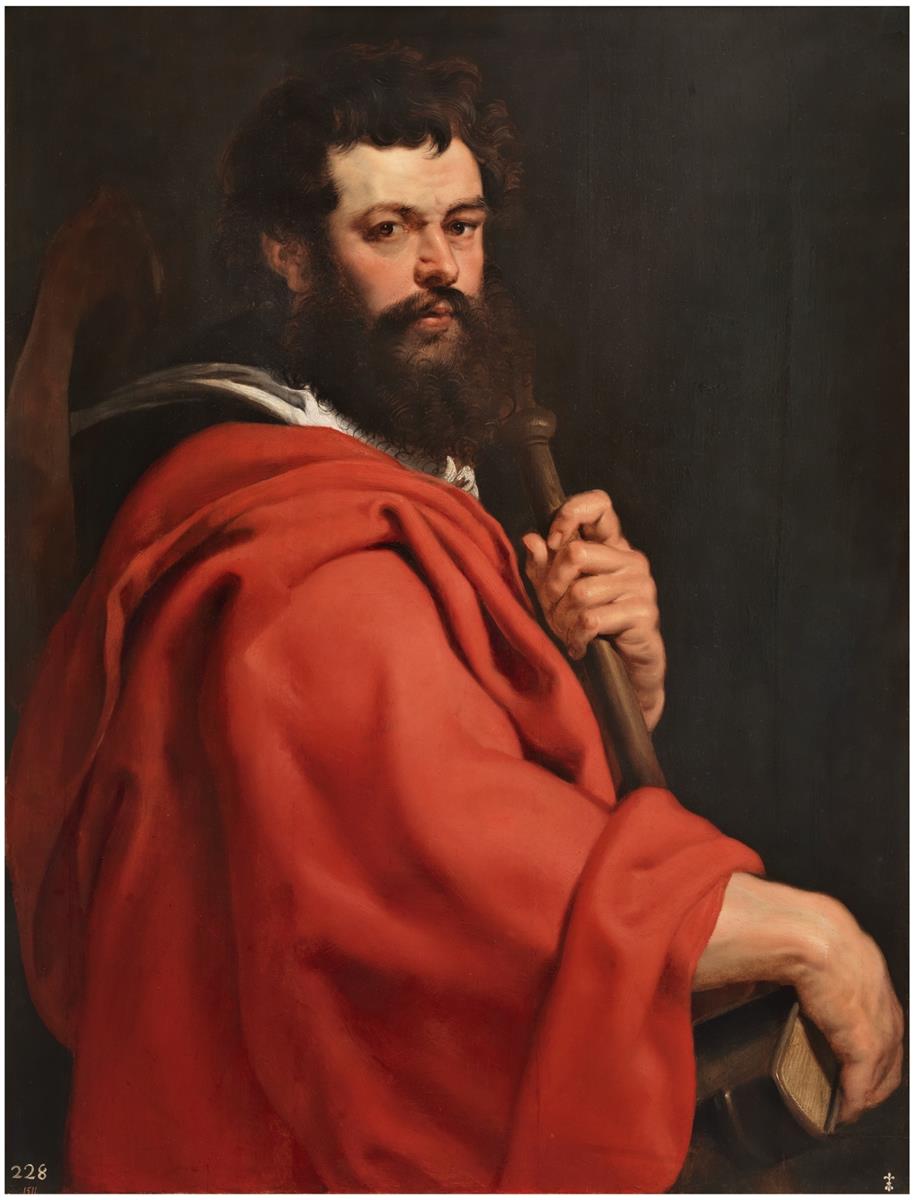
“Saint James the Greater” by Peter Paul Rubens is a powerful half length portrait of one of Christ’s closest apostles. The saint stands turned in three quarter view, wrapped in a voluminous red cloak, his bearded face emerging from the darkness with startling immediacy. He grips a sturdy staff with one hand and holds a closed book with the other, symbols that root him firmly in the traditions of pilgrimage and apostolic authority. Against a nearly empty dark background, every contour of his face, every fold of cloth, and every calloused knuckle becomes significant.
Rubens presents Saint James not as a distant, ethereal figure but as a vivid, living presence. He is robust, strong featured, and intensely human. His dark eyes meet the viewer’s gaze with a mixture of resolve and introspection, as if he has just turned from his mission to regard us for a moment. The painting condenses the history, spirituality, and legend of the apostle into a single commanding image that reflects the Baroque era’s fascination with both psychological depth and dramatic visual impact.
Historical and Religious Context
Saint James the Greater was one of the Twelve Apostles and the brother of Saint John the Evangelist. According to Christian tradition, he was among the first disciples called by Christ and later became the first apostle to suffer martyrdom. Over the centuries he came to be closely associated with pilgrimage, especially through the shrine at Santiago de Compostela in Spain, where his relics were believed to reside. Pilgrims from across Europe traveled there following the famous Camino de Santiago, making James a spiritual companion for travellers and seekers.
Rubens worked in the early seventeenth century, when the Catholic Church emphasized the veneration of saints as models of faith and as heavenly intercessors. Series of apostle portraits were popular in churches, monasteries, and private chapels, where they served as visual reminders of the foundations of the Church. Rubens contributed to this tradition with a number of monumental apostle images, including this striking representation of Saint James.
The painting therefore belongs to a devotional context. It would have encouraged viewers to contemplate the courage and steadfastness of James, to remember his missionary journeys and martyrdom, and to ask for his prayers. At the same time, Rubens uses the opportunity to explore the expressive possibilities of portraiture, creating a figure that feels as real and individual as any contemporary sitter.
Iconography and Identification of the Apostle
Rubens ensures that the viewer can recognize the figure as Saint James the Greater through a carefully chosen set of attributes. The most prominent is the staff he holds over his shoulder. This sturdy walking stick, grasped firmly in his right hand, alludes to his role as a pilgrim and as the patron saint of pilgrims. It evokes the long roads of mission and the countless travelers who invoked his protection along their own journeys.
In his left hand James holds a closed book, probably representing the Gospel message he preached or the broader body of Christian teaching. Apostles are often depicted with books or scrolls to indicate their role in transmitting the faith. The combination of staff and book sums up the saint’s identity: he is at once a man of the road and a man of the Word.
The red cloak wrapping around his shoulders and chest may echo the color traditionally associated with martyrdom and fervent charity. While James’s martyrdom is not shown directly, the cloak hints at the blood he shed for Christ and the burning zeal that animated his preaching. The absence of elaborate background details keeps attention focused on these few objects and on the saint’s expressive face, allowing the symbolic elements to speak with clarity.
Composition and Pose
Rubens structures the composition around a strong diagonal that runs from the lower right corner, where James’s hand grips the book, up through the staff and across his shoulder to his head. This diagonal gives the figure dynamic presence, as if he is about to move forward or turn more fully toward the viewer. Rather than a static frontal pose, we see a man caught in the midst of motion, suggesting the active life of an apostle.
The figure fills most of the canvas, leaving only a narrow area of dark background around him. This close cropping amplifies the sense of proximity. The viewer stands almost within arm’s length of the saint, close enough to see the texture of his beard and the slight furrow of his brow. The pose is slightly turned away, yet his head is rotated back toward us. This creates a tension between inwardness and outward engagement. He appears to have been looking elsewhere, perhaps toward the path ahead or toward the divine, and then to have turned his gaze toward us.
The staff resting on his shoulder gives structure to the pose and reinforces the idea of journey. It acts almost like a compositional axis around which the folds of the cloak and the lines of the arms are arranged. The book at the lower right anchors the composition and balances the weight of the upper body, creating a stable yet energetic configuration that reflects both physical strength and spiritual steadfastness.
The Psychology of the Gaze
One of the most compelling aspects of this painting is the intensity of Saint James’s gaze. Rubens renders his eyes with remarkable precision, set deep beneath a strong brow and framed by dark lashes. They are directed slightly to the viewer’s left, giving the impression that he is not staring blankly but focusing on something specific. The gaze carries a mix of scrutiny, concern, and quiet authority.
This psychological depth invites viewers to imagine what James is thinking. His firm mouth, partly hidden by his beard, suggests determination, but there is also a hint of weariness in the heavy eyelids and the slight shadows beneath them. He appears as a man who has seen hardship and persevered through it. This complexity makes the saint feel profoundly human. He is not an idealized, distant icon but someone who has struggled and remained faithful.
At the same time, the gaze operates as a bridge between the painted world and the viewer’s world. In a devotional context, it could be experienced as the saint looking directly at the person praying before the image, acknowledging their presence and perhaps examining their conscience. Rubens thus uses the psychology of portraiture to create a spiritual encounter, making the viewer feel personally addressed by the apostle.
Color, Light, and the Drama of the Red Cloak
Rubens is renowned for his mastery of color, and the red cloak in this painting is a tour de force. It occupies a large portion of the canvas, flowing over the saint’s shoulders and down across his chest and arm in richly modeled folds. The red is deep and warm, with subtle variations from bright highlights to shadowed maroons. These gradations give the fabric a sense of weight and movement, as if we could almost feel its heavy, slightly rough texture.
The choice of such a vivid color against a dark background has a dramatic effect. The cloak seems to emerge from the gloom like a flame, drawing the eye immediately to the figure. The highlights on the crest of the folds help to sculpt the form of the body beneath, while the shadows create mysterious depths that echo the spiritual depth of the saint himself. The red also contrasts beautifully with the more neutral tones of his flesh and beard, making his face stand out all the more.
Light in this painting appears to come from above and slightly to the left. It illuminates the upper planes of James’s face, catches on the bridge of his nose and the top of his brow, and glides across his knuckles and the edge of the book. By carefully controlling where the light falls and where it fades into shadow, Rubens heightens the sense of volume and directs attention to the most important elements: the face, the staff, and the book. The rest of the background recedes into darkness, reinforcing the contemplative mood.
Texture, Flesh, and the Painter’s Craft
Beyond color and light, the painting rewards close attention to texture. Rubens differentiates between skin, hair, cloth, and wood with subtle but effective brushwork. Saint James’s beard is rendered with small, varied strokes that suggest the curl and thickness of hair. The transitions between beard and skin are handled delicately, with soft edges that contribute to the naturalistic effect.
The skin of the hands and face shows Rubens’s mastery of flesh tones. He layers warm pinks, cool browns, and touches of ivory to convey the way blood and light interact beneath the skin. The hands, especially, are worth studying. They appear strong and slightly roughened, indicating a life of labor and travel, yet they are painted with sensitivity. Veins, knuckles, and tendons are suggested without exaggeration, enhancing the sense of authenticity.
The staff and book provide textural contrasts. The staff looks solid and worn, with a smooth but slightly irregular surface that hints at long use. The book’s cover and pages are described with minimal strokes yet convincingly, implying leather and paper. These textural differences enrich the visual experience and ground the saint’s spiritual role in tangible objects drawn from everyday life.
Spiritual Themes of Pilgrimage and Witness
Although “Saint James the Greater” is not a narrative scene, it conveys powerful spiritual themes through symbolism and expression. The staff and red cloak strongly evoke the idea of pilgrimage. James appears as the archetypal pilgrim, always on the move, carrying little more than his staff, his faith, and the word of God. This resonates with the historic devotion surrounding Santiago de Compostela and the many pilgrims who took to the road seeking spiritual renewal.
The book signifies the role of James as a witness to Christ’s life, death, and resurrection. In Christian tradition, apostles are foundational witnesses who went out to proclaim what they had seen and heard. By placing the book firmly in James’s hand, Rubens emphasizes that his authority rests not on personal power but on fidelity to the Gospel message. The closed book hints at mysteries that are contained but not yet fully revealed, inviting viewers to open their hearts to the teaching it represents.
The overall mood of the portrait is one of calm strength. James is depicted neither in ecstasy nor in dramatic suffering. Instead, he appears as a steadfast figure, ready to continue his mission. This quality would have offered viewers a model of perseverance in faith, especially in times of persecution, doubt, or fatigue. The painting thus functions as a visual exhortation to stay firm on the path, echoing the apostle’s own journey.
Rubens, Portraiture, and the Baroque Ideal of the Apostle
This painting also reflects Rubens’s larger approach to religious portraiture. Unlike earlier, more iconic representations of saints, Rubens brings the apostles close to the conventions of secular portrait painting. Saint James could almost be a contemporary dignitary or soldier, characterized by individualized features and psychological complexity. Yet the symbolic attributes and solemn mood clearly mark him as a sacred figure.
This blending of realism and sanctity is typical of Baroque art, which sought to make spiritual realities vivid and accessible. Rubens’s apostles do not belong to a distant, unreachable realm. They look like people we might meet, yet their bearing and attributes reveal their extraordinary calling. In “Saint James the Greater,” this approach results in a portrait that feels both timeless and historically grounded.
The painting may have been part of a larger series of apostles, which would have formed an imposing ensemble when displayed together. Each figure would contribute a distinct personality and attribute, creating a kind of visual chorus that celebrates the diversity and unity of the apostolic college. Within such a series, James’s strong red cloak and intense gaze would stand out, embodying zeal, courage, and pilgrimage.
Legacy and Contemporary Resonance
Today, viewers encountering “Saint James the Greater” can appreciate it on multiple levels. As a work of art, it showcases Rubens’s exceptional skills in composition, color, and characterization. The flowing red cloak, the textured beard, and the luminous flesh demonstrate why he remains one of the central figures in Baroque painting.
As a spiritual image, it still speaks to those who see life as a journey. The figure of James, staff in hand and book under his arm, evokes the experience of walking through uncertainty guided by faith. For modern pilgrims who walk the Camino de Santiago or for anyone engaged in an inner search, the painting offers an image of companionable strength. The saint’s direct gaze can be interpreted as encouragement to keep moving forward, to carry both the weight of tradition and the hope of new discovery.
Even for those outside a religious framework, the painting’s exploration of character and resolve has resonance. It presents a human being who has embraced responsibility and is prepared to face challenges. The portrait celebrates qualities that remain universally admirable: courage, dedication, and integrity.
Conclusion
“Saint James the Greater” by Peter Paul Rubens is far more than a simple identification of an apostle. It is a richly conceived portrait that fuses theological symbolism with keen psychological insight. Through the staff, book, and red cloak, Rubens encodes James’s roles as pilgrim, witness, and martyr. Through the intense gaze, robust physique, and dynamic pose, he presents the apostle as a living, breathing individual whose strength is both physical and spiritual.
The dark background and dramatic lighting isolate the figure, making his presence almost tangible for the viewer. Standing before this painting, one can easily imagine James pausing on his journey, turning to face us with measured seriousness, inviting us to share in the path of faith and perseverance. In this way, Rubens transforms canvas and pigment into an encounter across centuries, where art, history, and spirituality meet in the compelling figure of the apostle.