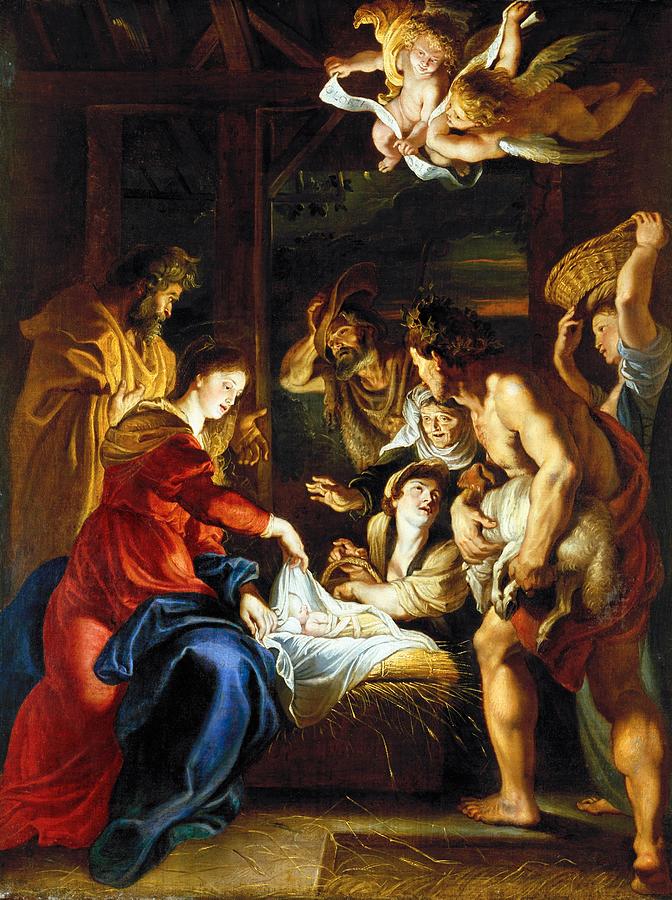
Image source: wikiart.org
Introduction to “Adoration of the Shepherds” by Peter Paul Rubens
“Adoration of the Shepherds” by Peter Paul Rubens is one of the most tender and luminous interpretations of the Nativity in Baroque art. In this painting Rubens imagines the moment when humble shepherds arrive at the stable to see the newborn Christ. The composition is crowded with figures who lean in toward the manger, their faces illuminated by the soft glow that seems to emanate from the child himself. Mary kneels in vibrant red and blue, Joseph watches quietly in the shadows, and rustic shepherds bring simple gifts with awe and joy. Above them angels hover, holding a banner of praise and showering the scene with celestial light.
Rubens combines emotional intimacy with theatrical brilliance. The painting is not a distant religious tableau but an invitation to join the gathering around the manger. The viewer feels as though they have just stepped into the stable behind the shepherds and are witnessing the miracle at close range. Through rich color, expressive gestures and masterful handling of light, Rubens turns a familiar biblical story into a deeply human scene filled with warmth and wonder.
Historical and Devotional Context
The subject of the Adoration of the Shepherds comes from the Gospel of Luke, which recounts how angels announced the birth of Christ to shepherds watching their flocks by night. These men hurried to Bethlehem and found Mary, Joseph and the infant lying in a manger. In Christian tradition the shepherds represent the poor and lowly who are among the first to receive the good news. Their presence emphasizes the humility of Christ and the openness of salvation to all people, regardless of social rank.
Rubens worked in the Spanish Netherlands during a time when the Catholic Church promoted vivid, emotionally engaging images as part of the Counter Reformation. Altarpieces and devotional paintings were meant to draw believers into the sacred events, encouraging them to feel the reality of the Incarnation and the closeness of God. “Adoration of the Shepherds” fits perfectly into this program. It invites viewers not only to remember but to participate imaginatively in the Nativity.
The painting likely served in a church or chapel, where it would have been contemplated during the Christmas season and beyond. Worshippers standing before it could recognize themselves in the shepherds, bringing their own lives and burdens into the presence of the Christ child. Rubens thus creates a bridge between scripture and everyday experience, using his visual language to make the mystery of the Incarnation accessible and immediate.
Composition and the Architecture of the Stable
Rubens constructs the composition around a strong diagonal that runs from the angels in the upper right down to the manger in the lower left. The figures form a kind of spiral around the child. Mary kneels closest to the viewer, Joseph stands behind her, and the shepherds cluster on the right, leaning inward. This layout guides the eye naturally toward the luminous center where the infant lies on a bundle of straw and cloth.
The architecture of the stable is suggested rather than fully described. Rough wooden beams frame the top of the scene, and a dark opening at the back hints at the night outside. The sense of enclosure increases the intimacy of the moment and intensifies the contrast between the dark surroundings and the radiance of the central group. At the same time the open upper right portion of the canvas, where the angels appear, connects the humble hut to the vastness of heaven.
Rubens uses overlapping bodies to create depth. Some figures are partly hidden behind others, giving the impression of a crowded gathering. The viewer feels that more people could be just outside the frame, eager to see the child. The scene is carefully staged yet appears spontaneous, as if the characters have rushed in and taken their places without any deliberate order.
The Holy Family at the Heart of the Scene
At the centre of the painting lie Mary, Joseph and the Christ child. Mary kneels at the left in a sweeping red robe and deep blue cloak. Her hands carefully open the white cloth that covers the baby, presenting him to the shepherds. The tilt of her head and the soft glow on her face express quiet joy and maternal tenderness. She is both mother and devotional figure, inviting viewers to contemplate the mystery lying in her arms.
The child himself is small and vulnerable, wrapped in simple white fabric that reflects the surrounding light. Rubens paints his skin with delicate warmth, making him appear both human and radiant. His body is slightly twisted, as if he is just waking, reminding us that this divine infant is also fully alive and responsive to the world. The whiteness of the cloth suggests purity and innocence, while the straw beneath him points to the poverty of the setting.
Joseph stands in the shadows behind Mary, wearing earth toned garments. His posture is one of protective watchfulness rather than prominence. Rubens often shows Joseph as a modest, supportive presence who quietly cares for his family. Here he leans forward, hands clasped, gaze focused on the child. His subdued colors and placement in the darker area balance the vivid attire of Mary and the shepherds, emphasizing his role as a steady guardian rather than a dramatic protagonist.
The Shepherds and Their Humble Offerings
On the right side of the composition the shepherds crowd in with lively curiosity and reverence. Each figure displays a distinct reaction to the sight of the child. One young man kneels in front, gazing upward toward Mary in awe, his hat pushed back and his face lit with wonder. Behind him an older woman stretches her hands forward in a gesture of delight, while another shepherd peers over her shoulder, his expression mixing joy with disbelief.
The foremost shepherd, muscular and half nude, carries a lamb over his shoulders and a woven basket on his arm. His strong body and rustic features contrast with the delicate infant, yet the lamb he brings symbolizes innocence and sacrifice. The offering recalls Christ’s later role as the Lamb of God who will give his life for humanity. This shepherd becomes a visual link between the Nativity and the Passion, connecting birth and future redemption.
Their clothes are simple, made of rough fabric and earth tones, with a few accents of color. Rubens uses these textures to emphasize their lowly status, yet he portrays them with dignity and vitality. They are not passive onlookers but active participants who have brought what little they have. Their eagerness, expressed in outstretched hands and leaning bodies, suggests that they are offering not only material gifts but their hearts and lives.
The Angels and the Light of Heaven
High above the group two cherubic angels swoop into the scene, wrapped in flowing drapery and bathed in golden light. One holds a scroll, likely bearing the words of praise sung at Christ’s birth, while the other lifts an arm in jubilant celebration. Their presence reminds viewers of the heavenly chorus that announced the news to the shepherds in the fields.
These angels are painted with soft, rosy flesh and fluttering wings, typical of Rubens’s charming putti. They bring movement and playfulness to the composition, lifting the viewer’s gaze upward. Their luminous bodies also help to explain the unusual lighting of the scene. Along with the glow from the child, the angels seem to pour celestial light into the dark stable, turning it into an illuminated sanctuary.
The combination of angels and shepherds underscores the union of heaven and earth in the Incarnation. High and low, celestial spirits and rustic laborers, all gather around the same child. This mingling of different orders of being is central to the theological meaning of the Nativity, and Rubens conveys it in visual form by placing the angels directly above the human crowd yet integrated into the same stream of light.
Light, Color and the Creation of Sacred Atmosphere
Light is the key to the emotional impact of “Adoration of the Shepherds.” The brightest area is the small body of the Christ child, whose white swaddling cloth seems almost to glow. This radiance spreads outward, illuminating Mary’s face, the hands and faces of the shepherds and portions of their clothing. In contrast, the background remains in deep shadow, which heightens the sense that the light is extraordinary and not merely natural.
Rubens uses a warm golden tone for this central illumination. It creates a feeling of warmth and intimacy, as if the viewer is standing by a fire on a cold night. The light also models the figures in a sculptural way, emphasizing the curves of limbs and folds of fabric. Subtle highlights on the shepherds’ muscles, the lamb’s fur and the basket’s weave give the painting a tactile richness that draws the viewer into the physical reality of the scene.
Color plays an equally important role. Mary’s red gown and blue cloak are the most saturated hues, marking her as the visual anchor. The shepherds’ garments are painted in browns, ochres and muted blues, with occasional flashes of white and red that echo Mary’s colors without rivaling them. The angels appear in soft golds and creams, harmonizing with the warm light. Overall the palette is rich but controlled, reinforcing the mood of solemn joy rather than exuberant spectacle.
Human Emotion and Spiritual Intimacy
One of the hallmarks of Rubens’s religious art is the way he conveys complex emotions through gesture and facial expression. In this painting every figure displays a different feeling in response to the child. Mary’s expression is serene and contemplative as she contemplates her son. Joseph’s gaze is thoughtful and protective. The young shepherd kneeling at the center looks upward with amazement, his lips parted as if caught in the middle of an exclamation.
The older woman behind him smiles warmly, leaning forward as if to get a better look. The muscular shepherd with the lamb gazes intently at the baby, his rugged features softened by reverence. Even the figures at the very back, partly obscured in shadow, peer inside with curiosity. The diversity of these reactions encourages viewers to find themselves somewhere in the group. Whether one approaches the manger with youthful wonder, quiet contemplation or simple joy, there is a place in the scene.
This emotional variety also reflects the nature of religious experience itself. The birth of Christ is both a cosmic event and a personal encounter. Rubens suggests that each person present receives the revelation in an individual way yet all share in the same light. The intimate closeness of the figures, almost touching shoulders as they lean in, symbolizes the shared community of faith that forms around the child.
Baroque Spirituality and Theatricality
“Adoration of the Shepherds” embodies the spirit of the Baroque, a style that sought to move the heart with dramatic compositions and vivid realism. Rubens uses theatrical devices such as strong diagonals, intense lighting and expressive poses to create a sense of immediacy. The painting feels like a scene from a sacred play, frozen at the climactic moment when the shepherds first behold the child.
Yet the theatricality is not empty spectacle. It serves the deeper purpose of Baroque spirituality, which aimed to draw believers into direct engagement with the mysteries of faith. The emotional gestures, rich textures and lifelike faces invite meditation on the reality of the Incarnation. Rather than presenting the Nativity as a distant historical event, Rubens makes it feel as though it is unfolding in the present.
The contrast between earthly poverty and divine glory is also a key Baroque theme. The stable is rough, the straw is scattered on the ground, and the shepherds’ clothes are worn. In the midst of this humble environment the light of heaven shines. The combination of rustic setting and radiant illumination reinforces the Christian belief that God entered the world in humility and transformed it from within.
Legacy and Contemporary Resonance
Today “Adoration of the Shepherds” continues to captivate viewers for its warmth and humanity. Even those who are not religious can appreciate the tenderness of the mother and child, the lively curiosity of the shepherds and the playful charm of the angels. The painting speaks to universal experiences: the wonder of new life, the gathering of community around a significant event and the desire to bring gifts, however small, to something greater than oneself.
For believers the painting offers a rich resource for contemplation during the Christmas season. It encourages meditation not only on the theological significance of Christ’s birth but also on the virtues of humility, generosity and joyful worship. The shepherds arrive with nothing more than a lamb and a basket, yet their eager presence is itself a form of devotion. Rubens suggests that what matters most is not the value of the gift but the sincerity of the heart that brings it.
The painting also resonates in times of social division or uncertainty. By showing people of modest means standing side by side with the Holy Family and being welcomed into the circle of light, Rubens affirms the dignity of the poor and the universality of grace. In a world that often values power and prestige, the image of shepherds as honored guests at the birth of the Savior remains a challenging and hopeful vision.
Conclusion
Peter Paul Rubens’s “Adoration of the Shepherds” is a masterful synthesis of narrative, emotion and technical skill. Through its carefully arranged composition, radiant light and expressive figures, the painting draws viewers into the heart of the Nativity story. Mary, Joseph, the infant Christ, the shepherds and the angels form a vibrant community gathered around a small but world changing child.
Rubens succeeds in making the scene feel immediate and personal. The viewer is invited to step into the stable, to feel the warmth of the light, the roughness of the straw underfoot and the shared joy of those who have come to adore the child. The painting remains a powerful visual meditation on humility, generosity and divine closeness. It reminds us that in the most modest of settings, surrounded by ordinary people, the greatest mysteries can unfold.
