Image source: wikiart.org
Introduction to “David Slaying Goliath” by Peter Paul Rubens
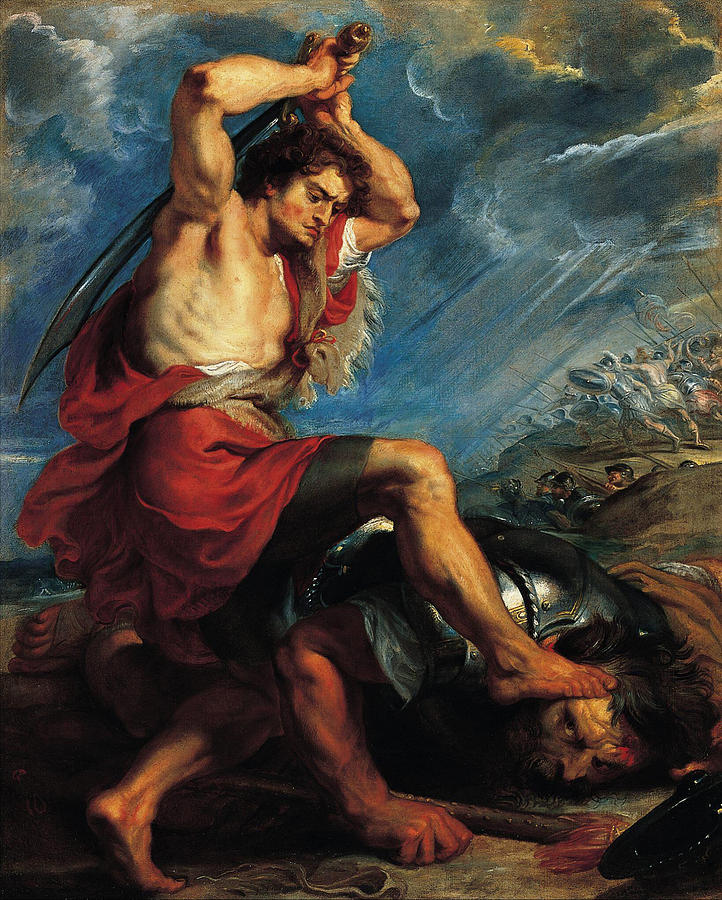
“David Slaying Goliath” by Peter Paul Rubens is one of the most intense and muscular depictions of the famous Old Testament story. Rather than showing the moment when David fells the giant with a stone, Rubens focuses on the climax that immediately follows. The young shepherd has already defeated his colossal enemy. Now he kneels over Goliath’s armored body, foot planted on the giant’s chest, both hands gripping a massive sword raised above his head. The sky churns with stormy clouds, and distant soldiers crowd the horizon as witnesses to this decisive instant.
Rubens transforms a biblical episode into a powerful study of energy, courage, and divine favor. The painting condenses an entire narrative into a single charged gesture. David is caught mid swing, his muscles taut, his face focused and resolute. The viewer almost feels the weight of the sword and the tension of his body. At the same time, Goliath’s fallen form and desperate expression underscore the reversal of power that has just occurred. A seemingly impossible victory has become reality, and Rubens invites us to linger on the moment when that triumph is sealed.
Biblical Story and Baroque Interpretation
The story of David and Goliath is told in the First Book of Samuel. Goliath, a giant champion of the Philistines, challenges the armies of Israel to send a single warrior to fight him in single combat. None of King Saul’s soldiers dare to accept, until the young shepherd David steps forward with simple faith in God. Armed only with a sling and five stones, he strikes Goliath on the forehead, knocking him to the ground. Then David uses the giant’s own sword to cut off his head, ensuring a complete and terrifying victory that sends the Philistines fleeing.
Artists for centuries have been drawn to this story because it dramatizes the victory of faith and courage over brute strength. During the Baroque period, painters like Rubens were especially interested in scenes that combined deep emotion with intense physical action. The story of David and Goliath offered exactly that combination. Rubens’s choice to depict the decapitating blow rather than the stone’s impact reveals his fascination with the climax of physical struggle.
In the context of seventeenth century Europe, the image also carried political and religious overtones. Catholic patrons could see in David’s victory a symbol of the Church triumphing over heresy or foreign threats. More generally, rulers and citizens could take from the painting a message of hope that small nations or seemingly weak individuals might overcome powerful enemies through courage and divine support.
Composition and the Focus on a Single Action
Rubens composes “David Slaying Goliath” as an almost sculptural close up. Instead of placing the combatants in a wide landscape, he pushes them to the front of the picture plane so that they dominate the viewer’s field of vision. David’s massive figure fills the left side, while Goliath’s twisted body occupies the right bottom corner. The two bodies lock together like opposing forces. David’s posture forms a diagonal from lower left to upper right as his arms rise with the sword. Goliath lies along a reverse diagonal, creating a powerful X that stabilizes the composition while also expressing dynamic tension.
The background is not empty, but it remains secondary to the central drama. Stormy clouds swirl above, and on the right horizon small soldiers mass in formation. These distant elements deepen the space and provide context. Yet the eye always returns to the central bodies, where the fate of the armies is decided.
The composition is tightly cropped, especially around David’s feet and Goliath’s head. This closeness heightens the sense of immediacy. We feel as though we are on the battlefield with them, close enough to see the strain in David’s muscles and the desperation in Goliath’s eyes. The viewer becomes an almost unwilling witness to an execution that is both horrifying and necessary within the logic of the story.
David as Hero of Faith and Physical Power
Rubens portrays David as a stunning embodiment of youthful strength. His torso is bare, revealing sculpted muscles that recall classical statues of heroes. The strong curve of his chest, shoulders, and arms conveys the immense force behind the downward swing. His left leg is bent firmly, supporting the weight of his body as he leans over the fallen giant. Despite his youth, David appears fully capable of wielding the enormous sword.
The red garment that wraps around his waist and shoulder is an important visual accent. It swirls with the motion of his body, echoing the turbulence of the fight. Red traditionally symbolizes courage, passion, and sacrifice. In this context, it highlights David as the instrument of God’s justice and the emotional center of the painting. The cloth also connects visually with the hints of blood at Goliath’s head, reminding viewers of the violent cost of victory.
David’s expression is concentrated and solemn. He is not triumphantly smiling nor is he lost in fury. Instead, his face suggests determination and perhaps a moment of sober awareness about what he is doing. This nuanced expression keeps the scene from becoming mere brutality. It suggests that David understands the gravity of taking a life and acts not for personal glory but in obedience to a higher purpose.
Rubens subtly indicates David’s humble origins through his simple attire and bare feet. He does not wear armor or royal garments. His power comes from within, supported by faith. This contrast with Goliath’s heavy armor reinforces the message that external strength alone cannot guarantee victory.
Goliath as Fallen Giant
Goliath’s body lies twisted beneath David’s feet, a mountain of armor and flesh now reduced to vulnerability. His massive form occupies the foreground, his head pushed forward toward the viewer. The giant’s facial expression mingles shock, pain, and reluctant recognition of defeat. His mouth is open, his brows furrowed, and a small wound on his forehead marks the earlier stone impact.
Rubens takes care to depict the elaborate armor that once made Goliath seem invincible. The polished metal surfaces and articulated plates glint in the dim battlefield light. Yet now this armor serves only to emphasize the tragic fall. It is bent and rendered useless by the simple shepherd who stands above him.
David’s foot presses firmly against Goliath’s chest or neck, pinning him to the ground. This gesture is more than a practical way to hold a fallen enemy. It symbolizes complete domination. The giant who once towered over everyone now lies beneath the foot of a youth. Rubens’s viewers would have recognized this as a visual metaphor for the overthrow of pride and arrogance by humble faith.
At the same time, Goliath’s body retains a certain dignity. Rubens does not caricature him. The strong features and muscular build hint at the greatness that has been toppled. This choice heightens the sense of miracle: David has not merely defeated a caricature of evil but a genuinely formidable opponent.
Background Armies and Battlefield Atmosphere
In the upper right of the painting, small figures of soldiers press forward in tight formation. They appear almost silhouetted against the turbulent sky. These distant armies represent the Philistines and Israelites whose fate hinges on the outcome of the duel. Their presence reminds viewers that David’s act is not only a personal victory but a turning point for two nations.
Rubens paints the battlefield as a rocky, uneven terrain, echoing the inner turmoil of the narrative. The slope on which David kneels leads the eye toward the background troops, creating a sense of depth and connecting the intimate foreground struggle to the larger war. Dust and shadow obscure some of the soldiers, giving an impression of chaos held at bay as all eyes focus on the climax between champion and challenger.
The sky overhead churns with dramatic clouds. Patches of blue break through darker masses, hinting at the dispersing storm. This atmospheric turmoil mirrors the emotional intensity of the moment. It also carries symbolic weight. The clearing sky may suggest that with Goliath’s fall, divine favor is once again shining on Israel. Rubens often used weather effects as visual metaphors, and here the stormy heavens parallel the clash of human forces and the intervention of God.
Light, Color, and Emotional Impact
Rubens uses light and color with exceptional skill to heighten the drama of “David Slaying Goliath.” The primary light source seems to come from the upper left, bathing David’s torso and limbs in a warm glow. His skin appears almost golden against the cooler blues and grays of the background. This strong contrast makes him stand out as the central hero.
Goliath’s body, by comparison, lies in deeper shadow. Highlights glint off his armor and catch the edges of his face and hands, but overall he appears more subdued. This difference in illumination underscores the shift in power. David shines, both literally and metaphorically, as the agent of victory. Goliath fades into the darkness of defeat.
The color palette combines deep reds, earthy browns, metallic grays, and intense blues. The red of David’s garment provides the most vivid accent, echoed by smaller touches of red near Goliath’s wound and scattered elements in the landscape. The blues of the sky and shadows create a moody environment that emphasizes the solemnity of the act taking place.
Rubens’s brushwork is energetic and varied. In the sky and distant soldiers, he uses broad, sweeping strokes that convey movement and atmosphere. In the bodies and armor, he refines the handling enough to describe muscle, fabric, and metal convincingly. This mixture of painterly freedom and precise detail gives the painting both vitality and solidity.
Movement, Tension, and Baroque Energy
“David Slaying Goliath” is full of Baroque dynamism. The entire composition revolves around movement. David’s raised arms form a powerful arc that suggests the path of the sword. His bent leg, twisting torso, and focused gaze all point toward the imminent downward blow. Even the red cloth around his waist seems to swirl with the force of his action.
Rubens captures the exact moment just before the sword falls. This choice is crucial. If he had depicted the blow already completed, the scene would be static. By freezing time at this instant of maximum tension, he draws viewers into the suspense. We almost instinctively contract our muscles in sympathy with David, anticipating the impact.
The diagonal arrangements of limbs and weapons enhance this feeling of motion. The giant’s body bends one way, David’s another, and the sword arcs above them both. These intersecting lines create a visual rhythm that keeps the eye moving across the canvas. The tension is not only physical but psychological. We sense David’s inner concentration and Goliath’s last awareness of defeat.
This intense energy is characteristic of Rubens’s style. He excelled at depicting bodies in motion, especially at moments of struggle or transformation. Here, the combination of muscular anatomy, swirling drapery, and charged gestures makes the famous biblical story nearly tangible.
Themes of Faith, Courage, and Divine Justice
Beyond its visual power, the painting invites reflection on several overlapping themes. First is the theme of faith. David’s victory is not explained by superior weaponry or training but by his trust in God. Rubens suggests this indirectly. David’s simple clothing and lack of armor contrast with the giant’s elaborate gear, yet he possesses a calm strength that hints at inner confidence. The clearing sky above can be read as a sign of divine approval.
Courage is another central theme. Rubens emphasizes David’s bravery not only in confronting Goliath but also in carrying out the grim task of final defeat. The painting does not shy away from the harsh reality of warfare. Victory requires decisive action. David’s solemn expression and powerful stance show that courage involves both emotional and physical fortitude.
Divine justice also plays a role. In the biblical narrative, Goliath is not merely a soldier but a blasphemer who mocks the God of Israel. His defeat demonstrates that arrogance and violence cannot ultimately stand against righteous trust in God. Rubens hints at this moral dimension through the posture of the figures. David stands literally above Goliath, embodying the triumph of a just cause over prideful aggression.
For viewers in Rubens’s time, these themes would have had immediate resonance. Europe was marked by religious conflict and political struggle. The image of a small but faithful force defeating a powerful adversary could speak to many communities who saw themselves as Davids facing new Goliaths.
Violence, Heroism, and Baroque Sensibility
“David Slaying Goliath” presents violence in a way that may challenge modern sensibilities. The act of decapitation is imminent, and the painting invites us to contemplate its necessity. Yet within the Baroque tradition, such intense scenes were valued for their ability to stir the emotions and communicate moral truths vividly.
Rubens balances the brutality with a sense of heroic resolve. He does not revel in gore. Instead, he focuses on the moment of decision, when the hero chooses to act for the sake of his people. The viewer is not asked to enjoy the violence but to understand its place within a larger story of deliverance.
This approach reflects a Baroque belief that powerful emotions can lead viewers toward deeper spiritual reflection. Fear, awe, and even horror can become paths to awareness of human frailty and the need for divine protection. The painting’s frank depiction of struggle therefore serves a moral purpose rather than mere sensationalism.
Legacy and Modern Appreciation
Today, “David Slaying Goliath” remains a compelling example of Rubens’s mastery of narrative painting. It continues to attract viewers for its muscular energy, refined color, and psychological depth. Artists and scholars study it as a model of how to capture a story’s climax in visual form.
Modern audiences may also find personal meaning in the image. The idea of facing overwhelming challenges with courage and faith remains relevant, whether the “giants” are literal enemies, social injustices, or inner fears. Rubens’s painting dramatizes that moment when a person chooses to act despite danger and doubt. In this sense, David’s raised sword can symbolize any decisive step taken in the face of daunting odds.
At the same time, the painting invites discussion about how violence is represented and interpreted. It raises questions about heroism, sacrifice, and the cost of victory. These questions continue to be important in contemporary cultures that grapple with war, conflict, and the use of force.
Conclusion
Peter Paul Rubens’s “David Slaying Goliath” is a powerful fusion of biblical narrative, physical drama, and Baroque artistry. By focusing on the instant before David’s final blow, Rubens captures both the physical exertion of the young hero and the psychological weight of his act. The contrast between David’s illuminated, muscular form and Goliath’s shadowed, sprawling body vividly embodies the reversal of fortune that defines the story.
Through composition, color, and movement, Rubens turns the scriptural tale into a universal image of courage in the face of towering opposition. The painting honors the faith that empowers the seemingly weak, while acknowledging the harsh realities of struggle and sacrifice. Centuries after its creation, it continues to speak to viewers as a reminder that moments of decisive action can change the course of history and that inner strength, grounded in conviction, can overcome even the mightiest giants.
