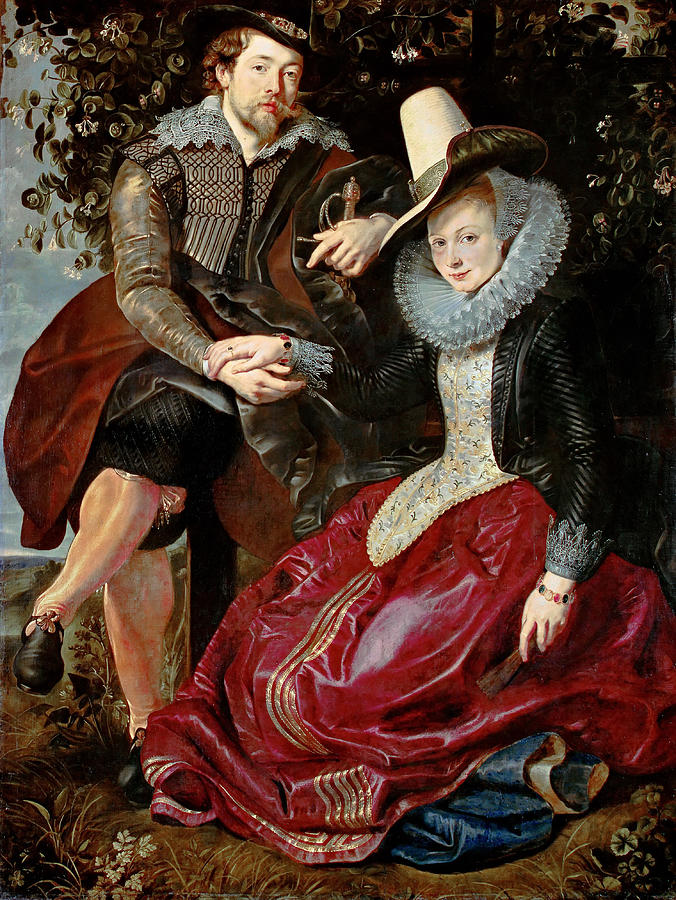
Image source: wikiart.org
Introduction to “Self Portrait with His First Wife Isabella Brant in the Honeysuckle Bower”
Peter Paul Rubens’s “Self Portrait with His First Wife Isabella Brant in the Honeysuckle Bower” is one of the most intimate and revealing images in seventeenth century Flemish art. Rather than presenting a distant, formal likeness, Rubens invites the viewer into a private garden where he and Isabella sit close together, hands joined, surrounded by fragrant honeysuckle. The painting is at once a declaration of love, a display of social status, and a brilliant exercise in Baroque color and texture.
Rubens appears on the left, dressed as a fashionable gentleman, his body angled protectively toward his wife. Isabella sits on the right, in a sumptuous red skirt and embroidered bodice, her hands resting lightly yet confidently. Both figures look directly at the viewer, calmly asserting the stability and affection of their union. The honeysuckle arbor frames them like a natural chapel, turning this garden corner into a sacred space dedicated to marriage.
The result is a portrait that feels both grand and tender. It presents the couple as they wished to be remembered at the beginning of their life together, capturing the balance between love, dignity, and worldly success that defined Rubens’s ambitions at this early stage of his career.
Historical Context and the Young Rubens
The painting is generally dated to the first decade of the seventeenth century, shortly after Rubens’s return to Antwerp from his formative years in Italy. This was a crucial period in his life. He had studied the works of Titian, Veronese, and Caravaggio, absorbing their lessons on color, composition, and drama. Back in the Low Countries, he quickly secured powerful patrons and became one of the leading painters of his generation.
The marriage to Isabella Brant, daughter of a prominent Antwerp humanist, also strengthened Rubens’s social position. By marrying into an educated, well connected family, the artist affirmed his own status as a learned gentleman rather than a simple craftsman. The double portrait advertises that achievement. It is not a workshop product made for a client but a deeply personal work painted for the couple themselves, yet it still functions as a kind of public statement.
The honeysuckle bower can be read as an allegory of the new household Rubens and Isabella were building. At the time, marital portraits often emphasized lineage and property, but here the focus is on mutual affection and shared refinement. Rubens is saying that his household rests on both love and culture. The painting thus encapsulates the hopes of a young couple at the outset of married life, placed within the broader aspirations of a rising Baroque master.
A Double Portrait of Love and Partnership
One of the most striking features of the painting is the way it presents the marriage as a partnership. Rubens and Isabella are not separated by space or props. Instead, their hands meet in the center of the composition, becoming the emotional and visual focus of the scene. Rubens’s left hand gently encloses Isabella’s right hand, an intimate gesture that suggests both tenderness and a promise of protection.
Their bodies form a subtle triangle. Rubens leans toward Isabella, his leg extended and his torso twisted slightly to face her. Isabella, seated more upright, turns her upper body to meet his gaze and the viewer’s. This interplay of angles and postures conveys dialogue, as if the couple is engaged in a quiet conversation that the viewer has just interrupted.
Unlike stiffer marriage portraits in which the man dominates the composition, Rubens gives Isabella a commanding presence. Her bright red skirt occupies a large part of the lower canvas, and her pale face is framed by an elaborate ruff and tall hat that mirror Rubens’s own dark hat and lace collar. The equality of their gazes and the balance of their silhouettes reflect a modern, humanized view of marriage, where affection and companionship take precedence over hierarchy alone.
Composition and the Geometry of Intimacy
Rubens’s mastery of composition is evident in the way he arranges forms, colors, and diagonals to guide the eye. The couple sits in three quarter view, occupying the foreground while the foliage of the honeysuckle bower fills the upper background. There is almost no empty space; instead, a tapestry of leaves, clothing, and flesh interlocks to create a sense of closeness.
A strong diagonal runs from Rubens’s hat down through his torso, across the joined hands, and into Isabella’s gleaming red skirt. This diagonal acts like a visual arm that embraces the couple, tying them together. At the same time, vertical accents, such as the trunk of the tree behind them and Isabella’s tall hat, stabilize the composition, anchoring the figures in place.
Rubens also uses overlapping forms to suggest depth and intimacy. His right leg pushes forward, almost entering the viewer’s space, while Isabella’s dress billows outward, softening the transition between the couple and the surrounding garden. The bench or low seat on which they rest is barely visible, implying that the natural setting, not furniture, supports their union.
The joined hands are strategically placed near the center of the canvas. Light falls across them, making them the brightest area among otherwise dark sleeves and shadows. This compositional choice underscores the idea that the bond between husband and wife is the true subject of the painting, more important than costume details or background scenery.
Clothing, Status, and Social Identity
The costumes in the painting are carefully chosen to project wealth, respectability, and refined taste. Rubens wears a black doublet with intricate lace at the collar and cuffs, along with a broad brimmed hat and smooth leather boots. The black fabric absorbs light, which allows the delicate white lace to shimmer, highlighting the painter’s hands and face.
Isabella’s attire is still more elaborate. Her bodice is embroidered with gold thread, and the high ruff encircling her neck resembles a white halo, emphasizing her importance and virtue. The tall hat, fashionable in Antwerp at the time, gives her additional height and elegance. The deep crimson of her skirt is one of the most eye catching elements in the painting. Red was an expensive dye associated with luxury, and Rubens revels in its folds and reflections.
Jewelry adds another layer of meaning. Isabella wears a bracelet, rings, and possibly a necklace partially obscured by the ruff. These adornments not only signal prosperity but also hint at the exchange of gifts within marriage. Rubens himself wears a sword at his side, visible near his right hand, suggesting his status as a gentleman entitled to bear arms. The artist is staking a claim to a social rank higher than that of a mere artisan.
Textile textures are lovingly rendered. Viewers can almost feel the soft sheen of satin, the stiff crispness of lace, and the smooth polish of leather. In this way, Rubens uses clothing not just as decoration but as a material expression of identity, turning the portrait into a showcase of both character and class.
The Honeysuckle Bower as Symbolic Garden
The honeysuckle bower surrounding the couple is not a generic backdrop. Honeysuckle was associated with marital fidelity and enduring love in early modern symbolism. By placing himself and Isabella under its arching vines, Rubens visually pledges the permanence of their bond. The plant forms a natural canopy, like a green chapel or a living wreath crowning the couple.
The garden setting also reflects contemporary ideals of cultivated nature. This is not a wild forest but a carefully tended bower, suggesting the ordered harmony of a well managed household. In many Renaissance and Baroque images, gardens symbolize purity, fertility, and the pleasures of civilized life. Here, the ground is dotted with small plants and grasses, signs of growth that echo the couple’s hopes for a prosperous future and perhaps for children.
The proximity of the couple to the earth is striking. Rubens sits with one leg extended, his foot firmly planted in the grass, while Isabella’s red skirt touches the ground like a rich carpet. This grounding effect keeps the painting from becoming overly formal or distant. It reminds viewers that these elegant figures are still human beings who live in the physical world, subject to time, seasons, and the cycles of nature.
The honeysuckle leaves, painted with quick, lively strokes, create a pattern of green against the darker background. They frame the faces and upper bodies of the couple, softening the transitions between figure and environment and reinforcing the idea that love flourishes when it is rooted in a nurturing setting.
Light, Color, and the Sensual Surface of Paint
Rubens is renowned for his mastery of light and color, and this work provides an early demonstration of those talents. Soft, warm light illuminates the faces of Rubens and Isabella, picking out the pale flesh tones and the glint of eyes and lips. Their complexions are rendered with a subtle mixture of pinks, creams, and warm browns, giving them a healthy, living presence.
The color scheme revolves around deep reds, earthy browns, luminous greens, and touches of gold and white. Isabella’s crimson skirt dominates the lower half of the painting, its rich folds catching small flashes of light that reveal the painter’s love of sensuous surfaces. Rubens’s darker costume provides a foil to her brightness, allowing her to stand out. At the same time, the repeated accents of white lace on both figures create visual harmony between them.
Light plays across the fabrics in varied ways. On the red skirt, highlights follow the contours of the folds, suggesting weight and volume. On the black sleeves, light is more subdued, barely glancing off the smooth surface. The lace ruff and cuffs sparkle with tiny touches of white paint that describe the openwork pattern without laborious detail. This ability to suggest texture with economical strokes is a hallmark of Rubens’s mature style.
In the background, the greens and browns of the foliage are painted more loosely, with less focus on individual leaves and more on overall atmosphere. This keeps the viewer’s attention on the couple while still conveying the impression of lush vegetation. The slightly cooler tones of the background contrast with the warm colors of skin and clothing, creating depth and enhancing the sense of intimacy in the foreground.
Psychological Insight and Characterization
Beyond its compositional and technical brilliance, the painting stands out for its psychological depth. Rubens was known for infusing his portraits with a feeling of inner life, and this double portrait is no exception. Both husband and wife meet the viewer’s gaze with calm assurance, yet subtle differences in expression reveal nuances of personality.
Rubens’s face carries a combination of confidence and seriousness. His eyes are alert, his lips slightly pursed, as if he is conscious of his role as both artist and subject. He seems to be presenting not just himself but the success of his life choices. The slight turn of his head and the angle of his body hint at movement, suggesting that he is a man of action, accustomed to navigating courts and studios.
Isabella’s expression is softer but equally self possessed. She smiles gently, her eyes bright, conveying warmth and intelligence. There is a hint of shyness in the slight tilt of her head, yet she does not appear submissive. Instead, she seems fully aware of her place in this partnership, proud of the role she plays in Rubens’s life. The protection implied by Rubens’s arm and hand is balanced by her quiet strength.
The closeness of their bodies, the relaxed positioning of legs and hands, and the serene atmosphere all contribute to a sense of genuine affection. This is not a marriage arranged solely for social gain but one rooted in mutual respect. Rubens’s ability to capture such emotional nuance is one reason the painting continues to resonate with viewers centuries later.
Rubens as Husband, Artist, and Self Promoter
The painting also functions as a sophisticated piece of self promotion. By depicting himself as a well dressed gentleman in a harmonious marriage, Rubens constructs a public image that would inspire confidence in patrons. Collectors seeking large altarpieces or mythological cycles wanted not only technical skill but also reliability and social polish. This portrait assures them that Rubens possesses those qualities.
At the same time, the work reveals the more private side of the artist. He is not in his studio surrounded by canvases and brushes. Instead, he appears in a garden, at home, in the company of his beloved wife. The sword at his side and the fashionable attire suggest that the painter sees himself as more than a craftsman. Yet his hands, so central to the composition, remind us of the creative labor through which he built this life.
The painting thus blurs the boundaries between personal and professional identity. Rubens is both subject and creator, husband and strategist. He uses the tools of art to define his place in society, while also preserving a tender moment for himself and Isabella. This dual purpose makes the painting unusual within his oeuvre and gives it enduring interest for modern audiences.
Legacy of the Painting for Modern Viewers
Today, “Self Portrait with His First Wife Isabella Brant in the Honeysuckle Bower” is often cited as one of the most affecting double portraits of the Baroque era. Modern viewers are drawn to its combination of elegance and intimacy. It offers a window into early seventeenth century fashion and customs while also speaking to timeless themes of love, partnership, and self representation.
For those interested in the history of portraiture, the painting marks a significant shift toward more informal, emotionally rich depictions of couples. It anticipates later developments in Dutch and Flemish art, where family groups and domestic scenes would become popular subjects. At the same time, it reflects the international nature of Rubens’s style, which fused Italian colorism and Flemish detail into a powerful new language.
The work also invites reflection on how individuals present themselves in images. Just as contemporary people carefully curate photographs for public display, Rubens crafted this portrait to express the version of himself and his marriage that he wanted others to see. The difference lies in the depth and artistry with which he did so. Every fold of fabric, every leaf of honeysuckle, every subtle shift of light contributes to a complex narrative about identity and affection.
For couples today, the painting can be seen as a model of shared presence. Rubens and Isabella sit together, grounded in nature, dressed in their finest, yet relaxed and open. Their joined hands symbolize the choice to move through life as partners. That message, conveyed through Baroque brushwork and symbolism, remains moving even in a world filled with rapidly taken photographs.
Conclusion
“Self Portrait with His First Wife Isabella Brant in the Honeysuckle Bower” is far more than a record of physical likeness. It is a celebration of a marriage, a declaration of social aspiration, and a demonstration of Rubens’s growing mastery of color, composition, and psychological insight. The honeysuckle bower shelters a union that is both tender and proud, rooted in affection yet conscious of the public gaze.
By uniting himself and Isabella within a harmonious composition of diagonals, rich fabrics, and living foliage, Rubens transforms a private bond into a universal image of love and partnership. The painting stands at the crossroads of personal biography and cultural history, reminding viewers that behind the grand narratives of Baroque art lie human stories of commitment, hope, and mutual respect.
Centuries after its creation, the portrait still feels surprisingly contemporary. Its warmth, intimacy, and visual splendor allow modern audiences to connect with the young couple in the garden, to sense their confidence in the future, and to appreciate the enduring power of art to capture the delicate balance between personal feeling and public presentation.
