Image source: wikiart.org
Introduction
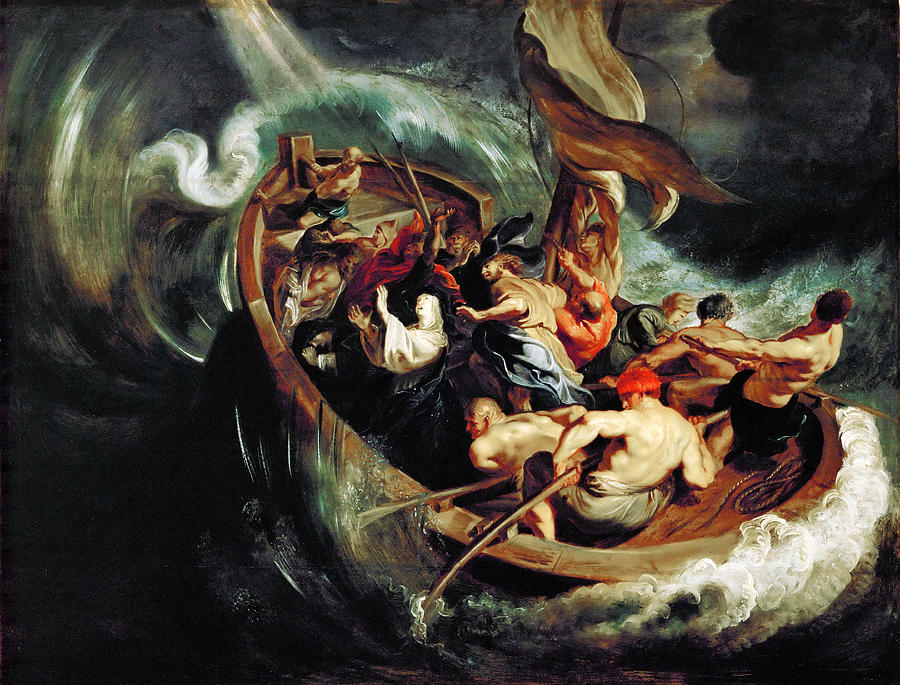
“The Miracle of Saint Walburga” surges with the elemental power that made Peter Paul Rubens the unrivaled dramatist of the Baroque. A single boat is hurled about on a black, roiling sea; wind lashes the sail into a living banner; oars bite into white water that explodes in foam. At the heart of the chaos, a veiled woman in pale habit—Saint Walburga—raises her hands in prayer as hardened sailors strain for survival. The canvas captures the instant when human strength collides with forces beyond control, and faith becomes the decisive counterweight to fear.
Subject, Legend, and the Saint’s Iconic Role
Saint Walburga was an eighth-century Anglo-Saxon nun and abbess whose cult spread across northern Europe. Among the miracles associated with her was protection for travelers and sailors, and the calming of storms through intercessory prayer or through the saintly “oil” exuded at her shrine. Rubens seizes on that patronage to craft a scene in which the saint’s presence on a perilous voyage transforms catastrophe into deliverance. Rather than portraying a vision floating above the waters, he places Walburga physically in the boat, an emphatically human figure whose prayer redirects the drama from panic to hope.
Composition Like a Whirlpool
Rubens organizes the picture as a sweeping spiral that turns counterclockwise, mirroring the sea’s vortex at the left. The boat, viewed from above and slightly behind, curves across the canvas in a grand arc. Every element keys into that rotation: the bend of the hull, the funnel of light in the storm cloud, the lash of the sail, and even the rhythm of bodies as they heave against the oars. This spiral is not decorative; it is kinetic architecture. It conveys the sensation that the viewer stands on a pitching deck, drawn toward the churning abyss yet held back by the compact energy of the figures.
The Axis of Faith
Amid the swirl, Saint Walburga functions as the painting’s vertical axis. Her upright, white-clad form interrupts the diagonal torrent of wind and foam. Rubens frames her with darker companions, making the habit blaze against the gloom. Hands lifted, face turned toward an unseen source of aid, she becomes the still point around which action gyres. The compositional implication is clear: spiritual steadiness checks physical tumult. By locating the miracle not in a detached apparition but in the embodied posture of prayer, Rubens binds the supernatural to human gesture.
The Theatre of Figures
Rubens’s boat is crowded with bodies, each a study in motion. Bare-backed rowers at the stern torque their torsos, muscles flaring under the exertion of pulling against the sea. One sailor braces his foot on the gunwale as he plants his oar; another leans out dangerously far, like a counterweight to the wave. A figure at the prow hammers a mast pin or wrestles a line; another shouts instructions lost in the wind. Their poses interlock like cogs, and their skin tones—copper, rose, and chalky highlights—animate the brown timber and black water. Against them, the draped figures around Walburga create a second register of action: clothes snap in the gale, sleeves billow, and the saint’s veil flutters, a soft echo of the thrashing sail.
Light Against the Deep
The painting’s light is theatrical, concentrated, and directional. A break in the cloud mass pours illumination across the central section of the boat, scaling up contrast so that bodies gleam with a pearly sheen while the sea appears almost metallic. Rubens heightens the foam with pure strokes of lead white that ride atop darker, translucent glazes; when seen in person, the surf is slightly built up, catching light physically as well as pictorially. The left side gathers into a dark green-black gyre, and a ghostly whitish sweep—wind made visible—curls down like a divine signature toward the saint. The overall effect is a revelation piercing storm.
Color as Weather
Rubens’s palette is reduced but potent. Verdigris and deep blue-black dominate the water; the boat runs from warm umbers to honeyed ochres; flesh strikes the warmest notes, and the sail supplies raw linen tones flared by light. A scarlet garment ricochets near the center, pumping heat into the cold composition and guiding the eye back to Walburga’s steadied presence. The saint’s habit is not pure white but a spectrum—creamy lights, cool grays in shadow, and soft reflections of sea green—so that sanctity reads as luminously real rather than graphic emblem.
Sound and Touch in Paint
One of Rubens’s hallmarks is his ability to make paint evoke touch and even sound. You can practically hear this canvas: the slap of water against the planks, the boom of the sail as the wind changes, ropes whipping, men shouting above the gale. The brushwork that renders foam is quick, looping, and slightly raised; the grain of the oars is striated; wet drapery clings and shines with long, loaded strokes. He does not describe every board; he gives the sensation of deck underfoot, the sleet-cold texture of spray on skin. The painting is meteorology made tactile.
Diagonals That Struggle
Baroque drama thrives on diagonals, and Rubens makes them collide like opposing armies. The mast tilts one way, the oars rake opposite, the sail bulges forward, and the sea claws backward into the whirlpool. The figures’ limbs are diagonals too—arms thrust outward, backs arched, knees braced—and each diagonal implies force meeting force. Amid these slashing vectors, the saint’s vertical presence declares the miracle: prayer does not cancel physics but meets it with a new vector, redirecting momentum.
The Psychology of Crisis
Every face is a state of mind. A rower grits his teeth, eyes narrowed in concentration. A man twists back toward Walburga with a startled, half-hopeful glance. Another, near the mast, shouts with mouth stretched wide, the wind whipping his hair into flame. The saint’s expression is the opposite: eyes lifted, mouth parted not in panic but petition. Rubens orchestrates these psychologies to dramatize the passage from terror through supplication to rescue. Even before we see deliverance, we feel the boat beginning to turn—morally, if not yet physically—toward safety.
Saint and Sailors: A Baroque Sermon
This painting works as a sermon in images. The sailors represent human industry, their bodies dedicated to action; the saint represents intercession, her body dedicated to prayer. Rubens refuses to diminish either. Muscles are honored; so is sanctity. But he also teaches hierarchy: skill alone cannot master the absolute. The miracle arises from the conjunction of exertion and grace, the very union promoted by the religious culture of Rubens’s Antwerp. Viewers in a harbor city would have recognized the message immediately: tie your lines, man your oars—and pray.
The Boat as Church
It was a familiar symbol in Christian imagery to liken the Church to a ship, the navis that ferries souls through perilous waters. Rubens leans into that metaphor without abandoning literal realism. The hull gathers the community; the mast and sail recall the cross and the Spirit-wind; the vortex to port suggests not merely a natural hazard but the maw of chaos. Saint Walburga’s place amid the crew hints at the communion of saints guiding the vessel. The painting thus speaks doubly: to sailors, about survival; to the faithful, about salvation.
Maritime Observations from a Painter’s Eye
Rubens’s knowledge of boats is as painterly as it is practical. He sets us high at the stern, an oblique vantage that intensifies the sense of tilt. He understands how a sail bellies when it catches a sudden gust and how oarsmen counter-steer by pulling in concert on one side. He paints the boat not as a diagram but as a machine under stress—ribs flexing, seams wet, water sheeting along the flank. Small observational niceties—an oarlock glint, a coil of line, the way spray flies in shreds—secure credibility so that the miracle can act upon a completely convincing world.
The Miracle’s Pictorial Signature
Rubens declines to depict an apparition hovering in the sky; instead he draws a white, spiraling scud of wind and light that sweeps inward toward the saint’s uplifted hands. It is as if the storm itself converts into a sign. This painterly choice matters. By translating the miracle into meteorology—a change within nature rather than a supernatural overlay—he shows grace working through, not apart from, the world. The swirl becomes the saint’s halo enlarged to cosmic scale, a vortex that uncoils instead of devours.
Dialogue with Other Storm Scenes
The subject invites comparison to storm miracles in scripture—Christ calming the sea—or to Northern seascapes where men are tiny against sublime waters. Rubens, however, keeps the human figure at full scale. His sea is not existential emptiness but an adversary to wrestle. Where some painters freeze the decisive instant, he saturates the canvas with duration: you feel what came before and anticipate what comes after. He is less reporter than composer, building a symphony of motion around a theme of deliverance.
Counter-Reformation Resonance
In Rubens’s cultural moment, dramatic sacred images served to persuade and to hearten. “The Miracle of Saint Walburga” would have spoken to a populace of merchants and sailors, reminding them that local saints intercede in concrete crises. It also advertises a broader theological claim: the world remains charged with grace. Far from presenting a remote, abstract piety, Rubens gives a faith you can grip like an oar when the hull lurches.
Technique: Ground, Glaze, and Velocity
Under the visible bravura lies careful craft. A warm ground peeks through the waves and wood, unifying cold and hot passages. Transparent green-black glazes build depth in the sea; scumbled highlights ride atop to make spindrift. Flesh is constructed with quick, elastic transitions—peach into coral into ivory—so that muscles look as if filled with blood and breath. The sail includes dragged, semi-dry strokes that mimic rough canvas catching light. Everywhere, the paint’s speed mirrors the event’s velocity.
Hope at the Edge
The composition’s rightward sweep leads the eye toward a lighter horizon, barely glimpsed beyond the spray. It is not yet safe water, but it is a promise. Walburga’s gesture leans that way; several bodies pivot likewise. Rubens thus writes hope directly into the movement of forms. Even if you do not know the saint’s story, the picture tells you how to read it: from whirlpool to wind-swirl to prayer to turn.
The Human Drama as Universal Allegory
Although the scene is anchored in a specific legend, its emotional grammar is universal. Every life meets storms that sheer away illusions of control. The painting’s power comes from showing, with visceral immediacy, the double truth that effort is necessary and insufficient. The men keep rowing. The saint keeps praying. Rescue arrives precisely where those lines cross.
Legacy and Contemporary Appeal
What keeps the canvas fresh is its fusion of spectacle and empathy. Viewers today respond to the sensory thrill—the spray, the tilt, the muscular heroism—but also to the luminous dignity of the praying figure. In a world that often feels storm-tossed, Rubens’s image offers both adrenaline and consolation. It is a story of survival that credits brawn and grace together.
Conclusion
“The Miracle of Saint Walburga” is Rubens at full sail. A spiral composition drags the viewer into the tempest; blazing highlights cut through green-black depths; bodies labor with convincing strain while a single praying figure turns chaos toward calm. The painting is a master class in Baroque motion and a profound meditation on how faith operates within the physics of the world. Its lesson is as bracing as sea wind: row hard, pray hard, and watch the storm re-shape around the axis of hope.
