Image source: wikiart.org
Introduction to Venus and Mars by Peter Paul Rubens
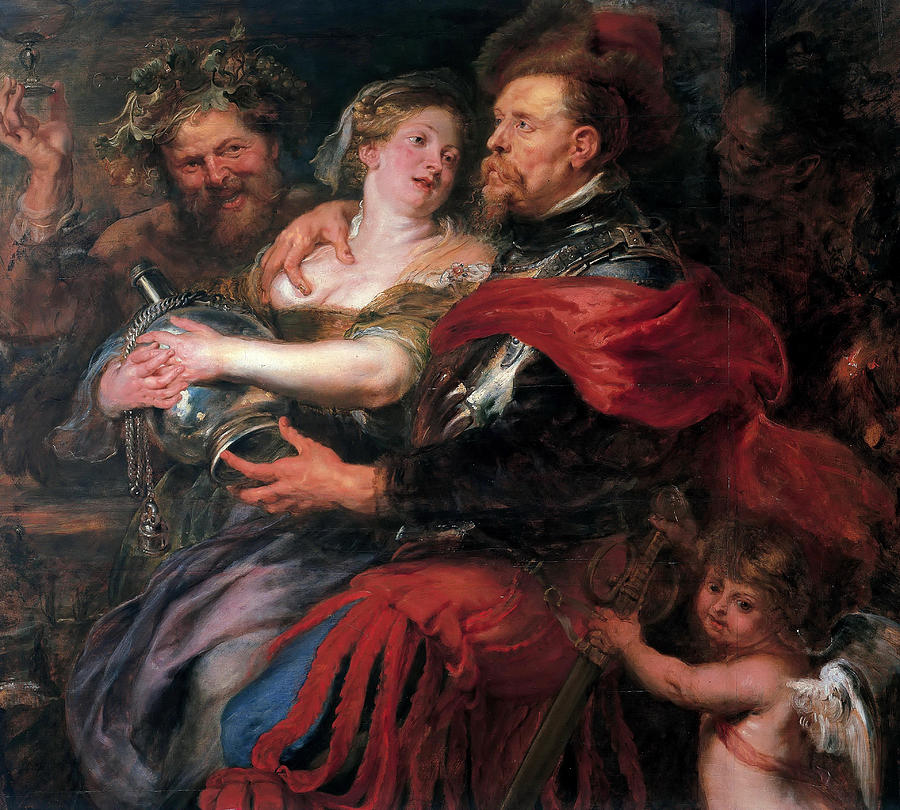
“Venus and Mars” by Peter Paul Rubens is an exuberant Baroque vision of love conquering war, sensual pleasure overpowering martial discipline. At the center of the painting a voluptuous young woman, identified as Venus, leans back into the embrace of a heavily armored man, Mars, god of war. Her pale skin glows against the dark background and the shining metal of the soldier’s armor, while a swirl of red drapery links the pair like a visual flame.
A tipsy, vine-crowned companion grins from the left, brandishing a large wine jug that Venus clutches in her arms. At the lower right, a chubby winged Cupid tugs playfully at Mars’s sword, trying to disarm the war god. The scene is rich with movement, color, and erotic tension, yet it also carries a moral and political message: the soft power of love and pleasure can subdue even the fiercest warrior.
Mythological Background: Love and War Entwined
In classical mythology Venus (Aphrodite in Greek tradition) is the goddess of love, beauty, and desire, while Mars (Ares) personifies war, aggression, and masculine force. According to ancient stories, the two gods were lovers despite Venus’s marriage to the smith god Vulcan. Their union symbolized the union of opposites: tenderness and fury, seduction and violence, pleasure and danger.
Rubens draws on this myth but translates it into a vivid, earthy encounter. Mars appears not as an abstract symbol of war but as a specific soldier, his armor detailed and his expression focused. Venus is more than a divine ideal; she is a lively, flushed young woman, clearly enjoying the intoxication of love and wine. The presence of the vine-crowned companion and the prominent jug of alcohol tie the scene to Bacchic revelry, linking erotic desire with the pleasures of drink and festivity.
By painting the myth in this manner, Rubens not only retells a classical story but also comments on the human condition. Love and war, he suggests, are not distant divine forces but impulses that play out in everyday human bodies and emotions.
Composition: A Swirling Knot of Bodies and Drapery
The composition of “Venus and Mars” is tightly packed and dynamic. Rubens crowds the figures into the foreground, allowing little breathing space between them. This closeness increases the sensual intensity and makes the viewer feel almost pressed into the revelry.
The central diagonal runs from the grinning figure at the left, across Venus’s pale shoulders and chest, through Mars’s face, and down along the curve of his red sash and the sword Cupid holds. The figures lean and twist along this line, creating a serpentine motion that guides the viewer’s eye.
Venus is placed slightly off-center yet acts as the luminous core of the painting. Her body, turned toward Mars but tilted backward toward the wine bearer, forms a bridge between divine love and earthy pleasure. Mars’s dark armor and the rich red of his sash and plume frame her, while Cupid at the bottom right completes the circular movement with his upward glance.
The background is kept murky and indistinct, with only hints of additional revelers or shadows. This darkness pushes the brightly lit figures forward, making them almost sculptural in their three-dimensionality. The entire scene feels like a burst of life emerging from a surrounding gloom.
The Character of Venus: Sensuality and Complicity
Rubens’s Venus is quintessentially Baroque: full-bodied, flushed, and physically present. Her bare shoulders and generous décolletage catch the strongest light, and the delicate blush in her cheeks suggests both wine and arousal. She turns her head toward Mars, lips slightly parted, eyes half-lidded in a mixture of flirtation and surrender.
Her posture is active, not passive. One arm wraps around the large silver jug, the other rests near Mars’s arm as if acknowledging his embrace while still maintaining some independence. The way she cradles the jug echoes the way Mars’s arm encircles her: she is both held and holding, lover and participant in the festive mood.
Rubens avoids presenting Venus as a remote, idealized goddess. Instead she looks like a lively Flemish woman dressed in classical-style garments, her hair partially pinned up with loose tendrils around her face. This blend of divine identity and local realism makes her more relatable and heightens the sense that the powers of Venus operate in ordinary human interactions.
Mars in Armor: War Momentarily Disarmed
Mars appears as a seasoned soldier, with reddish beard, weathered face, and a steady gaze. He wears polished armor that reflects glints of light, emphasizing his status as a man of battle. A plumed helmet crowns his head, and a vibrant red sash flows across his chest and around his waist, cascading down in loops that echo Venus’s curves.
Despite these signs of martial prowess, Mars’s posture reveals that he is no longer on the battlefield. His body leans toward Venus, one arm wrapped around her shoulders in a possessive yet tender embrace. His expression is attentive, perhaps slightly wary, as if he is both enthralled by and cautious of the intoxicating mix of love and drink.
The key symbol of Mars’s disarmament is his sword. Instead of gripping it firmly, he allows Cupid to handle it at the bottom of the composition. The weapon is present but neutralized, its power diverted by the god of love. Through this detail Rubens visualizes the idea that eros can soften and redirect the impulses of aggression and conquest.
The Companion Figure and the Role of Wine
To the left of Venus stands a jovial, coarse-featured man crowned with grape leaves and holding the neck of the large jug that Venus cradles. This figure likely represents a satyr, Silenus, or a Bacchic follower, associated with the god of wine. His wild hair, shaggy beard, and earthy grin contrast with the smoother, more refined features of the central couple.
His gesture adds a layer of interpretation to the scene. By presenting the wine to Venus, he acts as an agent of intoxication, encouraging her and Mars to yield to pleasure. The chain hanging from the jug suggests luxury and the allure of costly indulgence.
At the same time, his presence introduces a hint of danger or excess. Bacchic revels were often depicted as scenes where rational control and moral restraint dissolve. In this painting, love and wine combine to unarm war, but they also hint at the potential for chaos if desire becomes unchecked. Rubens thus walks a fine line between celebration and warning.
Cupid as Mediator: Love’s Child at Play
In the lower right corner, a small Cupid with wings and curly hair plays a crucial narrative role. He clings to Mars’s sword, either pulling it away or holding it up as if it were a toy. His chubby body and mischievous smile convey innocence, yet the object he manipulates is a deadly weapon.
Cupid personifies the power of love to redirect human energies. The sword that once symbolized violence is now part of a playful game. Mars’s indifference to this act shows that he has surrendered to Venus’s influence. The soft flesh of the child contrasts with the hard steel of the sword and the rigid plates of Mars’s armor, reinforcing the theme of softness conquering hardness.
Cupid also serves as a compositional link, connecting the central couple to the lower portion of the canvas. His gaze up toward the adults invites the viewer to follow his line of sight and consider the chain of cause and effect: wine and desire above, disarmed weapon below.
Light, Color, and Texture: Baroque Opulence
Rubens’s mastery of color and texture is on full display in “Venus and Mars.” The palette is dominated by warm reds, flesh tones, and deep browns, set against pockets of metallic gray and silver. The artist uses light to carve out forms from a dark, smoky background, creating dramatic contrasts and a sense of theatrical illumination.
The red drapery that trails from Mars’s shoulder and waist is particularly striking. It billows like a flame, echoing the passions at play. Its folds are painted with thick, energetic strokes, giving a tangible sense of weight and movement. The same red appears in small accents—on Cupid’s sash, in the flush of Venus’s cheeks—tying the composition together chromatically.
The sheen on the wine jug, the gleam on the armor, and the soft textures of skin and hair are rendered with virtuoso brushwork. Rubens varies his technique: smooth blending in faces and flesh, more visible strokes in fabrics and backgrounds. This variety enlivens the surface and invites close viewing. It also underscores the contrast between cold, reflective metal and warm, living bodies, central to the painting’s message.
Moral and Political Resonances
Beyond its sensual allure, “Venus and Mars” can be read as a moral and possibly political allegory. The motif of love disarming war was popular in early modern Europe, where rulers and patrons commissioned artworks that presented peace, prosperity, and marital harmony as ideals.
In this context, Mars represents military power, while Venus stands for diplomacy, marriage, or peaceful union. The painting suggests that a balanced society requires both strength and softness, but that the ultimate goal should be the transformation of violence into harmonious enjoyment of life. The presence of wine and revelry can symbolize the fruits of peace: leisure, celebration, and abundance.
At the same time, the painting hints at the potential excess of such pleasures. The Bacchic companion’s leering expression and the overflowing jug remind viewers that indulgence can lead to loss of control. The lesson may be that love and delight are necessary to tame aggression, but they themselves must be tempered by wisdom.
Humanization of the Gods and Baroque Sensibility
One of Rubens’s hallmark strategies is to humanize mythological figures. In “Venus and Mars,” the gods appear not as abstract ideals but as believable people caught in a moment of interpersonal drama. Mars’s thoughtful gaze, Venus’s flushed cheeks, and the companion’s tipsy grin all belong to the real world of taverns, courtyards, and flirtations.
This humanization aligns with Baroque art’s focus on emotion, theatricality, and sensory immediacy. Viewers are not asked to admire distant, perfect beings but to empathize with recognizable feelings: desire, amusement, seduction, and surrender. The painting thus functions on two levels simultaneously. It satisfies the taste for mythological erudition and allegory, while also delivering a straightforward, viscerally engaging scene.
Rubens’s robust figures and swirling draperies further exemplify Baroque dynamism. Nothing in the painting is rigid or still. Muscles flex, cloth billows, hair curls, and eyes sparkle. Even the dark background seems to tremble with movement, as though other revelers lurk just out of sight. This sense of continuous motion mirrors the restless energies of love and war themselves.
Psychological Complexity and Viewer Engagement
The psychological richness of “Venus and Mars” lies in the ambiguous expressions and interactions of the figures. Venus appears both seduced and slightly aware of her power; Mars seems captivated yet wary; the Bacchic figure is jovial but perhaps manipulative; Cupid is innocent yet instrumental. These overlapping motivations prevent the painting from being a simple celebration of pleasure.
Viewers are invited to read the scene in multiple ways. Is Venus the conqueror, using charm to subdue the warrior? Is Mars willingly laying aside his sword in search of respite? Is the wine bearer a benign host or a mischievous instigator? Such questions animate the composition and give it enduring fascination.
The painting’s intimate scale and crowded composition also draw the spectator in. There is no empty space to keep us at a distance; we must mentally step into the revelry, smelling the wine, hearing the laughter, feeling the weight of armor and the softness of skin. This immersive quality is central to Rubens’s art, which seeks not just to show but to make the viewer experience.
Conclusion: Love, War, and the Joyful Tension Between Them
“Venus and Mars” by Peter Paul Rubens is far more than a charming mythological vignette. It is a complex meditation on the interplay between passion and power, pleasure and violence, softness and strength. Through a dense, swirling composition, dazzling color, and finely observed human expressions, Rubens shows how love and wine can disarm even the fiercest warrior, at least for a time.
The painting embodies the Baroque ideal of art that delights the senses while stimulating thought. It invites us to revel in its sensual beauty, yet also to ponder the fragile balance between conflict and harmony in our own lives and societies. In the embrace of Venus and Mars, and in the playful tug of Cupid on the discarded sword, we glimpse both the danger and the hope that arise when love confronts war.
