Image source: wikiart.org
Introduction
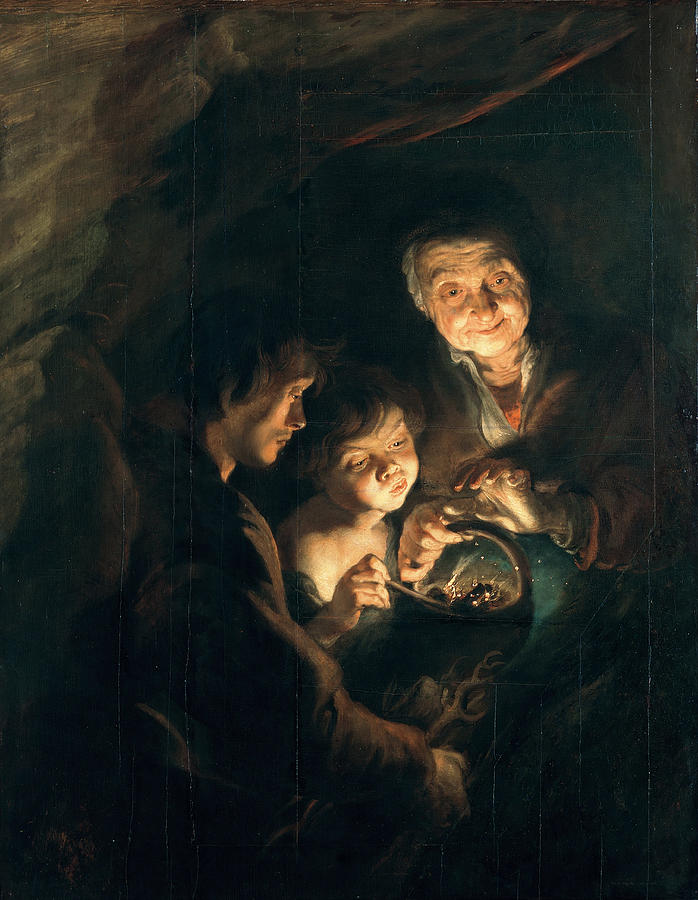
“Old Woman with a Basket of Coal” by Peter Paul Rubens is an intimate nocturnal scene that reveals the artist’s fascination with light, human expression, and everyday life. Instead of heroic battles, mythological gods, or grand altarpieces, Rubens turns his attention to a humble, domestic moment: an elderly woman, a young man, and a child huddled together around glowing embers in a basket. The painting is dramatic yet quiet, theatrical yet deeply human.
The work belongs to a tradition of night pieces in which the only source of illumination comes from a candle, torch, or fire. This device allows the painter to explore the psychological impact of light falling on faces and objects while the surrounding space dissolves into darkness. Rubens’s treatment of the subject is both technically masterful and emotionally rich, transforming an ordinary act—tending a coal fire—into a meditation on warmth, shared experience, and the passage of time across generations.
Composition and Grouping of Figures
The composition is tightly focused on the three figures, who form a compact triangular group in the lower half of the canvas. The old woman stands at the upper right, holding or leaning over a shallow basket filled with glowing coals. Directly below her, the child sits or kneels, leaning forward in fascination as the embers flicker. To the left, partially in shadow, the young man bends toward the child, completing the triangular arrangement.
This triangular formation is crucial to the painting’s sense of stability and intimacy. The old woman’s head occupies the uppermost point of the triangle, while the child’s face and the basket of coal form the central anchor. The young man’s darker profile counterbalances the bright expressions of the other two. Their bodies subtly overlap, emphasizing physical closeness and suggesting emotional connection.
Rubens compresses the composition with a dark, cave-like background that frames the figures and pushes them toward the viewer. The sense of surrounding enclosure intensifies the feeling that we are witnessing a private domestic moment. The figures are not arranged theatrically for our benefit; they are absorbed in their own small ritual with the coal basket, and we are lucky observers.
Chiaroscuro and the Magic of Firelight
The most striking feature of the painting is the dramatic use of chiaroscuro—the contrast between light and dark. All illumination comes from the glowing coals in the basket, which cast a warm, golden light upward onto the faces and hands of the figures. The rest of the space remains largely in obscurity, with hints of the surrounding environment barely visible in the shadows.
Rubens’s handling of firelight is extraordinary. The embers themselves are indicated by small touches of bright orange, red, and white, suggesting both heat and fragile brightness. This light spreads outward, losing intensity as it moves away from the source. The child’s face is closest to the basket, and therefore the most brightly lit; the old woman’s face, slightly above, is also strongly illuminated, while the young man’s features recede into semi-darkness.
This gradation of light not only creates a convincing illusion of depth but also guides the viewer’s attention. Our eyes move from the glowing coals to the child’s fascinated expression, then to the old woman’s smiling, lined face, and finally to the young man’s introspective profile. The interplay of light and shadow thus structures the narrative of the scene, revealing different emotional states and roles for each figure.
The Old Woman: Keeper of Warmth and Experience
The old woman is the most visually prominent figure, thanks to the bright illumination on her face and hands. Rubens paints her with a mixture of realism and affection. Her cheeks are slightly sunken, her mouth lined with wrinkles that deepen into a smile, and her eyes twinkle with both age and lively intelligence. The skin of her face shows the texture of years, yet it is warmed and softened by the firelight, giving her a welcoming presence rather than a stern or tragic one.
She wears a simple garment and a head covering, suggesting humble social status. Her hands, gnarled and veined, hold or adjust the basket of coals with practiced familiarity. The gesture conveys that she is in charge of this small source of heat and light; she is the custodian of warmth in a dark environment.
Symbolically, the old woman can be seen as the figure of experience and memory. She has lived through many winters and understands the importance of keeping the fire alive. Her smile, directed perhaps at the child or at the viewer, suggests a quiet satisfaction in sharing this knowledge. She embodies the wisdom of age: not abstract philosophy, but the practical understanding of how to nurture and protect life in a harsh world.
The Child: Curiosity and Innocent Wonder
At the center of the painting sits the child, bare-shouldered and bathed in the warm glow of the coals. Rubens renders the child’s features with tenderness: round cheeks, parted lips, wide eyes fixed intently on the basket. The expression is one of pure curiosity and wonder. The child does not yet understand the full significance of fire as life-giving heat; he or she is simply fascinated by the flicker of light, the tiny sparks, and the mysterious transformation of dark coals into glowing embers.
The child’s hands reach toward the basket, one perhaps holding a small stick or tool. The gesture is tentative, as if participating in the ritual under the guidance of the older figures. This moment captures the process by which knowledge and responsibility are passed from one generation to the next. The child is learning not only how to manage the physical world but also how to share in communal activities that bind people together.
The contrast between the smooth skin of the child and the wrinkled face of the old woman intensifies the painting’s theme of generational continuity. The firelight unites them visually: its glow touches both faces, suggesting that the same warmth sustains youth and old age alike.
The Young Man: Shadowed Presence and Protective Role
To the left of the composition, mostly in shadow, is the young man. His features are less distinct than those of the old woman and child, but Rubens gives him a thoughtful, almost introspective expression. He leans forward with his head tilted slightly down, his gaze directed toward the coal basket or the child’s hands.
His partial obscurity is significant. It allows him to act as a bridge between the brightly lit innocence of the child and the fully illuminated wisdom of the old woman. He is in the middle stage of life—no longer a child, not yet old—and the semi-darkness around him hints at the uncertainties and struggles of adulthood.
At the same time, his posture suggests a protective role. By leaning over the child, he seems to shield and support the younger figure, ensuring that the experiment with fire remains safe. He might be a father, older brother, or simply a helper, but his presence communicates responsibility and care. The composition thus evokes a whole family structure: grandparent, parent, and child united around a common task.
The Basket of Coal as Symbol and Focal Point
The basket of coal is small in size but immense in symbolic importance. Physically, it is the only source of light and warmth in the scene. The golden glow radiates from its center, creating the entire visual drama of the painting. Rubens pays careful attention to its details: the curved rim, the woven structure, the red and gold sparks among the coals.
Symbolically, the basket represents sustenance, survival, and the shared labor of daily life. In a pre-modern world, maintaining a fire was essential for cooking, heating, and protection. To let the coals die out meant hardship and possibly danger. The fact that all three generations gather around the basket underscores its importance as a communal resource.
On a more metaphorical level, the glowing coals can represent the spark of life, faith, or love that must be kept alive within a family or community. The old woman’s role as keeper of the basket becomes a metaphor for transmitting warmth—literal and emotional—from one generation to the next. The child’s fascination suggests how each new person must rediscover and learn to care for this flame.
Light as Storyteller and Spiritual Metaphor
In addition to its narrative function, the light in this painting carries spiritual overtones. The surrounding darkness suggests a world of uncertainty, hardship, or spiritual ignorance, while the coal’s glow evokes knowledge, hope, or divine grace. Rubens does not include explicit religious symbols here, but the overall effect aligns with Christian themes of light shining in darkness.
The faces illuminated by the coals appear almost transfigured. The old woman’s wrinkles soften into radiance, the child’s innocence is highlighted, and even the young man’s shadowed profile gains a quiet nobility. The light reveals their humanity, their shared vulnerability, and their capacity for warmth and connection.
For viewers, this luminous focus can suggest the idea that true illumination comes not from grand external displays but from small acts of care: tending a fire, teaching a child, and sharing a moment of togetherness in the midst of darkness.
Texture, Brushwork, and Atmospheric Depth
Rubens’s brushwork plays a crucial role in conveying the sensory richness of the scene. In the richly lit areas—the faces, hands, and basket—he uses more precise, controlled strokes to define features and textures. The child’s soft skin, the old woman’s wrinkles, and the shine of the coals are rendered with sensitivity and detail.
In the darker regions, however, the paint is looser and more suggestive. Broad strokes create the folds of clothing and the surrounding cave-like space. The background is not sharply defined; instead, it fades into a smoky blend of browns and blacks, enhancing the sense of depth and enveloping atmosphere. This handling mirrors the way the human eye perceives objects in low light, focusing on illuminated details while allowing other elements to merge into shadow.
The visible brushwork also adds a tactile quality to the painting. The viewer can almost feel the roughness of the old woman’s coat, the smoothness of the child’s arm, and the gritty texture of the coal. This tactile impression intensifies the immediacy of the experience, as if we were physically present in the cramped, warm space around the basket.
Baroque Naturalism and Genre Painting
“Old Woman with a Basket of Coal” reflects Rubens’s engagement with Baroque naturalism and genre painting. While he is best known for grand historical and religious works, Rubens was also interested in scenes from everyday life—people engaged in ordinary tasks, captured with empathy and realism.
This painting belongs to that tradition. There are no overtly heroic or miraculous events; instead, the drama lies in the interplay of light and expression. The figures are ordinary people, yet Rubens treats them with the same seriousness and artistry that he would bring to mythological gods or royal patrons.
Such genre scenes were increasingly appreciated in the seventeenth century, especially in the Low Countries. They allowed viewers to recognize their own lives and experiences in art, while also enjoying the painter’s virtuosity. In this work, Rubens elevates a simple act—tending coals—into a poetic reflection on family, survival, and shared warmth, bridging the gap between high art and everyday reality.
Emotional Tone and Viewer Engagement
The emotional tone of the painting is gently contemplative. Unlike some of Rubens’s more tumultuous scenes, there is no violent movement or intense suffering. Instead, the mood is one of quiet concentration and subtle joy. The old woman’s smile and the child’s fascination create a sense of comfort and safety, even though the surrounding darkness hints at hardship.
For viewers, the painting invites a personal response. The intimate framing and realistic details may recall memories of childhood, family gatherings, or moments spent around a fire or candle in dim light. The figures seem unaware of us, absorbed in their task, which makes the scene feel authentic rather than staged. We become silent witnesses, allowed to share in a moment of warmth without disturbing it.
The work also encourages reflection on the passage of time and the cycles of life. The three figures, representing old age, adulthood, and childhood, suggest the continuity of human experience. The fire they share becomes a metaphor for what we inherit and pass on—skills, stories, love, and faith that keep us going through dark seasons.
Conclusion
“Old Woman with a Basket of Coal” by Peter Paul Rubens is a masterful exploration of light, human connection, and the quiet heroism of everyday life. Through a simple domestic subject, Rubens creates a rich visual and emotional experience. The triangular composition, dramatic chiaroscuro, and meticulous attention to expression and texture transform a night-time chore into a profound meditation on warmth, family, and generational continuity.
The painting demonstrates Rubens’s versatility as an artist. Even when he turns away from grand narratives, he brings to seemingly humble scenes the same technical skill and psychological insight that mark his monumental works. In the glow of the coal basket, we glimpse not only the faces of an old woman, a child, and a young man, but also the enduring human need for light and companionship in a dark world.