Image source: wikiart.org
Overview of Landscape with Milkmaids and Cows
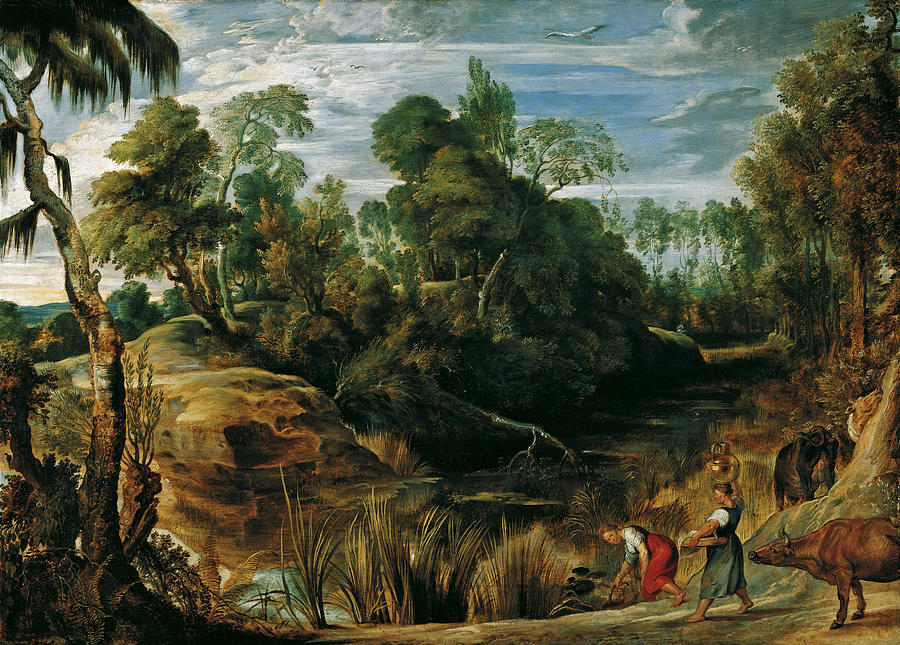
“Landscape with Milkmaids and Cows” by Peter Paul Rubens is a richly detailed pastoral scene that immerses the viewer in a lush, almost theatrical wilderness. At first glance, the eye is drawn to the sweeping mass of trees and vegetation that dominates the center of the canvas. Only later do we notice the small human figures in the lower right corner: two milkmaids, a pair of cows, and a distant herdsman leading animals along the path.
Rubens transforms a seemingly everyday rural activity into a grand meditation on nature, labor, and harmony between humans and their environment. The painting stands at the crossroads between traditional Flemish landscape art and Rubens’s dynamic Baroque sensibility, balancing close observation of plants and animals with a powerful sense of movement and atmosphere.
Composition and the Dominance of Nature
One of the most striking aspects of this work is how small the people appear within the scene. The milkmaids occupy only a tiny portion of the lower right foreground, while a vast forested hill rises above them, crowned with trees whose forms dissolve into the sky. This deliberate scale relationship emphasizes the grandeur of nature and the relative modesty of human presence.
The composition is built around a sweeping diagonal. From the lower left, where reeds and a narrow stream emerge, the ground rises toward a rocky, sunlit mound at the center. Above this mound, a dense cluster of trees forms a green mass that anchors the middle of the painting. The eye then moves to the right, following the darker, shadowed strip of water that recedes into the distance, and finally comes to rest on the milkmaids and cattle at the lower right.
This diagonal route gives the landscape depth and a sense of narrative flow. It feels as if we are strolling along the riverbank, gradually discovering the different elements of the scene. Rubens’s clever use of receding paths, winding water, and overlapping tree forms creates a believable space that invites the viewer to wander visually.
Sky, Light, and Atmosphere
The sky occupies nearly half the composition and plays a vital role in setting the mood. It is filled with rolling clouds ranging from bright white to deeper gray, with patches of blue peeking through. The cloud forms echo the undulations of the terrain below, giving the entire painting a rhythmic unity.
Light filters through these clouds in a broken, shifting way. Certain areas—such as the sandy rock in the middle ground and patches of tree foliage—are bathed in warm sunlight, while other portions are left in soft shadow. This dappled lighting suggests a breezy afternoon in which clouds continually pass before the sun.
The atmospheric perspective is subtle but effective. Trees and foliage in the distance are painted with cooler, bluer tones and less detail, while those in the foreground are sharper and warmer. This gradual loss of detail and shift in color temperature give the illusion of depth and open air, making the viewer feel the distance between the front edge of the path and the far tree line.
Trees, Rocks, and Water: A Study of Natural Forms
Rubens fills the scene with an astonishing variety of natural forms. The trees differ in species, shape, and age: some stand tall with slender trunks and airy crowns, while others are thicker, twisted, or partially broken. Leaves are painted with brisk, energetic strokes that suggest movement rather than static detail, capturing the shimmering quality of light on foliage.
The rocky mound at center stage introduces a contrasting texture. Its warm, earthy tones and rounded contours stand out against the cooler greens. Small patches of moss and grass cling to its surface, revealing Rubens’s careful observation of how vegetation colonizes stone. At its base, reeds and marsh plants sprout from the damp ground, further enriching the textural diversity.
Water winds through the landscape like a dark ribbon. In the foreground, it appears as a small pond or stream, partially hidden by tall grasses. As it recedes, it becomes a shadowy, reflective strip that leads the eye toward the horizon. The presence of water adds freshness to the scene and justifies the activity of the milkmaids, who have brought their animals to drink and graze.
The Milkmaids and Their Daily Labor
Only when we turn our attention to the lower right do we fully register the human story within this natural world. Two young women occupy the path. One bends toward the ground, perhaps guiding a trickle of water into a pail or checking the footing. Her pose is full of movement, with one leg stepping forward and her torso leaning down. The other, standing upright, carries a large vessel balanced on her head, her body turned slightly toward her companion.
Their clothing is simple but colorful: skirts of red and muted blue, white blouses, and bodices in earth tones. The garments help them stand out against the green and brown of the environment, yet they do not dominate the scene. Instead, they are harmoniously integrated into the color scheme, as if nature itself had provided their palette.
These figures embody the quiet dignity of rural labor. They are not idealized shepherdesses from antique mythology but robust, hardworking women who move with purpose. Rubens captures the bend of their backs, the tension in their legs, and the concentration in their gestures, reminding us that the bucolic charm of the countryside is built upon constant human effort.
Cows, Herdsman, and the Rural Economy
Near the milkmaids we see a pair of cows and perhaps an ox or water buffalo. One animal stands close to the women, its head turned slightly toward us, while another is partially hidden by the slope of the bank. Further back, a herdsman leads more animals along the path, his figure small but distinct.
These animals are more than decorative additions. They point to the economic basis of the countryside: dairying, grazing, and the management of livestock. The painting’s title highlights this theme by referencing “milkmaids and cows,” drawing attention to the intimate bond between people and animals in agrarian life.
Rubens paints the animals with the same care as the trees and rocks. The sheen on the cows’ hides, the soft folds of their skin, and the weight of their bodies are carefully rendered. The large hooves and steady gait convey a sense of gentle power. Their presence reinforces the idea that human beings in this world are not isolated individuals but part of an interdependent system of labor, land, and living creatures.
Human Scale Versus the Immensity of Nature
One of the painting’s most compelling messages is conveyed through scale. The milkmaids and cattle, though vital to the narrative, are tiny compared to the monumental trees and rolling hills. They occupy only a small fraction of the canvas, overshadowed by trunks that stretch upward and clouds that stretch across the sky.
This scale relationship suggests a worldview in which nature is vast, complex, and enduring, while human life is relatively small and transitory. Yet Rubens does not present nature as hostile. Instead, the human and natural elements seem to coexist peacefully. The figures appear fully at home in their environment, moving along well-trodden paths, drawing water from familiar streams, accompanied by animals they know and trust.
The painting thus avoids both romanticizing people’s dominance over nature and portraying them as insignificant victims of its power. Instead, it proposes a balanced, almost symbiotic relationship: humans work the land and care for animals; in return, the landscape supports and shelters them.
Flemish Landscape Tradition and Rubens’s Innovation
“Landscape with Milkmaids and Cows” also participates in the broader tradition of Flemish landscape painting. Earlier artists such as Joachim Patinir and Jan Brueghel the Elder developed panoramic views filled with intricate details, tiny figures, and a high vantage point that allowed viewers to survey vast distances. Rubens draws from this heritage but infuses it with his own Baroque flair.
The dynamic tree forms, the bold diagonals of the terrain, and the energetic brushwork all reflect Rubens’s interest in movement and drama. Even in this relatively tranquil subject, he introduces subtle tension: leaning trunks, clouds in motion, reeds that seem to sway in the wind. The landscape feels alive, not static.
At the same time, the painting exhibits Rubens’s sensitivity to collaboration. In some of his landscapes, he worked with specialist landscape painters for certain passages, while he concentrated on figures and compositional design. Whether or not that is the case here, the integration of finely observed vegetation with expressive human figures speaks to his ability to synthesize different painterly strengths.
Color Palette and Emotional Tone
The color palette of the painting is dominated by greens, browns, and blues—natural hues that evoke the freshness of the outdoors. Yet within this seemingly limited range, Rubens finds endless variations. The greens of the trees range from bright yellow-green in sunlit leaves to deep bluish tones in shaded foliage. The browns of earth and rock shift from warm ocher to cool umber.
Against this natural backdrop, the clothing of the milkmaids introduces small but important accents of red, white, and soft blue. These touches of color attract the eye and subtly organize the composition around the human figures.
The overall emotional tone is calm and reflective. There is no storm brewing, no dramatic sunset, no extreme contrasts of light and dark. Instead, the painting offers the quiet satisfaction of a productive day in the countryside. It is not sentimental; the work of carrying water and tending cattle is real. But neither is it harsh. Rubens presents rural life as meaningful and integrated within a generous natural world.
Narrative Without Overt Storytelling
Unlike many of Rubens’s mythological or historical scenes, this painting does not depict a specific famous story. There are no gods, heroes, or saints; the milkmaids are not mythic nymphs; the cows are not part of some allegory of abundance. Yet the painting still tells a story—one of daily routine and the passage of time.
The path suggests movement: the herdsman and animals have come from somewhere and are going somewhere. The milkmaids’ actions imply a sequence—drawing water, pouring it, returning with filled vessels. The landscape itself tells the story of natural cycles: water shapes rocks, trees grow and fall, grasses sprout and wither.
This understated narrative kind of painting allows viewers to project their own experiences and associations onto the scene. It encourages us to imagine the sounds of rustling leaves, lowing cattle, splashing water, and the quiet conversation of the women at work. In this way, the painting becomes not just an image but an evocation of lived reality.
A Baroque Meditation on Harmony
Ultimately, “Landscape with Milkmaids and Cows” can be seen as a Baroque meditation on harmony—harmony between man and nature, work and rest, motion and stillness. The dynamic shapes of trees and clouds are balanced by the steady, grounded presence of the figures. The eye moves across the scene in a gentle rhythm, guided by repeating forms and color echoes.
Rubens suggests that beauty is found not only in grand historical events or mythic dramas but also in the ordinary rhythms of rural life. By casting the milkmaids and their cows in the same glowing light that illuminates his heroes and saints, he dignifies their work and acknowledges their place within the grand tapestry of the world.
The painting invites viewers, then and now, to pause and look closely—to notice the intricacy of a leaf, the curve of a cow’s back, the concentration of a woman bending toward the water. In doing so, it reminds us that the everyday landscape around us is full of meaning, provided we take the time to see it.
