Image source: wikiart.org
Introduction
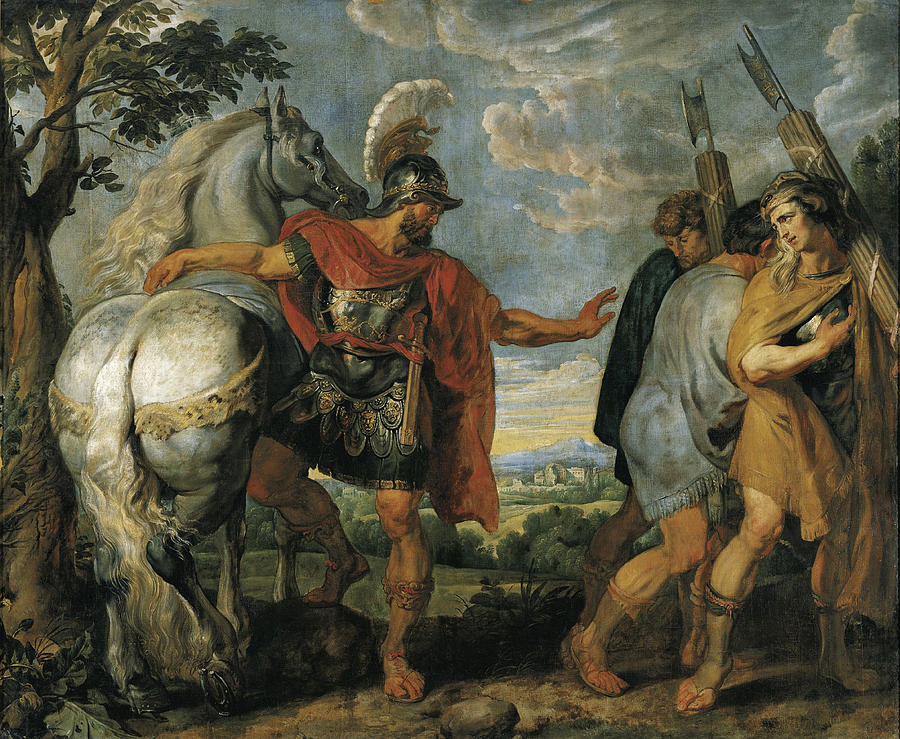
“The Dismissal of the Lictors” by Peter Paul Rubens is a stirring Baroque history painting that captures a decisive moral choice rather than a clash of weapons. The scene shows the Roman consul Publius Decius Mus turning away from his armed escort—the lictors—just before he rides to certain death in battle. In a single charged moment, Rubens condenses themes of civic duty, self-sacrifice, and leadership, wrapping them in the muscular energy and rich color that define his style.
The painting forms part of Rubens’ celebrated cycle on “The Story of Decius Mus,” commissioned for tapestries and grand interiors. Here he focuses not on the consul’s heroic charge or gory end, but on the quieter instant when Decius relinquishes the privileges of office, sending away the lictors who symbolize his authority and safety. For Roman viewers this gesture meant that he was preparing to devote his life (devotio) for the salvation of the army and the Republic. For Rubens’ contemporaries, it resonated as an image of principled, sacrificial leadership.
Historical and Literary Background
The source for the story of Decius Mus is the Roman historian Livy. During a desperate battle against the Latins, the consul has a prophetic dream that victory will be granted if one of the consuls offers himself to the gods of the underworld. When the Roman line begins to falter, Decius chooses to fulfil the oracle. He performs a solemn ritual, dedicates his life to the gods, and rides alone into enemy ranks, where he dies and secures Roman victory.
Rubens’ cycle narrates several episodes from this legend. “The Dismissal of the Lictors” is usually placed just after the interpretation of the dream and before the final consecration and heroic death. By ordering his lictors to stand down, Decius symbolically strips himself of magisterial immunity. As a Roman magistrate he is normally protected by these officers, who carry fasces—bundles of rods and axes—representing the power to punish. Rejecting them, he chooses to stand as an ordinary man, ready to die for the common good.
In early-seventeenth-century Europe, this story was read as a model of virtuous leadership, especially appealing to rulers and nobles who wanted to project an image of selfless service rather than mere appetite for power. Rubens, steeped in classical literature and political thought, translates this moral example into visual drama.
Overall Composition and Focal Point
The composition is built around a strong triangular arrangement. At the center stands Decius Mus in gleaming armor and red cloak, viewed in three-quarter profile. To his left rears a powerful white warhorse, its body turned away from the viewer so that its massive hindquarters occupy a large portion of the canvas. To the right, three lictors retreat reluctantly, their bodies turning away yet their heads glancing back toward the consul.
This triangular structure funnels our attention toward Decius’ commanding gesture. His outstretched right arm forms a firm horizontal line, palm facing outward as if to halt or dismiss. His left hand rests on the horse’s flank, subtly anchoring him to the animal that will carry him toward death. The eye moves from the broad curve of the horse’s body, along Decius’ sweeping red cloak, and into the diagonally receding line of the departing lictors.
Rubens cleverly uses the open landscape in the middle distance—a sunlit valley with a distant city—to create breathing space around the central figures. The horizon sits low, allowing the sky and trees to frame the scene like a stage backdrop. The result is both monumental and intimate: we sense the broad fields of war beyond, yet we remain focused on this critical human decision at the foreground.
The Figure of Decius Mus
Rubens portrays Decius as the ideal Roman general: muscular, poised, and resolute. His body is compact and powerful, with thick legs planted firmly on the ground. He wears elaborately chased armor with decorative reliefs, a short tunic, and greaves on his legs. A crimson cloak, clasped at the shoulder, billows around him, echoing the red of blood and sacrifice.
His helmet, with crest of white plumes, gleams beneath the shifting clouds. The visor is lifted so that his face is fully visible. Rubens gives him a stern, slightly furrowed expression; he looks not at the viewer but toward the lictors, as though making sure they obey his command. This lack of eye contact reinforces the sense that we are witnessing a real, unposed moment rather than a static allegory.
Decius’ gesture is complex. The right hand pushes outward, palm open, in a clear sign of dismissal; yet the curve of the arm is not harshly aggressive but controlled and measured. This suggests not anger but sober determination. He is not rejecting the lictors themselves but the protection they offer, in order to fulfil a higher duty. Meanwhile his left arm draws the horse slightly back, as if delaying the charge until this final formal act is complete.
The Lictors: Reluctant Obedience
On the right side of the composition, the three lictors are shown in various stages of turning away. All carry fasces over their shoulders, the rods and axe heads clearly visible. Their garments are simpler than Decius’—short tunics in faded blues and ochres—indicating their status as officials rather than elites.
The foremost lictor, wrapped in a yellowish cloak, twists his head back with a troubled expression. He seems emotionally torn, unwilling to abandon his consul in the face of danger. The middle lictor, in blue, looks downward more submissively, while the third, half hidden, strides ahead. This gradation of reactions—from resistance to resignation—adds psychological depth to the scene.
By giving the lictors such nuanced emotion, Rubens emphasizes the gravity of Decius’ decision. The dismissal is not a routine order but a shocking act that affects those closest to him. Their departure leaves him exposed, heightening the pathos of his impending sacrifice.
The Warhorse: Power Harnessed to Duty
The white horse on the left is almost a protagonist in its own right. Seen largely from the rear and in a slight twist, it displays the full power of Rubens’ animal painting: gleaming flanks, rippling muscles, and flowing mane. The unusual rear-view angle is daring; instead of showing the noble head frontally, Rubens chooses a more complex pose that highlights movement and strength.
The horse’s hind legs are spread and braced, suggesting restrained energy. Its tail flicks, and its head turns just enough for us to glimpse the bridle and a hint of eye. The animal seems ready to leap forward at any moment, but Decius’ hand on its side holds it back. This tension between readiness and restraint mirrors the consul’s own state: prepared for heroic action, yet pausing to complete the symbolic gesture of sending away his escort.
The luminous, almost silvery coat of the horse contrasts with the darker tones of Decius’ armor and the earth underfoot. It thus becomes a beacon of visual focus, reinforcing the centricity of Decius and his mount within the scene.
Landscape, Architecture, and Sky
Behind the figures, Rubens opens a landscape that recedes into soft blues and greens. Low hills, distant buildings, and a strip of sky suggest the wider theatre of war and civic life. The city in the distance may allude to Rome or to the Latin city that is the object of conflict; in either case, it stands as the community for whose sake Decius will sacrifice himself.
The sky above is full of dynamic cloud formations, painted with loose, energetic strokes. Patches of blue break through, suggesting a changeable atmosphere—appropriate for a moment when fate hangs in the balance. The large tree trunk that frames the left edge introduces a dark vertical element, counterbalancing the vertical forms of the lictors’ fasces on the right. Together tree and fasces create a kind of visual bracket around the central drama.
Rubens’ inclusion of lush foliage at the lower left also brings his Flemish love of nature into this Roman subject, subtly linking classical heroism with the artist’s own environment and sensibility.
Color and Light
Color is central to the painting’s emotional impact. The dominant tones are warm earth colors—browns, ochres, and muted greens—against which the bright red of Decius’ cloak and the cold luminosity of the horse stand out. This red acts as a visual metaphor for blood and courage; it catches the light in folds and highlights, leading the eye across the consul’s body and toward his extended arm.
Rubens uses a soft, diffused light, as if from an overcast sky, to model forms without harsh contrasts. However, certain areas—Decius’ helmet, sections of his armor, the horse’s flank, and parts of the lictors’ clothing—catch stronger highlights, adding sparkle and depth. The interplay of light on metal surfaces, leather straps, and fleshy limbs showcases Rubens’ virtuosity in rendering varied textures.
The overall effect is both harmonious and dramatic: colors blend naturally, yet the key symbolic elements are clearly emphasized.
Psychological and Moral Dimension
While the painting is outwardly an episode from Roman history, its deeper subject is the moral choice of self-sacrifice for the common good. Rubens does not depict Decius amidst cheering crowds or in the heat of battle. Instead we see him at a quiet, almost private moment, interacting only with his horse and the small group of lictors.
This intimacy allows us to sense the interior drama. Decius’ body is still, but his mind is clearly made up. The gesture of dismissal is firm but not theatrical; it conveys seriousness rather than bravado. The lictors’ reluctance and sadness underscore the cost of his decision—not only his own life, but the pain of those bound to him by duty and loyalty.
For a seventeenth-century audience, particularly within the princely courts that commissioned such works, this image carried political weight. It suggested that true leadership sometimes demands renouncing privilege and security for the sake of the state. In Catholic readings, Decius could even be seen as a pagan prefiguration of Christian martyrdom, someone who lays down his life so that others might live.
Baroque Style and Movement
“The Dismissal of the Lictors” is quintessentially Baroque in its sense of movement and its fusion of narrative and emotion. No figure is stiff: the horse twists, Decius turns, the lictors stride away in varied rhythms. Draperies swirl, especially the consul’s red cloak, which arcs around his torso in a sweeping curve. This dynamism animates what might otherwise be a static ceremonial scene.
Rubens’ brushwork, though carefully controlled, has a visible energy, particularly in the clouds, foliage, and horse. These more freely painted areas contrast with the crisp details of armor and facial features, balancing spontaneity with precision. The scene feels like a snapshot of life rather than a rigid reconstruction of antiquity.
At the same time, Rubens maintains clarity of storytelling: any educated viewer would immediately recognize the Roman context (armor, fasces, tunics) and understand that this is a moment of dismissal, not of attack or negotiation.
Dialogue Between Antique and Contemporary
Rubens, like many Baroque artists, was fascinated by the classical world. In “The Dismissal of the Lictors” he reimagines Roman virtue through a seventeenth-century lens. The armor and dress, while loosely based on antiquity, reflect the theatrical Romanizing costumes fashionable in early modern courts. The moral message—sacrifice for the state—spoke directly to debates about good governance in his own time, especially in the turbulent Spanish Netherlands.
By showing Decius Mus as a model of civic virtue, Rubens subtly encouraged contemporary leaders to see themselves in this ancient figure. The painting thus operates on two time levels: it narrates a remote past and simultaneously addresses present concerns about power, responsibility, and honor.
Conclusion
“The Dismissal of the Lictors” by Peter Paul Rubens is more than a scene of Roman pageantry; it is a profound meditation on leadership and sacrifice rendered with Baroque vigor. Through the commanding figure of Decius Mus, the reluctant retreat of his lictors, and the poised strength of the white warhorse, Rubens captures the crucial moment when a man of power voluntarily sets aside his protections to fulfil a higher duty.
The painting’s balanced composition, rich color, and animated forms draw the viewer into this moral drama. Landscape and sky hint at the wider battlefield and the fate of the city that depend on Decius’ choice. In blending classical history with emotional immediacy, Rubens creates an image that still speaks to modern questions about what it means to lead, to serve, and to lay down one’s life for others.
