Image source: wikiart.org
Introduction
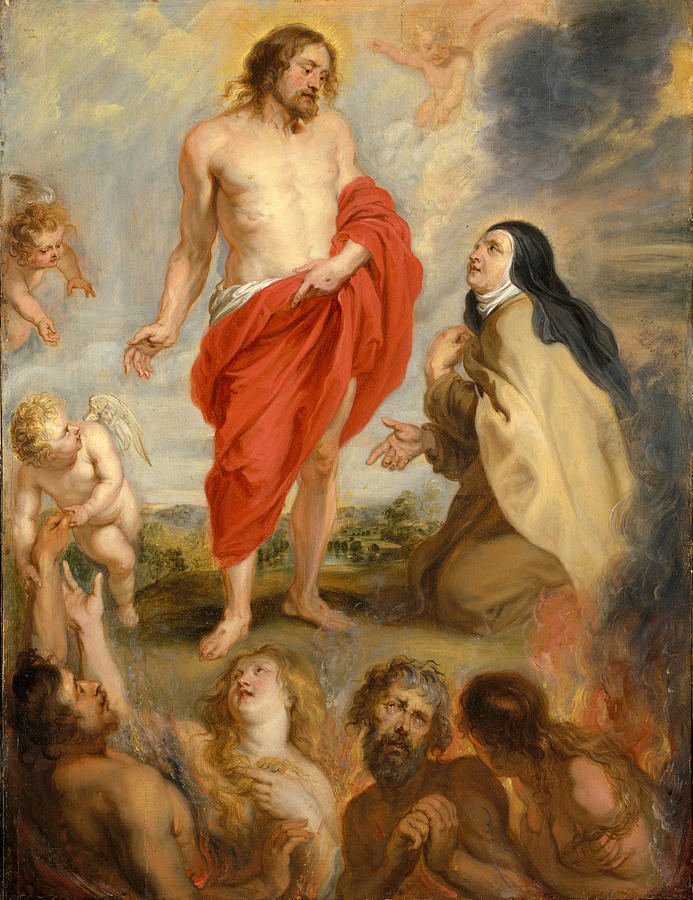
“Saint Teresa of Avila Interceding for Souls in Purgatory” presents a vivid encounter between the risen Christ, the great Spanish mystic Teresa of Avila, and a cluster of anguished souls engulfed in purgatorial flames. Attributed to the workshop of Peter Paul Rubens and reflecting his mature Baroque style, the painting visualizes a deeply Catholic doctrine: the belief that saints can intercede for the dead, hastening their purification and entrance into heaven.
Rubens and his studio translate complex theology into a direct, emotionally charged scene. Christ, partly draped in a red mantle, stands barefoot on the earth; Teresa kneels before him in her Carmelite habit, hands open in pleading. Beneath them, half-submerged in fire, the souls of men and women look upward with hope and desperation. Putti and small angels hover at the edges, reinforcing the link between heaven and earth. The result is a compact yet powerful drama of mercy, suffering, and contemplative love.
Composition and Spatial Structure
The composition is vertically oriented and can be read in three zones. At the top, clouds and cherubs suggest the heavenly sphere. In the middle, Christ and Teresa occupy the primary plane, slightly larger than life and bathed in warm light. At the bottom, the souls in purgatory writhe among flames, their bodies foreshortened and crowded.
This vertical arrangement underscores the theological hierarchy. Heaven descends toward earth through Christ, who is simultaneously divine and human. Teresa kneels in the middle ground, representing the Church militant still on earth, while the souls below embody the Church suffering in purgatory. The overall structure becomes a visual ladder of intercession: divine mercy flows downward through Christ, is mediated by the prayers of Teresa, and finally reaches the souls in need.
Rubens uses subtle diagonals to animate the composition. Christ’s body gently tilts toward Teresa, and his gaze descends toward her as she looks up, creating a loop of attention that anchors the viewer’s eye. The gestures of the souls below and the putti at the left also point upward, reinforcing this dynamic of appeal and response.
Christ the Risen Judge and Redeemer
Christ stands at the center of the painting, his nearly nude body wrapped in a red mantle that covers his lower torso and flows around his left arm. This red garment carries multiple meanings: the blood of his Passion, his royal dignity, and the burning love that motivates his mercy. His bare chest and visible wounds allude to the Crucifixion but his upright posture and calm expression mark him as the risen Lord.
His right hand hangs relaxed, fingers slightly bent, while his left hand, gathering the mantle at his hip, subtly points toward his side wound. Rubens often uses this gesture to emphasize Christ’s sacrifice as the source of salvation and forgiveness. The fact that he stands on solid ground rather than a cloud stresses his continued connection to the human world; he is not remote but present.
Christ’s face is turned toward Teresa, his features softened by compassion. The gentle inclination of his head and the warmth in his expression suggest that he is listening attentively to her plea. This visual dialogue between them encapsulates the idea of intercession: the saint speaks, Christ considers and grants. The viewer is encouraged to see Christ not only as judge but as deeply responsive to the prayers of the righteous.
Saint Teresa of Avila as Intercessor
Opposite Christ, kneeling on a low rise of earth, is Saint Teresa of Avila, the sixteenth-century Carmelite reformer and mystic. She wears the characteristic brown habit and white mantle of her order; the black veil frames her face. Rubens captures her in a moment of fervent prayer, mouth slightly open as if speaking, eyes raised toward Christ with unwavering trust.
Her hands express her role beautifully. One hand is pressed to her breast in a gesture of personal devotion, while the other extends outward, palm up, as though offering or presenting the souls below to Christ’s mercy. This dual motion—toward Christ and toward the suffering—captures the essence of intercessory prayer: rooted in love for God, it reaches outward in compassion for others.
Teresa’s body leans slightly forward, emphasizing both humility and urgency. She is not a distant, serene contemplative but an active advocate. The warm light that falls on her face and habit gives her a quiet radiance, suggesting the inner fire of charity that defines her sanctity. In a period when Spanish spirituality greatly influenced Catholic Europe, Teresa here stands as a model of intense, affective devotion capable of moving heaven itself.
Souls in Purgatory: Suffering and Hope
The lower portion of the painting is filled with figures half-submerged in flames. Their bodies are nude or lightly draped, their skin glowing with warm tones that blend into the surrounding fire. Unlike the damned in depictions of hell, these souls show no signs of despair or hatred; instead their expressions convey regret, longing, and a kind of suffering that is already oriented toward purification.
Rubens arranges them in a compact cluster. One woman, with flowing blond hair, lifts her eyes upward, hands clasped over her chest in penitence. A bearded man looks directly at Christ, brows knitted but gaze full of hope. Another figure twists sideways, hands folded tightly in prayer. Smoke and fire curl around them, but there is also a sense of upward movement, as if their bodies are already being drawn toward the light above.
The presence of these souls gives concrete shape to the doctrine of purgatory: a state of temporary suffering for those destined for heaven but not yet fully purified. Rubens emphasizes that they are reachable; they are not sealed off but openly visible to Christ, Teresa, and the viewer. Their upward-reaching gazes mirror Teresa’s, reinforcing the idea that her prayer gives voice to their silent plea.
Angels and Cherubs: Agents of Mercy
Small angels populate the painting’s upper corners, adding another layer of mediation between heaven and earth. On the left, a putto with wings helps lift one of the purgatorial souls, grabbing the person’s wrists and pulling upward, assisted by another cherub behind. This tiny scene dramatizes the effect of Teresa’s intercession: not only does Christ’s mercy extend to the souls, but the angels actively assist in their rescue.
Above, near the clouds, vague angelic forms gesture toward Christ and Teresa, as if encouraging the mutual exchange. These celestial witnesses reinforce the communal dimension of salvation in Catholic thought: God, saints, angels, and the faithful are all engaged in a network of charity and prayer.
The cherubs also soften the painting’s atmosphere. Their round faces and playful bodies introduce a note of tenderness, reminding viewers that divine mercy, though dealing with serious realities, is also gentle and affectionate.
Light, Color, and Atmosphere
Rubens’ color palette and lighting are crucial to the painting’s emotional resonance. The upper portion is suffused with golden and creamy tones, especially around Christ and Teresa. This warm light suggests the presence of grace and the nearness of heaven. It contrasts with the dusky greys and smoky oranges of the lower purgatorial region, where the flames burn but remain somewhat subdued.
The red of Christ’s mantle is the most intense color on the canvas, drawing immediate attention and symbolizing both sacrifice and love. Teresa’s brown and white garments provide an earthy counterpoint, grounding the composition in the reality of religious life. The skin tones of Christ, Teresa’s face, and the souls below share a similar warm modeling, visually linking all levels of the scene.
The sky behind Christ shows patches of blue mingled with soft clouds, giving a sense of open, breathable space. Around Teresa and the souls, the background becomes more neutral and hazy, focusing attention on the figures rather than on any specific landscape. There is a suggestion of distant fields behind Christ’s legs, hinting at the world of the living that continues beyond this mystical encounter.
Overall, the atmosphere is luminous rather than oppressive. Even the flames of purgatory are rendered with a kind of glowing beauty, reinforcing the idea that this suffering, painful as it is, is ordered toward healing and purification rather than eternal punishment.
Baroque Spiritual Drama
The painting exemplifies Baroque spirituality, which sought to engage the viewer emotionally and imaginatively. Rather than depicting theological concepts in abstract form, Rubens uses human bodies, faces, and gestures to make the drama of salvation tangible. Christ is not a distant judge on a throne but a physically present, approachable figure whose body still bears the marks of love. Teresa is not an idealized symbol of sanctity but a recognizable woman, intensely focused and deeply moved.
The close proximity of the figures to the picture plane helps draw the viewer into the scene. Christ’s bare feet rest almost at the edge of the canvas, as if he stands on the same ground as the spectator. Teresa’s kneeling posture and extended hand invite us to join in her prayer. The souls at the bottom seem to rise out of the very frame, their pleading faces turned partly toward us.
Rubens’ fluid brushwork adds to the sense of immediacy. Soft, blended strokes model flesh and drapery, while more energetic touches suggest hair, flames, and clouds. This painterly liveliness reflects the inner motion of grace: nothing in the painting feels static; all is in the process of transformation.
Theology of Intercession and the Communion of Saints
At the heart of the painting lies a distinctly Catholic theology. Christ’s unique role as redeemer is affirmed by his central position and by the emphasis on his wounds. Yet Rubens also highlights the participation of saints in God’s saving work. Teresa is not portrayed as competing with Christ but as drawing on his merits to obtain mercy for others.
This reflects the doctrine of the communion of saints, in which the holy ones in heaven and on earth can pray for the faithful departed, and those prayers are effective by virtue of Christ’s sacrifice. The painting visualizes this invisible network: Christ listens; Teresa speaks and gestures; the souls respond with gratitude and hope; the angels assist physically.
For seventeenth-century viewers, such imagery reinforced the practice of praying for the dead and seeking the intercession of favored saints. Teresa, canonized in 1622, was a relatively new saint at the time, and depicting her in this powerful intercessory role would have encouraged devotion to her as a heavenly advocate.
Devotional Function and Viewer Response
In its original context, the painting likely served as a devotional image in a chapel or private collection. Its scale and intimate focus make it well suited for personal prayer. Viewers could meditate on Christ’s mercy, examine their own readiness for purification, and ask Saint Teresa to pray for deceased loved ones.
The painting also invites viewers to imitate Teresa’s charity. By showing her passionately concerned for the souls in purgatory, Rubens suggests that true union with Christ leads naturally to concern for others, especially those who suffer unseen. Her example may prompt the viewer to offer prayers, masses, or acts of penance on behalf of the departed.
Moreover, the painting provides consolation. It presents purgatory not as a place of despair but as a realm pervaded by hope and touched by the love of Christ, the saints, and the angels. For believers worried about their own salvation or that of their relatives, this imagery would have been deeply reassuring.
Conclusion
“Saint Teresa of Avila Interceding for Souls in Purgatory” is a compact theological drama rendered with the warmth and energy characteristic of Rubens and his workshop. Through the luminous figure of the risen Christ, the fervent posture of Teresa, and the pleading faces of the souls in purgatory, the painting articulates a rich vision of divine mercy mediated through saintly prayer.
The vertical composition, expressive gestures, and glowing color palette guide the viewer from the depths of suffering to the threshold of heaven. At the same time, the painting brings lofty doctrine down to a human level, where individual faces and bodies reveal the stakes of salvation.
As both a work of art and a spiritual resource, this painting continues to speak about the power of intercession, the reality of purification, and the inexhaustible compassion of Christ. It invites anyone who contemplates it to stand with Saint Teresa—eyes lifted, hands extended—asking that the fire of divine love transform every soul, whether still on earth or awaiting the full vision of God.
