Image source: wikiart.org
Introduction
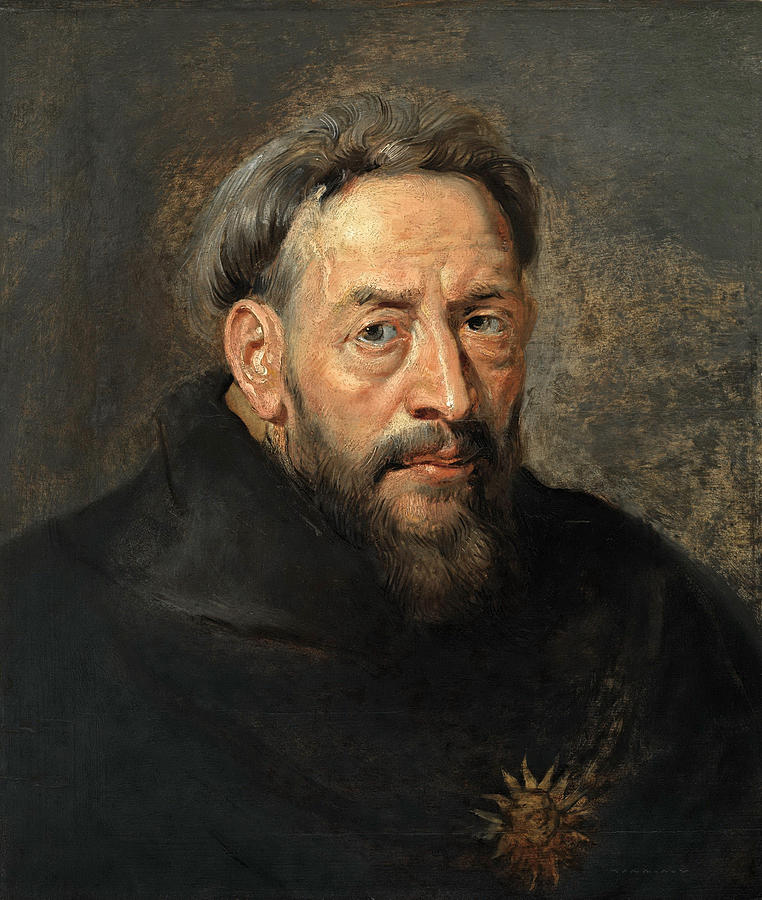
“Portrait of a Capuchin Monk” by Peter Paul Rubens is a striking example of Baroque portraiture at its most introspective. Instead of the sumptuous armor, glittering jewels, or flowing mythological drapery found in many of his other works, Rubens gives us a man dressed in the rough brown habit of the Capuchin order. There are no elaborate props, no architectural backgrounds, no narrative details. The focus is entirely on the monk’s face: weathered, thoughtful, and illuminated by a quiet inner light.
The painting captures a moment of intense psychological presence. The monk gazes out at the viewer with an expression that mingles watchfulness, gentleness, and a trace of melancholy. Rubens’s subtle use of light and color emphasizes the tension between worldly experience and spiritual detachment. In this portrait, holiness is not idealized or distant; it is embodied in the lines, scars, and tired eyes of a man who has lived, suffered, and prayed.
Historical and Religious Context
The Capuchins were a reform branch of the Franciscan order, founded in the sixteenth century with a strong emphasis on poverty, austerity, preaching, and close contact with ordinary people. Recognizable by their simple brown habits and hooded capes, they became important figures in the Catholic Reformation, championing a return to the radical simplicity of Saint Francis of Assisi.
Rubens lived and worked in the Southern Netherlands (modern Belgium) during a time of intense religious conflict. As a committed Catholic, he often collaborated with religious orders, creating altarpieces and devotional images that supported the Church’s efforts to engage the faithful emotionally and intellectually. A portrait of a Capuchin monk fits neatly into this world: it honors a representative of the renewed spiritual fervor and pastoral activism of the age.
While the exact identity of the sitter is uncertain, the painting clearly presents him as an individual of some distinction within the order. The sunburst-like emblem on his chest likely refers to a devotional symbol or a specific confraternity. Yet Rubens avoids any sense of official portrait pomp; he instead conveys the impression of a humble, steadfast servant of God.
Composition and Framing
The composition is disarmingly simple. The monk’s head and shoulders occupy most of the canvas, emerging from a dark cloak that blends into an equally dark, nearly monochrome background. There is no visible architectural frame or landscape; the background is a muted brown-gray field with loose, textured brushwork. This absence of setting strips away distractions and pushes the viewer’s attention entirely onto the man’s face.
Rubens places the head slightly off center, leaning gently toward the viewer’s left. This subtle asymmetry gives the portrait a sense of immediacy and naturalness, as though the monk has just turned his head in response to someone speaking. The angle of the shoulders, slightly sloping downward from right to left, reinforces this impression of spontaneous movement.
The portrait is cropped close enough that we feel within conversational distance. The monk’s gaze meets ours almost directly, though just slightly to the side, preventing a confrontational stare and creating instead a feeling of shared space. The format thus supports an intimate encounter between viewer and subject, appropriate for a man whose vocation is listening, counseling, and prayer.
The Monk’s Face: Character and Experience
The most compelling element of the painting is the monk’s face. Rubens renders it with extraordinary sensitivity, using a wide range of colors and brushstrokes to convey age, texture, and expression. The skin is not smooth or idealized; it shows wrinkles around the eyes, lines across the forehead, and subtle scarring near the temples. The cheeks are slightly flushed, as if from outdoor preaching or simple hard work.
His eyes are the true focal point. They are moist and reflective, with small, carefully placed highlights that make them appear alive. The gaze is level and steady, not shy but not aggressively penetrating either. It seems to hold a mixture of compassion and caution, as though the monk has seen much of human frailty and retains both empathy and healthy wariness. This blend of tenderness and realism gives the portrait tremendous psychological depth.
His mouth is set in a neutral line, slightly downturned at the corners. There is no smile, but neither is there harshness. Instead we sense a quiet seriousness, the gravity of someone accustomed to hearing confessions, comforting the sick, and facing the realities of suffering and death. The beard and mustache, tinged with gray, frame the mouth and chin, reinforcing the impression of maturity and wisdom earned through experience.
Rubens’s careful attention to the structure of the head—the bone beneath the skin, the hollow of the cheeks, the shape of the skull—ensures that the face appears three-dimensional and solid. Light falls from the left, emphasizing the forehead, nose, cheekbones, and parts of the beard while leaving the right side of the face in softer shadow. This modeling not only adds realism but also enhances the mood, suggesting an inner light that struggles against the darkness of the world.
Habit, Emblem, and the Language of Clothing
The monk’s clothing is as simple as it could be: a rough, dark brown habit characteristic of the Capuchins. Rubens paints it with broad, economical strokes, avoiding elaborate folds or textures. The fabric absorbs light rather than reflecting it, becoming a dark mass that contrasts with the illuminated face. This simplicity serves the spiritual message: the habit is a sign of poverty and renunciation, pointing away from worldly concerns toward an inward life of prayer.
The only decorative element is the small sunburst-like emblem on the chest. It radiates jagged golden rays against the dark habit, symbolizing perhaps the Divine Sun, the Sacred Heart, or a specific Franciscan devotion to the Eucharist. Whatever its precise meaning, the emblem introduces a subtle theological dimension. It suggests that beneath the humble exterior burns a flame of divine love, and that the monk’s entire identity is oriented toward this radiant center.
By minimizing clothing detail but emphasizing this single symbol, Rubens underscores the tension between outward simplicity and inner richness. The habit, like a frame, draws attention to the face and the emblem, which together tell the story of a life molded by spiritual commitment.
Light and Color: A Limited but Expressive Palette
Rubens employs a restrained palette dominated by browns, grays, muted greens, and warm flesh tones. This limited range of colors suits the subject: a Capuchin would not be surrounded by opulent fabrics or luxurious settings. Yet within these boundaries, Rubens finds remarkable subtlety.
The background is a mottled mixture of earthy browns and dull ochres, applied in loose, visible strokes. It lacks hard edges or specific forms, creating a soft halo around the head. This not only keeps the focus on the face but also suggests a kind of atmospheric aura—humble yet quietly dignified.
The habit is almost black, but on close inspection it reveals deep browns and greenish tones. Rubens uses minimal highlights to indicate folds at the shoulder and neckline, suggesting the volume of the cloth without pulling attention away from the face.
The flesh tones are rich and varied: warm pinks on the cheeks, cooler shadows around the eyes, yellowish notes on the forehead, bluish undertones in the beard region. This chromatic complexity gives the skin a lifelike vibrancy. The graying hair includes streaks of brown, ochre, and even subtle blues, catching the light along the top of the head and the fringe around the ears.
Overall, the light is soft but directional, emphasizing the planes of the face and creating a gentle contrast with the darker background. The effect is reminiscent of candlelight or daylight entering a monastic cell—intimate, contemplative, and conducive to quiet reflection.
Brushwork and Painterly Presence
Though the portrait reads as highly realistic from a distance, Rubens’s brushwork is energetic and visible upon closer inspection. He applies paint in varying thicknesses and strokes, adjusting his technique to the part of the image.
For the face, the strokes are smaller and more blended, yet not smoothed to invisibility. Fine lines describe wrinkles, while subtle transitions of color create the impression of pores and slight imperfections. This painterly texture enhances the feeling that we are looking at living skin rather than polished marble.
The hair and beard are handled more freely. Rubens uses brisk, curving strokes to suggest strands and tufts, especially where light catches the top of the head or the edges of the beard. This liveliness in the hair contrasts with the firmness of the facial features, adding a sense of movement and humanity.
The habit and background are painted with even broader, more economical strokes. Here Rubens is content to let the viewer’s eye blend the colors and forms, trusting that the mind will supply the sense of rough fabric and simple walls. This hierarchy of detail—finest in the face, looser in the surroundings—directs our focus without feeling artificially staged.
The visibility of the brushwork also reminds us that this is not a photographic capture but a painter’s interpretation. We are aware of Rubens’s hand at work, shaping the image just as the monk’s spiritual discipline has shaped his character.
Psychological Depth and Implied Dialogue
One of the greatest achievements of this portrait is its psychological depth. The monk does not appear frozen in time; he seems to be in the middle of a silent exchange with the viewer. The slightly parted lips suggest he may be about to speak or has just finished saying something. The eyes, though directed outward, have a reflective quality that implies inward thought.
This combination creates an implied dialogue. The viewer might imagine the monk listening to a confession, offering counsel, or sharing a story of his own spiritual journey. His gaze is attentive but not intrusive. There is kindness in it, but also an awareness of human complexity. Rubens avoids sentimentality; the monk is not idealized as a saint without struggle. His face bears traces of fatigue, worry, and perhaps past sorrows.
The portrait thus functions not merely as a likeness but as a character study. It invites viewers to consider the inner life of those who dedicate themselves to religious service: the sacrifices they make, the burdens they carry, and the wisdom they gain. In a broader sense, it reflects Rubens’s interest in human psychology and his ability to convey it through nuanced facial expressions.
Comparison with Other Rubens Portraits
When compared with Rubens’s portraits of aristocrats, diplomats, and self-portraits, “Portrait of a Capuchin Monk” stands out for its austerity and spiritual emphasis. In many of his secular portraits, Rubens showcases the sitter’s status through luxurious costumes, elaborate backgrounds, and props such as swords, gloves, or books. Here, none of that is present. The monk’s dignity comes not from wealth or rank but from inner character.
Yet there are also continuities. Rubens’s interest in realism, his careful observation of flesh and fabric, and his dynamic yet balanced compositions appear in both types of portrait. He brings the same technical skill to a humble friar as to a grand noble, suggesting a democratic respect for all human faces as bearers of personality and story.
In this sense, the painting aligns with the spiritual values of the Capuchin order itself, which honored the poor and commonplace as places where God’s grace could shine. Rubens’s choice to portray the monk with such care reflects his own sympathy for this perspective.
Spiritual and Devotional Dimensions
Although the painting is a portrait, it also has a quiet devotional quality. The monk’s calm yet intense gaze, the simplicity of his habit, and the small emblem of radiant light all hint at a life centered on prayer. For viewers of Rubens’s time, this image could function as a model of contemplative presence. Looking at the monk, they might be moved to emulate his seriousness and humility.
The portrait also reflects a key theme of Baroque spirituality: the intersection of the human and the divine. Holiness is not portrayed as an otherworldly glow removed from daily life, but as something that takes root in real, flawed human beings. The monk’s wrinkles and gray hair become signs of a long journey with God, not imperfections to be smoothed away.
In this way, the painting encourages a kind of reverence for the human face as a mirror of the soul. The viewer is invited to see in this ordinary friar a reflection of the universal call to holiness—one that can be lived out in hidden corners as much as in public glory.
Legacy and Contemporary Resonance
Today, “Portrait of a Capuchin Monk” continues to captivate viewers precisely because it feels so modern in its psychological insight. The man’s expression could belong to any dedicated social worker, counselor, or spiritual guide of our own time. His eyes convey empathy and fatigue familiar to anyone who spends their life caring for others.
The painting also speaks to contemporary interest in authenticity and simplicity. In a world saturated with images of glamour and power, this humble portrait offers a refreshing alternative: dignity rooted in service, wisdom written in wrinkles, and beauty emerging from lived experience rather than surface perfection.
Rubens’s art here bridges centuries, reminding us that behind every uniform—whether religious habit, office suit, or casual clothes—there is a unique face with a story. The Capuchin monk becomes a representative of all those whose lives are devoted quietly to others, often without recognition.
Conclusion
“Portrait of a Capuchin Monk” by Peter Paul Rubens is a masterpiece of restrained Baroque portraiture. Through a simple composition, limited palette, and focused attention on the sitter’s face, Rubens creates a powerful image of spiritual depth and human authenticity. The monk’s thoughtful gaze, weathered features, and unadorned habit speak of a life shaped by prayer, service, and encounter with both suffering and grace.
The painting invites viewers into a silent conversation with the sitter, encouraging reflection on vocation, sacrifice, and the meaning of true dignity. It demonstrates Rubens’s ability to see and honor the sacred in ordinary human faces and to use his formidable technical skill not just to display spectacle, but to reveal character.
Far from the grand altarpieces and mythological panoramas often associated with Rubens, this quiet, penetrating portrait shows another side of the artist: a keen observer of the soul, capable of capturing in a single gaze the complex interplay of humanity and holiness.
