Image source: wikiart.org
Introduction
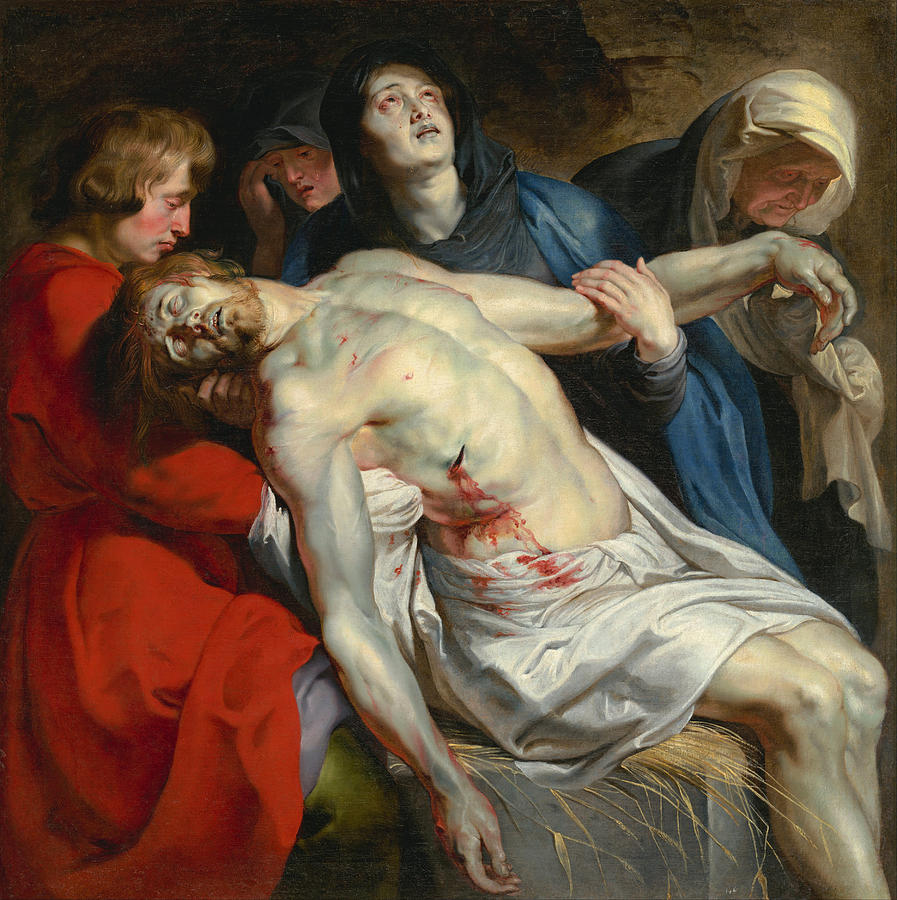
“The Entombment” by Peter Paul Rubens is one of the most intense and emotionally charged depictions of Christ’s death in Baroque art. The painting captures the heartbreaking moment when the lifeless body of Jesus is being prepared for the tomb. He is cradled and supported by those who loved him most: the Virgin Mary, Saint John, Mary Magdalene, and another grieving woman, often identified as Mary of Clopas.
Rubens does not show the actual burial or a distant, symbolic scene. Instead, he brings the viewer close to the physical weight of Christ’s body and the raw, unfiltered anguish of his followers. The composition is tight, the figures life-size, and the confrontation with death inescapable. At the same time, subtle hints of light, gesture, and color suggest that this moment of desolation is also the threshold of redemption.
Composition and Diagonal Drama
The first thing that strikes the eye is the powerful diagonal formed by Christ’s body. His pale torso stretches from the lower right corner up toward the upper left, cutting across the canvas like a bolt of lightning. The angle is steep and unstable, emphasizing the sense that his body is slipping, heavy and almost impossible for the mourners to support.
This diagonal is counterbalanced by the vertical presence of the Virgin Mary at the center. Her upright posture and dark cloak create a strong axis that stabilizes the composition, preventing it from collapsing under the weight of grief. To the left, Saint John in a brilliant red garment leans inward, curving his body in a way that echoes and supports the diagonal of Christ. To the right, an elderly woman bends over Christ’s arm, her posture mirroring the Virgin’s but with more weariness and age.
Rubens uses these intersecting lines to create a dynamic yet controlled arrangement. The viewer’s eye travels along Christ’s body, then up to the Virgin’s face, across to John, and back down around the figures in a continuous emotional circuit. The close cropping of the scene, with no wide landscape or architectural frame, intensifies the sense that we are right there beside the tomb, sharing the mourners’ struggle to bear both the physical body and the spiritual shock of his death.
The Figure of Christ: Vulnerability and Sublime Beauty
Christ’s body is rendered with exceptional care. His skin is luminous yet drained of life, its cool tones contrasted against the warm reds and browns of the surrounding figures. Rubens’s mastery of anatomy is evident in the subtle modeling of muscles and tendons, the slight slackness of the limbs, and the way the torso twists as if still echoing the agony of the crucifixion.
Wounds punctuate this serene yet tragic form: the gash in his side, nail marks in hands and feet, small streaks of blood along his arms and chest. These details are not exaggerated but clearly visible, reminding us that this is the same body that hung on the cross shortly before. The blood is bright against the pale skin, a stark visual reminder of sacrifice.
Christ’s head falls back, eyes closed, mouth slightly open. A trace of beard stubble and the crown of thorns resting in his hair emphasize his humanity. Yet the beauty of his features, calm even in death, hints at his divinity. Rubens walks a fine line between brutal realism and idealized serenity, making Christ’s body both an object of compassion and an icon of redemptive suffering.
The white shroud that covers his lower half is another masterpiece of painting. Its folds catch the light in crisp highlights and deep shadows, creating a swirling interplay of forms that leads the eye back up to his torso. The cloth serves both as burial linen and as a visual symbol of purity and resurrection.
The Virgin Mary: Center of Grief and Faith
At the center of the painting stands the Virgin Mary, wrapped in dark blue and black. Her face is tilted upward, eyes red and moist, mouth slightly open as if in a silent cry or prayer. Her hands, one supporting Christ’s arm and the other pressed against his chest, show the dual role she plays: loving mother and believer who clings to faith even in desolation.
Mary’s expression is extraordinarily complex. She is obviously devastated, yet there is also a sort of stunned composure in her gaze. She does not collapse or turn away; she looks toward heaven, as if searching for meaning or strength. Rubens thus presents her not only as a grieving mother but also as a model of steadfast faith.
Her large, dark cloak frames her pale face and hands, creating a stark contrast that draws attention to her emotions. The blue hints at her traditional iconographic color, while the black suggests mourning. By making Mary the vertical counterweight to Christ’s horizontal body, Rubens visually demonstrates that she is the anchor of the scene, the person who holds herself—and everyone else—together in this moment of despair.
Saint John and the Compassionate Youth
On the left side of the painting, Saint John supports Christ’s shoulders and head. He wears a flowing red garment that blazes like a flame against the otherwise muted palette. The red has multiple layers of meaning: it suggests love, sacrifice, and the future martyrdom that John will endure as a witness to Christ.
John’s face is close to Christ’s, his eyes lowered in sorrow. He appears younger than in many traditional depictions, with soft, almost boyish features. This youthfulness heightens the sense of vulnerability and emotional openness. His role here is that of the beloved disciple who remained at the foot of the cross and now tenderly helps lower Christ’s body.
The way John’s arms cradle Christ’s head recalls the imagery of a parent holding a child, reinforcing themes of intimacy and care. Yet his posture also shows strain; supporting the dead weight is physically demanding. Rubens makes the burden visible, reminding viewers that discipleship often involves difficult and painful acts of love.
The Other Women: Shared Sorrow across Generations
To the right of the Virgin Mary stands an elderly woman, her head wrapped in a pale veil. Her back bends under the strain of supporting Christ’s arm, and her face is etched with lines of age and grief. She may represent Mary of Clopas or another of the women who followed Jesus. Her presence introduces the perspective of age: someone who has endured many sorrows yet finds this one nearly unbearable.
Behind Mary and John, another woman emerges from the shadows, her eyes red, a hand pressed to her face as she weeps. Many identify her as Mary Magdalene, whose devotion to Christ is a recurring theme in Passion scenes. In contrast to the Virgin’s outward, prayerful grief, Magdalene’s sorrow is more inward and private. Her slightly obscured position suggests that she is almost overwhelmed by emotion, temporarily withdrawn into herself.
Together, these women form a chorus of mourning that spans generations and types of devotion. There is maternal love, faithful discipleship, penitential devotion, and the quiet endurance of age. Rubens uses their varied expressions and gestures to show that Christ’s death touches every kind of human heart.
Light, Shadow, and the Tomb’s Darkness
The lighting in “The Entombment” is both dramatic and carefully controlled. The primary light source seems to come from above and slightly to the left, illuminating Christ’s body and the faces of Mary and John. The light is cool and clear, accentuating pale skin and white fabric while casting deep shadows in folds of cloth and in the background.
The upper part of the painting is much darker, suggesting the interior of the tomb or the world sinking into darkness after Christ’s death. Within this gloom, the faces of the mourners emerge like small islands of light. The contrast between the luminous bodies and the murky surroundings heightens the emotional impact—the figures appear almost carved out of darkness, as if grief itself had solidified into human form.
This interplay of light and shadow carries symbolic resonance. The darkness stands for death, sin, and despair; the light falling on Christ and those who love him hints at the promise of resurrection and grace. The viewer senses that even in this bleak moment, divine light has not been extinguished. It clings tenaciously to the bodies and faces of believers.
Color and Emotional Resonance
Rubens’s color choices contribute significantly to the painting’s emotional tone. The cool, almost marble-like tones of Christ’s body contrast with the warm reds, browns, and blues of the surrounding figures. This difference separates him visually from the living while also making him the focal point of the composition.
John’s bright red garment acts as a visual magnet, drawing the eye immediately and then leading it along the curve of Christ’s body. The Virgin’s deep blue mantle provides a somber, stabilizing counterweight. The elderly woman’s pale veil and the muted tones of the background keep attention on the central group rather than on the setting.
Bloodstains scattered across Christ’s body and shroud supply sharp accents of red. These small but vivid patches echo John’s robe and link the sacrifice of the cross with the love of the disciple. They also punctuate the painting with reminders of physical suffering, preventing the viewer from drifting into purely aesthetic appreciation without confronting the brutal reality of crucifixion.
Texture, Flesh, and the Weight of the Body
One of Rubens’s great strengths is his ability to make flesh look palpable and weighty. In “The Entombment,” Christ’s body appears heavy, almost about to slip from the grasp of his supporters. The muscles of his arm hang slack; the abdomen sags slightly; the legs are limp. The mourners’ hands dig into his flesh, compressing it realistically, especially where the Virgin grips his arm.
The textured rendering of the shroud and clothing adds to this physical realism. The cloth appears thick and slightly rough, bunching under the pressure of hands and the weight of the body. Straw or coarse bedding beneath Christ’s legs is visible, reminding us that he is laid out not on a royal couch but on humble, scratchy materials associated with burial or a stable.
These tactile details ground the painting in bodily reality. The viewer can almost feel the cold weight of Christ’s body, the roughness of the cloth, the dampness of tears. Rubens thereby bridges the gap between spiritual contemplation and physical empathy.
Emotional and Spiritual Themes
Beyond its technical brilliance, “The Entombment” addresses profound spiritual themes. At its core is the mystery of Christ’s death—God entering into the full reality of human mortality. The painting insists on this reality: Christ is truly dead, his body lifeless and wounded. Yet the attitudes of the figures around him suggest that this is not the end.
The Virgin’s upward gaze, John’s tender support, the women’s devotion—all imply that they do not see his death as meaningless. Their grief is inseparable from faith. They honor his body, prepare it for burial, and hold onto him even as everything outwardly seems lost.
For viewers in Rubens’s time and today, the painting functions as a powerful aid to meditation on the Passion. It invites us not merely to observe but to participate emotionally, to take our place among the mourners. At the same time, it hints at the hope of resurrection: the light that clings to the figures, the purity of the shroud, and the quiet dignity of Christ’s face all suggest that this body will not remain in the tomb forever.
Baroque Devotion and Rubens’s Style
“The Entombment” exemplifies Baroque religious art at its most intense. Baroque spirituality emphasized affective devotion—stirring the heart through vivid images that made sacred events feel immediate and real. Rubens achieves this by compressing space, heightening emotion, and focusing on dramatic gestures.
His characteristic traits are all present: robust figures, swirling drapery, strong diagonals, and luminous flesh tones. Yet this painting is more restrained than some of his grand altarpieces. There are no angels overhead, no elaborate architectural settings. The drama is primarily emotional rather than theatrical.
This restraint allows the viewer to concentrate on the central mystery: the dead Christ and the love of those who hold him. Rubens’s artistry serves the devotional purpose, guiding the viewer’s gaze, touching the heart, and opening a space for contemplation of suffering and hope.
Conclusion
Peter Paul Rubens’s “The Entombment” is a deeply moving portrayal of Christ’s death, combining technical mastery with profound spiritual insight. Through a powerful diagonal composition, realistic depiction of the lifeless body, and nuanced expressions of grief, Rubens creates an image that is both heartbreaking and strangely beautiful.
The painting captures the moment when faith is tested to its limits—when hope seems buried, yet love continues to hold fast. The Virgin Mary, Saint John, Mary Magdalene, and the other woman embody different facets of human sorrow and devotion, inviting viewers to see their own reactions to suffering reflected in these faces.
Ultimately, “The Entombment” is not only about death but also about the love that persists in its shadow. The way Christ’s body is handled with reverence, the subtle glow of light amid darkness, and the compositional movement that lifts the eye from the tomb toward heaven all hint that this is not the final word. In this Baroque masterpiece, Rubens asks us to face the stark reality of the cross while also sensing the first quiet stirrings of resurrection.