Image source: wikiart.org
Overview of Young Woman with Curly Hair
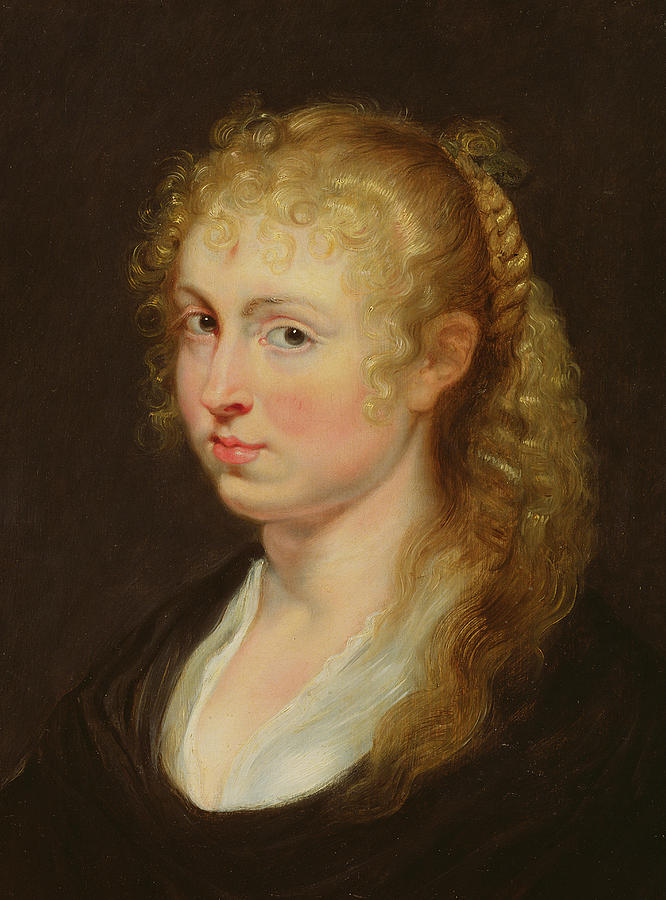
“Young Woman with Curly Hair” by Peter Paul Rubens is an intimate, half-length portrait that quietly radiates presence and personality. The sitter turns slightly to her left, shoulders angled away from us while her face pivots back toward the viewer. Her pale complexion glows against a dark, plain background; a cascade of golden curls frames her cheeks and falls down over a simple black dress and white chemise.
Unlike Rubens’s grand mythologies or crowded altarpieces, this painting strips everything back to a single figure. There are no symbolic attributes, no architectural setting, no elaborate jewelry—only a young woman, caught at a particular moment in her life, with a gaze that is at once shy, alert, and slightly appraising. The result is a portrait that feels surprisingly modern: psychologically nuanced, understated in its elegance, and focused on the individuality of the sitter rather than on status display.
Composition and Pose
Rubens composes the portrait using a classic three-quarter pose. The woman’s torso is turned at an angle, creating a gentle diagonal from her left shoulder down to the opposite side of the canvas, while her head turns back toward us. This twist in the body generates a sense of movement and keeps the composition from feeling static.
The sitter’s face is positioned slightly off-center, leaning toward the left side of the painting. This asymmetry gives the portrait a natural, conversational quality—almost as if we’ve just addressed her and she has turned mid-conversation to acknowledge our presence. Her shoulders are relaxed, not rigid; the fall of fabric around her chest and neck hints at a breathing, living body beneath the clothes.
Rubens crops the figure tightly, just below the bust. This close framing strengthens the connection between sitter and viewer. There is no table to rest her hands on, no chair back, no decorative objects to distance us. Instead, the painting becomes all about the face: its proportions, coloring, and expression.
Light, Color, and Atmosphere
Light in this portrait is soft but focused. It seems to fall from the left, illuminating the woman’s forehead, nose, and cheek while leaving the far side of her face and the background in deeper shadow. This directional light models her features gently, carving out the curve of her cheekbones and the subtle hollow under the jaw.
Her skin is painted with Rubens’s typical mastery of flesh tones—warm pinks and cool peaches layered to create a translucent effect. The flush in her cheeks and the slight redness of the lips suggest youth and vitality, while more neutral tones around the eyes and nose balance the color, preventing it from becoming saccharine.
The dark background is not pure black but a deep brownish tone, built with transparent layers. This warmth keeps the painting from feeling harsh or stark. It also enhances the luminosity of the face, which seems to glow forward from the surrounding darkness. The contrast between light skin and dark setting is a time-tested portrait device, but here it’s handled with particular subtlety, aligning with Rubens’s preference for rich, atmospheric shadows rather than flat, graphic contrast.
The Marvel of Curly Hair
The title draws attention to the sitter’s hair, and Rubens clearly enjoyed painting it. A halo of tight, delicate curls surrounds her forehead, each ringlet picked out with fine touches of light. These curls gradually loosen as they travel down the sides of her face, merging into longer, wavier strands that tumble over her shoulders.
On the right side of her head, the hair is pulled back and woven into a thicker, rope-like braid that falls down her back. This braid adds an element of structure and formality to an otherwise soft, cloud-like mass of hair. It also introduces a pleasing rhythm: tiny curls at the hairline, broader waves mid-length, and then the strong, solid curve of the braid.
Rubens renders the hair with fluid, confident strokes—short, curved lines for curls, broader sweeps for the braid. Light catches individual locks, creating sparkling highlights that echo the light on her forehead and the bridge of her nose. The golden tone of her hair, combined with its lively texture, is a major visual focus of the painting. It frames and amplifies the delicacy of her facial features, acting almost like a natural ornament.
Expression and Psychological Presence
What gives this portrait its particular charm is the expression on the young woman’s face. Her lips are gently pursed, her mouth neither smiling nor frowning. Her eyes, slightly turned toward the viewer, hold a steady but not entirely open gaze. There is a hint of reserve, perhaps even a touch of skepticism, as though she is aware of being observed and is still deciding what she thinks of us.
This ambivalence creates psychological depth. We are not looking at a generic “pretty face,” but at someone with an interior life—opinions, moods, and memories. Rubens often managed to combine flattering likeness with psychological observation, and this portrait is a good example of that balance. The sitter is clearly idealized—her skin is flawless, her features harmonious—but there is also something individual and recognizable about her look.
The eyes are particularly carefully treated. Rubens places tiny, precise highlights on the pupils, giving them a moist, reflective quality. Slight shadows under the lower lids add roundness and suggest the softness of youthful skin. The brows are light and thin, matching the hair color and giving the upper face an almost translucent delicacy.
Costume and Social Identity
Though the clothing is simple, it offers clues about the sitter’s status. She wears a dark, almost black robe or mantle that wraps around her shoulders, over a white undergarment or chemise visible at the neckline. The combination of black and white is sober and refined, often associated with middle-to-upper-class modesty rather than ostentatious wealth.
There is no jewelry visible—no necklace, earrings, or brooches. This absence can be read in several ways. It might emphasize the sitter’s youth, suggesting she has not yet entered fully into adult social display. It may also reflect a desire to focus the portrait on natural beauty and character rather than on material adornment.
The modest neckline and understated costume, paired with the emphasis on hair and complexion, align with Rubens’s portrait practice when depicting women from his own circle—wives, relatives, friends of the family—rather than formal, courtly commissions. The painting feels private, almost like a cherished image meant for a domestic interior rather than a public gallery.
Background and Focus
The dark, undifferentiated background does more than simply set off the figure. It creates a sense of quiet, contemplative space. With no visible window, curtain, or landscape, the viewer is not distracted by context or narrative. The young woman exists in a kind of timeless, neutral zone where personality and physical presence take center stage.
This type of background also allows Rubens to experiment with subtle optical effects. The edges of the sitter’s shoulders and hair slightly blend into the surrounding darkness, softening the transition between figure and ground. This soft focus enhances the illusion of depth: the face, brightly lit and crisply detailed, comes forward, while the clothing and outer curls recede gently into shadow.
By controlling sharpness and blur in this way, Rubens guides the viewer’s attention with great precision. Our eyes naturally gravitate to the areas where detail and light are strongest—the eyes, lips, and central curls—before wandering outward to take in the garment and the fading edges of hair.
Rubens’s Portrait Style and Possible Identity of the Sitter
Rubens was famed not only for religious and mythological scenes but also for portraiture. His portraits often combine dignity with warmth, capturing sitters in relaxed yet respectful poses. “Young Woman with Curly Hair” fits neatly into this tradition.
Some art historians have speculated that the sitter might be connected to Rubens’s family or social circle, perhaps even one of his relatives or acquaintances. While specific identification is uncertain, the painting’s intimacy supports the idea that it was not a distant official commission. The lack of heraldic symbols, elaborate costume, or explicit iconography suggests a more personal purpose—maybe a marriage prospect portrait, a family keepsake, or an image celebrating a young woman at the cusp of adulthood.
Regardless of her exact identity, Rubens treats her with the same seriousness and care he brought to portraits of nobles and monarchs. Her individuality matters; her presence commands the picture. This democratic respect for the sitter’s humanity is part of what makes Rubens’s portraits feel so alive to modern viewers.
Technique: Brushwork, Layering, and Luminous Flesh
From a technical standpoint, the painting showcases Rubens’s mastery of oil paint as a medium. The flesh is built up through layered glazes and semi-opaque strokes, allowing underlying tones to glow through. This layered approach creates depth in the skin: faint hints of blue-green around the eyes and jaw give a sense of blood beneath the surface, while warmer tones on the cheeks and nose suggest circulation and warmth.
The garment, by contrast, is more broadly handled. In the dark robe, brushstrokes are visible, with thicker paint indicating folds and highlights. Here Rubens is less interested in precise textile description and more in using the fabric as a framing device for the head.
The hair demonstrates a blend of careful detail and painterly freedom. Individual curls are indicated with fine lines, but many strands dissolve into looser, more suggestive strokes. This combination keeps the hair lively and prevents it from looking stiff or overly decorative.
Emotional Tone and Viewer Engagement
The emotional tone of “Young Woman with Curly Hair” is subtle, poised somewhere between reserve and approachability. The sitter does not smile; yet she is not cold. Her expression suggests introspection, perhaps a hint of curiosity about the viewer standing before her image.
Because Rubens keeps her hands and body mostly out of view, all emotional communication happens through face and head. This intensifies the viewer’s experience of eye contact, even though her gaze is shifted slightly aside rather than directly confronting us. We feel almost as though we’ve interrupted her thoughts.
That sense of interruption, of catching someone in an unguarded moment, gives the portrait its enduring fascination. Every time one looks, the expression appears slightly different—sometimes more skeptical, sometimes more amused, sometimes more melancholy. Rubens has crafted an image that remains open, resisting a single, fixed interpretation.
Place in Rubens’s Oeuvre and Lasting Appeal
Within Rubens’s body of work, “Young Woman with Curly Hair” represents the quieter, more personal side of his art. It lacks the theatrical lighting and complex multi-figure compositions of his grand canvases, but it shares the same love of life, color, and human presence.
The painting appeals today because it feels remarkably fresh. The sitter’s hairstyle may be seventeenth-century, but her slightly guarded look and natural complexion could belong to a contemporary photograph. There is no rigid idealization, no impossible perfection; instead, there is believable youthfulness and the sense that this is a real person we might have known.
As a study of portraiture, the work demonstrates how much can be achieved with limited means: a dark background, a simple dress, a single source of light, and the attentive observation of one human face. Rubens turns these modest elements into a quietly captivating picture that invites slow looking and repeated visits.
