Image source: wikiart.org
Overview of The Abduction of Ganymede
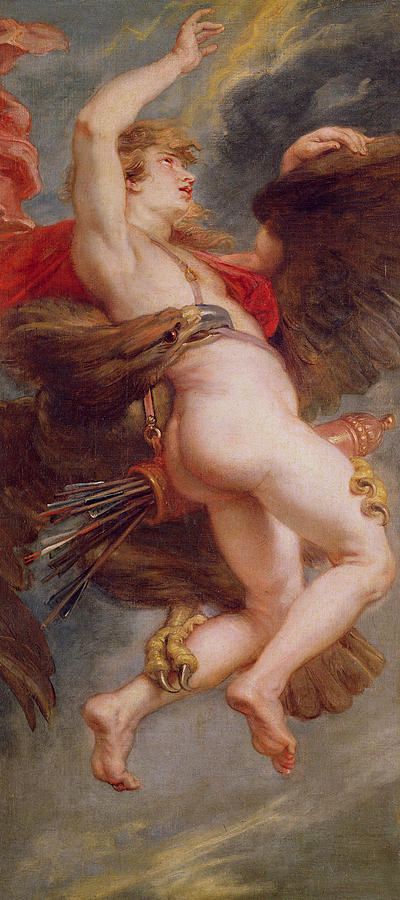
Peter Paul Rubens’s painting “The Abduction of Ganymede” presents one of antiquity’s most poetic and unsettling myths as a whirlwind of motion, flesh, and feathers. A nude youth is swept upward through a turbulent sky, seized by the talons and wings of a massive eagle. The boy’s body twists in a graceful arc, one arm flung above his head, the other bent protectively towards his torso. His mouth is parted, his golden hair tossed by the wind, and a red cloak billows behind him like a banner.
This is Ganymede, the beautiful Trojan prince carried off by Zeus, who has taken the form of an eagle. In classical mythology, Ganymede will become cupbearer to the gods and beloved of the king of Olympus. Rubens captures the instant when earth and heaven collide—when mortal beauty is violently yet seductively claimed by divine desire. The painting is both sensual and dramatic, a testament to Rubens’s ability to fuse storytelling with the Baroque fascination for dynamic movement and expressive anatomy.
Mythological Background and Narrative
The story of Ganymede appears in various ancient authors, including Homer, Ovid, and later Roman poets. Unanimous is the recognition of the boy’s extraordinary beauty, which captivates Zeus. In some versions, the god sends an eagle to seize the prince; in others, Zeus himself becomes the eagle and personally carries Ganymede to Olympus. There the boy is granted immortality, serves wine at the gods’ banquets, and becomes a symbol of divine favor and homoerotic love.
Rubens’s painting clearly embraces the version in which Zeus personally takes eagle form. The bird is not a separate creature but a manifestation of overwhelming divine power. Its talons clutch Ganymede’s thigh and hip, its wings envelop his torso, while its beak and fierce eye point toward the direction of ascent. The youth already carries a quiver and bow, hinting that he may have been interrupted mid-hunt—a reference to his princely role and perhaps a subtle analogy with Eros, another beautiful youth associated with arrows and desire.
The abduction is ambiguous in tone. On the one hand, Ganymede is being forcibly carried away from his homeland; his body is exposed and vulnerable. On the other hand, the myth assures that he is elevated into the realm of the gods, gaining a unique place at Zeus’s side. Rubens’s composition reflects this tension, blending fear, astonishment, and a strange kind of rapturous elevation.
Composition and Vertiginous Movement
One of the most striking features of “The Abduction of Ganymede” is its tall, narrow format. Rubens uses this vertical orientation to heighten the sense of upward motion. The entire composition spirals from the lower right, where the eagle’s claws grasp Ganymede’s leg, up toward the upper left, where the youth’s raised hand reaches into swirling clouds and light.
Ganymede’s body forms a sweeping diagonal, his torso arched and his legs trailing behind. This diagonal is countered by the powerful curves of the eagle’s wings and tail feathers, creating a complex network of arcs that suggest continual motion. There is no stable ground; everything in the painting participates in the ascent. Even the folds of Ganymede’s red cloak stream backward in response to the rapid flight, reinforcing the sensation of speed.
The placement of the figures within the narrow frame further intensifies the drama. Ganymede’s head and upper arm press toward the top edge, as if the composition cannot quite contain the soaring movement. The viewer feels the claustrophobic thrill of being close to the action, almost brushing against the youth’s outstretched hand as he rushes skyward. This spatial compression is a classic Baroque strategy, designed to pull the spectator into the scene emotionally and physically.
The Figure of Ganymede: Beauty, Vulnerability, and Ambiguity
Rubens renders Ganymede with the idealized yet robust anatomy characteristic of his male figures. The youth is neither a fragile boy nor a fully mature man; he inhabits a liminal stage of adolescence, with smooth skin, rounded muscles, and a slightly elongated torso. His pose is complex: the spine twists, the ribcage opens, legs bend at different angles, and toes flex in midair. This intricate choreography showcases Rubens’s mastery of the human body in motion.
Emotionally, Ganymede’s expression is elusive. His head turns slightly upward, lips parted, eyes directed toward something beyond the edge of the painting. There is no clear scream of terror, yet neither is there simple serenity. The parted mouth and wide eyes can suggest alarm, gasping at the speed of ascent, or the beginnings of a trance-like acceptance of divine contact. This ambiguity invites multiple readings—fearful victim, astonished captive, or youth on the verge of ecstatic transformation.
The nudity of Ganymede is central to the painting’s meaning. It expresses his vulnerability, the fact that he is stripped of earthly protection and defenses. At the same time, it displays the beauty that attracted Zeus in the first place. Rubens does not shy away from the sensuality of the body but balances it with a sense of buoyant grace. The youth’s exposed back and buttocks are framed by the eagle’s wings, creating a visual tension between flesh and feathers, desire and danger.
The small details of Ganymede’s accessories further enrich his characterization. The quiver full of arrows at his hip speaks of his princely, hunting identity; he is not a passive figure from the outset but an active youth seized in the midst of his own pursuits. The golden strap of the quiver cutting across his torso adds a decorative flourish and a diagonal counter-line, underscoring his physical motion.
Zeus as Eagle: Power, Possession, and Protection
The eagle in Rubens’s painting is not a mere bird of prey; it is the embodiment of Zeus’s power. The massive wings engulf the composition, their dark feathers contrasting sharply with the luminous flesh of Ganymede. The beak and eyes are sharply defined, radiating intelligence rather than mere animal instinct.
The way the eagle grasps Ganymede reveals the dual nature of the abduction. One talon clasps the thigh with undeniable force, indenting the skin and signaling the inescapability of divine will. Yet the wings also cradle the youth, curling around his torso as if to shield him from the roaring wind. This mixture of aggression and protection mirrors the myth’s complex portrayal of Zeus’s love: it is both possessive and elevating, domineering yet ultimately granting immortality.
Rubens emphasizes the physical connection between god and youth. Feathers brush against skin, the curve of the eagle’s neck mirrors the arc of Ganymede’s chest, and the bird’s body seems almost to fuse with the cloak behind the boy. The close interlocking of forms suggests that from now on, Ganymede’s identity will be inseparable from Zeus’s will.
Color and Light: The Drama of the Sky
Color plays a crucial role in establishing the mood of “The Abduction of Ganymede.” The background is dominated by swirling grays and blues, evoking a sky in tumult. These cool tones set off the warm colors of Ganymede’s flesh and the eagle’s dark umber feathers.
The most striking accent is the red cloak that billows behind the youth. Its rich, saturated hue both dramatizes the scene and functions symbolically. Red can suggest passion, danger, or royal status; here it hints at the intense desire motivating Zeus’s act and the exalted destiny awaiting Ganymede on Olympus. The cloak also acts as a visual bridge between the boy and the eagle, its fabric flowing into and around the bird’s body.
Light falls selectively on Ganymede, making his body almost glow against the darker surroundings. This spotlight effect suggests that he is the chosen object of divine attention. The eagle, though partially lit, remains somewhat in shadow, reinforcing its role as an instrument of a power beyond human understanding. Subtle highlights glint on the golden quiver and the strap, adding touches of luxury that signal the boy’s princely origin and future status among the gods.
The interplay of light and stormy sky also mirrors the psychological turbulence of the moment. We sense both the awe of a divine encounter and the instability of being uprooted from the earth. Rubens turns the sky into an emotional landscape, one that vibrates with the tension between fear and exaltation.
Baroque Dynamism and the Sensation of Flight
Rubens was a master of Baroque movement, and “The Abduction of Ganymede” is a textbook example of his ability to convey physical energy. Everything in the painting contributes to the sensation of flight. The clouds rush past, the cloak whips in the wind, the limbs stretch and flex, and the eagle’s wings beat with visible force.
The artist achieves this dynamism partly through the use of contrapposto and twisting forms. Ganymede’s body rotates along its axis, so that the viewer sees both his back and chest in partial view. The eagle’s wings also twist, one thrust forward, the other back, creating a spiraling motion that propels the figures upward. This serpentine arrangement—often described as the figura serpentinata—was a favorite of Mannerist and Baroque artists seeking to represent motion and tension in static media.
Furthermore, Rubens positions Ganymede at a slight diagonal that goes against gravity. Instead of hanging downward from the eagle’s claws, the youth appears to rise with the bird, his own limbs actively participating in the ascent. The raised arm suggests he is reaching for something ahead, turning the abduction into a kind of reluctant but real acceptance of the new direction.
Sensuality, Gender, and the Baroque Gaze
The myth of Ganymede has long been associated with homoerotic themes, and Rubens’s painting does not neutralize this aspect. The sensual modeling of the youth’s body, the careful attention to curves and skin tones, and the intimacy of his contact with the eagle all underscore the theme of male beauty desired by a powerful male deity.
For a seventeenth-century audience, this could serve several functions. On one level, it offered a respectable mythological framework for admiring the male nude. On another, it reflected complex attitudes toward desire, power, and hierarchy. Zeus’s attraction to Ganymede is not presented as a moral failing but as a sign of the boy’s exceptional loveliness; yet the imbalance of power between god and mortal also raises questions about autonomy and consent.
Rubens navigates these tensions by emphasizing the aesthetic and heroic aspects of the scene rather than dwelling on its more problematic implications. The youth is idealized, the eagle majestic, the entire composition animated by a sense of epic grandeur. The painting thus participates in Baroque culture’s fascination with passionate, overwhelming experiences, whether of love, faith, or mythic drama.
Allegorical and Political Readings
Beyond its mythological narrative, “The Abduction of Ganymede” could carry allegorical meanings for Rubens’s patrons. Ganymede sometimes symbolized the soul carried to heaven by divine love, or the human intellect elevated by Jupiter’s wisdom. In such interpretations, the physical abduction becomes an image of spiritual ascent, with the eagle representing nobility and transcendence.
In a political context, the myth could also be adapted to flatter rulers. Just as Zeus chooses Ganymede from among mortals, a sovereign might be seen as selecting worthy favorites or advisors. The elevation of a young man to the divine court could mirror the advancement of a loyal noble to high office. Rubens, who often worked for princely patrons and blended mythological subjects with courtly symbolism, was well positioned to exploit such resonances.
Whether or not a specific allegory was intended in this painting, the combination of beauty, power, and upward motion lends itself naturally to readings about elevation—social, spiritual, or emotional. Ganymede’s ascent can thus stand for various forms of transformation under the influence of a superior force.
Technique and Painterly Bravura
Rubens’s technique in “The Abduction of Ganymede” reveals his confidence with oil paint. The flesh is modeled with subtle transitions, using warm underpainting and translucent glazes to achieve a glowing effect. Feathers and fabrics, by contrast, are rendered with more vigorous, visible brushstrokes, which give them a sense of texture and movement.
The narrow format requires careful control of composition, and Rubens manages space masterfully. He keeps the focus tight, avoiding extraneous details. There is no landscape or architectural backdrop; only sky and cloud frame the figures. This economy of setting allows him to pour all his energy into the interplay of bodies, feathers, and drapery.
Close viewing would reveal small adjustments and reworked areas where the artist refined the contours or adjusted the position of limbs for maximum impact. Such pentimenti testify to the dynamic process behind the finished product, reflecting Rubens’s constant search for the most expressive arrangement.
Emotional and Aesthetic Impact
The enduring appeal of “The Abduction of Ganymede” lies in its combination of narrative richness, formal elegance, and emotional complexity. Viewers feel the vertigo of the ascent, sense the softness of the youth’s body and the roughness of the eagle’s talons, and are drawn into the ambiguous expression on Ganymede’s face. The painting does not offer a simple emotional script; it leaves room for awe, sympathy, admiration, and unease.
Aesthetically, the work showcases the Baroque delight in the male nude, in swirling motion, and in powerful diagonals that break the boundaries of the frame. At the same time, it invites reflection on the nature of desire and the price of being singled out by overwhelming power. Ganymede gains immortality but loses his earthly life; he is both exalted and taken.
Rubens’s canvas thus captures a moment of radical transition. The youth is suspended between worlds, between fear and fascination, between the ground he has left and the Olympus he has not yet reached. The viewer, likewise, is suspended between admiration for the painting’s beauty and awareness of the myth’s inherent tension. This unresolved quality gives the work its lasting vitality.
