Image source: wikiart.org
Introduction
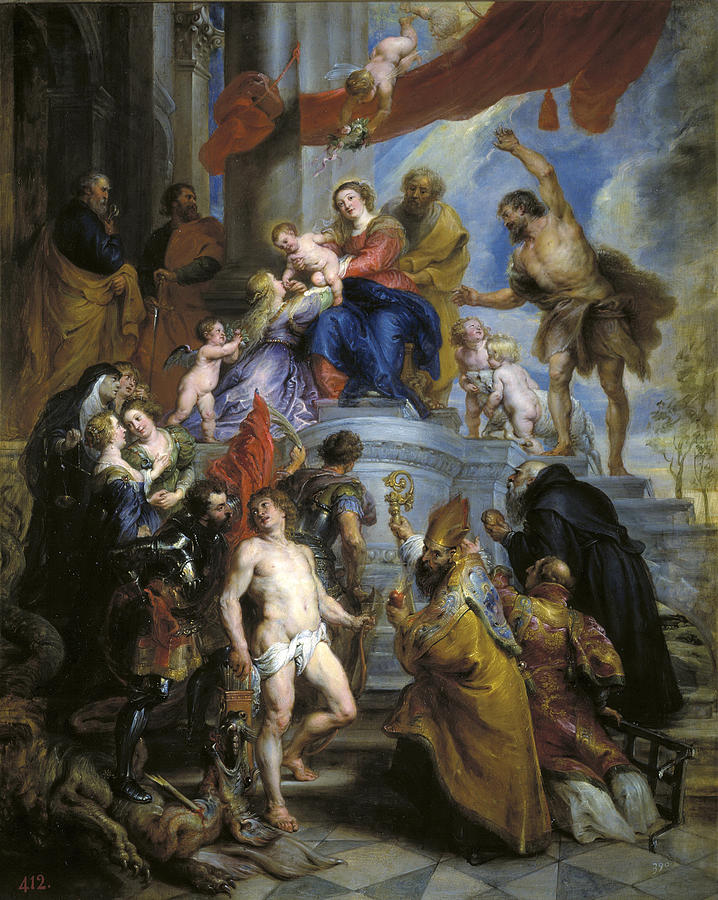
“Holy Family with Saints” by Peter Paul Rubens is a sweeping Baroque vision of the Church gathered around Christ. At the center of the painting, the Virgin Mary sits enthroned with the Christ Child on her lap, surrounded by Joseph, John the Baptist, and playful putti. Below, an animated crowd of saints, soldiers, bishops, and supplicants climb toward the pedestal, each bringing their own story of faith and sacrifice. Rubens fuses all these figures into a single, upward-driving composition that celebrates the power of Christ to unite different vocations, eras, and personalities into one redeemed community.
The painting reads like a visual litany: martyr, bishop, hermit, knight, noblewoman, child. Each figure recognizes in the Child the source of their holiness, and each is drawn toward him in a fervent, almost theatrical movement. Yet amid the swirling forms and rich color, the message remains clear: Christ, in the arms of his Mother, is the radiant heart of history and devotion.
Overall Composition and Two-Tiered Structure
Rubens organizes the scene in two main zones. The upper level presents the Holy Family in a more stable, pyramidal configuration. Mary, robed in red and blue, sits on a high stone base, gently supporting the lively Child as he stretches toward those below. Joseph stands behind her, calm and contemplative, while to the right the rough figure of John the Baptist points emphatically toward Christ. Around them flutter small angels and putti, some holding drapery that billows like a crimson canopy, others simply rejoicing.
The lower level is far more tumultuous. A crowd of saints and worshippers converges on the base of the pedestal from all directions. Some climb the steps, others kneel or stand on the tiled floor. Their gestures radiate outward in arcs and diagonals, creating a swirling motion that contrasts with the relative repose of the figures above. This two-tiered structure evokes a theological idea: the serene, eternal reality of the Holy Family and the restless, earthly pilgrimage of the Church.
Architectural elements reinforce the hierarchy. Massive columns and a curving stone platform elevate Mary and Child, suggesting a sacred altar or throne. At the same time, the steps and ledges provide footholds for the saints below, literally giving them a path upward. Rubens thus turns the architecture into both a symbol of transcendence and a bridge between heaven and earth.
The Holy Family and the Baptist
At the compositional and theological center sits the Virgin Mary. Her blue mantle and red gown identify her instantly as the Mother of God. She appears both queenly and approachable, her body slightly turned, her gaze directed downward toward the worshippers. She holds the Child not rigidly but with the relaxed confidence of a loving mother. Christ, plump and energetic, leans outward, one arm extended in blessing or curiosity. This outward movement implies that his mission is not to remain hidden but to go toward humanity.
Behind Mary stands Joseph, older and more reserved. His presence grounds the scene in the reality of a family, reminding viewers that the Incarnation took place within the ordinary rhythms of domestic life. Yet his position slightly behind and above also suggests a protective guardianship.
On Mary’s right, John the Baptist appears in his familiar guise: wild hair, simple garment of animal skin, muscular body, and intense expression. His raised arm and pointing hand direct attention unmistakably to Christ, fulfilling his biblical role as the forerunner who proclaims, “Behold the Lamb of God.” The Baptist’s vigorous gesture adds a dramatic diagonal to the upper group, injecting prophetic urgency into the otherwise tender domestic cluster.
Putti and small angels inhabit the space around the Holy Family. Their playful energy softens the solemnity of the architecture and indicates that heaven rejoices in this moment of human-divine encounter. The red drapery they hold aloft functions almost like a stage curtain, emphasizing that what happens here is both sacred ritual and divine drama.
Saints Below: The Church Militant
On the lower level, Rubens presents a cross-section of the Church Militant—the community of believers on earth, especially those renowned for heroism and holiness. Each saint brings a different attribute and story, yet all are oriented toward the Child.
At the center of this earthly group stands a nearly naked young man, his body muscular yet vulnerable, his hands bound or held as if he has just been freed. This figure likely represents Saint Sebastian, the Roman martyr traditionally shown stripped and pierced with arrows. In Rubens’s version, the physical wounds are minimal or implied, but the sense of worn yet resilient flesh communicates his martyrdom. Sebastian turns his head upward, his face filled with gratitude and awe, recognizing in Christ the source of his strength.
To his left, a knight in gleaming armor tramples a defeated dragon. This figure may be Saint George or Saint Michael, both known for defeating monstrous embodiments of evil. His polished breastplate and richly decorated garments catch the light, contrasting with Sebastian’s bare torso. Together they symbolize two forms of Christian courage: the soldier who combats external enemies and the martyr who endures persecution.
At the right foreground, richly robed bishops and churchmen kneel and stand in reverence. One, wearing a golden mitre and a magnificent cope, lifts his eyes and gestures toward the altar, as if presenting his office and teaching authority to the Child. Another bishop or abbot in darker habit bows more modestly, his hands joined in prayer. Their vestments, embroidered with gold and bright color, echo the splendor of liturgical worship and the institutional continuity of the Church.
Behind these central figures, additional saints and donors cluster: an older monk in black, perhaps representing a monastic order; elegant women with elaborate hairstyles and gowns; and, further back, more ordinary figures observing the scene. Rubens does not sharply separate historical saints from contemporary-looking worshippers, suggesting that sanctity can emerge from any time or station.
Gesture, Emotion, and Interconnection
What makes this multi-figure composition work is Rubens’s mastery of gesture and emotional connection. No figure stands isolated; glances, hands, and body movements link everyone in a complex web of relationships.
The line of sight travels from the worshippers upward to Mary and Christ, then back down through John the Baptist’s emphatic pointing. Sebastian’s upward turn echoes the direction of the Baptist’s gesture, visually reinforcing the idea that martyrdom finds meaning in Christ. The armored saint, though engaged with the vanquished dragon, also inclines his head toward the Child, acknowledging a higher source of his victory.
Mothers and children on the left side of the lower tier repeat on a smaller scale the tenderness of the Holy Family above. A woman lifts her child upward as if offering him to Mary, while another gently guides a toddler’s gaze. These familial interactions create a chain of affection that runs from ordinary human love to the divine love embodied in the Christ Child.
Even the bishops’ gestures are surprisingly dynamic. One extends his arm with a crozier, drawing a diagonal line that leads the eye to the base of the Virgin’s throne. Another’s folded hands and bowed head introduce a quieter note of contemplative reverence. Together, these varied gestures animate the scene without detracting from its central focus.
Light, Color, and Baroque Drama
Rubens’s color palette in “Holy Family with Saints” is rich and varied, filled with deep reds, royal blues, glinting golds, and warm flesh tones. Mary’s blue mantle and red dress form a chromatic anchor for the entire painting, with these hues echoed in smaller accents across the canvas: in banners, garments, and reflections on armor. This repetition creates unity amid complexity.
Light plays a crucial narrative role. A soft yet focused illumination bathes the Holy Family, making them the brightest area of the painting. The saints below are lit more selectively: Sebastian’s pale torso gleams against darker surroundings, emphasizing his martyrdom; the shiny armor of the knight catches sharp highlights, signaling his martial status; gilded vestments of bishops shimmer with a warm glow that suggests sacred splendor. The more shadowed corners hold figures whose roles are supportive rather than central, preserving depth while keeping attention on the main drama.
The sky visible behind the upper figures is bright but streaked with cloud, suggesting a realm at once natural and heavenly. The interplay of light and shadow across the entire composition embodies the Baroque love for theatrical illumination, but here it serves a clear theological purpose: grace shines into the world through Christ, and those who reflect that light—martyrs, bishops, faithful families—glow with secondary radiance.
Symbolism of the Dragon and Other Attributes
At the foot of the armored saint lies a writhing dragon or monstrous creature, partially hidden by the knight’s feet and cloak. Its presence introduces a powerful symbol of evil conquered. Whether the figure represents Saint George, Saint Michael, or a generalized Christian warrior, the message is the same: through faith and divine assistance, the forces that threaten humanity can be defeated. The dragon’s subdued position at the very bottom of the painting contrasts with the upward movement of the saints, suggesting that evil belongs to the realm of the trampled and overcome.
Other attributes are more subtle. The croziers and mitres of the bishops stand for pastoral authority and teaching office. The humble garments of John the Baptist and some monks signal penitence and simplicity. The tender children around the base echo the innocence of the Christ Child and may allude to the Church’s future generations. These visual cues help viewers identify the types of holiness represented without requiring explicit labels.
Architectural Space and Liturgical Overtones
The grand architectural setting resembles a monumental church interior with towering columns, broad steps, and a patterned marble floor. This setting situates the entire event within a quasi-liturgical framework. The high base on which Mary sits functions almost like an altar, and the multitude of saints approaching it resemble a procession, bringing their gifts of martyrdom, governance, and prayer.
The mixture of classical and ecclesiastical architectural elements reflects Baroque Catholicism’s claim to embody both the wisdom of antiquity and the living continuity of the Church. Rubens’s columns, balustrades, and sweeping staircases give the scene a sense of timeless grandeur. At the same time, the architecture provides practical compositional advantages: it allows for overlapping planes, varied vantage points, and a strong vertical axis that leads the eye inexorably upward toward the Holy Family.
Spiritual Message and Devotional Function
Beyond its visual impressiveness, “Holy Family with Saints” communicates a clear spiritual message. The painting proclaims that every form of Christian vocation—martyr, knight, bishop, hermit, mother, child—finds its meaning in relationship to Christ. The saints do not overshadow the Holy Family; they gather around it, receive from it, and direct others toward it.
For viewers in a church or chapel, this image would have served as a kind of mirror and invitation. They could recognize in the saints both models and intercessors, seeing their own struggles reflected in Sebastian’s wounds, the knight’s battles, the bishop’s responsibility, or the mother’s care for her children. The painting encourages them to approach Christ with their own lives as offerings, just as these saints do.
At the same time, the composition evokes the communal nature of the Church. No one approaches the Holy Family alone; everyone is part of a larger procession of believers. The painting thus strengthens a sense of belonging and shared pilgrimage.
Rubens’s Artistic Vision
This work showcases Rubens at the height of his powers as a painter of complex religious scenes. He masterfully integrates robust human anatomy, luxurious fabrics, lively putti, and grand architecture into a coherent narrative. His figures are dramatically posed yet psychologically convincing, their emotions readable despite the painting’s density.
Rubens’s vision of sanctity is thoroughly incarnational. Holiness is not ethereal but embodied in strong, flesh-and-blood people who struggle, fight, suffer, and rejoice. The generous depiction of muscular bodies and vivid faces underscores the belief that grace elevates nature rather than negating it. Beauty and vitality are not distractions from the divine; they are signs of it.
In “Holy Family with Saints,” Rubens manages to combine pageantry and intimacy, doctrine and emotion, in a single, compelling image. The result is a work that continues to captivate viewers, inviting them to join the throng of saints who turn their eyes toward the Child at the center of history.
