Image source: wikiart.org
Introduction
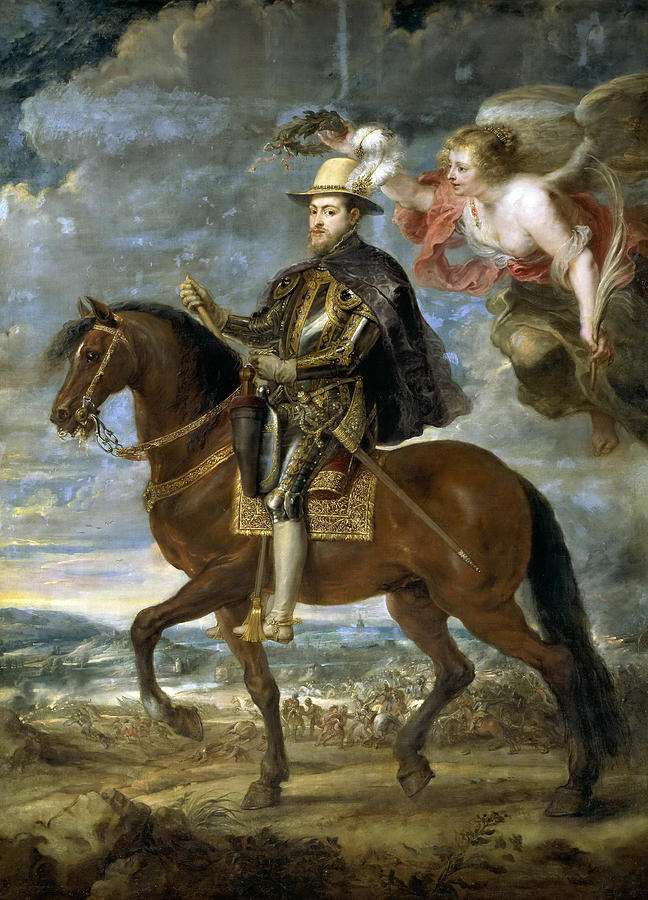
“Philip II on Horseback” by Peter Paul Rubens is a grand equestrian portrait that fuses political propaganda, military pageantry, and Baroque theatricality into one commanding image. The Spanish king rides a powerful chestnut horse across a battlefield, clad in gleaming armor and framed by an expansive, stormy sky. Beside him, an airborne female figure—an allegory of Victory or Fame—leans forward to crown him with a laurel wreath, symbolizing triumph sanctioned by the heavens. Below, the chaos of war churns, but above, Philip appears calm, collected, and unshakably regal.
This painting is not a neutral likeness; it is a visual manifesto presenting Philip II as a victorious, divinely favored ruler. Rubens uses the formula of the equestrian portrait—already associated with Roman emperors and Renaissance princes—and heightens it with dynamic movement, luminous color, and mythological symbolism. The result is an image designed to impress, persuade, and glorify, projecting an idealized vision of kingship that transcends mere historical fact.
Historical and Political Context
Philip II, king of Spain and ruler of a vast global empire, was a central figure of the sixteenth century. His reign saw both great victories and serious challenges: expansion in the Americas, conflict with the Ottoman Empire, the Dutch Revolt, and the famous confrontation with England. Even after his death, his image remained potent in the Habsburg dynastic imagination.
Rubens, working in the early seventeenth century, was deeply engaged with Habsburg patrons, especially in the Spanish Netherlands. He produced cycles of paintings celebrating their history, dynastic alliances, and military achievements. “Philip II on Horseback” should be understood within this context of political image-making. The painting does not depict a specific battle so much as a generalized idea of victorious campaign. It is a posthumous homage that turns the controversial, often embattled king into an almost timeless icon of Catholic monarchy.
Through this image, Rubens contributes to the broader project of Habsburg self-representation. The king is shown not in old age, but in an idealized, vigorous prime; his authority is reinforced by the celestial presence of Victory and by the disciplined armies below. The painting asserts that Philip’s rule, whatever its earthly complexities, is ultimately affirmed by divine will and military success.
Composition and Spatial Structure
The composition is dominated by the diagonally striding horse and the upright figure of Philip. The animal moves from left to right across the foreground, its raised foreleg and elongated neck creating an elegant, arcing silhouette against the landscape. Philip sits squarely in the saddle, slightly turned toward the viewer, his full armor and cloak catching the light.
To the upper right, the allegorical female figure sweeps in on a bank of cloud. Her body forms a counter-diagonal that intersects with the king’s vertical axis, creating a dynamic triangle that anchors the upper half of the canvas. Below, the battlefield stretches into the distance, its masses of soldiers and banners arranged in bands that recede toward the horizon. The lower register is busy and turbulent, but the upper zone where Philip and Victory occupy space is relatively uncluttered, emphasizing their dominance.
This arrangement reinforces hierarchy: the king and the allegorical spirit occupy the realm of clarity and light; the anonymous soldiers fight in the dust and chaos below. The viewer’s eye is drawn first to Philip’s face and armor, then to the crown being placed upon his hat, and only afterward to the small, restless forms of the battle. Rubens uses scale and perspective to make a political point: the fate of armies and nations turns on the actions of the sovereign.
The Portrait of Philip II
Rubens’ portrayal of Philip II balances idealization with recognizable likeness. The king’s face is carefully modeled, with a trimmed beard, distinctive Habsburg jaw, and a steady, slightly aloof gaze. He does not look downward at the battle but outward, beyond the picture plane, as if contemplating his empire or listening to advisors. This detachment suggests strategic oversight rather than direct participation in the melee.
The expression is calm, almost introspective. There is no visible strain, sweat, or aggression. Rubens wants us to read Philip as a ruler who commands by authority and intellect rather than brute force. His posture in the saddle is upright and controlled, hands gently holding the reins and a baton or staff of command. This baton, a traditional symbol of leadership in equestrian portraits, indicates that he directs the battle rather than simply joining it.
The choice to show Philip wearing a relatively modest hat crowned with laurel, instead of a heavily jeweled crown, supports the image of a soldier-king whose legitimacy rests on merit and service as well as birth. The laurel, bestowed by Victory, suggests that glory is earned in the field—a potent message for a dynasty that relied on military success to maintain its far-flung territories.
The Horse and the Equestrian Tradition
The horse plays an essential role in the rhetoric of the image. This strong, well-proportioned animal carries the king with apparent ease, its muscles rendered with Rubens’ typical sensitivity to animal anatomy. The chestnut coat glows with warm browns and reds, catching the ambient light against the cooler blues and greys of the sky.
In the long tradition of equestrian portraits, the horse is more than a vehicle; it embodies the energy, nobility, and power of the rider. A well-controlled horse implies a ruler capable of mastering forces that might otherwise turn chaotic. Here, the horse’s raised foreleg and high head suggest alertness and readiness, yet the reins are held lightly and the animal shows no sign of agitation. It responds perfectly to Philip’s subtle commands, symbolizing the obedience of his armies and subjects.
Rubens was deeply aware of Roman models, such as the bronze equestrian statue of Marcus Aurelius, as well as Renaissance reinterpretations like those of Titian and Tintoretto. In “Philip II on Horseback,” he updates this classical vocabulary with Baroque dynamism: the horse’s movement is more animated, the background more dramatic, and the interplay of light richer, all contributing to a sense of living presence rather than static monument.
The Allegorical Figure of Victory
The most explicitly symbolic element in the painting is the female figure flying beside Philip. Bare-breasted and draped in flowing fabrics, she emerges from the clouds with one arm extended to place a laurel wreath on the king’s head. In her other hand she often holds a palm branch, another traditional emblem of victory and peace following conflict.
Her appearance has a mythological flavor. She recalls the Roman goddess Victoria or the Greek Nike, who were often shown crowning emperors and generals. By including her, Rubens transforms the battlefield scene into a quasi-divine drama. Victory is not just a military outcome; it is a heavenly endorsement.
Her body, twisting in midair, exemplifies Baroque movement. The swirling drapery around her and the delicate modeling of her flesh contrast with the metallic hardness of Philip’s armor. Where the king is solid and earthbound, Victory is airy and fluid, yet the two are closely linked by gesture. The wreath she offers bridges their realms, connecting divine favor with earthly rule.
The Battlefield Below
Beneath the elevated figure of king and horse, the lower third of the painting shows troops in motion, banners flying, and dust rising from the ground. Rubens renders these scenes with lively but somewhat sketchier brushwork, conveying the confusion and energy of battle without overwhelming detail.
The massed soldiers are small in scale, emphasizing their distance from the viewer and their subordinate status. The variety of banners and formations suggests organized, disciplined armies rather than a chaotic mob. Their presence confirms that this is a moment of active campaign, not a parade or review.
At the same time, the fact that Philip appears calm above them suggests that the outcome is secure. The narrative moment is not the desperate middle of a fight but the assured triumph overseen by the sovereign. The battlefield thus becomes a backdrop that justifies the honors bestowed on Philip, underpinning his image with martial credibility.
Armor, Costume, and Insignia
Rubens lavishes attention on the king’s armor, using it as a central visual feature. The metal plates reflect the sky and surrounding colors in shimmering highlights. Ornamental details—golden borders, engraved patterns, and decorative tassels—signal the luxury and status appropriate to a monarch. The armor functions both as practical equipment and as ceremonial costume, bridging the roles of warrior and ruler.
Over his shoulders Philip wears a dark cloak that billows slightly with the horse’s motion. This cloak softens the metallic hardness of the armor and connects him chromatically to the stormy sky behind. Around his waist and saddle hang richly embroidered textiles, their intricate patterns hinting at the wealth of the Spanish court and its access to global resources.
These details do more than show off Rubens’ skill. They signify the fusion of chivalric tradition and early modern statecraft. Philip appears not simply as a politician or bureaucrat, but as a knightly king in the lineage of medieval Christian monarchs. In a period when dynasties used images to legitimize their claims, such visual connections to heroic past ideals were crucial.
Light, Color, and Atmosphere
Light in this painting is dramatic and carefully directed. A cool, silvery illumination falls from the left, striking Philip’s face, armor, and the horse’s neck. This light separates them from the darker clouds behind, giving them sculptural clarity. At the same time, the sky itself is full of changing tones—deep greys, pale blues, and golden touches near the horizon—that suggest an unsettled, post-storm atmosphere.
Rubens’ color palette enhances the painting’s emotional tone. The warm browns of the horse and the gold of the armor stand out against the cooler blues and greys of the background, making the central figures visually dominant. The flesh of the allegorical Victory, with its peaches and pinks, adds another warm accent, echoing the horse and providing chromatic harmony.
The landscape in the distance glimmers with softer, more muted colors—greens and blues that recede into atmospheric haze. This contrast between the detailed, richly colored foreground and the hazier distance creates a sense of depth while reinforcing the separation between the king’s elevated realm and the world of everyday terrain and struggle.
Movement and Baroque Dynamism
Although the subject is a relatively static portrait, Rubens infuses the composition with movement characteristic of the Baroque. The horse is captured mid-step, its raised leg and taut muscles suggesting imminent forward motion. The swirl of the king’s cloak and the flutter of decorative fringes amplify this sense of momentum.
Above, Victory’s body twists in a serpentine curve, her drapery streaming backward as if caught by a strong wind. The diagonals formed by her limbs, the laurel wreath, and the palm branch cut across the vertical of the king and the horizontal of the horse, animating the upper canvas.
The clouds themselves seem to roll and billow, echoing the movements of figures below. Even the distant troops form arcs and lines that imply forward march. All these elements combine to produce a sense that we are witnessing a living moment rather than a posed tableau. Philip rides not in a static parade but in an unfolding campaign, with destiny itself rushing to keep pace beside him.
Political Message and Divine Kingship
At the heart of the painting lies a powerful political message: Philip II’s rule is both militarily effective and divinely sanctioned. The equestrian pose associates him with heroic classical emperors, while the presence of Victory crowns his actions with a cosmic legitimacy that transcends human judgment.
For Habsburg patrons and viewers, this image would reaffirm belief in the righteousness of their cause—whether defending Catholicism, maintaining imperial territories, or asserting dynastic rights. The calm demeanor of Philip, his perfect command over the horse, and the orderly armies below all communicate an ideal of absolute monarchy in which the king functions as God’s chosen instrument on earth.
At the same time, Rubens’ artistry ensures that the painting does not feel like cold propaganda. The human face of Philip, the warm glow of the horse, and the sensuous beauty of Victory evoke admiration and emotional engagement. The viewer is encouraged not just to acknowledge Philip’s power but to feel awe and perhaps even affection.
Rubens’ Style and Influences
“Philip II on Horseback” encapsulates many aspects of Rubens’ mature style: robust figures, vibrant color, complex spatial design, and the integration of allegory with portraiture. The painting reflects his study of Italian art—especially Titian’s equestrian portraits and the grand fresco cycles of Roman palaces—yet it is unmistakably his own.
Rubens brings a Northern European sensitivity to detail and texture to the Italianate compositional schemes he admired. His ability to depict metal, cloth, leather, and flesh with equal conviction enriches the viewing experience. Additionally, his training as a diplomat and courtier equipped him to understand the political stakes of such commissions, enabling him to craft images that satisfied both aesthetic and ideological needs.
In this work, we see Rubens bridging eras: reviving classical motifs, reinterpreting Renaissance formulas, and pushing them toward the heightened drama that would influence later Baroque and even Rococo equestrian imagery.
Conclusion
“Philip II on Horseback” is far more than a portrait of a king; it is a complex statement about power, victory, and the relationship between heaven and earth. Rubens situates the Spanish monarch at the center of a carefully orchestrated drama: a strong horse strides across a battlefield, armies move in disciplined formations, and an angelic Victory descends from the clouds to crown the sovereign. Through skillful composition, luminous color, and expressive gesture, Rubens transforms Philip II into an emblem of ideal kingship—calm in command, triumphant in war, and favored by divine forces.
The painting demonstrates how Baroque art could serve political ends without sacrificing visual richness or psychological nuance. It invites viewers not only to recognize the authority of the Habsburg monarchy but also to admire the sheer beauty and vitality of the image. Even centuries later, “Philip II on Horseback” continues to impress as a masterpiece of equestrian portraiture and as a vivid testament to Rubens’ genius in shaping the visual language of power.
