Image source: wikiart.org
Introduction to Study of Two Heads by Peter Paul Rubens
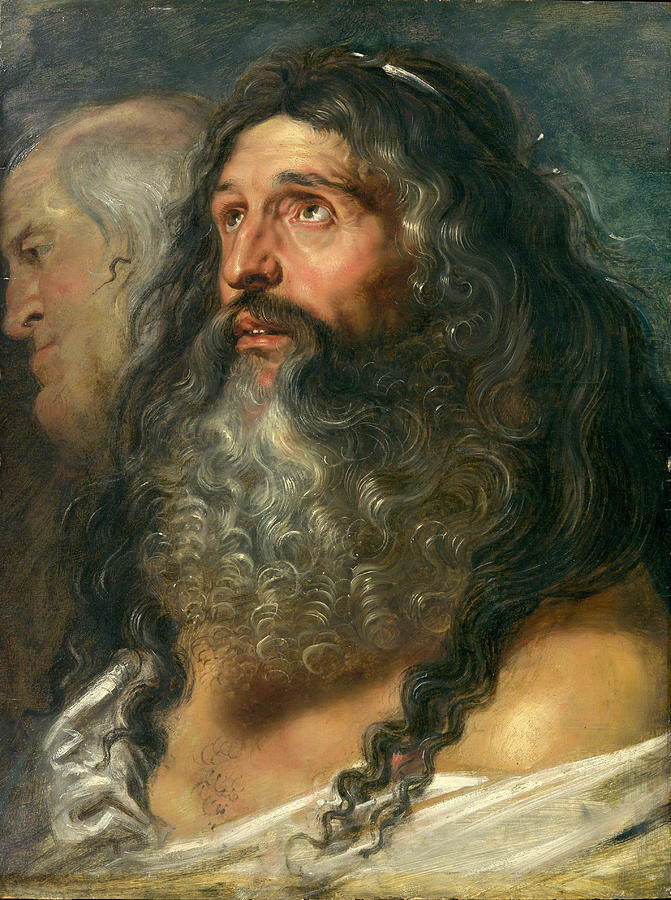
“Study of Two Heads” by Peter Paul Rubens is a striking example of how a seemingly modest oil sketch can reveal the full force of an artist’s imagination and technical mastery. Rather than a finished narrative painting, this work is an exploratory study of character and expression. Two male heads appear in close proximity: in the foreground, a wild-haired, powerfully bearded man gazes upward with burning, moist eyes; behind him, turned almost completely in profile, an older bald man withdraws into the shadows.
Rubens focuses his attention on the drama of faces rather than on setting or storyline. There is no landscape, no elaborate costume, no symbolic attributes. Everything depends on paint and light, on the play of color across flesh and hair, and on the tension between two very different personalities. The painting gives viewers a privileged look into Rubens’s working process, where he studies features, explores emotions, and prepares himself to populate his grand historical and religious canvases with believable human beings.
A Close Look at the Composition
Compositionally, “Study of Two Heads” is deceptively simple. The large bearded head dominates the canvas, filling most of the right side and projecting forward into the viewer’s space. His shoulders and upper chest are visible, wrapped in a loosely painted white cloth that barely contains his physical presence. His head is turned slightly to the left, eyes raised, lips parted as if speaking or breathing an intense prayer.
Behind him, on the left, Rubens places the second head. This man is older, bald, and seen in profile, his features softer and more withdrawn. He is partially obscured by the mass of hair and beard belonging to the foreground figure, making it clear that he is secondary. Yet his presence changes everything about how we read the image. The two heads form a diagonal pair, with the younger man’s upward gaze contrasted by the older man’s lowered, inward look.
The background is dark and loosely painted, with no clear details. This deliberate emptiness pushes the figures forward and heightens their sculptural quality. Light falls from the upper left, striking the bearded man’s forehead, nose, and cheek, then traveling down into the thick curls of his beard. The older head catches less light, dissolving into shadow. The composition therefore guides our focus first to the intense, searching gaze of the bearded man, then to the quieter, contemplative presence behind him.
The Bearded Head: Intensity and Spiritual Longing
The central figure of the bearded man is one of the most memorable creations in Rubens’s portrait studies. His hair and beard, long and unruly, frame his face in a dark halo of curls. The beard is especially elaborate, built from countless loose strokes of gray, white, and brown that twist and loop into ringlets. These curls catch the light like metallic threads, giving the beard a living, almost flame-like quality.
The man’s eyes are the emotional center of the painting. They are wide and moist, the irises directed upward toward an unseen source. The whites of the eyes glisten, and the lower lids shine with a suggestion of tears. His brows lift slightly, expressing surprise, awe, or fervent supplication. The parted lips, tinged with red, suggest that he is breathing heavily or murmuring words. Together, these features create a look of rapture or intense spiritual concentration.
Rubens does not idealize the man’s features. The nose is strong and irregular, the forehead furrowed, the skin ruddy with hints of age and weathering. Yet the overall impression is noble and compelling. The combination of rough physicality and elevated gaze conveys a figure who is both deeply human and spiritually engaged. This type of head could later serve as a prophet, apostle, or patriarch in a large religious painting, embodying the union of bodily vigor and inner vision.
The Secondary Head: Quiet Reflection and Contrast
The second head, half hidden in the shadows, provides an essential counterpoint. This older man is bald, his scalp gleaming softly in the dim light. His nose and mouth are sharply profiled, and his eyes are turned slightly downward, away from the sky toward which the bearded man looks. He seems lost in his own thoughts, perhaps contemplating, listening, or remembering.
By juxtaposing these two heads, Rubens creates a dialogue of emotions. The younger bearded man expresses outward longing and upward aspiration, while the older man suggests inward reflection and resignation. One reaches toward something beyond; the other turns back into himself. The painting thus explores different ways of responding to mystery or revelation.
This contrast also helps to structure the image visually. The older head’s smooth scalp and pale skin form a calm area next to the turbulence of the bearded man’s hair. The simplified shapes of the profile balance the complex rhythms of curls in the foreground. Through this interplay, Rubens achieves harmony without sacrificing dynamism.
Brushwork, Color, and the Illusion of Life
“Study of Two Heads” showcases Rubens’s virtuoso handling of oil paint. He builds forms with a combination of broad, fluid strokes and delicate, precise touches. In the skin, he uses warm tones—pinks, ochers, and soft reds—blended smoothly to suggest living flesh. Subtle shifts in color describe the transparency of the eyelids, the dampness of the lips, and the warmth of blood beneath the skin.
The beard and hair, by contrast, are painted more freely. Rubens drags the brush in quick, curving motions to create curls and waves. Highlights of pale gray and white sit on top of darker browns and blacks, giving the hair dimension and sparkle. These strokes are less blended, leaving traces of individual hairs that catch the light. The result is a texture that feels both dense and airy, as if the beard could move with the slightest breath.
The white cloth draped around the shoulders is rendered with similar freedom. Rubens suggests folds with a few swift sweeps of thick paint, using whites and cool grays to capture the play of light on fabric. The cloth’s looseness underscores the informality of the study; it is not a carefully detailed costume but a convenient means of framing the shoulders and catching highlights near the neck and beard.
Overall, the painting’s surface reveals Rubens at work: adjusting tones, reworking edges, leaving areas loosely defined where detail is unnecessary. This spontaneity contributes to the illusion of life. The heads do not feel frozen; they seem captured mid-breath, as though they could move or speak at any moment.
Purpose and Function as a Studio Study
While “Study of Two Heads” is compelling in itself, it also carries important clues about Rubens’s working method. The absence of a clear narrative scene and the focus on heads suggest that it was painted as a preparatory study for a larger project. Rubens often created such oil sketches to explore character types he would later use in altarpieces and history paintings.
The intense, upward-looking bearded head could serve as a model for prophets like Moses, apostles like Saint Peter, or devout believers witnessing a miracle. The older profile might become an observer, a scholar, or a secondary figure in a crowd. Having these studies at hand, Rubens and his workshop could adapt them to different contexts, varying expressions but maintaining the essential character.
These oil head studies also allowed Rubens to practice the subtleties of flesh tones, hair textures, and lighting effects. They were both exercises and reference tools—a visual library of faces and expressions that he could draw upon when composing large, complex works. For modern viewers, they offer an intimate glimpse into the preparatory stages behind the finished masterpieces.
Emotional and Psychological Depth
Beyond their practical function, the heads in this study possess real psychological depth. The upward gaze of the bearded man suggests emotion that goes beyond simple curiosity or surprise. His eyes shine with a mix of hope, fear, and devotion, implying that he is witnessing something extraordinary or appealing fervently for help. If we imagine him as a prophet or apostle, he could be receiving divine revelation or contemplating a vision.
The older man’s introspective profile adds another layer. His downcast look may express doubt, humility, or mournful acceptance. Placed beside the ecstatic gaze of the bearded head, his quiet demeanor suggests the range of human responses to spiritual experience. Some people are lifted into rapture; others withdraw and reflect silently.
Rubens embeds this complexity of feeling in the smallest details: the slight tightening of the lips, the shadows under the eyes, the tension in the neck muscles. Even without a clear storyline, the painting feels charged with narrative possibilities. Viewers are invited to imagine who these men are, what they see, and what emotions course through them at this instant.
Light and the Suggestion of the Supernatural
Light plays a vital role in shaping the mood of “Study of Two Heads.” A gentle but focused illumination falls across the bearded man’s face from the upper left. It ignites his eyes, accentuates the planes of his cheekbones and nose, and sinks into the recesses of his beard. This directional light subtly suggests an external source—perhaps a window, a lamp, or symbolically, a divine presence.
The older head receives less of this radiance, remaining half in shadow. This difference in illumination not only establishes depth but may hint at differing levels of spiritual awareness. The bearded man appears bathed in light, as if his attention is fully engaged with what he sees. The older man, turned away, stands at the edge of that illumination.
Rubens thus uses light to evoke the possibility of the supernatural without explicitly depicting it. There is no halo or heavenly apparition, yet the upward gaze and focused brightness together imply that something beyond the visible world is being contemplated.
Connections to Rubens’s Larger Oeuvre
“Study of Two Heads” can be related to several aspects of Rubens’s broader body of work. In many of his large religious paintings—such as depictions of apostles, prophets, or Old Testament patriarchs—similar bearded heads appear, imbued with the same intensity and rugged dignity. It is likely that Rubens reused and adapted this type of head for multiple compositions, adjusting the angle or expression as needed.
The painting also reflects Rubens’s interest in expressive physiognomy. Throughout his career, he studied faces that could convey complex feelings, drawing upon both real models and classical sculptures. His oil studies of heads bridge the gap between observation and invention, blending realistic detail with heightened emotional impact.
In addition, the contrast between youth and age appears frequently in Rubens’s works, underscoring themes of wisdom, experience, and human vulnerability. The pairing of the vigorous, dark-haired man with the paler, older profile echoes similar dualities found in his scenes of saints with their mentors, apostles in debate, or crowds reacting differently to Christ or the Virgin.
Contemporary Appeal and Viewing Experience
For contemporary viewers, “Study of Two Heads” offers a uniquely intimate encounter with Rubens’s artistry. Unlike large altarpieces that keep viewers at a distance, this painting brings us close—almost uncomfortably close—to the faces of two individuals. We see the brushstrokes, the thickness of paint, the slight shifts in color that animate their features.
The humanity of the figures is striking. They are not idealized abstractions but real, flawed, emotionally complex people. Their expressions invite empathy and curiosity. One might see in the bearded man’s gaze the intensity of personal prayer or the awe of sudden realization; in the older man’s profile, the weariness or wisdom of age.
The painting also resonates because it foregrounds the act of looking. The bearded man looks up, the older man looks away, and we, as viewers, look at them. This chain of gazes prompts us to reflect on what we ourselves attend to—what commands our vision, what we ignore, how we respond to moments of revelation or challenge.
Conclusion
“Study of Two Heads” by Peter Paul Rubens is a compact yet profoundly rich work. Through close cropping, bold brushwork, and delicate modulation of light, Rubens transforms a studio exercise into a compelling meditation on character, emotion, and spiritual attention. The bearded man’s upward gaze and the older companion’s withdrawn profile together create a silent drama that continues to engage viewers centuries later.
As both a practical study and an expressive artwork, the painting reveals Rubens at his most immediate and insightful. It reminds us that behind every grand Baroque composition lies a series of intense observations of the human face—the primary stage on which inner life becomes visible.