Image source: wikiart.org
Overview of Seated Male Youth Study for Daniel
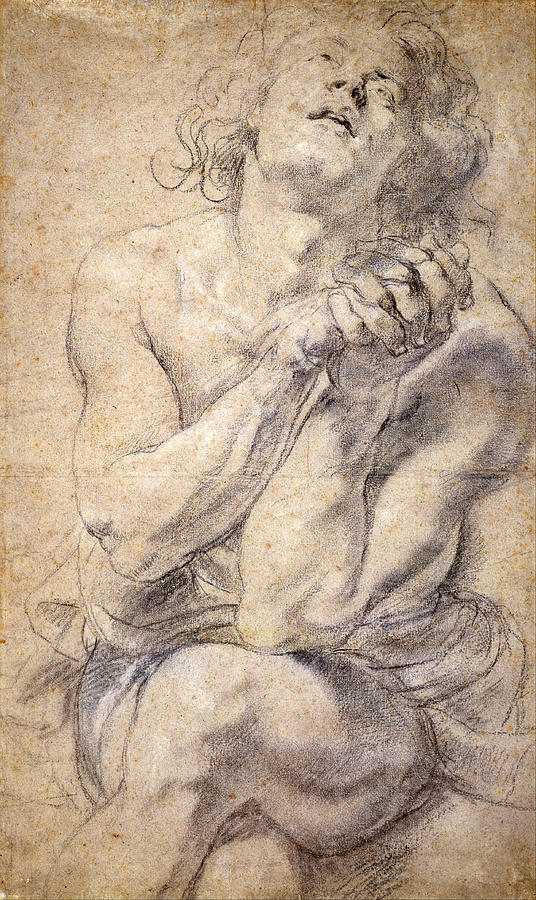
“Seated Male Youth Study for Daniel” by Peter Paul Rubens is an electrifying figure drawing that captures a young man in a moment of intense physical tension and spiritual longing. The work functions as a preparatory study for the prophet Daniel, likely intended for a larger religious painting or decorative scheme. Although it is “only” a study, the drawing possesses a power and completeness that make it compelling as an independent artwork.
The youth sits with his legs crossed, torso twisting as his clasped hands rise toward his chest. His head tilts back, eyes half-closed and mouth slightly open, as if caught between pain and ecstasy. Rubens uses a network of forceful, energetic lines to model the figure’s anatomy, emphasizing swelling muscles, taut tendons, and the subtle shifts of skin across bone. The result is a vivid visualization of the body under emotional and spiritual strain.
This drawing demonstrates Rubens’s deep understanding of human anatomy and his ability to translate physical gesture into psychological narrative. Even without any setting, lion, or overtly religious symbol, the viewer senses that this youth is engaged in fervent prayer or supplication, a fitting prelude to the figure of Daniel in the lions’ den.
Context: A Study for the Prophet Daniel
Rubens frequently produced detailed figure studies as part of his working process, especially when preparing large altarpieces or cycles of religious paintings. In this case, the drawing is traditionally identified as a study for Daniel, the Old Testament prophet who was thrown into a den of lions for remaining faithful to God. When represented in art, Daniel often appears kneeling or seated, hands clasped, gazing upward toward the source of his deliverance.
By exploring the pose in this drawing, Rubens refines the language of Daniel’s prayer. The youth is not depicted in calm, formal devotion; instead, his entire body participates in the act of supplication. The crossed legs, twisting torso, and straining forearms all suggest a man who has reached a moment of desperate intensity. This conveys the danger of Daniel’s situation as well as the strength of his trust.
As a study, the drawing allowed Rubens to experiment freely. Without the need to depict clothing in full detail or to integrate the figure into a complex environment, he could concentrate on the underlying structure and emotional thrust of the pose. This focus on pure figure and feeling is one reason why the study feels so immediate and modern to contemporary viewers.
Composition and the Power of the Diagonal
The composition of “Seated Male Youth Study for Daniel” is deceptively simple: a single figure fills the sheet from top to bottom. Yet within that limited frame, Rubens orchestrates a series of diagonals that give the drawing extraordinary dynamism.
The most obvious diagonal runs from the youth’s left knee at the lower left, up through his bent torso, and toward his tilted head at the upper right. This line emphasizes the twisting motion of his body, as if he is turning away from worldly danger and toward a higher power. A second diagonal, formed by the forearms and clasped hands, cuts across the chest, creating a cross-like structure that further heightens the sense of strain.
These diagonals prevent the seated pose from feeling static. Instead, they make the figure appear as though he is rising inwardly, if not physically, toward an unseen source of light or salvation. The crossed legs anchor him to the earth, but the spiral energy of his upper body pulls upward, echoing the spiritual ascent implied by prayer.
The empty background intensifies this effect. With no architectural or landscape elements to distract the eye, the viewer focuses entirely on the figure’s movement and the expressive shapes created by limbs and torso. The drawing thus becomes a study not just of anatomy but of the body as a vehicle for spiritual drama.
Anatomy, Muscle, and the Heroic Body
Rubens was renowned for his knowledge of human anatomy, honed through life drawing, study of classical sculpture, and careful observation of living models. In this study, he demonstrates that knowledge with remarkable subtlety and vigor.
The youth’s arms are particularly striking. The muscles of the forearms bulge under the strain of the clasped hands, tendons standing out near the wrists. The biceps and triceps are carefully modeled, with lines following the natural flow of muscle fibers. Yet the drawing never descends into anatomical diagram; the marks remain lively and responsive to the overall gesture.
The chest and shoulders convey a similar sense of power. Rubens indicates the collarbones, pectoral muscles, and the slight twist of the ribcage with minimal but confident strokes. Patches of cross-hatching and softer shading suggest the roundness of the torso, while a few darker accents at the armpit and along the side create depth.
The legs, folded beneath the figure, complete the impression of a robust, athletic body. The overlapping thighs and knees form a solid base, their weight emphasized by dense shading and firm contours. The viewer understands that this is not a fragile youth but a physically strong man—an appropriate embodiment for Daniel, who must endure a night among lions yet remain unharmed.
Gesture, Emotion, and Spiritual Intensity
What elevates this drawing beyond a simple anatomical study is the intensity of emotion conveyed through gesture. The figure’s hands, clasped tightly together, suggest urgent prayer. They are drawn with special care: knuckles protrude, fingers press into one another, and the palms cup an invisible space that might hold the words of his plea or the focus of his faith.
The head, tilted back with eyes half-closed, amplifies this feeling. The slightly parted lips imply an inward dialogue or silent cry. The neck muscles stretch as the head lifts, and the jawline is softened by the upward angle, creating a sense of vulnerability. This upward orientation directs attention beyond the sheet, toward an implied divine presence above.
Rubens thus gives us a psychological portrait without specific facial details or context. The emotion is communicated by the overall posture rather than by minute expressions. The youth’s entire body becomes an instrument of prayer, his muscles channeled into spiritual energy. In this way, the drawing embodies a key Baroque principle: the union of inner feeling and outward movement.
Medium, Line, and Surface
“Seated Male Youth Study for Daniel” appears to be executed in black chalk or graphite on slightly toned paper. The surface carries tiny specks and signs of age, which now contribute to the atmospheric quality of the image. Rubens uses a variety of line types—firm contours, soft shading, cross-hatching, and blended areas—to build up the figure.
The lines around the edges of the body are generally darker and more decisive, giving the figure a clear silhouette. Within the body, however, the marks become more varied. Light strokes indicate hair and softer flesh, while short, repeated lines describe shadowed areas such as the inside of the elbow or the crease of the folded leg.
Rubens is not afraid to leave some areas relatively open. Portions of the torso and thigh are defined with minimal shading, allowing the paper’s tone to serve as mid-value. This balance between fully modeled passages and looser, more suggestive ones gives the drawing vitality. The viewer’s eye completes what is merely implied, engaging actively with the work.
The hair is rendered with lively, swirling strokes that echo the emotional turbulence of the scene. Loose curls frame the upturned face, further dramatizing the tilt of the head and adding to the sense of movement.
Daniel’s Iconography and the Lions’ Den
While no lions are visible in this study, the drawing resonates strongly with traditional depictions of Daniel in the lions’ den. In many paintings and sculptures, Daniel appears nearly nude, arms lifted or hands clasped, facing upward as he prays for deliverance. Lions surround him, often in varying states of calm or agitation, underscoring the miraculous protection he receives.
Rubens’s study fits into this iconographic tradition by emphasizing the vulnerability and trust of the prophet. The near-nudity of the figure suggests both physical exposure and spiritual purity. There is no armor, royal robe, or worldly protection—only the strength of his faith.
By focusing on the bare body, Rubens also draws parallels between Daniel and figures from classical antiquity, such as heroic athletes or mythological sufferers. This connection elevates Daniel’s story beyond its specific historical context, presenting it as a timeless representation of courage in the face of peril. The combination of classical heroism and biblical narrative is characteristic of Rubens’s approach to religious subjects.
Rubens’s Working Method and Artistic Intent
This study offers valuable insight into Rubens’s working method. Before tackling a complex multi-figure composition, he often produced numerous drawings exploring different poses and emotional nuances. Such studies allowed him to test how light would fall on the body, how gestures could convey meaning, and how figures might interact within the larger scene.
In “Seated Male Youth Study for Daniel,” we see Rubens immersing himself in the physical experience of prayer. By embodying the emotion in a single figure, he could later adapt and refine the pose for a painted Daniel surrounded by lions. The drawing thus acts as a laboratory for ideas, a place where the artist experiments without the constraints of color, background, or narrative details.
At the same time, the care and expressiveness of the drawing suggest that Rubens valued these studies as artworks in their own right. Their preservation and appreciation today confirm that they possess an aesthetic and emotional completeness independent of any finished painting.
Contemporary Resonance and Lasting Appeal
For modern viewers, “Seated Male Youth Study for Daniel” holds a striking immediacy. Stripped of overt religious symbols, the drawing can be read simply as a human being in a moment of intense inner struggle. The clasped hands and upturned face might signify prayer, desperation, gratitude, or even ecstatic joy.
This universality makes the work relatable across different beliefs and backgrounds. Anyone who has experienced a moment of emotional crisis or profound longing can recognize their own feelings in the youth’s posture. The drawing thus transcends its initial function as a study for a biblical figure and becomes a powerful image of the human condition.
The rawness of the medium also contributes to its modern appeal. The visible strokes, unfinished edges, and direct contact of chalk on paper feel closer to the artist’s hand than a polished oil painting might. We sense Rubens thinking, adjusting, and responding to the model in real time. That immediacy bridges the centuries, making the seventeenth-century master feel surprisingly present.
Conclusion
“Seated Male Youth Study for Daniel” by Peter Paul Rubens is far more than a preparatory sketch. It is a concentrated meditation on the relationship between body and spirit, strength and vulnerability, human limitation and divine reliance. Through masterful use of line, anatomy, and gesture, Rubens reveals how a single figure, captured at the height of emotional intensity, can communicate an entire narrative of faith and endurance.
The drawing distills the story of Daniel into its essential experience: a man facing overwhelming danger yet turning upward in trust. That distilled emotion, rendered with Baroque energy and classical understanding, explains why this study continues to captivate viewers and why it remains a key example of Rubens’s genius as a draftsman.