Image source: wikiart.org
Introduction
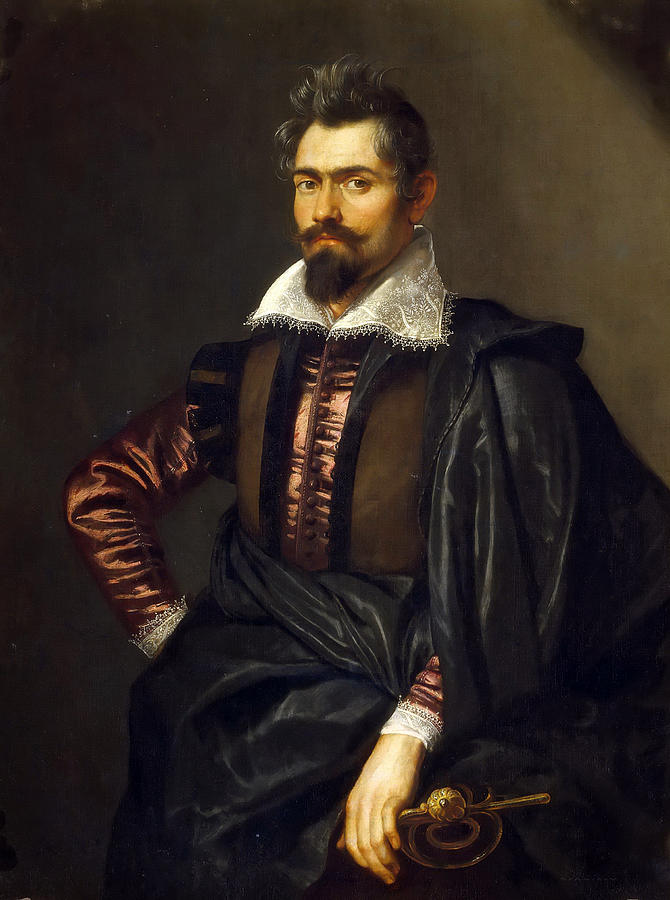
“Portrait of Kaspar Scioppius” by Peter Paul Rubens is a commanding image of an intellectual warrior. The sitter, Kaspar Scioppius (also known as Gaspar Schoppe), was a sharp-tongued humanist scholar and pamphleteer whose polemical writings made him both admired and feared in early seventeenth-century Europe. Rubens presents him as a man of letters and a man of action, dressed in sumptuous fabric, seated yet alert, hand resting on the hilt of his sword.
The portrait is not merely a likeness; it is a carefully constructed statement about character, reputation, and social standing. Through pose, costume, light, and expression, Rubens crafts a visual biography of a complex figure: learned, combative, elegant, and self-possessed. The painting invites viewers to look beyond the surface luxury of velvet and lace and to confront the determined mind behind the dark, steady eyes.
Historical Context and the Figure of Kaspar Scioppius
Kaspar Scioppius lived during a time of intense religious and political conflict in Europe. A convert to Roman Catholicism, he became notorious as a controversial theologian and satirist, writing fierce attacks against Protestant thinkers and sometimes even against Catholic leaders he deemed insufficiently zealous. His pen functioned almost like a weapon on the intellectual battlefield of the Counter-Reformation.
Rubens, himself deeply engaged with courtly and diplomatic circles, would have understood the significance of portraying such a figure. This portrait most likely arose from a milieu in which scholars, clerics, and statesmen mingled, and where public image mattered. In a world where printed texts circulated rapidly, an author’s reputation could be amplified by a powerful portrait. Rubens’s representation of Scioppius thus participates in the broader culture of baroque self-fashioning, where identity was crafted through both words and images.
Composition, Pose, and Spatial Arrangement
The composition of “Portrait of Kaspar Scioppius” is straightforward yet highly effective. The sitter occupies almost the entire vertical height of the canvas, placed slightly off-center so that his body forms a subtle diagonal from the lower left to the upper right. He sits turned three-quarters toward the viewer, with his left arm bent and his hand resting confidently on his hip. His right hand, lower in the frame, holds the hilt of a sword.
The background is an undifferentiated, dark tone, with a beam of light slanting in from the upper right. This simplification of setting pushes all attention onto the figure. There is no distraction of furniture or architectural architecture; Scioppius himself becomes the entire stage. The lighted triangle behind his head functions almost like a halo of worldly distinction, separating his silhouette from the surrounding shadow.
Rubens employs a pyramidal structure common in portraiture: the broad base formed by the seated body narrows as it rises to the head. This stable arrangement conveys solidity and authority. At the same time, the bent arm and slight twist of the torso suggest movement, preventing the figure from appearing static. The overall impression is that of a man momentarily arrested in thought, poised between rest and action.
Costume, Fabric, and Social Status
Scioppius’s costume is a rich display of early seventeenth-century fashion, and Rubens revels in capturing its textures. The scholar wears a dark, heavy cloak draped over one shoulder, opening to reveal a fitted doublet and gleaming satin sleeves in a deep, reddish tone. Down the center of his torso runs a vertical band of the same shimmering fabric, bordered by narrow strips of black.
Around his neck, a crisp, lace-edged collar rises and folds outward, framing his face with a touch of elegance. The lace is rendered with delicate, precise strokes that contrast with the broader, more flowing handling of the cloak. This attention to lace, satin, and velvet signals cultivated taste and material success. Scioppius is not presented as a cloistered scholar in austere robes but as a gentleman with access to fine clothing and a courtly environment.
The combination of intellectual identity and aristocratic appearance is significant. Rubens’s patrons valued learning but also expected visible markers of rank. By dressing Scioppius in luxurious garments, the painter visually elevates the profession of letters, suggesting that powerful ideas deserve the same respect as noble lineage or military command. The costume communicates that the sitter belongs to the cultural elite, a man whose words carry weight in society.
Light, Color, and the Baroque Atmosphere
Light plays a crucial role in shaping the mood of the portrait. A strong, directional light falls from the upper right, illuminating the left side of Scioppius’s face, the gleam of his satin sleeves, and the folds of the cloak draped across his lap. The opposite side of his body recedes into shadow, creating a dramatic contrast characteristic of baroque painting.
This interplay of light and dark not only models the form but also implies psychological depth. The lit portions of the face draw attention to the eyes, nose, and mouth, while the shadowed side suggests mystery and introspection. The effect is one of heightened realism: the figure emerges from the darkness as a living presence, occupying real space and time.
Color is relatively restrained—dominated by deep blacks, warm browns, and the muted red of the satin. This limited palette prevents the portrait from becoming decorative and keeps focus on the sitter’s expression. The subtle warmth of the flesh tones stands out against the cooler, darker clothing, emphasizing the humanity beneath the formal garments. Rubens’s mastery of blending and glazing allows him to create a luminous skin that seems to breathe, adding life to the intense gaze.
Facial Expression and Psychological Insight
The most compelling aspect of the portrait is Scioppius’s face. Rubens renders it with acute attention to individuality: the sharp cheekbones, the slightly furrowed brow, the pointed beard, and the careful moustache. The hair, somewhat unruly and streaked with gray, rises in a wave that echoes the energy of the sitter’s personality.
His eyes look directly at the viewer, dark, focused, and slightly wary. There is intelligence and self-possession in this gaze, but also a hint of guardedness. This is not a man who smiles easily or yields ground without a fight. The tightened lips and the subtle tension in the jaw suggest firmness, perhaps even stubbornness. Rubens does not flatter the sitter with idealized softness; instead, he honors his subject by capturing his complexity.
The expression can be read as that of a man used to argument and controversy, always ready to defend his positions. Yet there is also a suggestion of weariness in the slight shadows beneath the eyes. This duality—confidence laced with fatigue—speaks to the toll that a life of relentless intellectual combat can take. Rubens thus presents Scioppius as both formidable and humanly vulnerable.
Hands, Sword, and the Language of Gesture
The placement of Scioppius’s hands is highly expressive. His left hand rests on his hip, fingers spread slightly, creating a strong diagonal line and an air of assertiveness. This pose is reminiscent of noble and military portraits, where such a stance conveyed command and self-assertion. By adopting it for a scholar, Rubens suggests that Scioppius’s weapons are his mind and his pen, yet he possesses the same inner steel as a soldier.
His right hand, partially visible at the bottom of the canvas, holds the hilt of a sword. The presence of this weapon emphasizes the connection between intellectual and physical courage. It may allude to his willingness to defend his beliefs or to his service in courts where political tensions could quickly turn violent. The sword’s golden guard catches the light, forming a small but important accent that underscores the sitter’s status as a gentleman, not merely a man of books.
Together, the hands and sword create a subtle narrative. Scioppius is seated and clothed as a courtier, but his posture hints at readiness. If the world of ideas demands it, he can rise, argue, and fight. Rubens uses these details of gesture to enrich the psychological portrait, turning a simple seated figure into a person with implied history and potential action.
Rubens’s Portrait Style and Artistic Choices
This painting showcases several hallmarks of Rubens’s portraiture. He combines keen observation of individual features with a generalized elegance of form. The anatomy is convincing without being harsh; the sitter’s presence feels robust yet dignified. Rubens often favored three-quarter views, dynamic poses, and dramatic lighting to infuse his portraits with energy, and all of these elements appear here.
The brushwork varies across the surface. In the face and hands, Rubens uses fine, smooth strokes, carefully modulating color to capture subtle shifts of light across skin. In the clothing, especially the cloak, his touch grows broader and more expressive. Swirling folds of fabric are suggested with confident sweeps of paint, allowing the viewer’s eye to complete the illusion of texture. This contrast between detail and suggestion keeps the portrait visually lively.
Rubens’s skill lies also in his ability to balance realism with idealization. While the features of Scioppius are clearly individualized, the composition and lighting raise him above mundane reality. The sitter appears both as a specific person and as an archetype of the learned, combative intellectual of his age. This dual quality explains why Rubens’s portraits continue to appeal: they are both historical documents and timeless explorations of character.
Intellectual Identity and the Portrait of a Controversialist
Kaspar Scioppius was known for his fierce polemics, and this aspect of his identity subtly informs the painting. Rubens does not depict him surrounded by books or writing tools; rather, he centers on the man himself, suggesting that his intellect is inseparable from his personality. Still, certain features hint at his life of letters.
The sharply focused eyes and intent expression evoke concentration and analytic power. The slightly raised eyebrows suggest a readiness to question and critique. The neat beard and carefully groomed hair reveal attention to self-presentation, important for a man whose reputation depended on both written beliefs and social standing.
This portrait could be understood as a visual counterpart to Scioppius’s printed works. Just as he crafted arguments to persuade or attack, Rubens crafts an image designed to communicate the sitter’s authority and seriousness. The painting becomes a kind of public argument about who Scioppius is: not just a quarrelsome writer, but a formidable, honorable figure whose intellect deserves respect even from those who disagree with his positions.
Legacy and Interpretation
Viewed today, “Portrait of Kaspar Scioppius” offers insight into how early modern society viewed the intellectual and the power of the written word. Through Rubens’s eyes, the scholar is not cloistered or marginal; he takes on the bearing of a gentleman and the presence of a commander. The painting reminds us that debates over faith and politics in seventeenth-century Europe were not academic in the modern sense—they were urgent, high-stakes conflicts that could shape policy, alliances, and lives.
The portrait also illustrates the enduring appeal of psychological portraiture. Even without knowing detailed biographical facts about Scioppius, viewers sense a strong personality: intelligent, disciplined, slightly severe, yet undeniably compelling. The tension between the luxurious clothing and the ascetic sharpness of the face encapsulates the contradictions of a figure who combined worldly status with unyielding conviction.
For admirers of Rubens, this work stands as a testament to his versatility. Famous for large, mythological canvases and dynamic religious altarpieces, he was equally gifted at capturing individuals in more intimate formats. Here he distills drama into a single figure, relying on subtle shifts of posture and expression rather than on elaborate narrative scenes. The result is a portrait that continues to speak with quiet force centuries after it was painted.
Conclusion
“Portrait of Kaspar Scioppius” by Peter Paul Rubens is a masterful study of character, status, and intellectual power. Through a carefully arranged composition, sumptuous yet controlled color, and finely observed facial features, Rubens presents Scioppius as a man whose mind is as sharp as the sword he grasps. The portrait embodies the ideals and tensions of its time: the elevation of learning, the combative spirit of religious controversy, and the baroque fascination with strong personalities rendered in vivid paint.
Standing before this painting, viewers encounter not only an image of one historical figure but also a broader reflection on what it means to be a public intellectual in a turbulent age. The direct gaze, the poised hands, and the luminous face emerging from shadow all invite an almost conversational engagement. Rubens’s artistry ensures that Kaspar Scioppius remains present to us, challenging, questioning, and asserting his place in the long dialogue between art, history, and thought.
