Image source: wikiart.org
Introduction
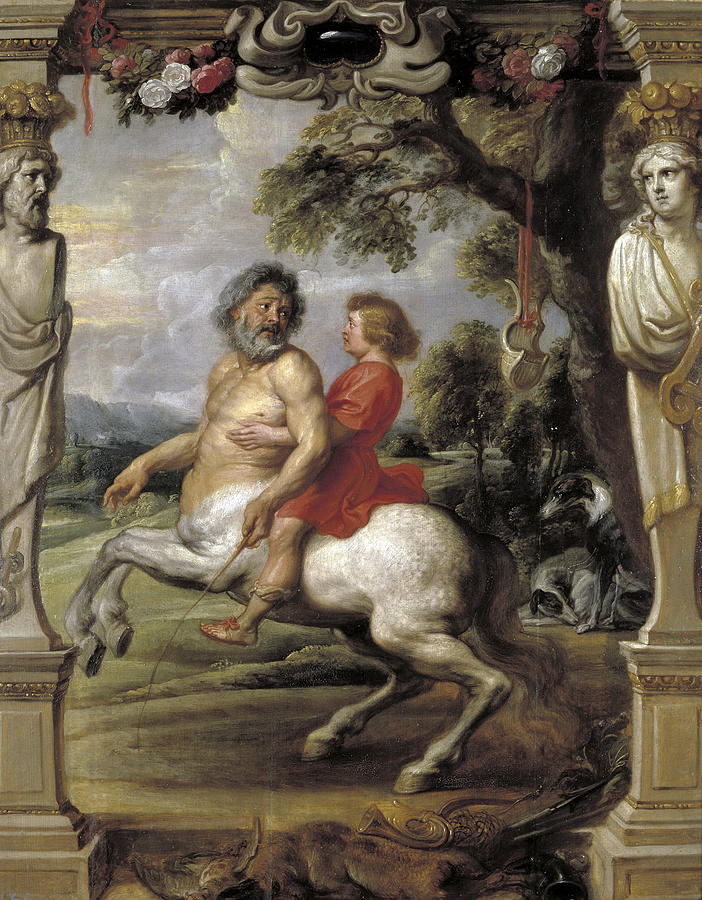
“Education of Achilles” by Peter Paul Rubens is a tender yet powerful meditation on mentorship, heroism, and the shaping of character. The painting shows the wise centaur Chiron carrying the young Achilles on his back, a moment drawn from Greek myth in which the future warrior receives his education in both music and arms. Rubens transforms this narrative into a richly layered allegory about how great leaders are formed. The canvas combines intimate human feeling with classical grandeur, both through its figures and through the elaborate architectural frame that encircles the scene.
While Rubens is often associated with turbulent battle scenes and dramatic religious narratives, here he explores a more contemplative side of heroism. The emphasis is not on Achilles’ later exploits at Troy but on his formative years, the quiet work of instruction and guidance that will eventually make him a legend. Through subtle gestures, expressive faces, and a carefully orchestrated setting, Rubens reveals the delicate balance between nature and culture, strength and wisdom, youth and experience.
Mythological Background
In Greek mythology, Achilles is the son of the mortal Peleus and the sea nymph Thetis. Destined to become the greatest warrior of his age, he is entrusted as a child to the centaur Chiron, famous for his knowledge of medicine, music, and martial arts. Unlike other centaurs, who are often depicted as wild and unruly, Chiron is a figure of wisdom and restraint. On Mount Pelion he trains heroes, teaching them how to control their passions and channel their strength toward noble aims.
Rubens chooses a relatively peaceful moment from this story. Instead of showing Achilles practicing with weapons or playing instruments, he depicts the boy seated on Chiron’s back, as if in transit between lessons. This choice allows Rubens to highlight the affection and trust that underlie the relationship. The painting becomes an image of education understood not as a strict drill but as a close companionship in which knowledge is passed on through shared journeys and experiences.
Composition and Framing Architecture
One of the most distinctive features of this painting is the elaborate architectural frame that encloses the central scene. Carved columns, garlands of flowers, sculpted masks, and standing statues create the impression that the viewer is looking through an ornate portal into the mythic world. This painted frame has a double function. On one level, it echoes the decorative schemes of Baroque palaces and galleries, where mythological subjects often appeared as panels surrounded by stucco and sculpture. On another level, it acts as a symbolic threshold between the viewer’s reality and the ancient heroic past.
Within this frame, the figures of Chiron and Achilles occupy the center, moving calmly from left to right across a gentle landscape. The strong verticals of the columns and statues balance the horizontal stride of the centaur and create a stable structure for the composition. Yet the frame is not rigid. Garlands of flowers drape loosely across the top, and at the bottom trophies and animal skins spill over architectural elements, suggesting the abundance and richness of the world from which heroes emerge.
Chiron: The Wise Centaur
Chiron is depicted as a robust, aging centaur with gray hair and beard, his human torso seamlessly joined to the body of a powerful horse. Rubens emphasizes his physical strength with broad shoulders and muscular arms, but there is nothing ferocious in his expression. His gaze is turned sideways toward Achilles, and his eyebrows are slightly raised, as if he is speaking or listening intently. The gesture of his right arm, which lightly supports the boy’s back, conveys protective care.
The centaur’s posture, moving forward with sure-footed calm, suggests stability. Unlike the violent centaurs in Rubens’ more tumultuous mythological scenes, this Chiron is steady and composed. His animal half represents energy and natural vigor, while his human half embodies intellect and moral sense. By uniting the two harmoniously, Rubens presents Chiron as the ideal tutor—someone who can teach Achilles how to harness his innate strength and temper it with wisdom.
Achilles: Youth and Potential
Achilles appears as a young boy, clothed in a simple yet vibrant red garment. The choice of red hints at the martial future that awaits him, suggesting courage, passion, and the blood of battle, but in this moment he is still at the threshold of his destiny. His youthful face is thoughtful rather than reckless; he looks into Chiron’s eyes with attention and trust.
The boy sits sideways on the centaur’s back, his legs draped over one flank, his small hands resting lightly on Chiron’s torso. The pose is intimate and relaxed, more like that of a child riding a familiar animal than a warrior in training. This posture underscores the emotional foundation of their relationship: before Achilles can become a hero, he must first experience guidance, security, and a sense of being supported.
Rubens subtly suggests the future through Achilles’ bearing. Even as a child, his figure is upright, his head held high. There is a hint of determination in the set of his mouth. The painting captures him at the moment when curiosity and receptiveness will gradually turn into conviction and leadership under Chiron’s instruction.
Landscape and Setting
Behind the central figures stretches a serene landscape of rolling hills, distant water, and scattered trees. The sky is filled with soft clouds, gently lit, without the dramatic storms that mark Rubens’ more violent scenes. This calm natural environment is an extension of Chiron’s domain, the wilderness where he teaches his pupils to live in harmony with nature while mastering their own impulses.
On the right side of the background, partly hidden behind a tree, a figure kneels or bends over a stream or pool. This small vignette may represent another pupil or perhaps an attendant engaged in daily tasks. Its presence reinforces the sense that education under Chiron involves practical skills and close contact with the natural world.
The landscape also serves to open the composition spatially. While the architectural frame pushes the viewer’s attention inward, the distant horizon draws the gaze outward, suggesting the wide world that Achilles will one day enter as a hero. The peacefulness of the scene implies that education is a period of preparation and repose before the storm of future adventures.
Symbolic Details and Classical Allusions
Rubens enriches the painting with a range of symbolic details. The garlands of flowers at the top of the frame evoke celebration and honor, suggesting that the education of a hero is itself a noble undertaking. The carved masks and ornamental scrolls hint at the theater and at the arts more broadly, reminding viewers that Achilles’ training includes music and culture as well as warfare.
The sculptures that flank the scene—standing figures with idealized features—represent the classical heritage from which the story comes. They also point to the ideal virtues that Achilles is meant to embody. Their rigid, timeless forms contrast with the living, moving bodies of Chiron and Achilles, emphasizing the process by which the boy will be shaped into a living embodiment of those ideals.
At the bottom, near Chiron’s hooves, lie trophies and hunting spoils, including what appears to be a lion skin and possibly weapons. These items allude to the heroic feats that await Achilles, but for now they remain at ground level, not yet taken up by the young hero. Education, the painting suggests, must come before the full assumption of martial glory.
Light, Color, and Atmosphere
Light in this painting is soft and evenly distributed, bathing the figures and the landscape in a warm, golden glow. There are no violent contrasts of shadow and illumination; instead the subtle modeling of forms reflects a gentle, reflective mood. The centaur’s torso gleams with a healthy, ruddy tone, while Achilles’ red garment stands out as a bright accent against the more muted greens and browns of the environment.
Rubens’ color choices reinforce the emotional tone. The warm flesh tones of Chiron and Achilles highlight their living presence within the cooler architectural frame. The white horse body of the centaur suggests purity of intention and strength under control. The greenery of the background and the blue-gray of the sky create a soothing natural context, emphasizing that education unfolds in harmony with the rhythms of the world.
The polished handling of paint, especially in the highlights on muscles, hair, and fabric, adds a tactile quality that makes the figures feel tangible and real. Rubens resists excessive idealization; Chiron’s body is solid and slightly weathered, Achilles’ hair falls in soft curls, and the textures of stone and foliage are described with care. The result is an atmosphere that feels both mythical and human, elevated yet accessible.
Movement and Narrative Flow
Although the scene is relatively calm compared to Rubens’ more dramatic canvases, there is still a sense of movement. Chiron steps forward with one foreleg raised, his body angled diagonally across the picture plane. This gentle motion suggests the ongoing journey of education—a path, not a static achievement. The direction of their movement, from the deeper interior of the frame toward the open landscape, may symbolize Achilles’ gradual progress from sheltered instruction into the wider world.
The exchange of glances between Chiron and Achilles creates an invisible line of communication that energizes the composition. Their interaction draws the viewer into the narrative, encouraging us to imagine the conversation taking place: perhaps Chiron is offering advice, recounting heroic stories, or pointing out features of the landscape as lessons. The viewer becomes a silent witness to this formative dialogue.
Education as Transformation
At its core, “Education of Achilles” is a meditation on how education transforms raw potential into realized greatness. Rubens illustrates this process by placing the young hero literally on the back of his mentor. Achilles is carried by Chiron, not because he is weak, but because his strength is still being guided and directed. The centaur’s body becomes both vehicle and support, a physical metaphor for the intellectual and moral support he offers.
The painting suggests that true education is not merely the transfer of information but a relationship grounded in trust and example. Chiron teaches Achilles not from a distant podium but through close companionship. Their shared gaze and proximity indicate mutual respect. Achilles listens because he senses that Chiron’s wisdom springs from lived experience, represented by the centaur’s age, scars, and powerful physique.
Rubens thus invites viewers to see education as a dynamic, lifelong process. Even Chiron, though depicted as wise, appears engaged and alert, perhaps learning in turn from the innocence and questions of his young pupil. The scene embodies an ideal of learning as exchange rather than one-sided imposition.
Rubens’ Humanist Sensibility
Rubens was not only a painter but also a learned humanist who studied classical literature and philosophy. In “Education of Achilles,” his admiration for antiquity and his belief in the value of learning come together. The painting can be read as an emblem of the humanist ideal: that the study of classical stories and virtues can shape modern individuals into better citizens and leaders.
By choosing Achilles—at once a figure of extreme physical prowess and tragic complexity—Rubens acknowledges that natural gifts alone are not sufficient. The hero must be educated to use his talents wisely. The painting implicitly addresses the patrons and viewers of Rubens’ time, many of whom were nobles or rulers responsible for guiding their realms. It suggests that they, too, require wise counsel and moral formation if their power is to benefit society.
This humanist dimension gives the painting lasting resonance. It speaks not only to ancient myth but to the perennial question of how societies should nurture the young and prepare them for responsibility.
Conclusion
“Education of Achilles” presents a quieter but profoundly meaningful facet of Peter Paul Rubens’ art. Instead of the frenzy of battle or the spectacle of divine intervention, we encounter a moment of thoughtful companionship between teacher and pupil. Surrounded by rich architectural ornament and a serene landscape, Chiron and Achilles embody the transformative power of education grounded in trust, wisdom, and respect for nature.
Rubens combines his love of classical mythology with his mastery of figure painting, color, and composition to produce an image that is both visually captivating and philosophically rich. Chiron’s steady stride, Achilles’ attentive gaze, the soft light and harmonious colors—all contribute to a sense of purposeful calm, the calm of preparation before a life of action.
In this painting, the great Baroque master reminds viewers that heroism is not born in a single moment of glory but is patiently cultivated over years of guidance and learning. The education of Achilles becomes, in Rubens’ hands, a universal symbol of how human potential is shaped into greatness through wise mentorship and the patient journey of growth.
